

On Monday, November 27, 1826, the United States sloop of war Lexington entered Newport Harbor carrying an unusual passenger. Below deck were the remains of Commodore Oliver Hazard Perry, the Rhode Island naval officer whose victory on Lake Erie had made him famous during the War of 1812. Perry had been dead for more than seven years. His body had lain in Trinidad since August 1819, when he died returning from a diplomatic mission to Venezuela.[1]
Newport did not hurry the coffin ashore. The city, the state, and the Navy prepared a public funeral. One week later, boats from the Lexington carried Perry’s remains to Clarke’s Wharf at the southern end of town. There a combined guard of United States soldiers and Marines received them. A black funeral car, drawn by four white horses, waited on shore. An American ensign covered the coffin. On top rested Perry’s naval hat and epaulettes, and the ceremonial sword presented to him by the city of Philadelphia in honor of his famous victory on Lake Erie during the War of 1812.
The Newport Mercury called the ceremony “the most imposing ever witnessed in this State.” That contemporary description is more revealing than the later tradition that Perry simply received the largest funeral in Newport history. It directs attention to the spectacle and to the work the spectacle performed. Perry’s first funeral in a British colony had honored him as an admired former enemy. The second in Newport made his return a federal operation, a statewide observance, and a local reenactment of his most famous victory. The two ceremonies did not simply bury the same man twice. They made different claims on his body—and helped determine which parts of his life Americans would remember.
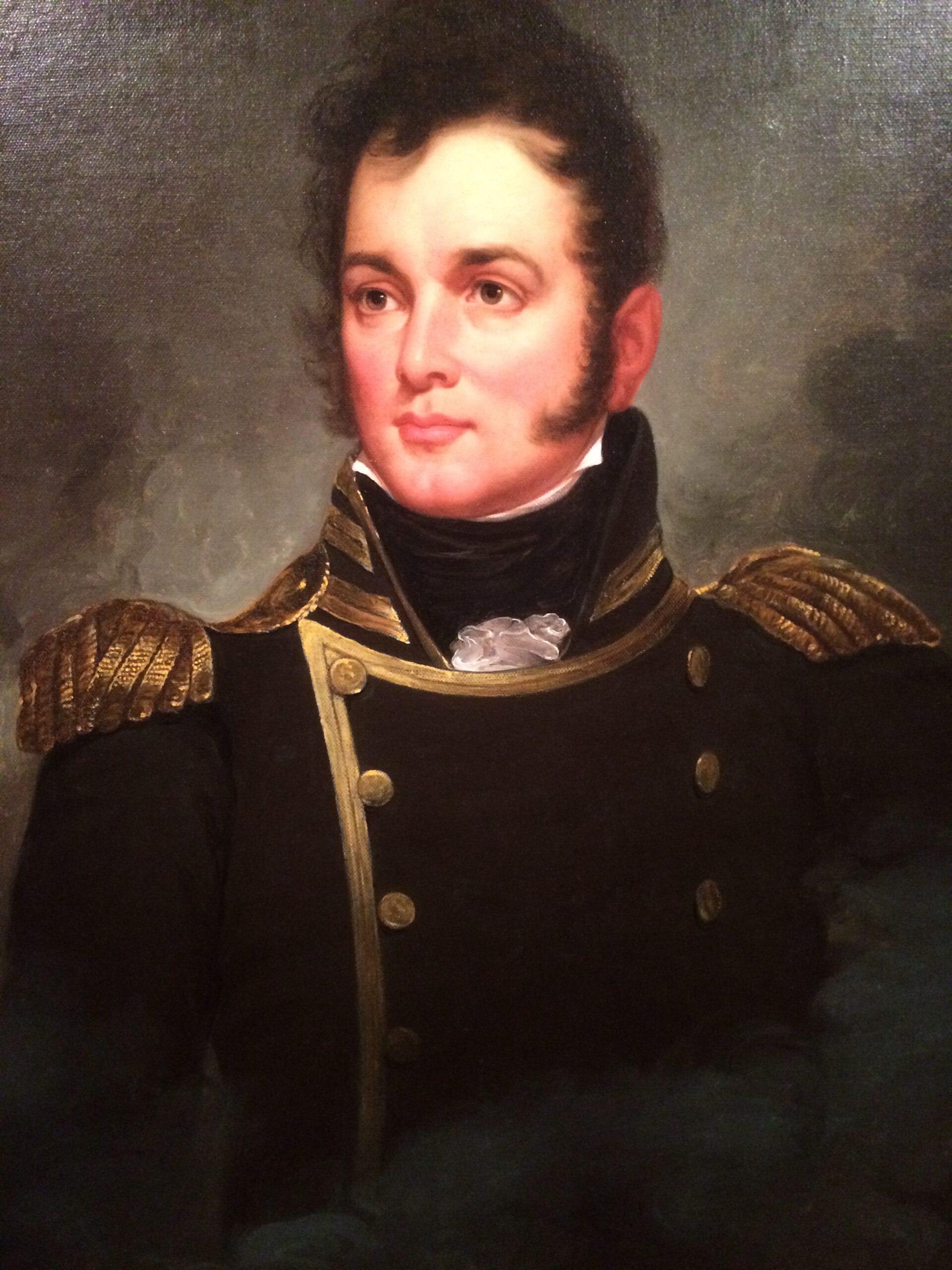
This portrait of Commodore Oliver Hazard Perry was painted by Martin Johnson Heade in 1855. He painted the work posthumously as a copy after an earlier life portrait painted by John Wesley Jarvis around 1816 (National Portrait Gallery)
The mission that took him away
Oliver Hazard Perry was born in South Kingstown, Rhode Island, on August 23, 1785, the eldest child of Christopher Raymond Perry and Sarah Alexander Perry. His father served on privateers during the Revolutionary War and endured British captivity in Ireland. According to later family accounts, he met Sarah during his captivity, returned to Ireland after the war to bring her back to Rhode Island, and married her in South Kingstown in 1784. The family moved to Newport in the early 1790s, making its home in the Point district. Christopher later commanded the frigate General Greene in the Quasi-War with France, and Oliver joined him aboard as a thirteen-year-old midshipman in 1799. Oliver was educated in Newport and married Elizabeth Champlin Mason there in 1811. He commanded gunboats off Newport at the beginning of the War of 1812. The city that would welcome him home in 1826 was a place of family, schooling, marriage, and naval service—not merely the setting for a public funeral.[2]
Perry was only twenty-eight when he defeated and captured the British squadron on Lake Erie on September 10, 1813. The victory secured American control of the lake, and helped force British troops to abandon Detroit. His dispatch to General William Henry Harrison—“We have met the enemy and they are ours”—became one of the best-known sentences of the war. Newport already possessed a hero before his body ever returned to its wharf.
His final assignment was less familiar and more complicated. In 1819 President James Monroe’s administration sent Perry to Venezuela, where an emerging country was fighting for its independence from Spain. The United States had not yet recognized that government as an independent nation. Perry went as a naval officer entrusted with diplomatic business rather than as an accredited minister. His instructions joined several delicate problems: attacks by privateers on American shipping, the treatment of disputed vessels and property, and the desire to keep communication open with an emerging republic without openly abandoning American neutrality.[3]
The larger John Adams carried Perry south, while the shallow-draft schooner Nonsuch was assigned to take him up the Orinoco River. The John Adams waited at Port of Spain, Trinidad. After a voyage through punishing heat, insects, rain, and stagnant air, the Nonsuch reached Angostura, the republican capital, on July 26. Simón Bolívar was away with the army in New Granada, where his victory at Boyacá would soon transform the war. Perry instead negotiated with Vice President Francisco Antonio Zea and Secretary of State Juan Germán Roscio.[4]
The talks produced an official answer, promises of later action, and a continuing diplomatic record, but not the sweeping anti-piracy agreement sometimes ascribed to the mission. Perry pressed the government to restrain privateers, provided copies of United States laws on neutrality, and sought action on disputed maritime claims. Evelyn M. Cherpak, who reconstructed the mission in Newport History, judged its immediate diplomatic results limited: the Venezuelan government promised remedies, while privateering abuses continued. Perry’s mission brought a celebrated American officer into contact with Venezuela’s republican government. In December 1819, the Congress at Angostura united Venezuela and New Granada as the Republic of Columbia, now generally known as Gran Colombia.
Disease turned the assignment into a disaster. Perry left Angostura on August 15 as yellow fever spread through the expedition. The Nonsuch moved quickly downriver, but he became ill near the Orinoco’s mouth. By the night of August 22, ship’s surgeon Dr. Mordecai Morgan believed he would not survive. Lieutenant Daniel Turner, Dr. Leonard Osborne, and purser Charles O. Handy came from the John Adams. Perry recognized them, made arrangements for his family and effects, and died aboard the Nonsuch at about half past three on the afternoon of August 23—his thirty-fourth birthday. The John Adams lay within sight.[5]
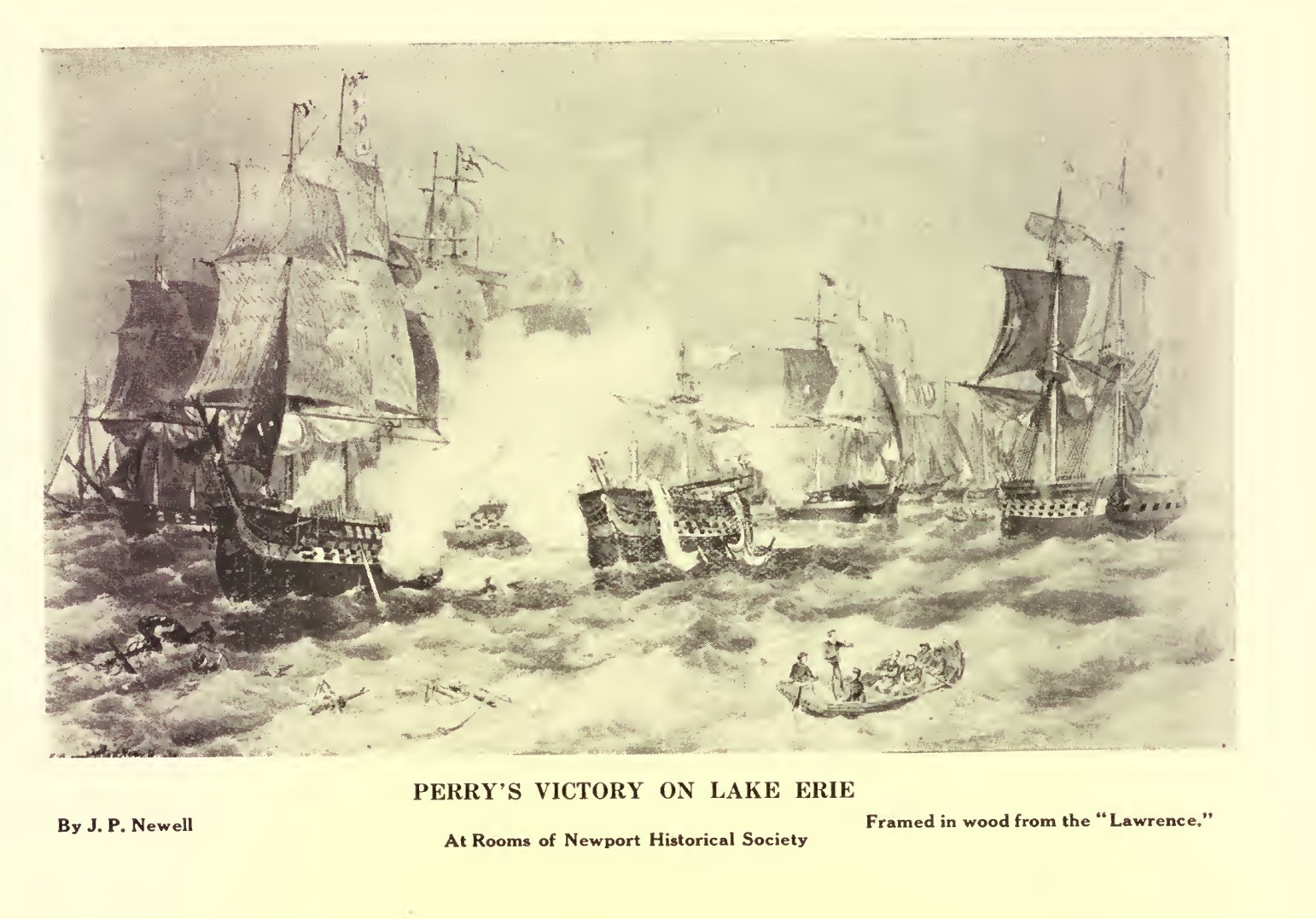
“Perry’s Victory on Lake Erie,” by J. P. Newell, as reproduced in the Newport Historical Society’s Items of Interest (1913). The engraving’s frame was reportedly made with wood from the USS Lawrence (Items of Interest)
A funeral arranged by former enemies
The American officers wanted to carry Perry home. The surgeons advised immediate burial instead, fearing the danger of keeping a yellow-fever victim aboard ship. Turner therefore asked Sir Ralph James Woodford, the British governor of Trinidad, for permission to land the body. Woodford did far more than consent. He organized honors on a scale that startled the Americans.
Late in the afternoon on August 24, boats from the John Adams and Nonsuch left the ship with the coffin, their officers, and 120 sailors. The crews pulled slowly in measured strokes while minute guns (used for ceremonial purposes where a cannon is fired repeatedly at strict sixty-second intervals) sounded. When the boats reached shore, the battery at Fort St. Andrew took up the salute. The Third West India Regiment waited with arms reversed; its officers wore white scarves and hatbands, and its band played a dead march. British officers on horseback served as bearers. American officers, sailors, townspeople, and the governor himself followed the hearse through Port of Spain. After services at Trinity Church, the procession continued to Lapeyrouse Cemetery, where three volleys were fired over the grave.[6]
Woodford’s attendance mattered. As the king’s representative, he did not ordinarily follow a funeral. Port of Spain’s balconies were crowded, and American accounts dwelt on the grief of spectators who knew Perry principally by reputation. A local newspaper described him as “a gallant man, and a good parent and citizen.” The officers of the John Adams and Nonsuch published their thanks to the town, praising the respect shown by “strangers and former enemies.”
Why did a British colony embrace the man who had defeated a British squadron only six years earlier? Perry’s brother-in-law and biographer, Alexander Slidell Mackenzie, offered an answer. British soldiers then stationed in Trinidad included men who had heard from prisoners taken in the Lake Erie campaign. Those veterans reportedly spoke of Perry’s generous treatment and admired him as a commander. The explanation is difficult to test in every detail, but the ceremony itself is unmistakable. Naval reputation, professional respect, and the language of chivalry crossed the recent enemy line.
The first funeral complicates a simple national story. Perry did not wait seven years in a neglected foreign grave for Americans to value him properly. A British governor and garrison had already staged an international tribute. That fact would shape the federal return. When the Navy came back in 1826, its commander declined a second large Trinidad procession because, he wrote, Woodford had already buried Perry “in the most splendid manner.”
The federal government and the Navy reclaim the body
President Monroe had called Perry’s death “a national misfortune,” but repatriation did not immediately follow. The federal record becomes precise in 1826. On May 18, the House of Representatives resolved that the secretary of the Navy should remove Perry’s remains from Trinidad in a public vessel and convey them to Newport. The distinction is small but important: the authority was a House resolution, not, as later retellings often put it, an act of Congress.[7]
Secretary of the Navy Samuel L. Southard chose the Lexington and its commander, William Branford Shubrick. Southard’s orders joined naval protocol to family obligation. He notified Perry’s mother, widow, relatives, and Rhode Island friends so that they could prepare funeral honors. He directed Shubrick to approach the colonial government formally, receive the remains with the colors at half-mast, and render the honors due Perry’s rank. Daniel Turner accompanied the expedition, creating a human link between the deathbed, the first funeral, and the second.
The Lexington sailed from New York on October 12 and entered the Gulf of Paria after a seventeen-day passage. Shubrick reached Port of Spain on November 1 and again found Woodford helpful. The governor ordered a carriage prepared to bring the coffin from Lapeyrouse Cemetery, using his own horses; members of his household and colonial officials attended. At the wharf, minute guns sounded and boats from the Lexington received the remains. A Marine guard presented arms when the coffin came aboard, officers and sailors uncovered their heads, and the musicians played a dead march. The warship sailed on November 4 after American and British guns exchanged seventeen-gun salutes.
Calms in the Caribbean and gales nearer the American coast lengthened the voyage. On November 27, the Lexington anchored at Newport. Shubrick had completed more than a transport assignment. He had carried a body through a sequence of official courtesies connecting a British colonial governor, the United States Navy, Perry’s family, and a congressional resolution. Southard captured the union of purposes in a letter to Perry’s widow, Elizabeth Champlin Mason Perry: the government’s action joined “private affection” to “public gratitude.” In November 1819, Elizabeth had written to Perry’s mother, Sarah Alexander Perry, that her husband had left “a name to his country and his children that is without stain.”[8]
Newport stages Lake Erie
The week between the Lexington’s arrival and the funeral turned federal repatriation into Rhode Island commemoration. The Newport Mercury printed detailed instructions on December 2. Streets were to be cleared, stores closed while the procession passed, and citizens organized under chief marshals marked by swords draped in black. The Lexington would fire minute guns while its boats carried the coffin ashore. The document reads like municipal logistics, but its precision reveals how deliberately the spectacle was built.[9]
On Monday, December 4, Governor James Fenner and Major General Thomas Carpenter of the Rhode Island militia arrived from Providence aboard the steamboat Washington with civil and military officers and citizens from northern and central Rhode Island. Six independent military companies came from Providence and Pawtucket; two Bristol companies crossed by packet. Naval officers arrived from Boston and New York. Providence appropriated $300 toward transporting the visiting companies. Bells rang and flags hung at half-mast in Providence, and Boston observed its own signals of mourning. The homecoming was locally staged but regional in reach.
At half past eleven, the boat procession from the Lexington reached Clarke’s Wharf. Perry’s coffin passed from shipboard officers and seamen to a committee of arrangements, federal troops, and Marines. The formal order stretched far behind it: military units and bands, pallbearers and naval officers, Perry’s relations, clergy, the governor and state officers, members of the General Assembly, town officials, judges, foreign consuls, and citizens. The Mercury reported that “an immense number of citizens and strangers” lined the streets and that women watched from windows and doors.[10]
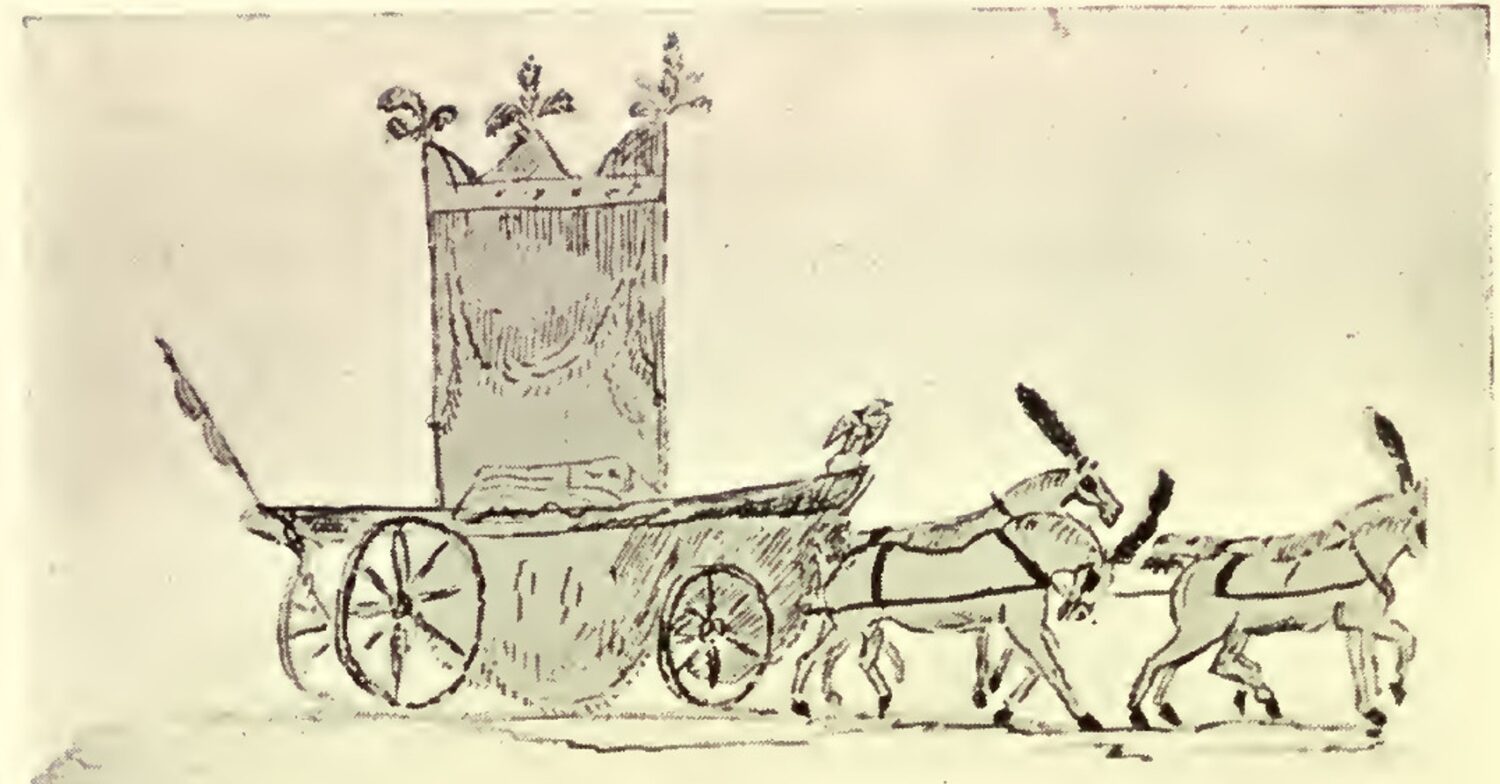
The ceremony’s most striking object was the funeral car. Newport artisan Benjamin J. Cahoone designed it to resemble the small boat that had carried Perry from his shattered flagship Lawrence to the Niagara during the Battle of Lake Erie. Draped in black and drawn by horses, it carried the ensign-covered coffin. Perry’s hat and epaulettes rested above him, together with the ceremonial sword.[11]
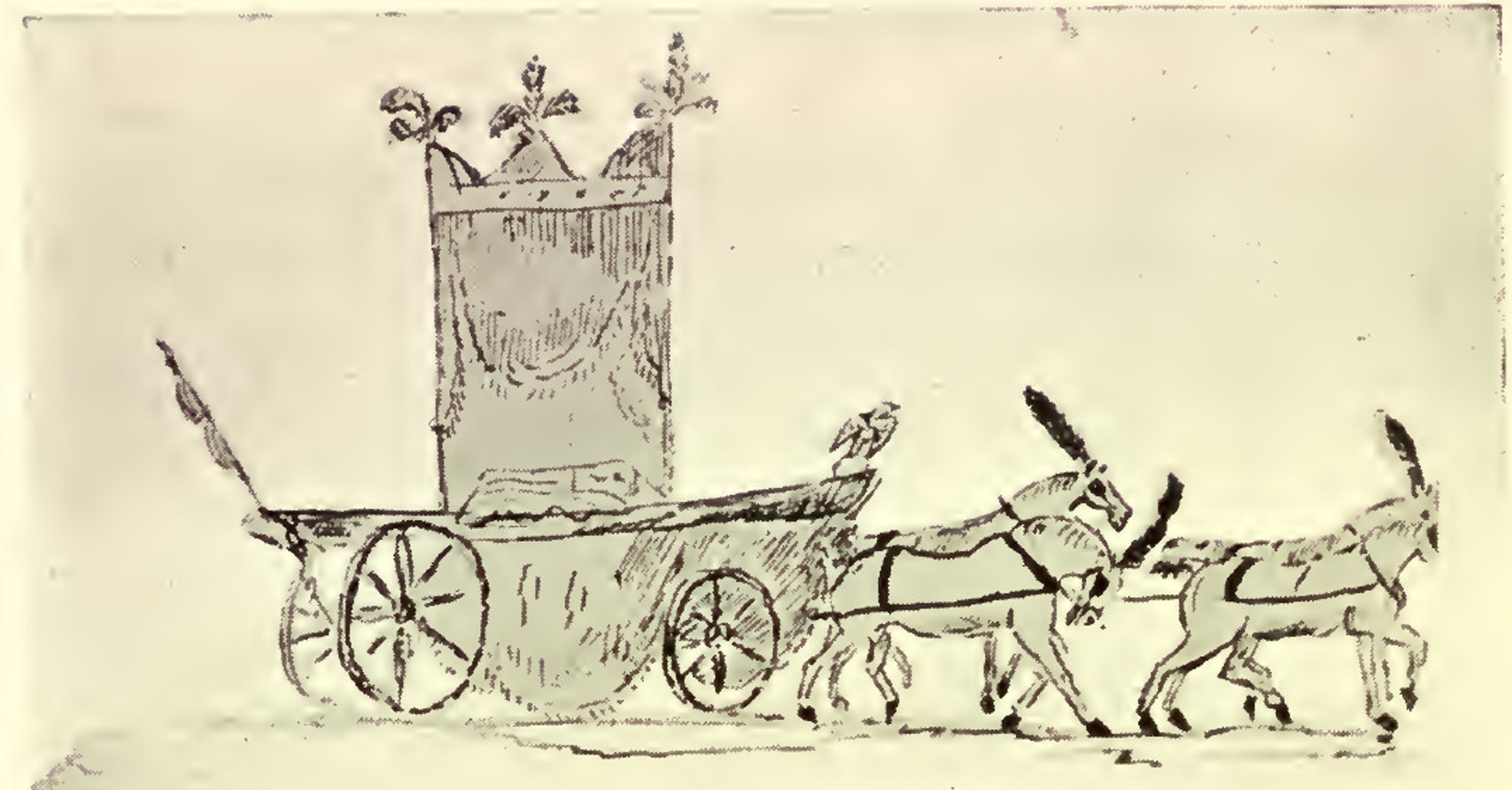
Drawing of Oliver Hazard Perry’s 1826 funeral car by Dr. J. Bernard Gilpin. The carriage was designed to evoke the boat in which Perry transferred from the Lawrence to the Niagara at the height of the Battle of Lake Erie. Reproduced in the Newport Historical Society’s Items of Interest (1913). (Item’s of Interest)
The car did more than move a coffin. It compressed the remembered drama of September 10, 1813, into a tableau that Newporters could watch pass through their own streets. The disabled Lawrence, the dangerous transfer under fire, Perry’s assumption of command aboard Niagara, and the victory that followed were evoked by the shape of the vehicle and the objects displayed above the body. The procession translated naval combat into civic theater.
The point becomes sharper when the two sea passages are placed together. In 1813, a small boat carried the living Perry from a battered vessel toward victory. In 1826, boats carried his remains from the Lexington to Newport, where the coffin was placed inside a wheeled version of that earlier craft. The homecoming repeated the motion on which his fame depended: ship to boat, boat to shore, crisis to triumph.
The crowd completed the scene. Thousands occupied the length of Thames Street, yet the Mercury emphasized silence rather than noise. Only mournful music and the measured march of military companies broke the stillness. The newspaper compared the rites with Newport’s elaborate 1780 funeral for the French admiral Charles-Louis d’Arsac de Ternay and judged Perry’s ceremonies still more solemn. Ternay had been the admiral of the fleet that had carried Comte de Rochambeau’s French army from France to Newport in July 1780. Ternay’s burial in Trinity Churchyard had fixed Newport inside the international history of the American Revolution. The comparison placed Perry in the same civic hierarchy while making his funeral the new standard against which public mourning in Rhode Island could be measured.[12]
What Newport chose to remember
Perry’s reputation did not need to be invented in 1826. Lake Erie had already made him famous. Yet reputation does not preserve itself. It requires bodies, objects, routes, institutions, and repeated stories. The federal government supplied a warship, diplomatic correspondence, salutes, and an escort. Rhode Island supplied its governor, legislators, and military companies. Newport supplied the wharf, the street, the burial ground, the crowd, and the most inventive symbol of all: a funeral car in the form of Perry’s Lake Erie boat.
That visual language also selected one Perry from several possible Perrys. The man who died in 1819 had spent his final weeks negotiating over privateering, neutrality, confiscated property, and relations with an unrecognized South American republic. His mission ended amid epidemic disease rather than combat. The funeral did not deny that final service, but it translated the unfamiliar diplomat back into the victorious captain of 1813. Spectators did not need to understand Venezuelan politics or the law of privateering.
British Trinidad emphasized Perry’s humanity as an opponent: brave, generous, and deserving of honor across national lines. The Newport funeral emphasized possession. Perry belonged to his family, to the Navy, to Rhode Island, and to the United States. Southard’s phrase—private affection and public gratitude—held those claims together. Shubrick’s report also prevented the national ceremony from erasing the first one: Newport’s triumphal homecoming rested on the governor and people of Trinidad having honored and protected the grave for seven years.
Perry was placed beside his father, Captain Christopher Raymond Perry, in Newport’s Common Burying Ground. Plans for a state monument began in 1828, but the granite and marble obelisk was not completed until 1843. Island Cemetery’s records state that Perry’s remains were then moved to a grave four feet south of the monument and marked by two small stones. The later relocation did not repeat the great public ceremony of 1826. It fixed the family plot within the landscape now known as Island Cemetery and gave Newport a permanent shrine to Perry’s memory.[13]
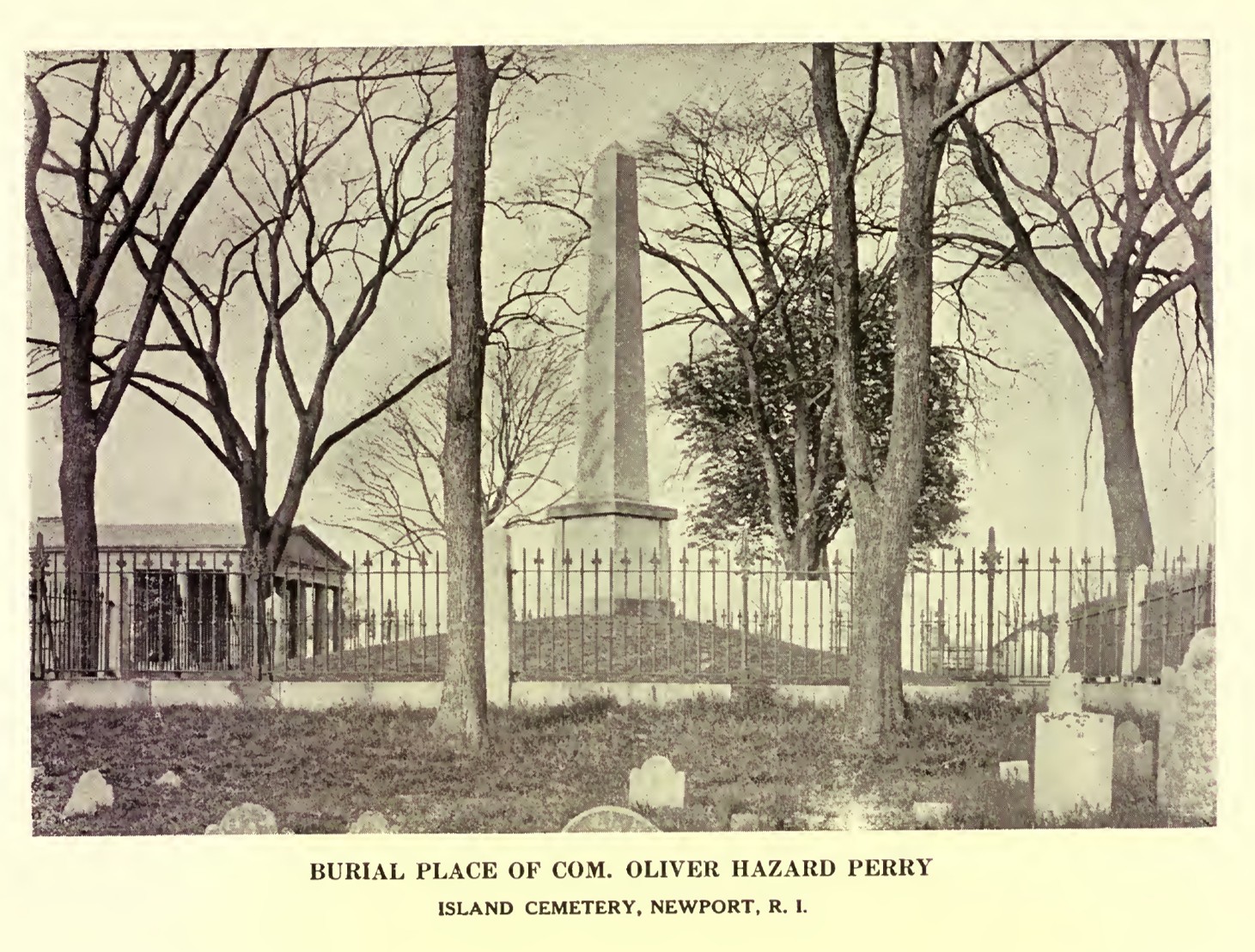
Perry family burial place and monument at Island Cemetery off Farewell Avenue in Newport, as reproduced in the Newport Historical Society’s Items of Interest (1913). (Items of Interest)
The afterlife of a procession
Newport renewed the claim in later generations. In 1885, the city unveiled William Greene Turner’s statue of Perry opposite his last Newport residence. At the dedication, historian George Bancroft described Lake Erie as an episode that had helped turn a scornful enemy into a peaceful neighbor. In 1913, the Newport Historical Society published Items of Interest Concerning Oliver Hazard Perry in Newport. The pamphlet reprinted the Mercury’s funeral report and reproduced Dr. J. Bernard Gilpin’s drawing of the funeral car.[14]
By then the Perry name carried another celebrated naval story. Oliver’s younger brother Matthew Calbraith Perry became famous for the expedition that opened formal relations with Japan. Yet the Newport Historical Society’s 1913 pamphlet concentrated on Oliver, his local home, and the objects associated with Lake Erie. As historian Jan M. Copes later chronicled, the brothers belonged to a wider Newport naval dynasty. The 1826 funeral, however, had made a particular civic claim about Oliver.[15]
The familiar phrase “We have met the enemy and they are ours” fixed Perry at Lake Erie. His two funerals tell a larger and more human story. Taken together, the ceremonies connect revolutionary Venezuela, British Trinidad, the federal government, the Navy, and the streets of Newport. Former enemies practiced reconciliation before Americans returned to claim their hero; public commemoration then transformed a family homecoming into a political and civic act. Seven years after his death, Newport did not simply receive a coffin. It made the homecoming reenact the victory by which the nation remembered him.
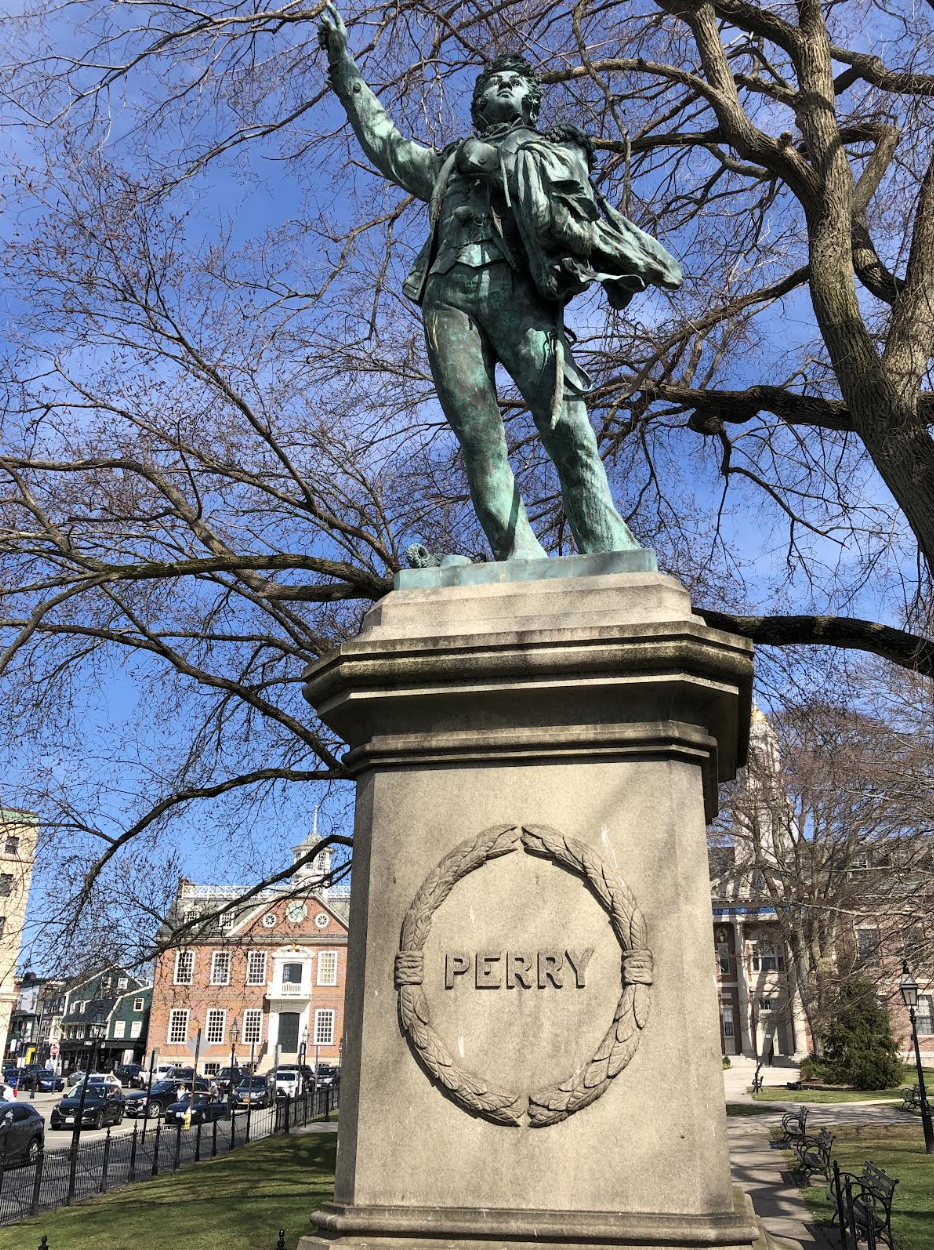
Statue of Oliver Hazard Perry in Eisenhower Park, Newport. The Colony House can be see on the left side. (Christian McBurney)
Notes:
[1] Newport Mercury, December 9, 1826, 2–3; Newport Historical Society, Items of Interest Concerning Oliver Hazard Perry in Newport, and Newport in the War of 1812 (Newport: Mercury Publishing Company, 1913), 13–16. The 1913 pamphlet reprints the Mercury account and reproduces the funeral-car drawing. https://archive.org/details/oliverhazardperry00newprich [2] Jan M. Copes, “The Perry Family: A Newport Naval Dynasty of the Early Republic,” Newport History 66, pt. 2, no. 227 (Fall 1994): 50–59, especially 54 and 57; Naval History and Heritage Command, “Oliver Hazard Perry,” biographical entry, https://www.history.navy.mil/browse-by-topic/people/historical-figures/oliver-hazard-perry.html. Copes’s account of Christopher Perry’s meeting Sarah Alexander in Ireland draws on later family biographies. [3] Evelyn M. Cherpak, “The Naval Officer as Diplomat: Oliver Hazard Perry’s Mission to Angostura, Venezuela, 1819,” Newport History 57, no. 193 (Winter 1984): 5–15, especially 7–10. [4] Cherpak, “Naval Officer as Diplomat,” 9–12. Cherpak identifies Zea’s office and the absence of Bolívar, who was then campaigning in New Granada. [5] Cherpak, “Naval Officer as Diplomat,” 12–14; Alexander Slidell Mackenzie, The Life of Commodore Oliver Hazard Perry, 2 vols. (New York: Harper & Brothers, 1840), 2:219–24. https://archive.org/details/lifeofcommodoreo02mack [6] Henry D. Baker, “Commodore Perry: An Interesting Sidelight on American History,” American Consular Bulletin 6, no. 1 (February 1924): 37–39, 64–65. Baker, then the American consul at Port of Spain, drew on Mackenzie and a contemporary Trinidad newspaper account. https://afsa.org/sites/default/files/fsj-1924-02-february_0.pdf [7] James Monroe, Third Annual Message, December 7, 1819; Report of the Secretary of the Navy, December 1826, “Correspondence Respecting the Removal of the Remains of Commodore Oliver H. Perry.” The Navy report quotes the House resolution of May 18, 1826. https://www.history.navy.mil/research/library/online-reading-room/title-list-alphabetically/a/secnav-reports/annual-report-secretary-navy-826.html [8] William B. Shubrick to Samuel L. Southard, November 5 and November 27, 1826, and related correspondence in Report of the Secretary of the Navy, December 1826. https://www.history.navy.mil/research/library/online-reading-room/title-list-alphabetically/a/secnav-reports/annual-report-secretary-navy-826.html For the widow’s letter, see Elizabeth Mason Perry to Sarah Alexander Perry, November 13, 1819, Oliver H. Perry Papers, box 7, William L. Clements Library, quoted in Jan M. Copes, “The Perry Family: A Newport Naval Dynasty of the Early Republic,” Newport History 66, pt. 2, no. 227 (Fall 1994): 64, n. 42. [9] Newport Mercury, December 2, 1826, 2, “Funeral Solemnities”; digitized in the Dartmouth College Libraries collection, Correspondence of Commodore Oliver Hazard Perry. https://collections.dartmouth.edu/archive/object/Perry/perry-18261202 [10] Newport Mercury, December 9, 1826, 2–3; Newport Historical Society, Items of Interest, 13–15. [11] Newport Historical Society, Items of Interest, 14–15. The pamphlet identifies Benjamin J. Cahoone as designer and Dr. J. Bernard Gilpin as the young witness who sketched the car along Thames Street. [12] Newport Mercury, December 9, 1826, 3. On the comparison with Admiral de Ternay’s funeral, see Norman Desmarais, “French Soldiers Who Died at Newport During the Revolutionary War,” Small State Big History, March 4, 2016. [13] Newport Historical Society, Items of Interest, 16; Newport Historical Society, “History Bytes: Final Resting Place of Oliver Hazard Perry,” June 14, 2012; Island Cemetery, “Island Cemetery Photo Archive,” entry for Oliver Hazard Perry. Both institutional accounts place the original Newport interment in the Common Burying Ground and the relocation beside the completed monument in 1843. [14] Newport Historical Society, Items of Interest, 16–17; “Oliver Hazard Perry: Speech of Mr. George Bancroft at the Newport Banquet,” New York Times, September 13, 1885, 6. [15]. On the family’s longer Newport naval history, see Jan M. Copes, “The Perry Family: A Newport Naval Dynasty of the Early Republic,” Newport History 66, pt. 2, no. 227 (Fall 1994): 49–77, especially 64–65.The Author

You Might Also Like