

Amos Cross Brewster and his nephew, Joseph Orin Cross, had a nuanced heritage of African and Native American descent and were swept up in the tumult of war. With ties to New London County, Connecticut, Charlestown, South Kingstown, and Providence, Amos and Joseph joined the Twenty-Ninth Connecticut, Connecticut’s first Black volunteer regiment, which mustered in March 1864 to fight for the freedom of their fellow men of color. Both men were listed as thirty years old when they entered service. Their story powerfully illustrates the diversity among men in Black regiments and highlights their courage and perseverance during the Civil War.
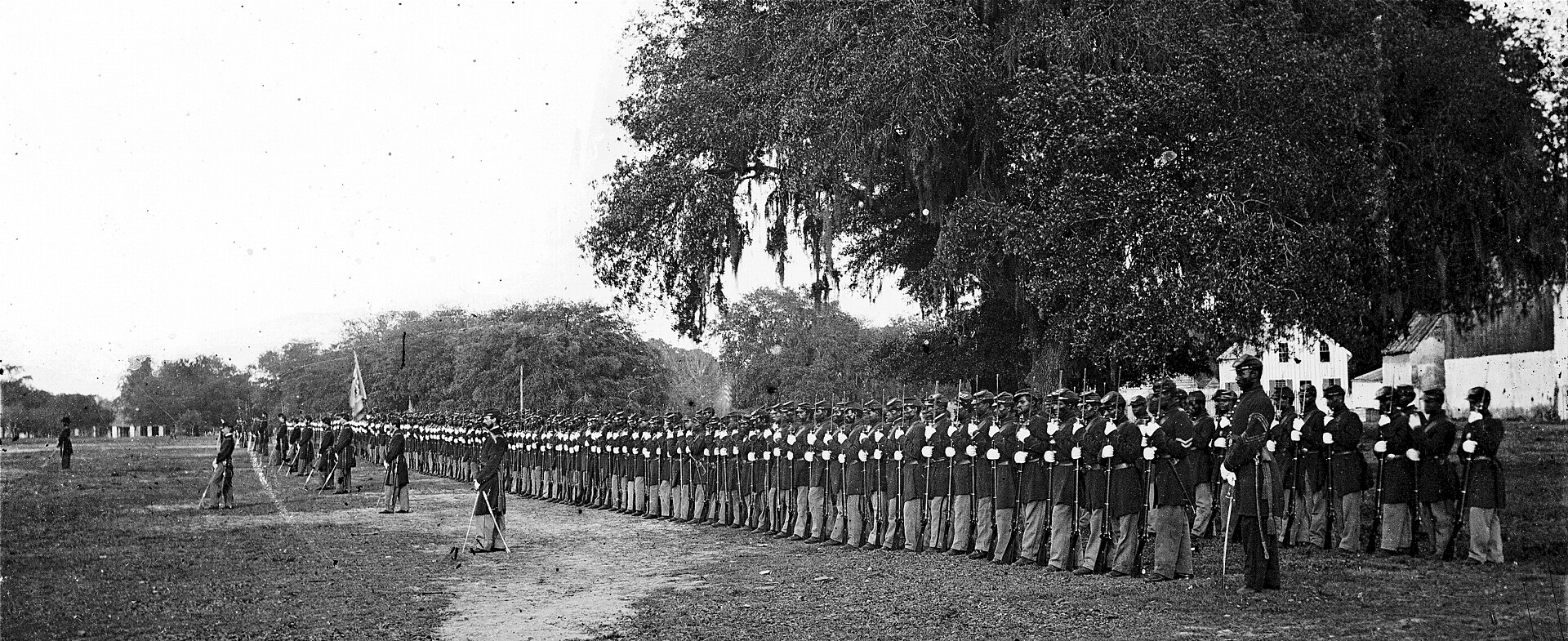
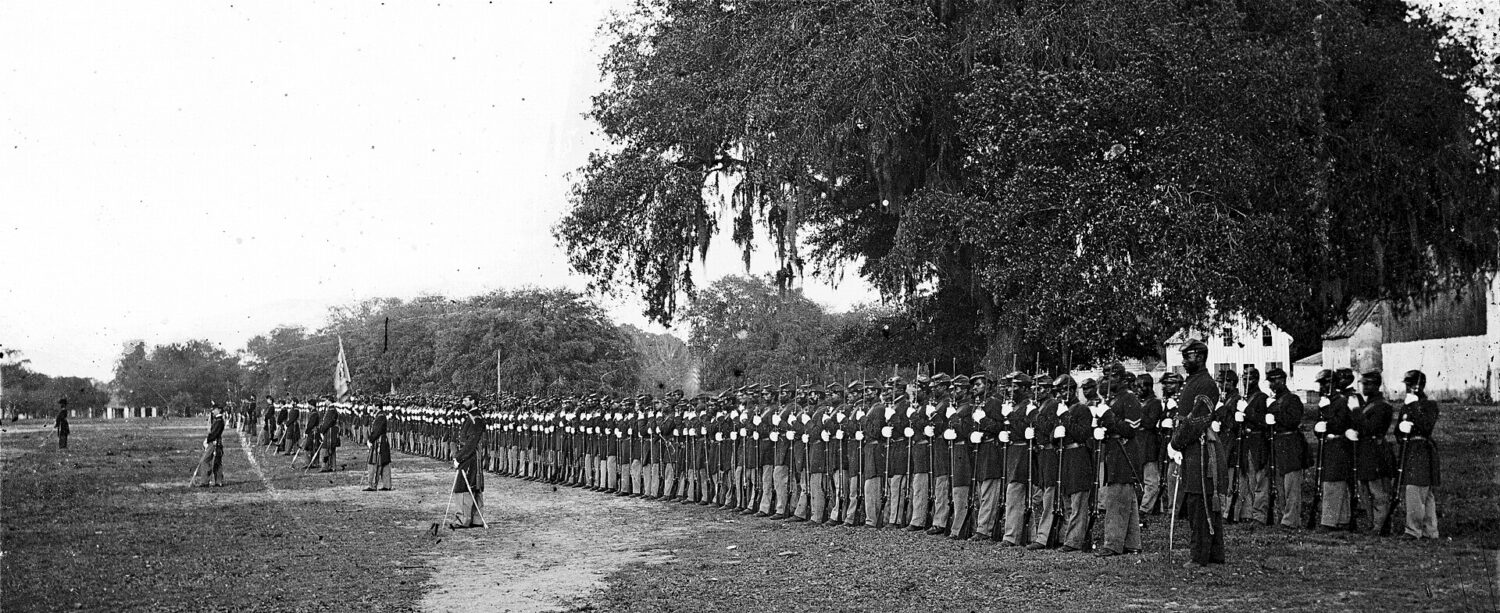
The Twenty-Ninth Connecticut Volunteer Infantry, Beaufort, South Carolina, circa 1864 (Library of Congress)
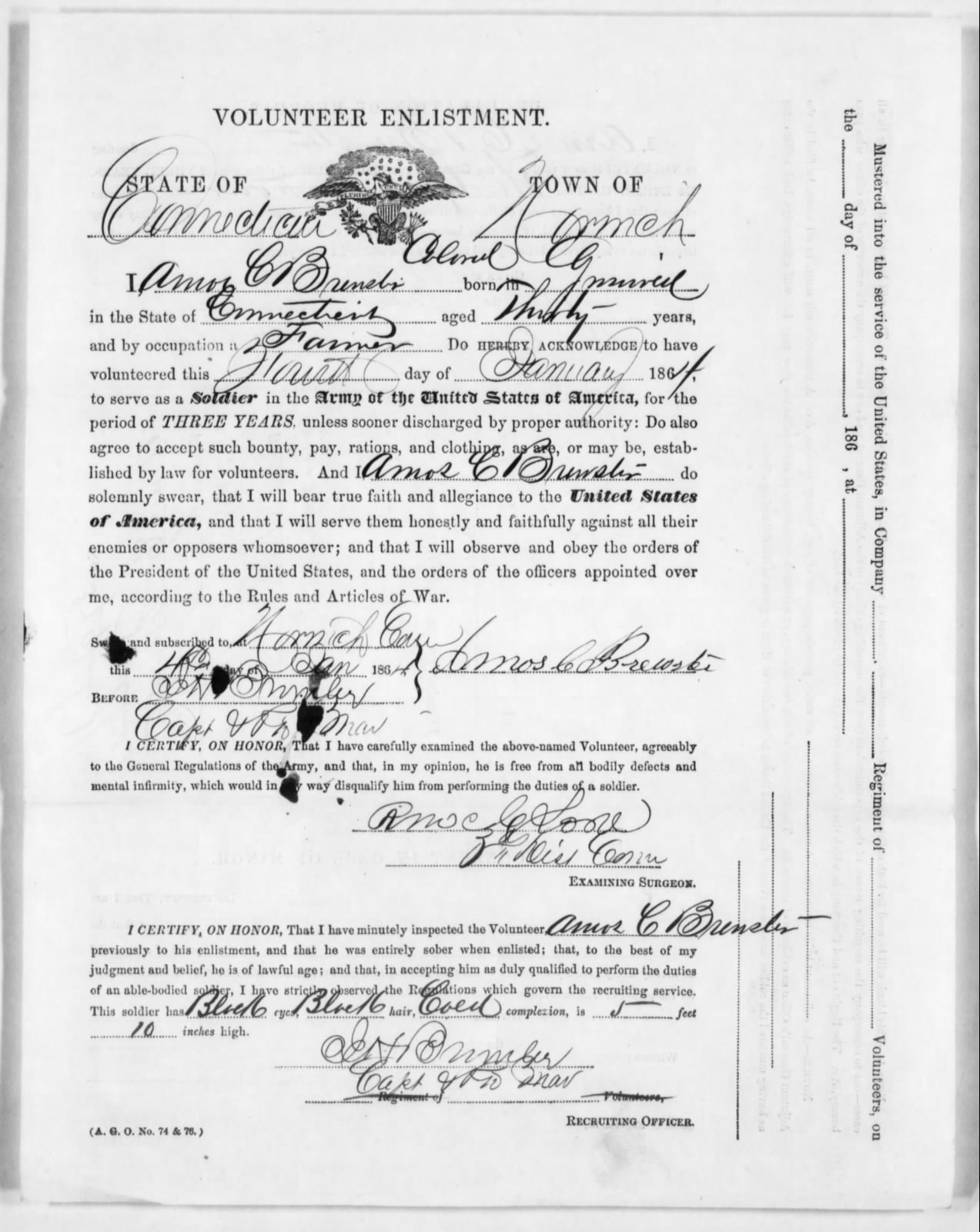
Amos C. Brewster’s Enlistment Paper (National Archives)
The Twenty-Ninth Connecticut Volunteers: A Brief Record of Service
After training in Fair Haven, Connecticut, Colonel William B. Wooster led the regiment to the seat of war in Beaufort, South Carolina. The Twenty-Ninth bolstered Union siege operations against Petersburg and Richmond, Virginia, beginning August 13, 1864, and was part of the Union vanguard that entered the Confederate capital of Richmond on April 3, 1865. Thereafter, on April 18, the regiment was garrisoned at Point Lookout, Maryland, guarding Confederate prisoners until May 28. The Twenty-Ninth then sailed for Texas on July 3, arriving in Brownsville to help enforce the Emancipation Proclamation by providing the military presence needed to uphold Major General Gordon Granger’s June 19, 1865, General Orders No. 3—later commemorated as Juneteenth. While occupying Brownsville to protect newly liberated families, the regiment remained on duty there until October 1865. The Twenty-Ninth completed its service in New Orleans, Louisiana, from October 27 to November 11, replacing the recently departed Fourteenth Rhode Island Heavy Artillery (Colored) (later redesignated as the Eleventh United States Colored Heavy Artillery)—at Camp Parapet in Jefferson Parish.[1]
Ironically, when the Twenty-Ninth returned home to New Haven, Connecticut, on November 25, 1865, they were greeted by the news that men of color still did not have the right to vote. In a resounding welcome-home speech by Governor William Buckingham to the regiment before receiving their final pay and official mustering out, he told them, “Although Connecticut now denies you privileges which it grants to others…the voice of a majority of liberty-loving freemen will be heard demanding for you every right and every privilege.”[2]
Over a month earlier, Connecticut voters soundly rejected a state referendum that would have removed the word white from the state’s voting requirements. It was not until the adoption of the Fifteenth Amendment that the federal government prohibited states from denying the right to vote on the basis of race, color, or previous servitude. Connecticut was the last New England state to grant suffrage to Black men, and even then, it took until 1876 for the state to formally align its laws with the federal Constitution.
Rhode Island had enfranchised Black men in May 1843—a result of the Dorr Rebellion—but still denied Narragansett Indians and immigrants the right to vote. Rhode Island’s 1843 Constitution allowed naturalized citizens to vote if they met residency requirements and owned qualifying real estate valued at $134—a requirement that carried over after the Dorr Rebellion but did not apply to native-born citizens, who instead had to pay a $1 poll tax. This property qualification remained in place until the Bourn Amendment of 1888, which applied only to foreign-born citizens; at that point, the $1 poll tax was extended to all citizens who did not own property. A 1951 state constitutional amendment ultimately removed this remaining poll tax requirement.
Connecticut’s 1818 Constitution similarly recognized voting rights for qualifying naturalized citizens, subject to age, residency, and other requirements, later introducing literacy tests. Although presented as neutral, these requirements disproportionately burdened immigrants with limited English-language education. Native Americans and people of color also faced exclusion and discriminatory voting practices, including restrictive registration procedures, poll taxes, literacy tests, and other barriers to the ballot.
Connecticut and Rhode Island Natives remained effectively excluded from the franchise long after the federal Indian Citizenship Act of 1924, which granted birthright citizenship to all Indigenous people but left voter qualifications under state control. Both states exploited legal loopholes to maintain Native disenfranchisement; Connecticut, in particular, used an “overseer” system that classified reservation-dwelling Native Americans as wards of the state—a legal dependency that local registrars relied on to bar them from voting on the grounds that they were not autonomous citizens. Some Native men in Rhode Island did vote before 1924, but only in narrow instances. Their eligibility depended on affording the one-dollar poll tax, and—critically—being classified by officials as “colored” or “mulatto” rather than Native. Because Rhode Island’s suffrage laws did not recognize Indigenous identity at all [3], any Native-descended voter could participate only by being recorded as African American and therefore eligible under the post–Dorr Rebellion expansion of Black suffrage. This meant their participation was not an acknowledgment of Indigenous political rights but rather the result of misclassification that erased their Native identity. While voting restrictions formed one avenue of exclusion, Rhode Island also pursued broader strategies to undermine Native political existence. This culminated in the state’s aggressive 1880 “detribalization” act, an attempt to dissolve the Narragansett Tribe by severing its legal and territorial ties to its reservation land. The Narragansett people resisted these efforts, ultimately reclaiming part of their ancestral lands through a 1978 federal lawsuit and securing formal federal re-recognition of their tribal nationhood on April 11, 1983.
The Battle of New Market Heights and Second Fair Oaks
A letter from Amos’s uncle, Corporal Joseph O. Cross, recalled the horror he had seen during his first taste of combat—what Civil War soldiers called “seeing the elephant”—in the brutal fighting at New Market Heights on September 29–30, 1864. This was a notable and celebrated engagement for African American soldiers, fought just outside Richmond, Virginia.
Although the Twenty‑Ninth Connecticut was present during the operation, it served in a supporting role rather than in the main assault, which was carried out by Brigadier General Charles J. Paine’s Third Division of the XVIII Corps, composed of United States Colored Troops. Their attacks pressed the Confederate line and demonstrated the fighting skill and determination of Black soldiers. The action at New Market Heights was part of the larger Union offensive known as the Battle of Chaffin’s Farm, aimed at seizing key Confederate fortifications north of the James River, including Fort Harrison. The Twenty‑Ninth Connecticut advanced as part of this broader operation, helping secure ground and reinforce the frontline units whose assaults had broken through portions of the Confederate defenses. Though Rebel reinforcements ultimately halted the Union advance, the battle became a political and symbolic victory. Fourteen African American soldiers received the Medal of Honor for their heroism that day.[4] Joseph wrote to his wife:
The Rebs pi[t]ched Battle with us Thursday morning… Wee the 29th Marched up [and] the balles did whistle around[d] our heads dreadfully[.] Wee all expected that it was our last time[.] The Rebs [k]ept firing for a long time but they finaley gave up after a while[.] Wee could look ahead & see the men fall one after another[.] Wee had orders to drop under abank… Wee Just [sat] their & look at the woonded men as they passed by[.] Some was shot in the face & eyes some in the arme & legs [&][feet] [&] hands & some lay dead in the field & some crawling on their hands & knees trying to get away[.][5]
A month later, Joseph witnessed his nephew Amos wounded at the Second Battle of Fair Oaks, fought October 27–28, 1864, in Henrico County, Virginia—an engagement the regiment called the Battle of Kell House. Major General Benjamin Butler’s Army of the James launched a deliberate Union attack intended to threaten Richmond’s defenses. As part of this operation, the Twenty-Ninth Connecticut assembled at the Kell House on October 27 and advanced through dense woods, driving Confederate pickets back to their rifle pits and taking a forward position only about 200 yards from the main Confederate line. The regiment held this exposed ground under continuous musketry and severe artillery fire—including canister—throughout the day and night. Officers recalled ramrods stuck in fouled muskets, heavy incoming fire, and orders to hold the line “at all hazards” until relief arrived the next morning, by which time some men had fired more than 225 rounds. The Twenty-Ninth served under Major General Alfred Terry’s X Corps, Brigadier General Joseph R. Hawley’s Third Division, and Colonel Ulysses Doubleday’s Second Brigade (which included the Twenty-Ninth Connecticut, the Eighth USCT, and part of the Forty-Fifth USCT). While the Twenty-Ninth and X Corps engaged Confederate forces along Darbytown Road—both to hold them and to support the main attack—the XVIII Corps launched a flanking assault farther north toward Fair Oaks. That assault failed, and Confederate defenses held. The regiment was heavily engaged, suffered its worst losses in an afternoon attack around 2 p.m., remained under fire into the night, and held its position until relieved the next morning.[6]
Amos received a gunshot wound to the foot during the fray, incapacitating him. In a correspondence dated December 31, 1864, Joseph wrote to his wife that he received a letter from “Sargent A. C. Brewster” in an army hospital, and “he says that the [gangrene] has got into his foot very bad but it is better now.” Joseph remarked he “heard that he was a comeing [sic] home but he does not say so in his letter” to him.[7]
Having survived the battle, Amos was declared unfit for further military service and received a “Certificate of Disability for Discharge” on May 9, 1865. The loss of his small toe on his left foot left him unable to march properly, and the injury was further compounded by the loss of his third and fourth toes; it is unclear whether the loss was caused by the initial gunshot wound, infection, amputation, or a combination of all three. He was officially discharged on July 19, 1865.[8]
The regiment suffered several casualties during the battle, with sixty-nine wounded, including Amos and one captain, and twelve killed. Total Union casualties: 1,603 (killed, wounded, and approximately 600 captured). Confederate casualties numbered fewer than one hundred.[9]
Over the course of its service, the Twenty-Ninth Connecticut lost one officer and suffered forty-four enlisted men killed or mortally wounded, and one officer and 152 enlisted men killed by disease, for a total of 198 men.[10]
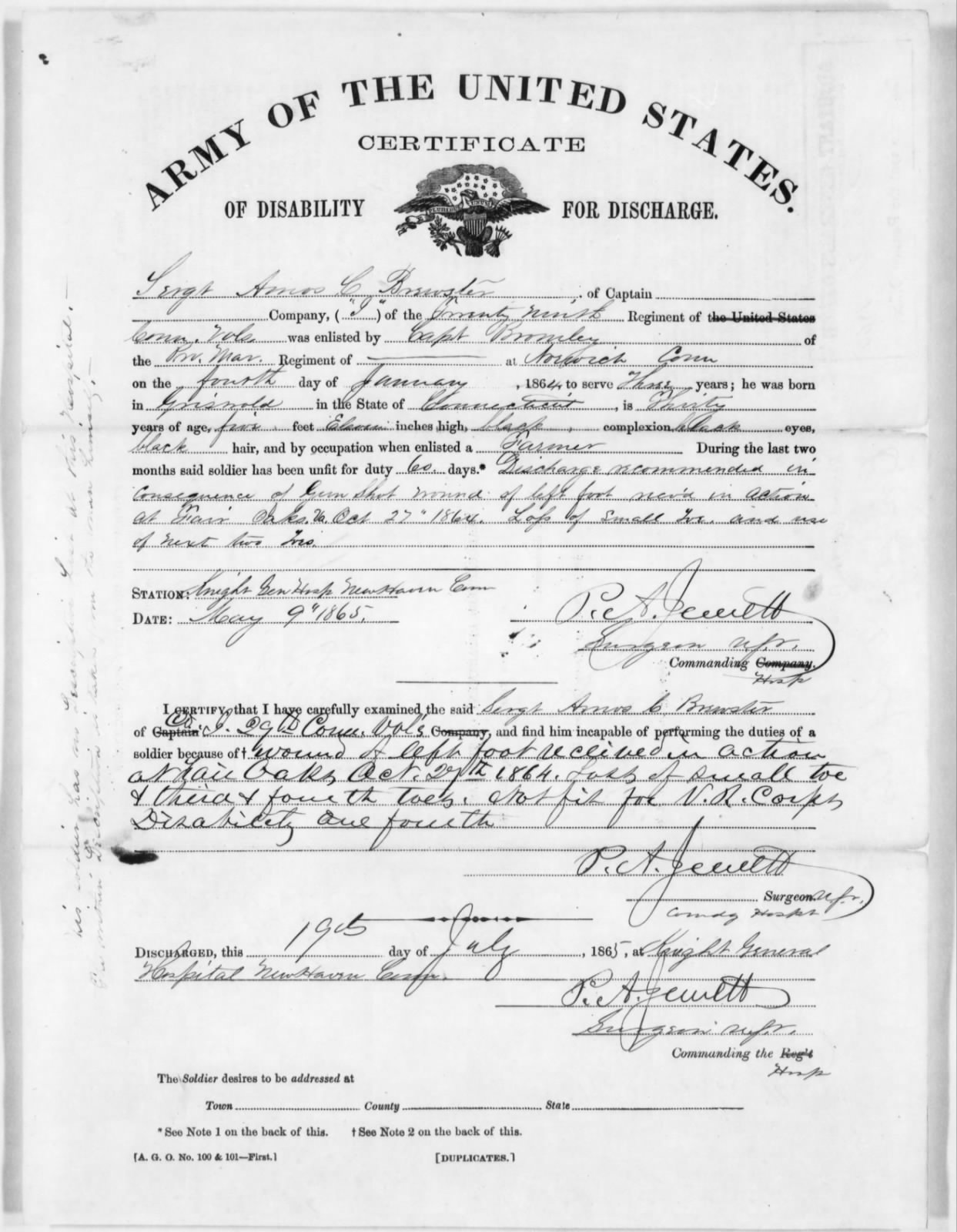
Amos C. Brewster’s Discharge Paper (National Archives)
A Genealogical Reconstruction
Amos C. Brewster was born August 21, 1834, in the Jewett City and Griswold area of Connecticut[11]. (Contradictorily, the 1885 Rhode Island state census lists Charlestown as his place of birth[12]). He was the son of George Brewster and Olive Cross (his parents are listed as “mulatto” in the 1860 federal census)—Joseph O. Cross’s sister—making him Joseph’s nephew. Olive was of Narragansett descent.
Amos was a laborer—his enlistment paper lists his occupation as “farmer”— living with his family in South Kingstown during the outbreak of the Civil War. He had seven siblings, ranging in age from three to twenty-two; he was the second oldest and one of only two sons. His father was a stonemason, while his mother worked as a washerwoman. His 1863 Rhode Island draft registration listed him as a resident.[13]
On January 4, 1864, Amos left South Kingstown and enlisted in Company I of the Twenty‑Ninth Connecticut Volunteers in Norwich, Connecticut—a decision typical of Black recruits who crossed state lines to join units that accepted soldiers of color—and he was mustered into service as a corporal. He was promoted to sergeant on April 1, 1864, and might have continued to climb the ranks had he not sustained the wound he later suffered in battle, which led to his discharge.[14] After the war, he returned to South Kingstown for a time and worked as a laborer as best he could, despite his debilitated foot.
On May 25, 1873, Amos married Sarah N. Potter (born ca. 1844, no birth filed, listed as thirty-three and Black in their marriage record) in South Kingstown.[15] They soon moved to Fox Point, Providence, on Williams Street, and then to a house at 72 John Street in 1887 (John Street was home to an urban Native community).[16] Despite his disability, he worked as a teamster. In Providence, Amos applied for a portion of the proceeds from Rhode Island’s June 1880 purchase of the Narragansett reservation, asserting descent through his grandmother’s line—presumably through his maternal side. The effort failed because he could not afford the travel needed to attend tribal meetings and verify his eligibility during the sale negotiations.[17]
Amos moved to Providence’s West End, first to Pond Street and then to Coddington Street, perhaps on the advice of his sister, Maria Blunt, who moved there before his wife’s death in 1888 (circa date; no death record on file).[18] He married for the second time in Providence on June 4, 1889, to Mary Elizabeth Mott, a dressmaker (born on April 1, 1853, Sturbridge, Massachusetts), and they were wed at Pond Street Church; both were widowed. Amos died November 21, 1899, at 7 Angle Street (a side street that once existed off Pond Street), Providence, of myocarditis and right-sided paralysis, at age sixty-five. His remains lie at rest in Grace Church Cemetery, Providence.[19] Available vital records and census data show no evidence that he had children with either wife.
Mary Elizabeth died on December 5, 1934, at the age of eighty-one, from carcinoma of the liver. At the time of her death, she was residing at the Home for Aged Colored Women at 45 East Transit Street in Providence—an institution founded and championed by Christiana Carteaux Banister, a prominent African American entrepreneur, hairdresser, and philanthropist. Christiana married Edward Banister. He was the first African American artist to win a national art prize in 1876 and co-founded the Providence Art Club. Mary’s embalmer was Andrew J. Bell Jr., a pioneering African American business owner, funeral director, civil rights activist, and community leader from South Providence, Rhode Island, who ran Bell Funeral Home—the city’s first Black-owned funeral home—at 571 Broad Street. Mary lies among the many unmarked graves in the lot belonging to the Home for Aged Colored Women in Providence’s North Burial Ground.[20]
Joseph Cross was born on July 5, ca. 1832 (1830, according to his obituary) [21], in Griswold, New London County, Connecticut, to Abraham (African American) of South Kingstown and Betsy (a Narragansett Indian) of Charlestown. He married Abby Jane Simons (born ca. 1834, according to the 1880 federal census, in Sterling, Connecticut) on September 8, 1853, in North Stonington, Connecticut. He and Abby had eleven children.[22]
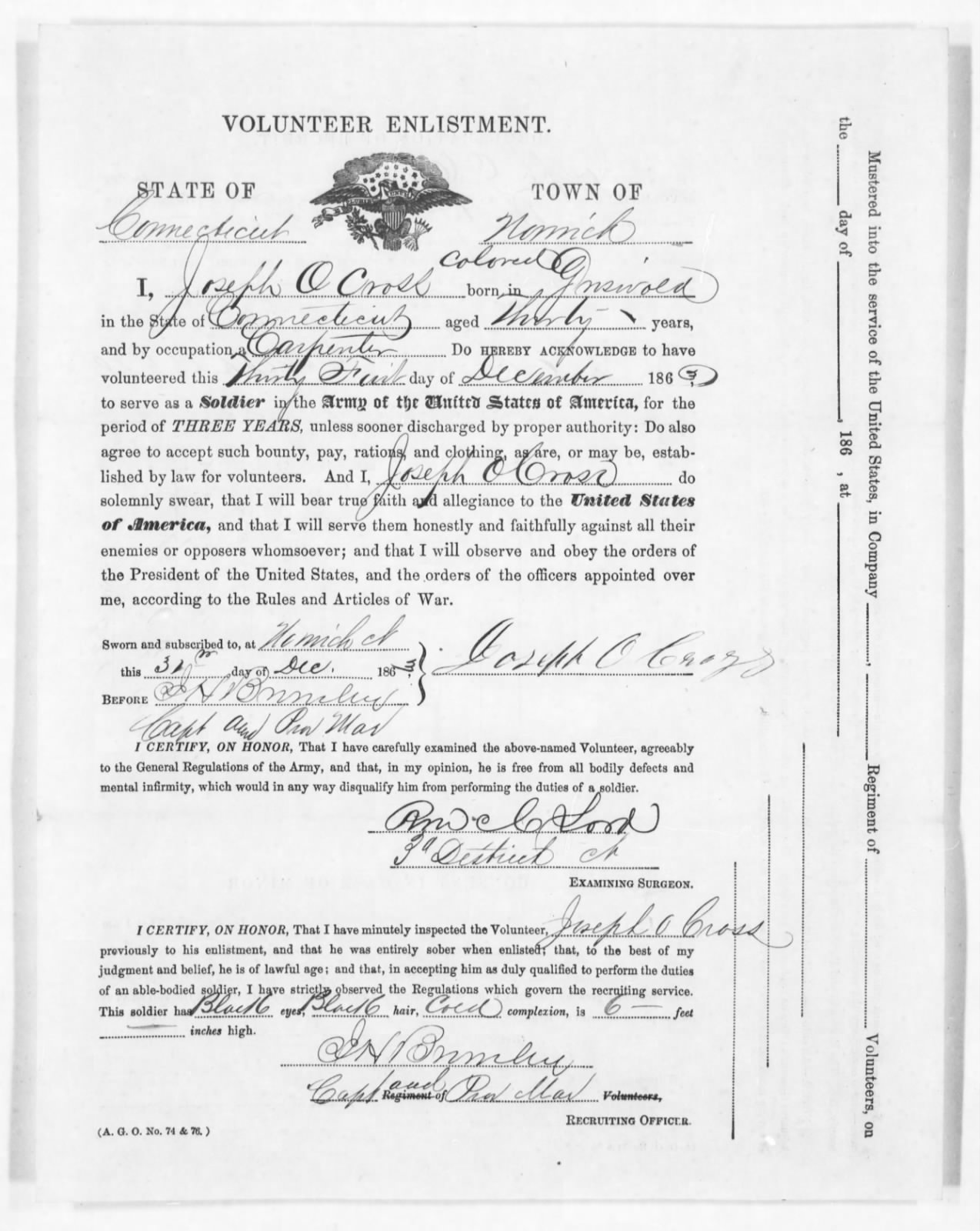
Joseph O. Cross’s Enlistment Paper (National Archives)
Abby’s brothers, John and William H. Simons, were drafted and mustered in on July 16, 1863, as privates in Company D of the Fourteenth Rhode Island Heavy Artillery. In a cruel twist of fate, both brothers died of disease: William died on August 20, 1864, of typhoid malaria fever, and nearly a month later, John died on September 28, 1864, of consumption, both at Fort Jackson, Louisiana.[23] Perhaps inspired by his brothers-in-law’s call to arms, Joseph enlisted in Company H of the Twenty-Ninth Connecticut Volunteers in Griswold on December 31, 1863, was promoted to corporal on April 30, 1864, and then to sergeant on New Year’s Day, 1865. He mustered out of service on October 24, 1865, and received a pension after the war.[24]
As the century turned, Joseph’s wife Abby died on July 30, 1899, at age sixty, of heart disease, and he met the same fate on February 15, 1916, at the age of eighty-three; they are both buried in Pachaug Cemetery in Griswold.[25]
Given their documented genealogical backgrounds, birthplaces, and residences, Amos and Joseph undoubtedly shared Native American ancestry. Their surnames are historically linked to the Narragansett and Mashantucket Pequot tribes through generations of intermarriage among early English settlers, enslaved Africans, and indentured Native servants who adopted these names. Many Indigenous people converted to Christianity under the influence of these prominent families or adopted English surnames for land deeds and court records.
Census records at both the federal and state levels consistently label Amos and Joseph as “colored,” reflecting the common practice among census takers who often overlook the Indigenous ancestry of mixed-race individuals. Compiler and superintendent of the 1865 Rhode Island census, Edwin M. Snow, explained that Natives were counted among the Black population, and that “there are no Indians of pure blood among them at the present time; but the blood of the African race predominates.” Because of this bureaucratic shift, Indigenous people were last enumerated under a distinct, standalone “Indian” category in Rhode Island in 1782, after which they were statistically absorbed into the broader “colored” population. [26] This administrative practice persisted for the remainder of the program’s history, meaning a distinct Indigenous category was never restored to the standard Rhode Island state census before operations permanently ceased in 1935.
A similar census policy applied to Connecticut. New London County contained a diverse enclave of Pequot, Mohegan, Nipmuc, Narragansett, and African American people. Given their extensive kinship throughout the county and into southern Rhode Island, Amos and Joseph’s bloodlines could have been traced to several tribes. However, due to mismanagement by census enumerators, these specific lineages were omitted from the official records.
Historian David J. Naumec uncovered sixty-nine Native American soldiers from New England and Long Island who served in the region’s regiments or the navy and bravely fought in the War of the Rebellion (as the Civil War was once called). Among them, forty-two hailed from Connecticut and Rhode Island bordered Native lands—including Private Augustus Harry of Company K, Twenty-Ninth Connecticut, a proud Narragansett who lived on the Mashantucket Pequot Reservation—it would be amiss not to acknowledge him. Amos and Joseph’s stories, along with those of other Indigenous soldiers presented here, highlight a diverse and brave heritage of men who fought to preserve the Union and remain part of our nation’s history.[27]
Dependent on a modest veteran’s pension, Amos Brewster appears to have been buried in the cemetery’s pauper’s lot near the fence line at West Friendship and Broad Streets. Surviving records, originally informal caretaker index cards later entered a master database in 1994, document only interments, not headstones. As a result, no evidence indicates that a marker was ever erected over Amos’s grave. He may have received a simple pauper’s stone whose inscription later eroded, like the many shown in this photograph, but no documentation confirms that a marker was ever placed or what became of it.
Decades later, records indicate that the American Legion Graveyard Committee became involved in efforts to provide Amos with a military marker. In 1941, the committee applied to the War Department’s Office of the Quartermaster General for a government headstone for Amos, which furnished government markers for eligible veterans buried in private cemeteries. The application specified a flat granite headstone, and records indicate that the marker was shipped in January 1942. However, no surviving cemetery records document its installation, and no physical trace of the marker can be found at Lot 765 today. As a result, the present whereabouts of the 1942 marker—and whether it was ever installed at Amos’s grave—remain unknown.[28]
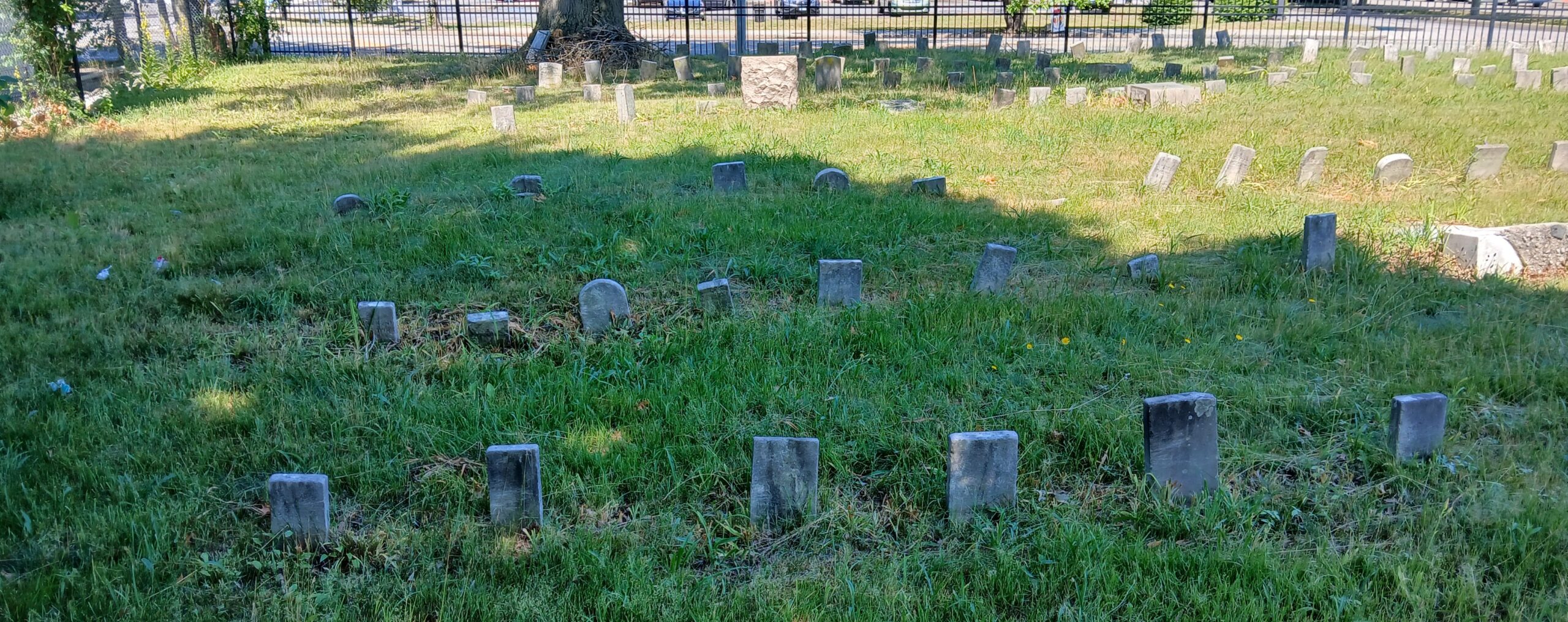
Amos C. Brewster was buried with a pauper’s headstone in Grace Cemetery, Providence (Lot 765), as in his later years he relied mainly on his modest veteran’s pension due to his war-related disability. His inscription has faded, and his headstone remains one of many nameless graves there (The author)
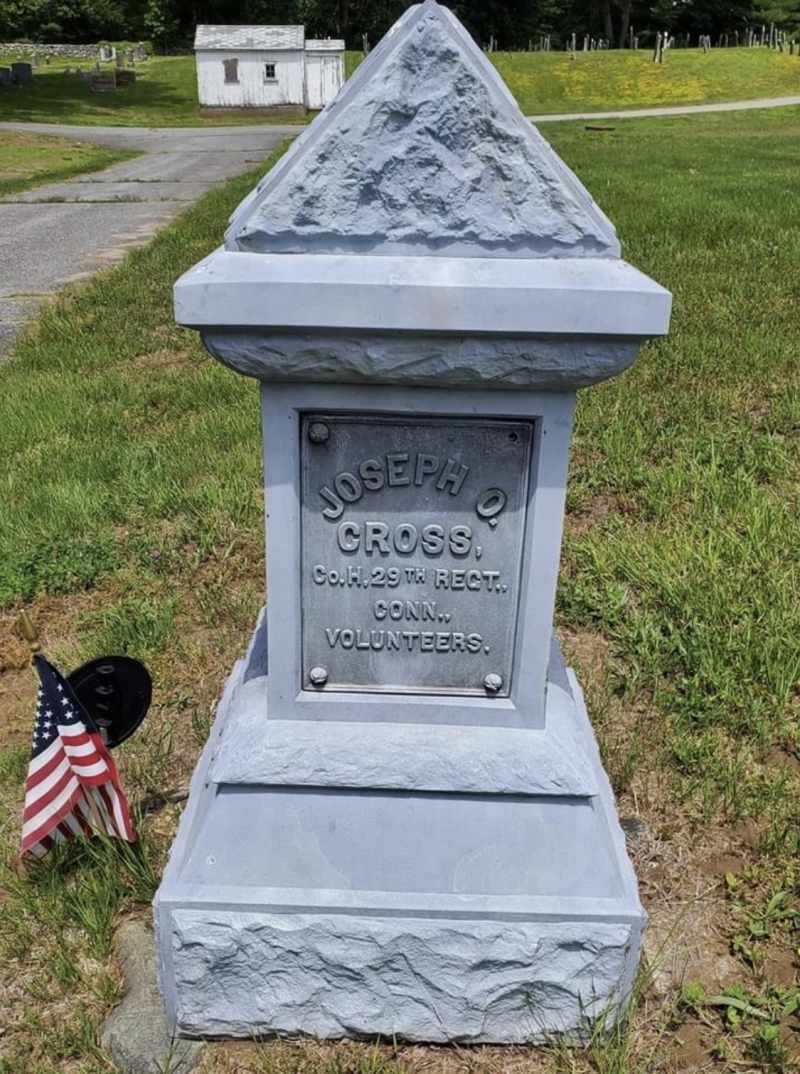
Joseph O. Cross’s headstone, Pachaug Cemetery, Griswold, Connecticut (The author)
Notes:
[1] National Park Service, “Battle Unit Details—the Civil War (US National Park Service): 29th Regiment, Connecticut Infantry (Colored),” Soldiers and Sailors Database, https://www.nps.gov/civilwar/search-battle-units-detail.htm?battleUnitCode=UCT0029RI00C. [2] Hartford Daily Courant, November 25, 1865. [3] Edwin M. Snow, Report Upon the Census of Rhode Island, 1865; with the Statistics of the Population, Agriculture, Fisheries, and Manufactures of the State (Providence: Providence Press Company, State Printers, 1867), xlv–xlvi (copy in Providence City Hall Archives). [4] National Park Service, “Overview—Richmond National Battlefield Park,” US National Park Service, https://www.nps.gov/rich/learn/historyculture/overview.htm. [5] The passage of this letter is excerpted from Kelly Nolin, “The Civil War Letters of J.O. Cross, 29th Connecticut Volunteer Infantry (Colored),” Connecticut Historical Society Bulletin 60, no. 3–4 (Summer/Fall 1995): 220; “Letter from Joseph Cross, 1864 October 4,” Connecticut Digital Archive, https://ctdigitalarchive.org/node/35764. Twelve letters, including this one, are held at the Connecticut Museum of Culture and History, Hartford, Connecticut; digital copies can be accessed at https://ctdigitalarchive.org/node/35765. [6] “The 29th Connecticut at Kell House,” Project29: Sharing the Stories of Northwest Connecticut’s African American Civil War Soldiers, https://www.project29.org/kell-house. [7] “Letter of Joseph Cross, 1864 December 31,” Connecticut Digital Archive, https://ctdigitalarchive.org/node/1536849; Nolin, “Letters of J.O. Cross,” 223. [8] Amos C. Brewster, Compiled Military Service Records of Volunteer Union Soldiers who served with the United States Colored Troops, 1861-1866 (CMSR), Microfilm Publication (M)1824, Roll (R)55, Records of the Adjutant General’s Office, RG 94, National Archives. [9] Casualty figures for the October 27–28 Second Battle of Fair Oaks—1,603 Union casualties and fewer than one hundred Confederate—are taken from the official tables in The War of the Rebellion: A Compilation of the Official Records of the Union and Confederate Armies, ser. 1, vol. 42, pt. 1. The Twenty‑Ninth Connecticut’s losses in that engagement (twelve killed and sixty‑nine wounded) are reported in Capt. Frederick E. Camp, Official Report No. 302. See The War of the Rebellion: A Compilation of the Official Records of the Union and Confederate Armies, vol. 42, pt. 1 (serial 87), 779. [10] National Park Service, “Battle Unit Details—29th Regiment, Connecticut Infantry (Colored).” See footnote no.1 for link. [11] “Return of a Death” certificate for Amos C. Brewster, Registrar of Vital Statistics, RG 125, Providence City Hall Archives, lists his birth date and Jewett City/Griswold, Connecticut, as his birthplace. [12] State Census 1885 Advance Sheets, Providence, Ward 3, District No. 26, Line No. 2, C#00200, State Census Board records, 1865-1935, Rhode Island State Archives. [13] Patricia Rubertone, Native Providence: Memory, Community, and Survivance in the Northeast (Lincoln: University of Nebraska Press, 2020), 48; 1850 Census of the United States, population schedule, Griswold, New London County, Connecticut, p. 32b, M432, R49, Records of the Bureau of the Census, RG 29, National Archives; 1860 US census, South Kingstown, Washington Co., RI, p. 366, M653, R1211; Amos C. Brewster, Class 1 enrollment record, 2nd Congressional District, Rhode Island, June 1863, No.27, Series Nm‑65, Entry 172, Consolidated Lists of Civil War Draft Registration Records, Records of the Provost Marshal General, RG 110, National Archives. [14] Amos C. Brewster, CMSR, M1824, R55, RG 94, National Archives. [15] Marriages, 1873, pg. 749, Department of Health Vital Records, Marriage Records, 1853–1925, Rhode Island State Archives. [16] Rubertone, Native Providence, 50. [17] Ibid., 49–51. The 1887 Providence directory lists his John Street address and occupation as a teamster (a copy is kept in the Providence City Hall Archives). The 1880 federal census also lists his occupation as a “Low Gear Driver”; see 1880 US census, Griswold, New London Co., CT, p. 32b, M432, R49, RG 29, National Archives. For more information on John Street and its connection to a Native American enclave, see above. [18] Rubertone, Native Providence, 53, 119. According to the city directories, in the year of his marriage, Amos boarded at 82 Pond Street and moved to 35 Coddington Street two years later. [19] Record of Marriages, book 16:10, and “Return of a Death,” RG 125, Providence City Hall Archives. [20] “Certificate of Death” for Mary Elizabeth Brester, No. 3003, State File No. 32, RG 125, Providence City Hall Archives. [21] Joseph Cross’s obituary in The Norwich Bulletin, February 15, 1916, lists his birth as July 5, 1830, but his headstone and the 1900 federal census record a birth in July 1832. His compiled military service record lists his age as thirty on his enlistment papers, consistent with an 1832 birth year. Cross’s obituary also erroneously identifies the regiment he served in, listing the Ninth Connecticut instead of the Twenty-Ninth. Therefore, his obituary is not a reliable source. [22] Nolin, “Letters of J.O. Cross,” 211, 216; vital information in: Invalid’s Pension Application No. 448.192, Certificate No. 477.839, General Index to Pension Files, 1861–1934, Microfilm Publication: T288, R104, Civil War Pension File for Joseph O. Cross, Records of the Department of Veterans Affairs, RG 15, National Archives. [23] See Elisha Dyer and Rhode Island Adjutant General’s Office, Annual Report of the Adjutant General of the State of Rhode Island and Providence Plantations for the Year 1865, vol. 2, rev. ed. (Providence: E.L. Freeman & Son, 1895), 680–681; Caleb Horton and Ken Carlson, A Complete Roster of the Fourteenth Rhode Island Heavy Artillery, 122-123 (Providence City Hall Archives: https://t93c12bb2a2098924.starter1ua.preservica.com/uncategorized/IO_970c418a-7063-4665-846a-d2d8ec044f19/); for genealogical information, see: Nolin, “Letters of J.O. Cross,” 223, and, Barbara W. Brown and James M. Rose, Black Roots in Southeastern Connecticut, 1650–1900 (Detroit: Gale Research Co., 1980), 376–77. [24] Joseph O. Cross, CMSR, M1824, R55, RG 94, National Archives; Joseph O. Cross pension file, Invalid’s Appl. 448.192, Cert. 477.839, T288, R104, RG 15, National Archives. [25] [Obituary for Joseph O. Cross], The Bulletin, Norwich, Connecticut, February 15, 1916; Joseph O. Cross pension file, Invalid’s Appl. 448.192, Cert. 477.839, T288, R104, RG 15, National Archives. Death date for Abby in Black Roots, 99. Death and burial information for Joseph and Abby are on file in the Griswold Town Clerk’s Office. [26] Snow, Report upon the Census of Rhode Island, xlv–xlvi. [27] David J. Naumec, “From Mashantucket to Appomattox: The Native American Veterans of Connecticut’s Volunteer Regiments and the Union Navy,” The New England Quarterly 81, no. 4 (2008): 603, 621. [28] Amos C. Brewster pension file, Invalid’s Appl. 448.192, Cert. 477.839, T288, roll 104, RG 15, National Archives; Amos C. Brewster (headstone entry), Rhode Island Historical Cemeteries, https://rihistoriccemeteries.org/newgravedetails.aspx?ID=230038; Amos C. Brewster, Headstone application, March 27, 1941, O.Q.M.G. Form 623, for burial at Grace Church Cemetery, Providence, Rhode Island, M1916, R12, Records of the Office of the Quartermaster General, RG 92, National Archives, digitized image accessed via Ancestry.com.The Author

You Might Also Like