

Recently there has been new scholarship focusing on the enslavement of Indians in Rhode Island as well as the rest of southern New England in colonial times. This has been a welcome and exciting development. But as frequently happens with history, many people exaggerate the impact of a new development. It appears that many students of Rhode Island history believe that the enslavement of Rhode Island Indians and other New England Indians in Rhode Island was common throughout colonial times, including up to and after the American Revolutionary War that started in 1775 and ended in 1783. However, my limited research on the topic indicates that after 1750, the enslavement of New England Indians in Rhode Island was rare and infrequent, but not yet extinguished.
Here are just two examples about which I have heard. There is a plaque at the entrance to the Barrington Library (the Barrington Preservation Society was not consulted) that assumes that the 13 Indians in Rhode Island’s 1774 census who resided at households headed by White people in Barrington, and even a town household of five Indians headed by Joshau Quom, an Indian man, were all enslaved. But merely because Native peoples lived at White households does not mean they were enslaved; and it is highly unlikely that any of the Indians in the separate household were enslaved. In addition, a historian friend of mine found out that a particular young Indian woman was brought onto the farm of a White family on Aquidneck Island in the 1760s and automatically assumed she must have been enslaved. As this article will show, enslaving Indians in Rhode Island was rare after 1750.
In this age of language in flux, I raise two topics. I usually use the term “Indians” for Native North American peoples. Surveys of Indians in the United States have demonstrated widespread approval for the term, from the naming of the National Museum of the American Indian (a Smithsonian museum) to the name of the Narragansett Indian Church in Charlestown. However, if the use of the term “Indigenous” continues to spread among ordinary people (as opposed to academics), I will revisit my practice.
Another word usage that appears to be in flux is what types of unfree people should be called enslaved. I believe people who were held in bondage for life, with their status passed on to their children, were enslaved. There were several types of unfreedom in colonial times. Some people, of all races including Whites, were held as indentured servants, meaning they were obligated to work for and be under the control of their “master” for a term of years—perhaps seven years or until a child became an adult. Then they would become free. While indentured servants were unfree during their terms of service, I do not call them slaves or enslaved. To do so would mean that many White Rhode Islanders who served terms as indentured servants would be called slaves or enslaved. Virginia and Maryland, in colonial times, had more than 100,000 White indentured servants, perhaps as many as 150,000. I do not think it is appropriate to call them enslaved as I believe it diminishes the term when it is applied to Black, Indian and multiracial people who were enslaved for their lifetimes. Lifetime, chattel slavey was much worse than indentured servitude, even if the latter was difficult too.
The two ground-breaking books in this area were Margaret Ellen Newell’s Brethren by Nature: New England Indians, Colonists, and the Origins of American Slavery (Cornell University Press, 2015) and Wendy Warren’s New England Bound: Slavery and Colonization in Early America (Liveright, 2016). The latter book focuses on the enslavement of Narragansetts and other New England Indians in the wake of King Philip’s War from 1675 to 1676. Newell’s book provides evidence of the enslavement of New England Indians in Rhode Island in the early eighteenth century. Recently, Brown University professor Linford D. Fisher released an entire book about the enslavement of Indians throughout what is now the United States. In his Stealing America: The Hidden Story of Indigenous Slavery in U.S. History (Liveright, 2026), Fisher has chapters (five and ten) that discuss the enslavement of New England Indians in Rhode Island in the seventeenth century and eighteenth century.
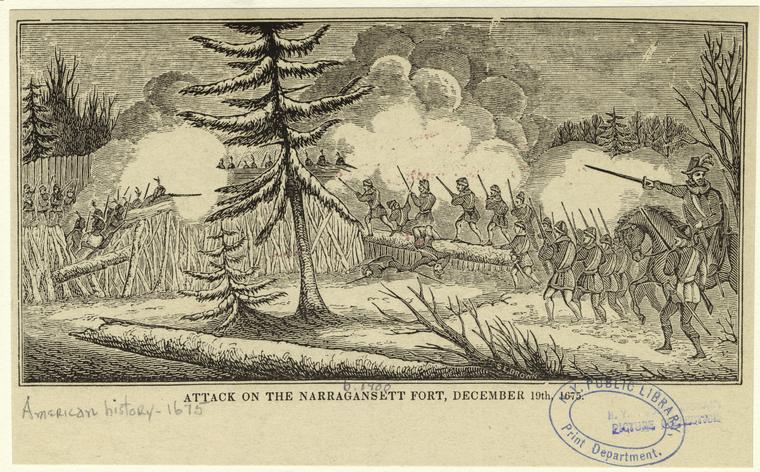
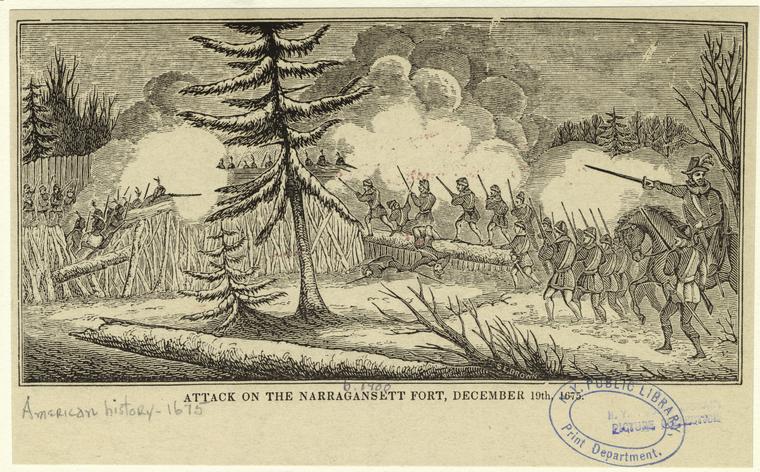
Puritan soldiers from Massachusetts and Connecticut are attacking the Narragansett fort in the Great Swamp in South Kingstown in December 1675. After the end of the war, surviving Narragansett warriors who were caught were often sold into slavery in the Caribbean (New York Public Library Digital Collections)
After the end of King Philip’s War in 1676, as an act of victor’s justice, captured Narragansett warriors were often either hanged or sold into slavery to British-controlled Caribbean island colonies. Many Narragansett women and children found themselves impoverished and often entered into long-term contracts binding themselves or their children for years to White families. Under these arrangements, the Indians would perform work as ordered by the White adults in exchange for food, clothing, and shelter. In the late seventeenth and early eighteenth centuries, these relationships occasionally devolved into enslavement for life, even though the General Assembly in 1676 had banned enslaving Indians.[1]
In 1730, the General Assembly enacted a law to prevent the practice of converting short-term indentured servitude arrangements into longer term arrangements or even lifetime slavery, explaining that “Several evil minded persons in this Colony . . . often draw Indians into their debts by selling them goods at extravagant rates, and get the said Indians to be bound to them for a longer time than is just or reasonable.” In the same year, to prevent Whites fraudulently converting an Indian apprentice into an enslaved man, the General Assembly passed an act requiring the consent of two justices to any apprenticeship agreement to which an Indian was a party.[2] It may be that these laws started to make it less socially acceptable in Rhode Island to enslave full-blooded New England Indians.
In my own research, I came across a few instances of the enslavement of Indians around 1730. In one, Captain William Gibbs of Newport, who lived at what is now the Vernon House at the corner of Clark and Mary Streets in Newport at the time of his death, was reported as having an estate in 1729 that included “Indian Hector” with a value of £100 and “Indian Tom,” with a value of £80.[3] I also found a runaway slave advertisement in the October 28, 1728 edition of the Boston Gazette, which advertised a runaway enslaved Indian from Warwick, Rhode Island.
While I have not done in-depth research and therefore have not reached a final conclusion, my sense is that the enslavement of New England Indians in Rhode Island was never a widespread practice in the early eighteenth century. I base this on the fact that I have reviewed many original eighteenth century documents from South Kingstown and Newport and I found that while most all Black people were enslaved, I have come across few full-blooded New England Indians who were enslaved. To the extent it existed, it appears that the practice of enslaving Indians was most common in Newport.
What I want to address in this article is whether the enslavement of New England Indians in Rhode Island had effectively ended by 1750 and thereafter? No historian has analyzed when the enslavement of Indians ended in Rhode Island, or when it became a rare practice. It appears historians have assumed that the enslavement of Indians ended at the same time as the enslavement of Blacks in Rhode Island ended. Actually, that is not easy to explain either. The Rhode Island General Assembly enacted a law to abolish slavery in the state in 1784, but only gradually. The act did not free anyone. The children of enslaved people had to remain with their enslavers until they became adults, when they would be freed. In reality, the institution of slavery ended much faster than that, mainly because of the Revolutionary rhetoric of liberty and the work of Quaker agitators who lobbied against slavery. As a result of the Revolutionary War and afterwards, thousands of enslaved people in Rhode Island became free. Typically, their enslavers manumitted them, or the enslaved people liberated themselves by running away and the enslavers did not bother to find them. Sometimes there was a negotiation: for example, the enslaver and the enslaved might agree that the enslaved person would be freed after three more years of labor.[4]
The first federal census of 1790 showed that Rhode Island had 948 enslaved people, down from about 3,000 in 1774. The 948 figure included many children born after February 1784 who would be freed at adulthood and elderly enslaved people, whom it would have been cruel to manumit at an age when they could not support themselves. Enslavers also remained financially responsible if they manumitted an enslaved person 40 years old or older and the free man or woman became a public charge. Some town councils would not allow the manumission of elderly enslaved people for that reason. Still, based on the federal census each decade, the numbers of enslaved people in the state declined to about 380 in the 1800, 110 in 1810, 50 in 1820, 20 in 1830, and 4 in 1840.[5] Rhode Island officially banned slavery in 1842.
Numbers matter. I think that is an important point. Yes, Rhode Island did not ban slavery until 1842, but there were only five enslaved people left, and it was likely each one was elderly and could not support themselves if freed. As an institution, slavery was unimportant by the start of the nineteenth century, even if that was not the case for those still in its grips.
I want to examine whether the gradual end of Indian enslavement mirrored that or Black enslavement or ended earlier. According to my limited research, it was rare and had practically ended in Rhode Island by the 1750s and 1760s. One prominent Rhode Island historian agrees, Christy Clark-Pujara, author of Dark Work: The Business of Slavery in Rhode Island (New York University Press, 2016). She wrote, “Though Native American slavery thrived in the first few decades of the founding of Rhode Island, it dwindled in the late seventeenth and early eighteenth century.”[6]
Based on my research, I believe that by the 1750s, the practice was rare, but it had not entirely ended, and that by the 1770s, the practice was even rarer.
It appears that some in the General Assembly did not believe that Rhode Island Indians were still being enslaved in 1774. In June that year, when the General Assembly enacted a law prohibiting the importation of enslaved Africans into Rhode Island, the law provided that if an enslaved African were brought into the colony illegally, such person would be “granted personal freedom, and the enjoyment of private property, in the same manner as the Native Indians.”[7]
Initially, it must be understood that Rhode Island Indians had three main living arrangements in the mid-to-late eighteenth century.
By 1774, census takers counted 1,479 Indians residing in Rhode Island. More than one-third of them, 528, lived in Charlestown, which hosted the main reserve for Narragansetts.[8] About 140 Pokanokets and Sakonnets resided in the East Bay towns, mostly in Tiverton and Little Compton, with some also in Bristol, Warren, and Barrington. Another fifty Manisses lived on Block Island.[9] A small number of Nipmucs may have resided in Providence. (Today, the Narragansett Tribe is the only federally recognized Indian tribe in Rhode Island.)
So, a little more than one-third of the Rhode Island Indians resided on the main Narragansett (and Niantic) reserve in Charlestown in 1774. None of them would have been enslaved.
In order to obtain farm work, the remaining two-thirds of the colony’s Indians moved outside of the reserve, particularly to successful farming towns such as South Kingstown (then including Narragansett), North Kingstown, Warwick, and Jamestown. A little less than one-third of all Rhode Island Indians resided in independent homes that the Indians headed. None of them would have been enslaved either. They would have been mostly temporary farm workers.
That left the remaining Indians, a bit more than one-third, who resided on the farms and in the houses with White families, working as laborers on farms alongside Whites and Blacks or as domestic servants.[10] Some of them may have been entirely free and were temporary laborers; some of them would have been indentured servants working for a term of years (and thus were not enslaved); and some may have been enslaved.
Indentured servitude sometimes happened with Indian children, whose parents were unable to support them financially (or town officials deemed that was the case). The children were bound out by towns to White families until the children became adults and then were set free.[11] Sometimes the “binding out” arrangements were requested by parents. For example, an “Indian squaw” unknown to George Babcock of South Kingstown dropped off her two-year-old female child Sarah at Babcock’s house, apparently admitting that she could not provide for her. The South Kingstown Town Council ordered Sarah to be bound out in Babcock’s care until her twentieth birthday.[12] Most planters used only a handful of Indians at their plantations, but one South Kingstown planter had a workforce of ten Indians and six Blacks.[13]
The last unambiguous reference to an Indian being enslaved that I am aware of was made in 1764 when, at the death of Captain Benjamin Sheffield of Jamestown, his estate included “an old Indian called Philis.” She was valued at a mere 4 pennies, an indication that she was very old and not able to work very much. Her value is to be compared to three enslaved Black men and women mentioned in the same will who were each valued at from £30 to £45. In 1771 Jamestown records, Philis was described as formerly enslaved by Captain Sheffield, deceased.[14] For another unambiguous reference two years earlier, Israel Brayton of Newport, in the December 20, 1762 edition of the Newport Mercury, offered for sale an unnamed nineteen-year-old “Indian Wench” described as “a Slave for Life.” But there are few other references after 1750. By comparison, after 1764 and through the Revolutionary War, there are probably hundreds of references to Black people being enslaved in Rhode Island.
I have reviewed the runaway slave advertisements in the Providence Gazette from 1762 (when the publication began) to 1777 (just before enslaved Rhode Island men were offered the opportunity to obtain their freedom by enlisting in the 1st Rhode Island Regiment in February 1778). Such advertisements often did not state whether the runaway was enslaved. In part, this was probably because if the runaway were described as a “Negro,” the contemporary reader would have assumed the runaway was enslaved. The races of the runaways, however, were usually mentioned—the enslaver was motivated to describe the runaway accurately so the runaway could be identified, caught, and returned. I found that the Rhode Island runaways in thirty advertisements were described as follows: in 22 cases, as a “Negro,” in 5 cases as a “mulatto” (the slang for a person descended from Black and White parents), in 2 cases as a “mustee” (the slang for a person descended from Black and Indian parents), and in just one case as an Indian.[15] The reference to an Indian runaway from Warwick did not state whether the Warwick man was enslaved, but from the facts provided in the advertisement in the Newport Mercury edition of November 6, 1773, he probably was. So the ratio here is 30 to 1 (30 Black and multiracial runaways to 1 full-blooded Indian runaway).
In addition, of these thirty runaway advertisements described in the above paragraph, six of them mentioned both the race of the runaway and that the runaway was a “slave.” Of these six, three described the runaway as a “Negro,” two as a “mustee,” and one as a “mulatto.” One man, in the February 4, 1775 edition of the Newport Mercury, was described as a “Mustee Man Slave” from South Kingstown; he was said to be enslaved because he was “in part a Spanish Indian,” meaning an Indian from a Caribbean island controlled by the Spanish or a Yamasee from the Carolinas. While not legal either in Rhode Island, enslaving “Spanish Indians” was more socially acceptable than enslaving New England Indians. Accordingly, he was not a full-blooded New England Indian. The ratio here is 6 to 0.
I also reviewed runaway slave advertisements in the Newport Mercury from 1758 to 1777. They were more complicated. But I did determine that in ten runaway advertisements, both the race of the runaway and the fact that the runaway was a “slave” were set forth. I found that the runaway enslaved people in these ten advertisements were described as follows: in three cases, as “Negro,” in six cases as a “mustee,” in one case as a “mulatto,” and in one case as an Indian. The Indian, named Isaac and from Tiverton, was not described as a full-blooded New England Indian; rather, he was said to have been “born of a Spanish Squaw.”[16] Under the laws and practices of the day, if the mother was enslaved, so were her children. And to be a member of a New England tribe, the mother had to be a member of the tribe. The ratio here is 10 to 0.
By comparison, I found ten runaway advertisements in the Newport Mercury where the runaway of color was described as an “indentured servant,” meaning the runaway was not enslaved but was required to work a term of years and then be released. Often, a child who was bound out to a White family was an indentured servant until he or she reached around age twenty-four. In these ten advertisements, the races of the runaway indentured servants were reported as follows: five were Indians, three were “mustees,” one was a “mulatto,” and one was a “Negro.” This evidence suggests that there were more indentured servants than enslaved people in the community of full-blooded New England Indians.[17]
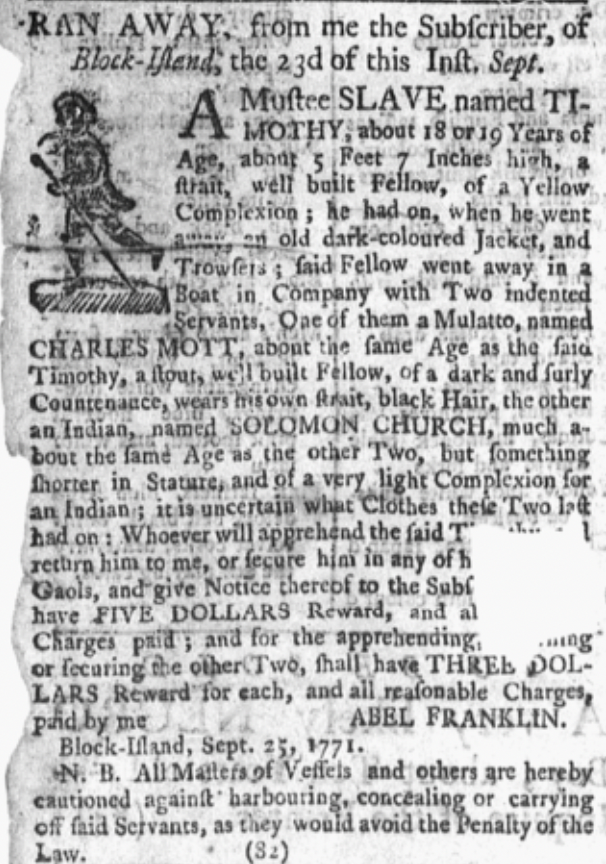
This is an example of a runaway advertisement. Block Island’s Abel Franklin ran the advertisement in the September 30, 1771 edition of the Newport Mercury. The three runaway men likely stole a boat and escaped to the Rhode Island mainland. Franklin described the three runaways. First is his “Mustee Slave” named Timothy, with a “yellow” complexion. Timothy was of Black and Indian heritage. Second is an indentured servant (so not enslaved), Charles Mott, described as a “Mulatto.” Thus, he was of Black and White heritage. Third was an Indian, Solomon Church, also an indentured servant. The reward for the enslaved Timothy was $5, while the reward for the two indentured servants was $3 each.
Accordingly, the numbers I arrived at above show that runaway enslaved Indians were rare in the two decades prior to 1778, but that runaway Indian indentured servants were not.
In the period from 1750 to 1775, I have reviewed dozens of references, perhaps reaching one hundred, in Rhode Island town council records about Indians as indentured servants for a term of years, but none as enslaved people. In trying to find evidence of the enslavement of Rhode Island Indians after 1750, I searched for specific references in probate and town council records in about ten Rhode Island towns.
I also searched for specific references in recent secondary history books and articles, and some unpublished sources, discussing the enslavement of Rhode Island Indians.[18] I did not find any references to enslavement of Indians after 1750, except in the limited times noted above in this article.
If enslaving Indians was a common practice in colonial Rhode Island, it would have been mentioned in the important contemporary diaries and journals, and recollections, such as those by the Reverend Ezra Stiles of Newport, “Nailer Tom” Hazard, “Sheperd Tom” Hazard, and Jeffrey Watson of South Kingstown (including current Narragansett), the diary of Joseph Fish, 1765-1776, which has frequent mentions of the Narragansets, and the diary of the Reverend James MacSparran of North and South Kingstown. But I have found no such references. (If you find any I missed, please let me know.) The closest I have found is a reference by “Sheperd Tom” Hazard to seeing in South Kingstown several veteran soldiers of Black and Narragansett descent who had served in Rhode Island’s Continental regiments during the Revolutionary War.[19] Notably, Hazard did not mention any full-blooded Narragansetts from South Kingstown serving in the war
My research is not intended to be exhaustive. I am trying to finish my next book, An Unfinished War: A History of Rhode Island’s “Black Regiment” During the Revolutionary War, and thus I do not have time for such a big project. But I do believe the evidence above is pretty compelling in establishing that after 1750 the enslavement of New England Indians in Rhode Island was rare and after 1770 was rarer still.
The most authoritative place to look for evidence of enslaved Indians would be in the probate records of Rhode Island towns. Enslaved people were treated in them as a form of property. A child might inherit from the child’s parents, a house, a bed, and an enslaved person. But such research would take thousands of hours. I don’t have the time for that.
One example of what needs to be done for each town was performed by Marjory Gomez O’Toole in her excellent book, If Jane Should Want to be Sold, Stories of Enslavement, Indenture, and Freedom in Little Compton, Rhode Island (Little Compton Historical Society, 2016). O’Toole writes that “Little Compton’s probate records show the evolution of what was often short term bondage for Native people into life-long slavery for African people.” In the town’s earliest wills and estate inventories, from 1696 to 1720, she identified 36 unfree people who were inherited under the terms of the wills. Of the 36, 12 were described as “Indians,” 16 as “Negros,” and 4 as “Mulattos.” O’Toole does not say so, but it is likely that all of the Black people were enslaved; perhaps some of the Indians were too. Then she reviewed the probate records from 1721 to 1740. She identified 34 unfree people—27 “Negros,” 5 “Mulattos,” and just 2 “Indians.” O’Toole writes, “The two unnamed Indians who appear in 1733 and 1736 probate records were assigned very low values in their masters’ probate inventories, just £2 and £16, while several “Negro” people from the same period were valued between £35 and £100.” The high monetary value assigned to the Black people definitely indicates that they were likely enslaved. By contrast, the low monetary value assigned to the two Indians indicates that they were likely indentured servants, with only a fixed term of years to work before they were required to be freed. However, O’Toole accurately adds, low values could also indicate “great age or illness in an enslaved person.”[20] O’Toole did not identify any other enslaved Indian residing in Little Compton after 1740.
Along these lines, one historian of Indian slavery in the United States, writing in the early twentieth century, observed that “In Rhode Island the prices of Indian slaves were lower than those [in Massachusetts], for here the Indians were sold into slavery for limited periods only.” (Here he meant that they were indentured servants.) In inventories, Indians “were appraised at £8 and £10 each, while negroes were valued at from £60 to £80 . . . . An inventory in 1723 valued the two years and ten months’ service of an Indian girl at £5.” The author concluded, “This spirit of opposition to the enslavement of Indian captives for life, shown by Rhode Island, during both the Pequot and King Philip wars, was somewhat out of harmony with the spirit of the times . . .”[21] The author may have exaggerated somewhat, but he does provide some evidence that the lifetime enslavement of New England Indians in Rhode Island was not as common as that of African captives and their descendants.
In my next book on Rhode Island’s “Black Regiment,” I have identified 135 enslaved men who obtained their freedom by enlisting in the 1st Rhode Island Regiment of Continentals from February 1 1778 to June 10, 1778. I have not found one of them who was a full-blooded New England Indian. There are not always descriptions of these men that describe their race. I have found that in half the cases (67), I have credible descriptions of their races. The vast majority are described as “Negro.” A handful are described as of Black and Indian heritage, and a smaller number as of Black and White heritage. There is only one identified as an Indian—and he is described as a “Spanish Indian,” that is, not from New England. By contrast, the same lists have dozens of free Narragansetts and other New England Indians enlisting in Rhode Island’s Continental regiments. I will have much more detail on this topic in my upcoming book.
I plan to supplement the research in this article over the next several months and even years. So if you are serious about the topic, you should revisit this article from time to time.
If you find relevant information, please email me at editor@smallstatebighistory.com (or by responding to one of my smallstate emails to you!).
Notes:
[1] See Margaret Ellen Newell, Brethren by Nature: New England Indians, Colonists, and the Origins of American Slavery (Cornell University Press, 2015), 214-36; General Assembly Resolution, March 1676 Session, in Bartlett, ed., Records of R.I., 2:535 (“noe Indian in this colony be a slave, but only to pay their debts or for their bringing up, or custody they have received or to perform covenants as if their countrymen were not in war.”). [2] General Assembly Public Law, June 1730 Session, Acts and Resolves, Rhode Island State Archives; Almon Wheeler Lauber, Indian Slavery in Colonial Times Within the Present Limits of the United States (New York, 1913), 199. [3] See Inventory of Captain William Gibbs, taken February 11, 1728/1729, in Rhode Island Law Cases, File Papers, 1737 vol. 7, 13-18, Rhode Island State Archives. Dean Berkeley, who used to visit Narragansetts from his base in Newport, wrote in 1731 that nearly all of them are “servants or laborers for the English” White settlers. See Wilkins Updike, History of the Episcopal Church in Narragansett in Rhode Island, including a History of Other Episcopal Churches in the State (New York: Henry M. Onderdonk, 1847), 177. The use of the term “servants” is ambiguous because it can refer both to enslaved people and indentured servants. [4] Christian McBurney, Jailed for Preaching: The Autobiography of Cato Pearce, a Freed Slave from Washington County, Rhode Island (Pettaquamscutt Historical Society, 2006), 3-5 and 34-39. [5] Heads of Families at the First Census of the United States Taken in the Year 1790, Rhode Island (Government Printing Office, 1908), 8. There were 3,407 people of color who were recorded as residing in Rhode Island, not including Indians who were not subject to tax (which meant that most all Indians were not counted in this census). There were some diehard slaveholders. For example, in South Kingstown in 1790, Rowland Robinson headed a household that consisted of him and six enslaved people, and Henry Gardner headed a household that comprised him, his wife, and nine enslaved people. Heads of Families, 1790 Rhode Island Census, 48-49.For the 1800 and later census counts, see Edward M. Snow, ed., Report Upon the Census of Rhode Island, 1875 (Providence: Providence Press Company, 1877), xliii.
[6] Clark-Pujara, Dark Work, 33. [7] See General Assembly Resolution, June 1774 Session, in Bartlett, Records of R.I., 7:251. [8] See Charlestown section, R.I. 1774 Census, Rhode Island State Archives. [9] See Tiverton, Little Compton, Bristol, Warren, and Barrington sections, R.I. 1774 Census, Rhode Island State Archives; Bartlett, John R., ed. Census of the Inhabitants of the Colony of Rhode Island and Providence Plantations . . . 1774. Providence: Knowles, Anthony, 1858, 239 (fifty-one Indians reside in New Shoreham (Block Island), but the book (and the Rhode Island Archives) is missing the detail on them). Pokanokets also resided in southeastern Massachusetts. [10] These proportions are based on my calculations from reviewing the details of the Rhode Island 1774 Census, held by the Rhode Island State Archives, including heads of households and races of household residents. [11] See, e.g., South Kingstown Town Council Records, vol. 2, 13, 16, and 17, and Town Council orders, July 13, 1767, in South Kingstown Town Council Records, vol. 5, 184-85, South Kingstown Town Clerk’s Office. [12] Town Council order, April 9, 1770, in South Kingstown Town Council Records, vol. 5, 228-229, South Kingstown Town Clerk’s Office. [13] See Silas Niles, South Kingstown section, R.I. 1774 Census, Rhode Island State Archives. At least two of the “Indians” Niles reported at his household were of Black and Indian descent who were bound out until they became adults. Town Council order, Oct. 13, 1772, in South Kingstown Town Council Records, vol. 6, 7, South Kingstown Town Clerk’s Office. [14] Summary of the inventory of the personal estate of Capt. Benjamin Sheffield of Jamestown, Jan. 5, 1764, in Jane Fletcher Fiske, Gleanings from Newport Court Files, 1659-1783 (Privately Printed, 1998), par. 1048. In 1771, Philis was no longer performing services. Instead, she was being supported by the town as a public charge and boarding at houses owned by people who the town paid as part of her support. See Jamestown Town Council Records, June 24, July 20 and Nov. 12, 1771, vol. 4, 61-66, 70, and 73-34, Jamestown Town Clerk’s Office; Ruth Wallis Herndon and Ella Wilcox Sekatau, “The Right to a Name: The Narragansett People and Rhode Island Officials in the Revolutionary Era,” Ethnohistory 44, no. 3 (Summer 1997): 439 and 457n23. [15] I reviewed the advertisements transcribed in Maureen Alice Taylor, ed., Runaways, Deserters, and Notorious Villains From Rhode Island Newspapers, Volume 1: The Providence Gazette, 1762–1800 (Picton Press, 1998), 1-83. In her introduction, Taylor stated that she “attempted to include all notices that dealt with . . . runaway slaves and servants,” as well as other types of advertisements. Without that book, the task would have taken hundreds of hours. Interestingly, about half of the runaway slave advertisements in the Providence Gazette, if not more, were for runaways from neighboring Massachusetts and Connecticut, as well as other colonies other than Rhode Island. In addition, more than twenty runaway advertisements were for White apprentices or indentured servants. [16] Newport Mercury, Nov. 11, 1765. [17] I reviewed the advertisements transcribed in Maureen Alice Taylor and John Wood Sweet, eds., Runaways, Deserters, and Notorious Villains From Rhode Island Newspapers, Volume 2: Additional Notices from The Providence Gazette, 1762–1800, as Well as Advertisements From All Other Rhode Island Newspapers from 1732 to 1800 (Picton Press, 1998), 26-93. [18] See, e.g., Newell, Brethren by Nature; Warren, New England Bound; and Fisher, Stealing America, chapters 5 and 10; John Wood Sweet, Bodies Politic: Negotiating Race in the American North, 1730–1830 (University of Pennsylvania Press, 2003); Joanne Pope Melish, Disowning Slavery: Gradual Emancipation and “Race” in New England, 1780–1860 (Cornell University Press, 1998); Robert A. Geake, A History of the Narragansett Tribe of Rhode Island: Keepers of the Bay (History Press, 2011); Marjory Gomez O’Toole, If Jane Should Want to be Sold, Stories of Enslavement, Indenture, and Freedom in Little Compton, Rhode Island (Little Compton Historical Society, 2016); John A. Sainsbury, “Indian Labor in Early Rhode Island,” New England Quarterly 48 (1975): 378-393; Ruth Wallis Herndon and Ella Wilcox Sekatau, “The Right to a Name: The Narragansett People and Rhode Island Officials in the Revolutionary Era,” Ethnohistory 44, no. 3 (Summer 1997): “Stolen Relations: Recovering Stories of Indigenous Enslavement in the Americas, Brown University, accessed June 16, 2026, https://stolenrelations.org. [19] See Thomas R. Hazard, The Jonny-Cake Papers of “Shepherd Tom”(Boston: Privately printed, 1915), 341. [20] O’Toole, If Jane Should Want to be Sold, 65. [21] Lauber, Indian Slavery in Colonial Times, 299-300 and 304.The Author

You Might Also Like