

[Note from the editor: Last year I visited City Hall in Providence to do some research at the City Archives. While walking through the building, I noticed a number of large photographs (really posters) of old Providence on the walls, ranging from 1885 to 1907, some with captions. Of course, I immediately thought to myself, “Wow, collectively, these would make a nice article for smallstatebighistory.com.” So here it is.
I was informed by current City Archivist Caleb Horton that the late Paul Campbell, formerly the City Archivist of Providence, prepared the captions for four of the photographs. So I am making him a co-author. (Paul authored an article for smallstatebighistory.com in August 2015, titled “Supplying Water to Providence: Cranston’s ‘Slow Sand’ Filtration Plant, Circa 1905.”)
Three photographs displayed did not have captions to go with them, so I asked Rhode Island historic photograph expert Maureen Taylor to prepare those captions. Those are noted below, where Maureen is credited. So I made her a co-author of this article.
All photographs are believed to be from the Providence City Archives collection. Enjoy!]
Market Square (Circa 1845-1846)
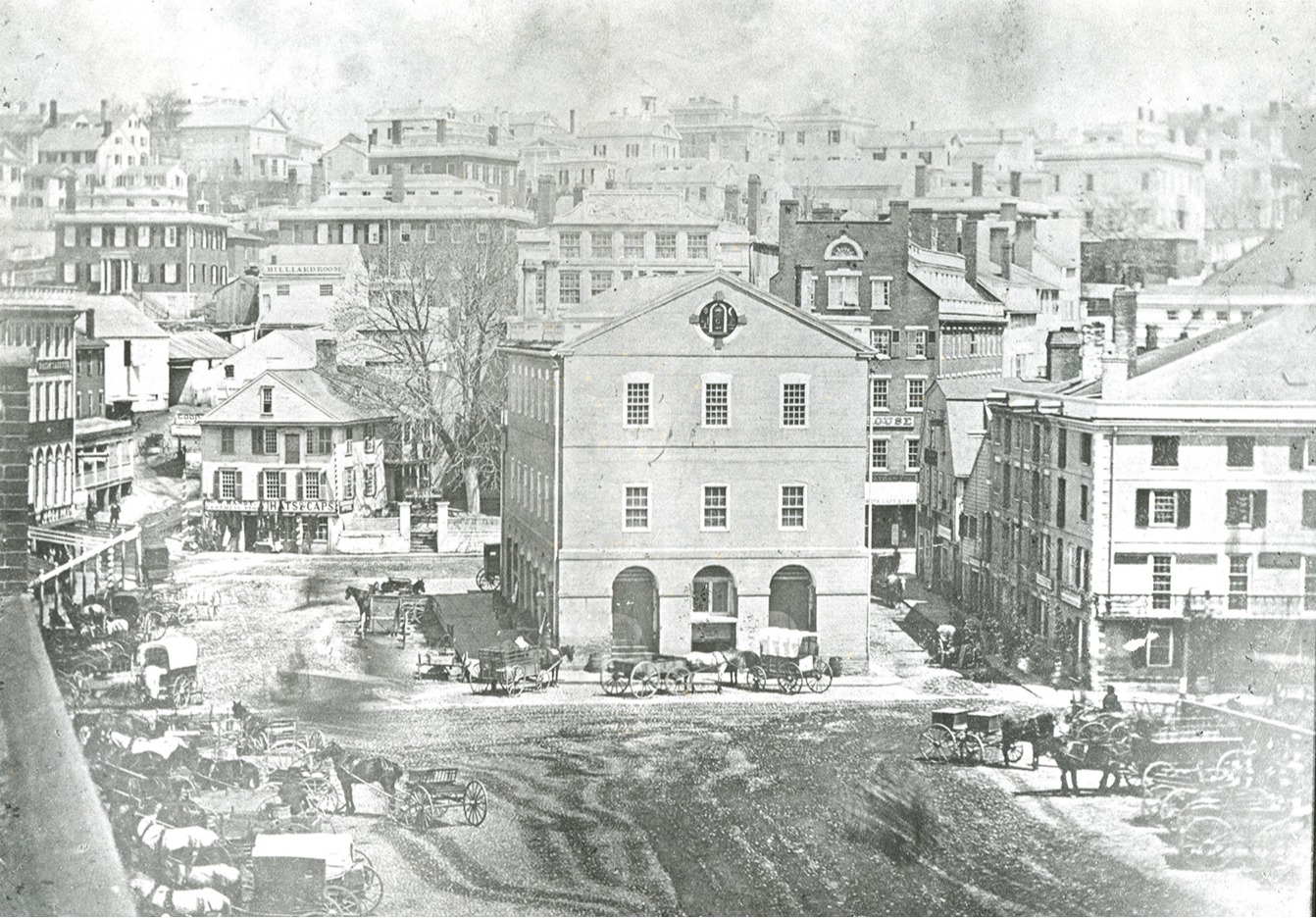
Daguerreotype of Market Square circa 1845-1846 taken on a winter or early Spring day. The Market House was a commercial center of Providence which featured hotels like the Franklin House on the far left, and the Manufacturers Hotel behind and slightly to the left. Westcott Handy sold clothing at 17 Market Square in retail space under the Manufacturer’s Hotel having moved there from Granite Building in February of 1845.[1] His listing in the 1847 Providence City Directory has him on Union St.[2] The Roger Williams Bank building is directly behind the Market House. A Billiard Room sign adorns a building on Benefit St. In the upper window of the Market House is the Masonic symbol.
This caption prepared by Maureen Taylor
[1] New Clothing Store, Republican Herald (Providence), February 26, 1845: 2.[2] The Providence Directory of the Names of Inhabitants and Occupations. Places of Business and Residence, 1844. Ancestry.com accessed January 20, 2025.
Market Square (Circa 1885-1889)
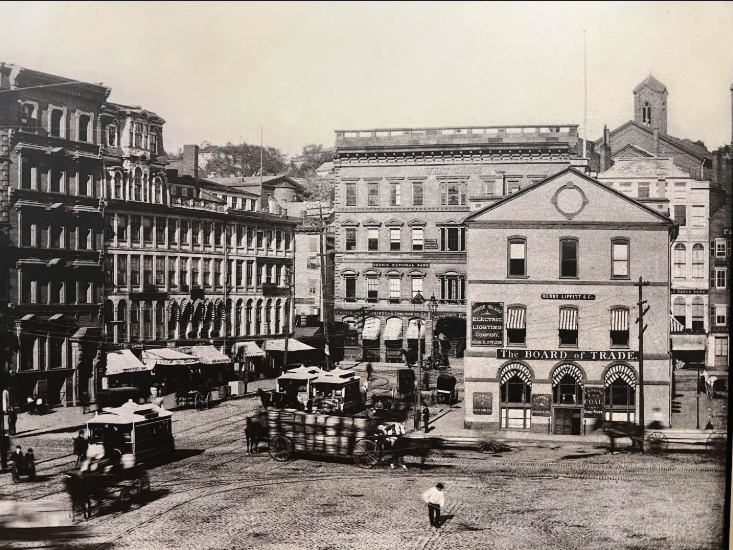
In this image Market Square bustles with activity—horse drawn street cars convey people to other areas of town. Commercial wagons carry barrels. In the foreground, a man with a long-handled shovel cleans up after the horse traffic. Alongside the Market House, buggies wait for their owners. The Board of Trade began occupying Market House in 1878, and in 1882 the Rhode Island Electric Lighting Company installed the first electric arc lights in the city in the area. Other tenants included Demming and Reynolds, cotton brokers, and Henry Lippitt & Co. The Phenix National Bank occupied space in the What Cheer Building from 1852 to 1889 in the Providence Washington Insurance Co building (1875-1949) along with the Providence Gas Company. On the north side of Market Square, shops selling food and sundry goods occupied the ground floor of the two brownstone blocks.[1]
This caption prepared by Maureen Taylor
[1] See John Hutchins Cady, “The Providence Market House,” Rhode Island History, vol. 11, no. 4 (Oct. 1952), 111.Weybosset Street in an Earlier Era (1885)
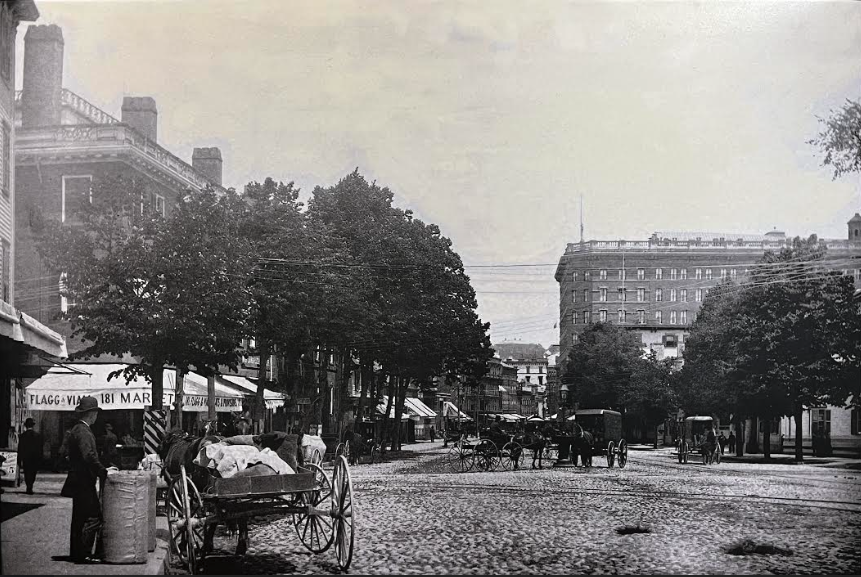
This photographer was positioned on Weybosset Street in front of what is now the Providence Performing Arts Center (PPAC). The view was taken in 1885 looking east towards the East Side. The large building on the right is the Narragansett Hotel. Built on the corner of Dorrance and Weybosset in 1878, the 250-room hotel was called by a local observer one of the “largest, grandest, best furnished hotels in the world.” It featured a grand staircase and a spacious 30-by-150-foot open court. Adjacent to the hotel (partially obscured by trees) is the City Hotel. Constructed in 1832, it was the city’s first hotel and many dignitaries including President Andrew Jackson stayed there. The Narragansett Hotel was demolished in 1960 and the site is now occupied by the Johnson & Wales University Library.
Notice the horse drinking fountain in the center of the photo. These fountains were strategically located around the city to provide liquid refreshment for the city’s four-legged primary means of local transportation.
This caption prepared by Paul Campbell
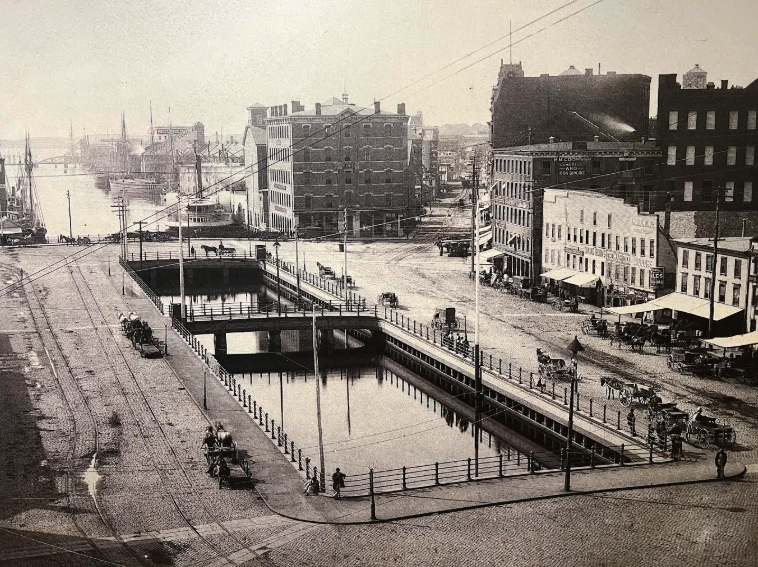
The Providence Waterfront (1886)
The Owen Block (center right built in 1867) is the only remaining structure in this 1886 photo. At that time, the building’s occupants manufactured worsted yarn and it served as a warehouse for goods being transported to and from the adjacent port of Providence. Capriccio’s Restaurant now occupies the lower level of this building. Just south of this building you can see one of the packet ships that carried passengers to coastal towns along Narragansett Bay and recreation areas such as Rocky Point Park Amusement Park in Warwick. Another popular destination was Atwell’s Clam House at the Field’s Point Farm (now ProvPort). On Fridays, many businessmen took the 15-minute steamship ride to Atwell’s and for 50 cents they could feast on chowder, clam cakes, baked fish, steamers, locally harvested oysters, and watermelon. A “good sized” lobster was extra—25 cents.
At this time, the Point Street Bridge was a draw bridge allowing ships as large as the five-masted coal schooner Governor Ames to dock at the Providence Coal Company yard (just south of the packet boat on the right). The 1938 hurricane destroyed the wharves in the upper harbor and they were never rebuilt. In the foreground is a portion of the Crawford Street Bridge, which won mention in the Guinness Book of World Records as being the “widest bridge in the world.” It was 1,147 feet wide.
This caption prepared by Paul Cambell
Westminster Street Looking East (1886)
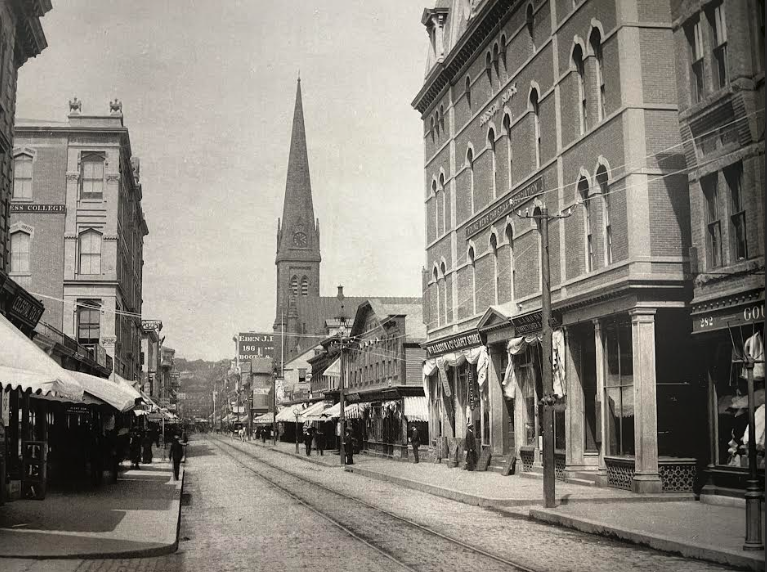
A well-known and still existing landmark, Grace Church, is clearly visible on the right. The Young Men’s Christian Association (YMCA) occupied the second floor of the brick building on the right. A $1.00 annual membership included use of a gymnasium, a game room, “parlor,” a 4,000-book library with 70 daily and weekly newspapers, and a 400-seat hall for religious and social meetings. Gould’s Corset Works occupied the building on the far right. The four-story Hoppin Homestead Building (demolished 1979) had the distinction of being the first home of the Rhode Island School of Design, which occupied that building from its establishment in 1877 to 1893 when it moved to the East Side.
In the 1880s new technologies began to change the streetscape in Providence. Three years after Alexander Graham Bell’s 1876 invention of the telephone, the Providence Telephone Company was established and in 1881 the first telephone poles began to appear (right side of photo). Two years later, the first electric lights were installed at Market Square and along Westminster Street. At that time, however, most of the city’s 4,397 lights were illuminated by gas (see pole on far right). Despite these improvements horse cars remained the basic form of city transportation. They had a speed limit of 7 mph.
This caption prepared by Paul Cambell
The City’s Retail Heyday (1907)
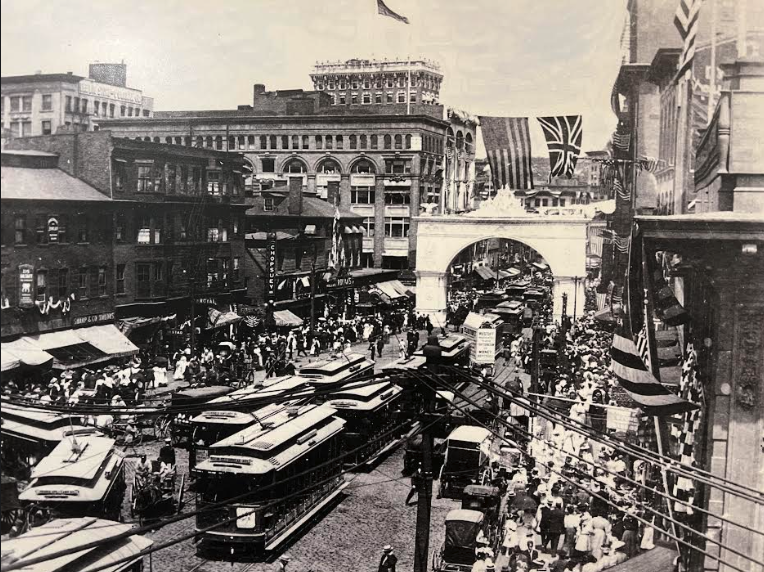
This August 1907 photo shows Weybosset Street filled with shoppers drawn to the city for the annual week-long Old Home Week celebration. Many of the city’s 224,000 residents flocked to the state’s retail epicenter along Weybosset and Westminster streets where stores filled with goods of all kinds were offered to eager buyers. Shepard’s, occupying a block-long area along Westminster Street, boasted 66 separate departments staffed by 1,400 employees. Their chief rival, the Outlet Company (shown in this photo on the right), constructed the arch in the center of the photo, thus ensuring that the Old Home Week parade route would pass by its store. During that week, a wedding was performed atop the arch, which drew 20,000 spectators to the ingenious promotional event. Merchants at that time stayed open until 11:30 p.m. on Saturday night to accommodate blue-collar workers.
Downtown retailing began its rapid decline in the late 1950s. Shepard’s declared bankruptcy in 1974 and the Outlet Company closed its doors in 1982.
This caption prepared by Paul Cambell
Human Flag (June 3, 1916)
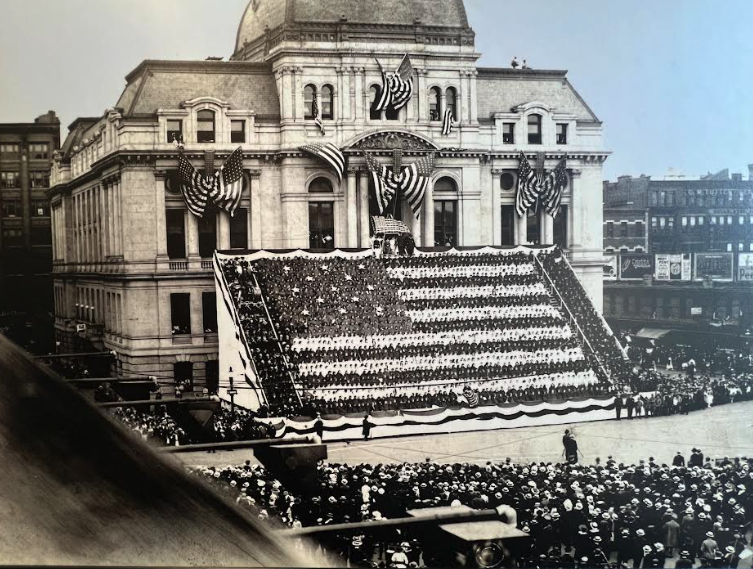
More than fifteen hundred school children dressed in red, white, and blue formed a ‘human flag’ on the steps of Providence City Hall as part of Rhode Island’s Human Petition for Americanism and Preparedness parade. The parade was meant to support United States military readiness prior to U.S. involvement in World War I (the United States entered the war in 1917). Civil War veteran members of the Grand Army of the Republic bordered the flag. Thousands of Rhode Islanders attended the parade watching seventy-five bands, and twenty-four divisions along the three-mile parade route. Cities across the country held similar events.
This caption prepared by Maureen Taylor
The Author

You Might Also Like