

Afterwards, a candidate who had a Know-Nothing past was tainted when it came to running for national office. Edward Bates of Missouri probably would have been nominated for the Republican Party in 1860 rather than Abraham Lincoln, but his Know-Nothing past alienated some German immigrant Catholic voters and doomed his candidacy.
Rhode Island had the highest percentage of Catholics and immigrants in the country. Many were recent Irish immigrants, fleeing the Great Famine in Ireland.
The hottest issue of the day remained slavery in the South. The Kansas-Nebraska Act, enacted in 1854, led to great controversies North and South. It created the territories of Kansas and Nebraska and allowed its settlers to vote on whether to permit or exclude the institution of slavery. Abolitionists despised the law. Know-Nothing supporters tended to support anti-slavery and pro-temperance positions.
This article was written in 1894 by a former president of the Rhode Island Historical Society. The citation is: Charles Stickney;, “Know-Nothingism in Rhode Island,” in Publications of the Rhode Island Historical Society, New series, 1:243-257 (January, 1894). This article below does not include the full text of Stickney’s original article and I have made a few minor revisions. It is interesting that Stickney places partial blame on Catholic bishops in the United States pushing the idea of the preeminence of the Pope in Rome. It is likely that few would make that argument today. The article is written in fairly plain prose, which was not common in those days.
I thought this article would be a nice companion piece to Kelly J. Sullivan’s ground-breaking article on the Ku Klux Klan that ran several weeks ago on this website at https://smallstatebighistory.com/the-ku-klux-klan-attempts-to-take-over-rhode-island-militia/.]
During the years 1854-’55-’56, when the Kansas-Nebraska strife was absorbing the attention of the whole country, obliterating party lines and alienating the fraternal feeling between the North and the South, a new political organization was swiftly and secretly formed; its spread over the country was magical and its strength, as demonstrated at the polls, was wonderful. The party was quickly formed, swept the North, and dissolved, on account of the absence of cohesive principles; in its various stages and in the different portions of the country it bore different names, but that by which it was most generally known is “Know-Nothing,” from the fact that its members always asserted that they knew nothing not only of the principles but also of the existence of such a party.
. . . .
But it was not alone the movements which I have mentioned that gave birth and vitality to the new party. The immigration from the continental countries and Ireland had been unprecedented during the previous ten years The discovery of gold in California and the bounteous crops throughout the country were strong inducements for immigration, while the general disquietude throughout Europe in 1848, and the Irish famine were driving many to seek other places in which to live.
A large part of this immigration was Catholic and especially subservient to Catholic domination. The Catholic press of this country, as well as the clergy, was radically ultramontane in its views [i.e., supporting the belief that the pope is the spiritual head of the Church in all countries], nor did it hesitate to express these views even in a time of great excitement. It is probable that the thoroughness with which public attention was absorbed over the Kansas-Nebraska struggle emboldened the Catholic element to overstep the bounds of wisdom in their assertions of Catholic domination—especially that the Pope could summon all possessors of temporal power, and execute judgment upon them.
. . . .
Notwithstanding the fact that Rhode Island had been the most advanced in religious toleration, the bitterness against the Catholics in this State was deep. But all that was said and done cannot be regarded as the result of genuine apprehension. When the Know-Nothing party adopted a constitution in 1854, they thought they had a mission to perform; the desire to become a national party cast all other desires aside. It is true that they were still animated by the one idea—hostility to Catholic influence; but in the organization of the councils in each State their one object to carry the State, was to be accomplished by whatever means or arguments were most potent.
In a strong anti-slavery section [of the country] their position on the slavery question was the rallying principle for partyless voters. In Massachusetts they found their best argument to be in defense of that principle for which they were supposed to have been founded—to keep Catholics out of office and Catholicism restricted in its influence.
In Rhode Island they had a variety of principles; they advocated all that was popular whether they were Whig or Democrat principles. The foreign-born population of Rhode Island was about 30,000, or one-fifth of that of the whole State, and the occupation of this element threw them more into congregations where their evil influence was easily imagined.
“America for the Americans” was the rallying cry. The slavery question was not omitted from the declared principles for which the party contended. By advocating this – and they were probably more sincere in it than in their denunciation of foreigners – they attracted to themselves a large following from the Whig Party and not a few Democrats.
In the history of Know-Nothingism in Rhode Island there is only one fact that can be absolutely asserted. In the Spring of 1855, it conquered. When it came no one can say, what it saw can only be imagined. Its proceedings were too secret and its records too few to betray much of its existence.
There was a party in the field of Rhode Island politics in 1854, but it went by the name of “Independents”-a very non-committal title; in the campaign which this party waged there is nothing to indicate that it had anything in common with the Know-Nothings of a year later. It corresponded most nearly to our Prohibition Party, composed of radical temperance men with a sprinkling of those who were radical on other subjects. Although the party accomplished nothing at the polls, it was the beginning of Whig dissolution in the State, and in that way was instrumental in contributing to Know-Nothing success.
It is not improbable that the formation of a council for Rhode Island was begun soon after the adoption of the Know-Nothing party’s Constitution in June, for allusions are made from time to time in the press of the day to secret gatherings, and an uncertain feeling penetrating all ranks of politicians.
Whether the dreaded party was organized among them, the Democrats and the Whigs knew not. In July, 1854, the Providence Post, the Democratic organ [newspaper], protested against the action of the governor when he issued arms and uniforms to two companies of men, who called themselves the “Guards of Liberty.” The companies were composed wholly of native-born Americans, and the Post considered it a manifestation of the presence of Know-Nothingism and an attempt [by the party] to have a military footing in the State.
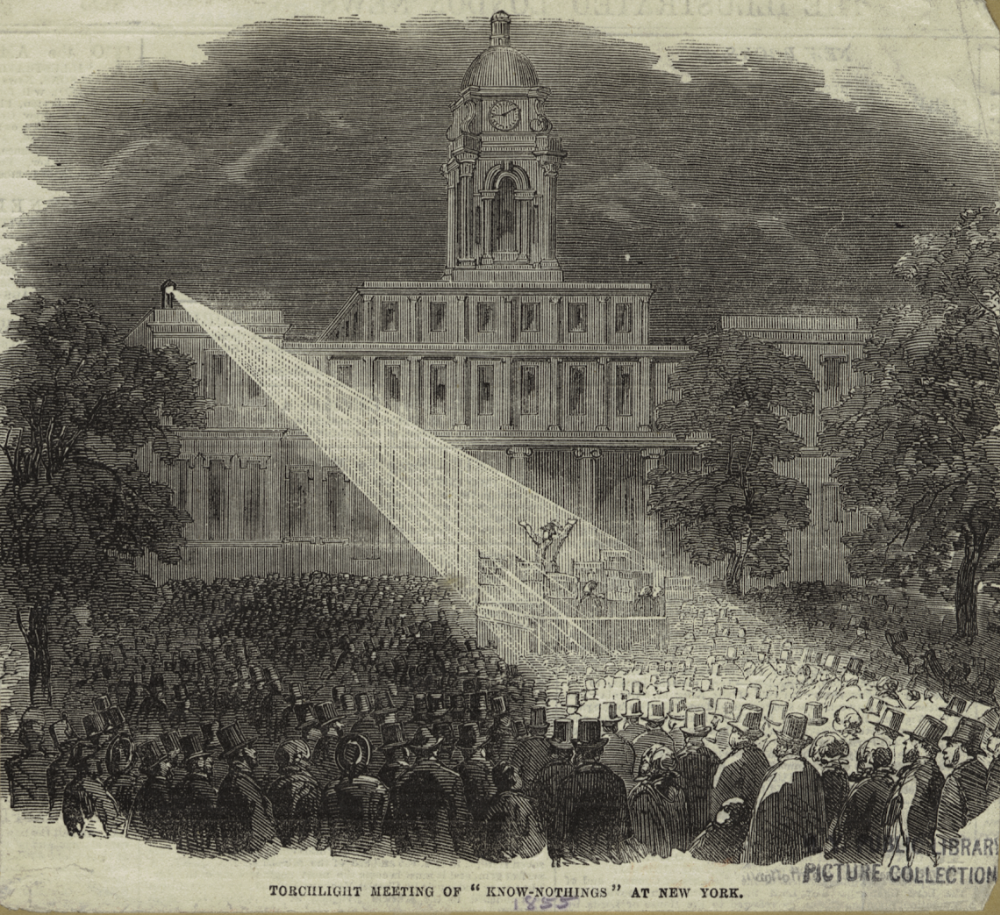
A drawing of a torchlight parade by about 20,000 Know Nothing supporters in New York City in November 1855 (New York Public Library Digital Collections)
. . . .
It was in the election of an assemblyman from Cumberland, that the Know-Nothings were first successful in this State. In that contest the Democrats nominated their strongest man, a native American, and a man of tried ability, Fenner Brown On the whole he deprecated foreign influence, but he had not pronounced himself decidedly against it at an opportunity he previously had. The Whigs made no nomination, while the Know-Nothings brought forward one Boyden, whom they elected by the small majority of 16. But small as it was, it signified much.
Whatever may have been done in perfecting their organization, but little had been publicly done; so little indeed that no one knew of the certain presence of the party. Nearly a month later, the Worcester Spy, said, “From all that we can learn, there are pretty certain indications that Rhode Island will, at the next election, place herself by the side of Massachusetts on the American question, for it seems that ‘Sam’ [an allusion to Uncle Sam] has marched across the disputed boundary.”
From the November election till that held in April, the Know-Nothings conducted a vigorous campaign, though a secret one. There were no public Know-Nothing meetings of a political character, but everything was done under cover of secrecy. As the election of 1855 resulted in the annihilation of the Whigs and the success of the Know-Nothings, by a five-sevenths vote of all cast, there was some essential force which contributed to the result; and as the party held their power for little more than a year, this force was something which could not long continue to dominate men.
In the consideration of this, those three questions—Slavery, Catholicism and Temperance, which were being agitated in the State—must not be overlooked. But why did the advocates of each ally themselves with the Know-Nothing Party? In moments of excitement men are often borne away beyond the domains of reason; to accomplish their desires they will grasp at every object which may seem to be helpful to their cause; and the movements of 1854 and 1855 were only aberrations of political reason. The Catholic organization in respect to its nunneries and some of its rites and customs was secret, and a secret order was founded to combat it.
There was not a crime committed by an Irishman that was not flashed before the public as a proof of the evil influence of their religion; there was not a statement of a prominent priest or bishop that was not picked to pieces and considered in the light of prejudice. In the State of Massachusetts a committee was appointed by the legislature to visit certain Catholic nunneries, so as to bring to light their supposed iniquitous practices. Ex-priests and nuns who advertised themselves as having escaped from convents, harangued in public or wrote for the press.
In Providence, a great amount of political excitement was made of the case of a young lady who entered a convent. Hand-bills, bearing the startling headline, “Americans to the Rescue!” were freely circulated. On them, it was asserted that she had been compelled to join against her own and her parents’ wills. At the time appointed for the rescue a small crowd gathered in front of the convent, but no attempt was made as there were too many police to make it successful. This was done after the young lady in question had asserted in the daily papers that her act was voluntary, although opposed by her parents.
An affair which occurred in New York helped to incite the citizens here. A man named Poole had been very prominent in the movements of the new party. After a time of some excitement he was killed by one of the roughs of the Bowery. He was regarded as a martyr and honored with imposing funeral ceremonies. Leading Know-Nothings in this city claimed that they had been threatened with like treatment, but asserted their intention to meet it, if necessary.
This was the method which they had adopted in their work of winning voters. The influence of the press in this State in favor of the Know-Nothings was limited; they had no avowed organ, but the Whig papers gave them limited support. This was true of the Journal and especially of the Providence Tribune, which was, primarily, the organ of the temperance advocates. Early in the campaign they assumed a neutral attitude towards the secret order, and finally consented to defend them and their principles. But the pages of all the papers seem to have been free for the use of “Sams” and “Anti-Sams,” for we find long controversies running in the papers; but these articles bore not at all on the question of the day, but dwelt on what had or had not been done in other times, together with creeds and doctrines.
In this contest there was much feeling against the new party, among the Catholics in the Democratic Party, and among many Whigs who feared the results attending the machinations of a secret organization.
The Democratic State Convention heartily denounced the Know-Nothings, and made their destruction one of the principal objects to be accomplished in the election. The party organ, the Post, published in full the outrageous conduct of the nunnery investigating committee appointed in Massachusetts. This committee exceeded its instructions and aroused great indignation throughout New England.
One of the most powerful methods of attack was the publication in full of the oaths of the order, together with certain signs, passwords, etc. The penalty for breaking the oath is not stated, but from an instance which came to notice it appears to have been a boycott of the betrayer, but it was seldom accompanied with personal violence. A right-angled triangular piece of white paper pasted up in certain places was a call for a mass meeting. A red paper with an equilateral triangle meant trouble, and each one must come prepared. Only one public call was made for a convention and the convention itself was secret. As more clearly indicative of the feeling and attitude of the parties toward the new organization a few quotations from the dailies are made.
The Providence Post (Democratic) of November 10th, 1854, said: “American Party, and other like terms, are coming into common use. If one could only tell their meaning it would be agreeable. They doubtless have some peculiar significance as now used. Whatever they may be, and we confess our ignorance on this point, such a use of the words is certainly unfortunate.”
December 29th. “The fact that a new organization is about to make its first appearance at the ballot-box is one that should not be lost sight of. Its power no man can estimate, its objects are mysterious and whether bad or good the results only can show.”
February 16th. “The Whig Party may be said to have resolved itself into its original elements; all that remains of it is to be found in the mysterious depths of Know-Nothingism, or abolitionism.”
March 27th. “We have “ow an organization whose whole purpose is to give new strength and life to the Whig Party.”
But this last quotation must not be taken as true; not only did the election returns prove its falsity, but likewise the nominations of the Whig and Know-Nothing parties, each of which had a ticket of its own. These were the tactics adopted by the Democratic organ to rally Democrats to their party’s support by intimating that their old opponent was their opponent still and not the new and different organization.
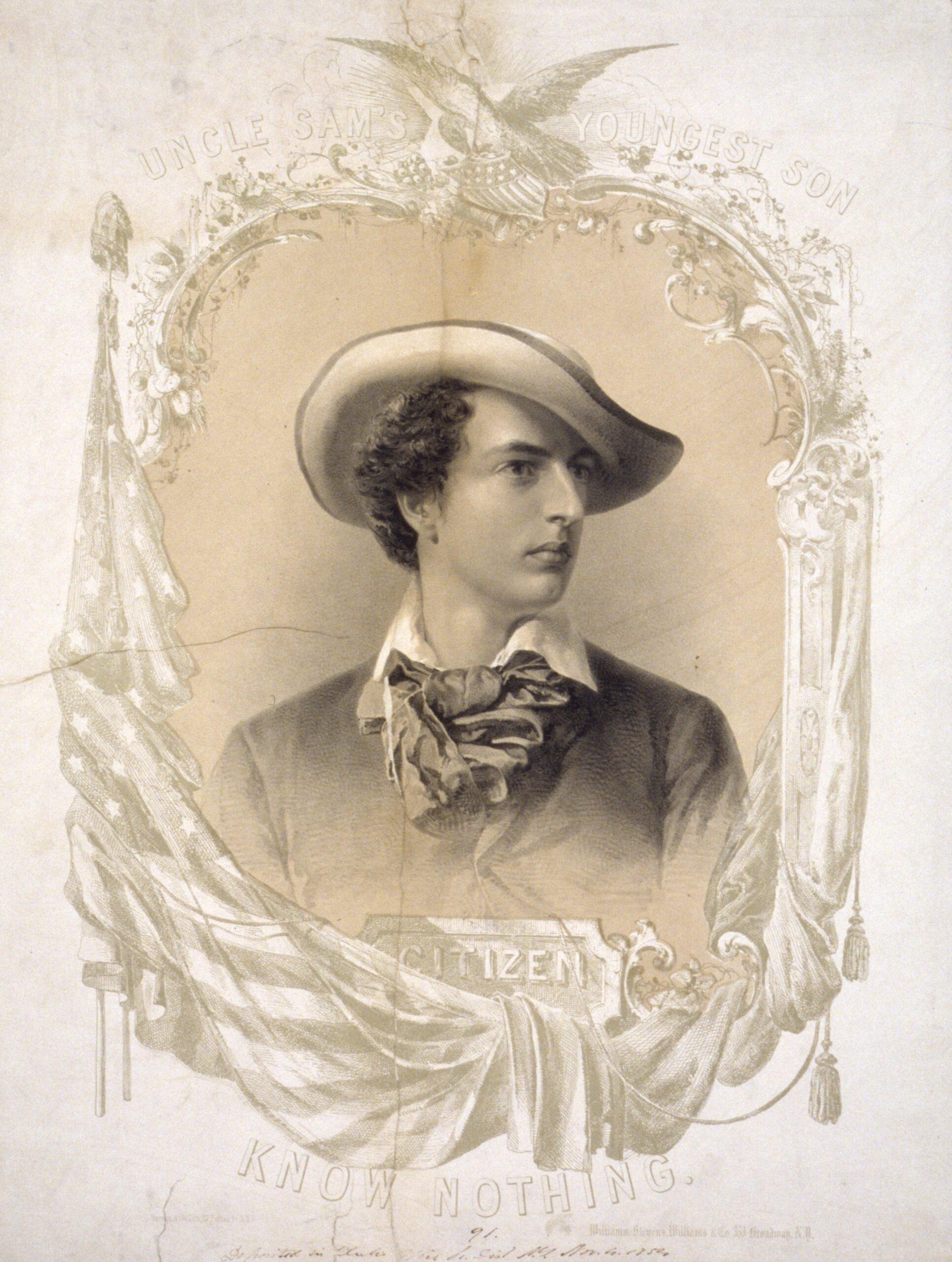
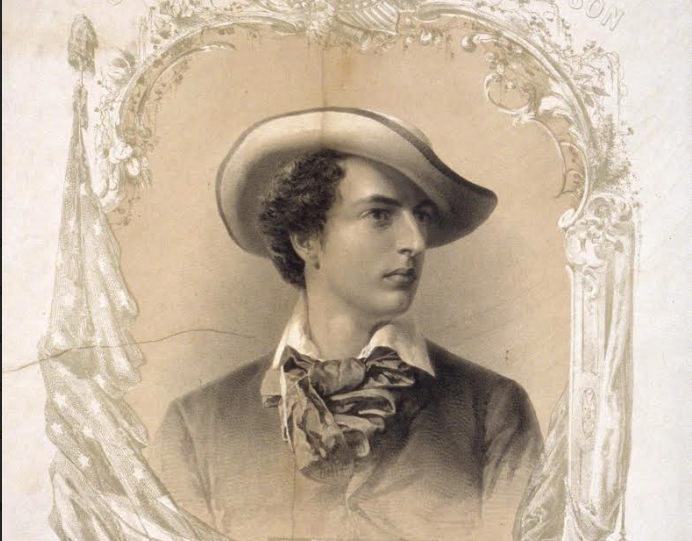
A drawing of Uncle Sam’s youngest son, Citizen Know Nothing, 1856 (Library of Congress)
. . . .
As the April election drew near, the Democratic Party and the secret organization made ready for the contest. The advantage was obviously with the Know-Nothings. Whigs had ceased to be an element in the campaign as an organization, while the Democratic platform was satisfactory to but few besides its authors.
. . . .
The Know-Nothings made a public call for a secret convention. The Providence Tribune, the organ of the Maine Law Party [i.e., temperance], was partial to the new organization, and on the 19th of February contained the following call:
“REPUBLICAN STATE CONVENTION. A Republican State Convention will be holden at Unity Hall, in the city of Providence, on Thursday, March 8th, 1855, for the purpose of nominating candidates for State offices and representatives to Congress who are known to be opposed to the encroachment of the Slave power, especially as exhibited in the repeal of the Missouri Compromise, opposed to the interference and influence of foreigners in state and national affairs, and in favor of the principles and faithful execution of the law against drinking-houses, etc.”
This can hardly be considered an early call of the present Republican Party, for at that time the name “Republican,” as applied to any party, had hardly been resuscitated, and this is the first time the word had been used in Rhode Island as a party name for a long period.
These facts, the principles set forth in the call and the assertion afterwards of Know-Nothings, together with the work accomplished in that convention, make it partially certain that although issued under the name “Republican,” it was thoroughly a Know-Nothing affair.
Two days later the call was fathered by a writer who signed himself “Sam” to an article which said:
“We take the same platform as enumerated in the call for a ‘Republican Convention,’ announced in your paper. We in Rhode Island embrace temperance, restoration of the Missouri Compromise, the total abolition of all foreign influence, whether in the name of the Pope of Rome, or of Bishop Hughes of New York.”
The latter gentleman, it may be well to add, was one of the most influential Catholics in the United States at that time, and by far the most pronounced in the defense of Catholic rights.
Of the results of this convention no record has been found. The convention met, however, but its proceedings were secret. The Warren Star, published as the ticket nominated by this convention the following: “For Governor, ‘Sam;’ for Lieut. Governor, ‘Sam;’” and in like manner the same gentleman was a candidate for every office on the ticket. This will illustrate the secrecy with which they did their work.
It was claimed by the Democratic and Whig press that a convention of the Know-Nothings was held March 27th, for on that day was published their party ticket, headed by W. W. Hoppin, who was at that time the Whig governor of the State. It was not probable, though of course possible, that a convention was held on that date, for all the nominations were made by the grand council of the State; and the date would have been too late for an active campaign.
The next day, a Whig convention, attended by few, was held. For a long time it was questioned among the leaders whether it was advisable to nominate a ticket at all, so discouraged had they become. They re-nominated their State officers for the most part.
In the three tickets offered to the people the Whigs and Know-Nothings nominated the same candidates for governor and representative from the eastern congressional district, N. B. Durfee. In the western district there was no Whig candidate, there being only six Whigs present at the nominating convention, so little was the interest manifested in that party. The Democrats and Know-Nothings, combined on one man, or rather the Know-Nothings nominated one who had already been nominated by the Democrats; this was B. B. Thurston, the candidate for congressional honors from the western district; the other Democratic nominee for Congress was Davis, a naturalized citizen.
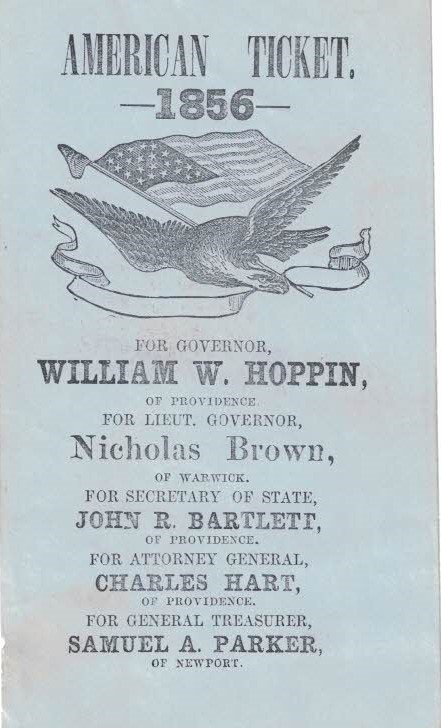
The 1856 election ticket for Rhode Island’s American Party (the formal name for the Know Nothing Party), including for the then current governor, a Democrat, William Hoppin (Russell J. DeSimone Collection)
It is impossible to say whether these Democrats and Whigs who were placed on the Know-Nothing ticket were members of the organization or not. The presumption is, that they were, for while all three were prominent men and would strengthen any ticket on which they might be placed, they were not necessary to Know-Nothing success. They were either actual members of the organization, or active supporters of its principles; and the grand council of the State did not at that time look so much to obtaining office as to the execution of certain principles. It is probable that any respectable man the Know-Nothings might have nominated would have been elected, for they were undeniably strong. Their very secrecy was a source of strength to themselves and of weakness to their enemies. Nothing so annihilating as an invincible and uncertain force.
Outside the two opposing parties the Know-Nothings had little to contend with. In some districts, as in Newport, a rival secret organization, styling itself the Anti-Know-Nothing party, made nominations for municipal offices.
When election day came, there was no doubt in the minds of any except of the blindest politicians that the Know-Nothings would elect their ticket. The Journal commenting on the registering, which had been done systematically by the Know-Nothings, alone asserted that at the close of the day preceding the last on which voters might register, there were in the city of Providence two-thirds who had not listed their names. The Post assumed a forced cheerfulness and hope as to the result.
The election was an overwhelming defeat for Democrats and Whigs alike. Governor Hoppin, the candidate of two parties, received 10,500 to 2,300 for the Democratic candidate. The real strength of the parties is best shown in the vote for lieutenant-governor and the other State officers. Here the Know-Nothing strength was 8,875; Whig, 1,258; Democratic, 2,274; this was a decrease of about 8,000 from the Whig vote of 1854, and of 4,000 from the Democratic vote of the same year. The Democrats saved only two towns, one of which, Glocester, had long been a democratic stronghold; the other was Foster. It is curious to note that the feeling against the temperance law was very strong here. It was said that no place in the State took so little interest in the temperance movement as Glocester.
Both branches of the General Assembly were strongly Know-Nothing. In the year during which they had control of the State government we cannot see any marked changes in legislation or execution of the laws. They did not attempt to go to that radical extreme to which the legislature of Massachusetts had gone, nor did they retain control of the offices long enough to undertake and accomplish any great measures. The same governor continued in office and pursued the same course.
In the following Spring [1856], a new condition of affairs caused new combinations, and while the Know-Nothings were nominally in the field, their influence had greatly declined. The rising Republican Party supplanted them, and, like the Whigs they [the Know-Nothing Party] disappeared altogether. Yet we can find some of their old prejudices still existing in the minds of men, who though now old, were once members of that powerful organization, adopted its principles and have refused to abandon them when true American patriotism asserts that those principles are hostile to the safety of a free government.
You Might Also Like