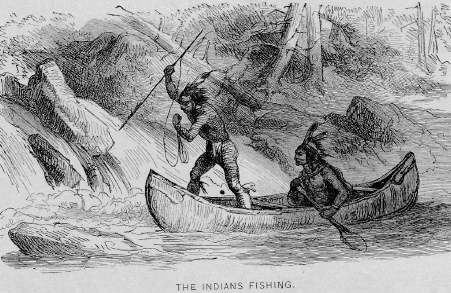


The earliest efforts in Rhode Island at what we might call “fisheries management” occurred before the arrival of the first White settlers. The Blackstone River had an enormous run of anadromous fish, upon which the Native Americans depended for food at certain times of the year. In 1853, Reverend David Benedict, in his reminiscences, stated that the Indians and early colonists “took much pains to smooth them (the rocks at the Pawtucket Falls) off by battering down the projecting points, that the fish, in the time of their running, might the more easily ascend them.”
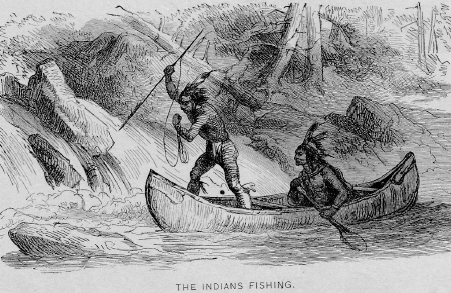
Indians ae fishing in early Rhode Island (Greene, Providence Plantations for 250 Years)
At this time, the natural dam formed by rocks and ledge called Pawtucket Falls was the only impediment to fish passage up the Blackstone for a long distance. It was surmountable, and the “Little River,” a secondary stream that by-passed the falls to the west, also helped passage. Records show that the area around Pawtucket Falls was set aside very early on as common fishing grounds.
In the early 1700s, two things happened to impede fish passage. In 1713, the Pawtucket Main Street Bridge was built, blocking “Little River;” and in 1718, the Pawtucket Lower Dam was built at the falls, increasing the height of this obstacle by several feet. Fish movement upstream to northern Rhode Island and Massachusetts was drastically curtailed.
In 1719, as a result of numerous petitions from both Rhode Islanders and Massachusetts residents near the Blackstone River, the Rhode Island General Assembly passed a law enabling town councils to preserve and improve fishing and to prevent obstructions which would impede fish passage from being built. Town council permission was required for any dam that would affect fish migrations, and councils were empowered to remove obstructions in rivers that stopped fish passage.
The year 1735 saw the passage of a sweeping act providing that any mill owner building a dam across a river where there were fish runs had to provide a “sufficient way through such Dam or Wear for the fish to pass and repass” that had to be open during the spring fish runs from April 21 to June 1 . . . . forever!
In 1741, Sargent’s Trench, as the “Little River” was then called, was dammed, after having been re-opened in 1718. Smithfield, Rhode Island, and Grafton, Massachusetts, both petitioned the Rhode Island General Assembly for permission to build a new trench. Also in the 1740s, a petition against the Unity Furnace Co. of Manville was granted, with a judge determining that the dam was to be broken and a way made through it for the fish, as the company was in continuous operation and never opened their dam.
By 1774, mill owners were beginning to cause the state to swing in favor of industrialism rather than agriculture and fishing. A 1773 law providing that it was legal to break down and blow up the rocks at Pawtucket Falls to aid fish passage was repealed and the General Assembly required that no rocks could be blown up for this purpose without permission of a new committee made up of Moses Brown, Stephen Hopkins, and Darius Sessions—all mill owners!
In 1787, there was still enough concern about the fishery in the Blackstone to get an act passed to regulate the fishing in the trench at Pawtucket Falls. Between April 1 and June 30, there was no fishing within four rods of the trench with nets or lines. But by 1805, the General Assembly dealt another blow to the fishery by repealing the 1787 act.
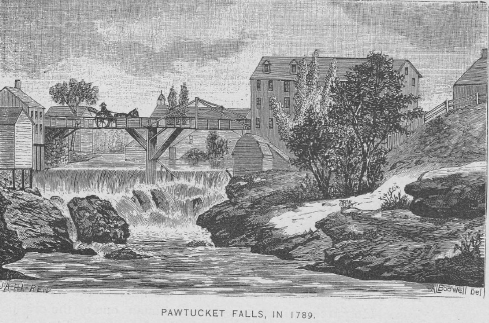
Pawtucket Falls from the cove in 1789 (Greene, Providence Plantations for 250 Years)
South of Pawtucket, on the west shore of the Providence River was another area where Indians had gathered to harvest anadromous fish. This was in Pawtuxet where the Pawtuxet River entered the bay. Fuller’s History of Warwick, written in 1875, describes a fishing technique as follows:
“A wooden trellis-work armed with sharp pointed sticks and sunk upon rocks one or two feet below the surface of the stream, and as the middle of the river by being filled with large stones was rendered too shallow for the upward passage of the salmon and shad, they plunged by necessity into the deeper water near the shore, where these concealed traps received them with a fatal welcome.”
The spring runs of alewives, shad, and herring were valuable additions of food and fertilizer for Indians and White settlers alike. Buried alongside the seeds for corn and squash planted by the farmers, fish provided rich fertilizer. Cleaned and hung to dry in a smokehouse or chimney, the fish could be preserved for winter or for use as food on long journeys. The roe which filled the females was a delicacy; and the filleted fish cooked on a wooden plank over the fire was a welcome addition to a limited menu. In later years, as the lobster fishery expanded, the fish served as cheap bait in the wooden lobster traps.
Sixty-four years later, the first Commission of Inland Fisheries was formed in Rhode Island, calling for three commissioners. S.S. Foss and Newton Dexter, both of Providence, accepted two of the positions, but the third was left unfilled when Rouse Babcock of Westerly declined to serve.
At the January session of the General Assembly in 1870, the Commission of Inland Fisheries made its first report. Covering 1869, it was one printed sheet, folded once and without covers. The Commission had received an appropriation of $1,000. A total of $900 was paid to the Poquonnoc Fish Company of Mystic, Connecticut, for 350 adult Black Bass. These were dispersed as follows: (1) 100 fish in Sneech Pond, Cumberland; (2) 125 fish in Moswansicut Pond in Scituate; and (3) 50 fish in Herring Pond in Burrillville
This first state stocking of fish stimulated “certain public-spirited citizens of Burrillville” to stock Black Bass at Wallum Pond and Pascoag and Wilson’s Reservoirs. In addition, William Clift of Mystic Bridge, Connecticut., “also voluntarily stocked Beach Pond, which lies respectively in the towns of Exeter [, Rhode Island], and Voluntown [, Connecticut].” This was a fine start for the future of fresh-water fishing in Rhode Island.
Town Councils of the towns where stocking had occurred “promptly voted the necessary protection” for the stocked waters; and the Commissioners “caused to be printed and placarded the Fishery Act, and proper notices, forbidding fishing in the ponds during the term of 3 years.”
The Commission had a strong interest in the success of the anadromous fish runs in the state’s rivers, and the remainder of that first report was devoted to the need for “stairs” or manufacturing purposes on Rhode Island’s rivers to enable the Atlantic Salmon, shad, herring, and alewives to spawn. The report added, “It is a well-established historical fact that all the principal rivers of Rhode Island, like those of our sister states of New England once abounded with anadromous fish.” They claimed that “but for these dams, these fish would furnish a large amount of excellent and cheap food for the people.”
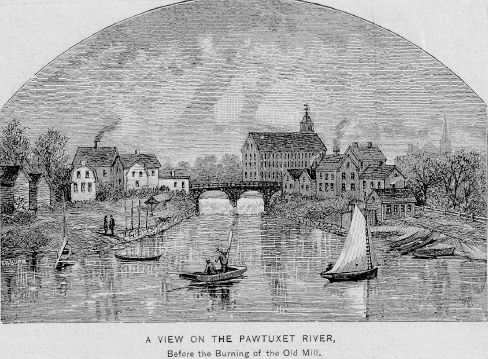
A view of the Pawtuxet River (Greene, Providence Plantations for 250 Years)
The 1872 Annual Report (for 1871’s activities) showed that Alfred Augustus Reed, Jr. of Warwick, was filling the space that Rouse Babcock had declined, and John H. Barden of Rockland, in Scituate, replaced S. S. Foss. The commissioners served three-year terms, without pay. The General Assembly, in January 1871, had allotted $2,500 to the work of the commission. The commissioners had interviewed mill-owners along the Pawtuxet River and found them receptive to plans to build stairs or fishways in their mill dams. Being prudent, they wanted the state to build a model fishway first.
The commissioners had the Pawtuxet River tested and found “A chemical analysis of the water of the Pawtuxet, taken from points where impurities most abound, gave very satisfactory results, which leaves nothing to be desired on that very important point.” In view of continuing efforts today, the comments of the commission report regarding Atlantic Salmon were overly optimistic. After pointing out that “a resident of River Point, on the latter stream (Pawtuxet) remembers salmon being taken from the ‘Salmon Hole’, so called, below that village, some 60 years ago (1812 or thereabouts)” the commissioners announced: “to get this glorious fish back to its former haunts becomes now, with the aid of artificial incubation and fishways, a comparatively simple matter.” Over 140 years later, we are still trying.
Meanwhile, the commission had selected the dam at the mouth of the Pawtuxet River in the village of Pawtuxet as the location for the model fish ladder. The commissioners petitioned the City of Providence, which owned the dam, for an appropriation of $500 to match the state’s $500 to build it. The City Council approved this amount with the proviso that it be built under the supervision of the City Water Commissioners. Delays held up the start of construction until the spring of 1873; and the 1874 Annual Report to the General Assembly states: “A fishway has been completed over the dam at the mouth of the Pawtuxet, and we are glad to report an increasing interest in the public mind in regard to our labors.”
For the first time, stocking of trout by the State was undertaken in 1871. During June, 1870, the commissioners visited the trout-breeding establishment of Dexter and Cooledge at West Barnstable, Massachusetts. In 1871, the commissioners selected a site at what was then Poneganset, near Commissioner Barden’s home for a “hatching house.” Thus, for $641.22, the first State Trout Hatchery was built. A total of 30,000 impregnated trout ova were purchased from Dexter and Cooledge, and a “practical pisaculturist,” Robert Holmes, was hired for $35 to “oversee the ova at the critical time of hatching.” The range of 12 to 18 months was selected as the time for these trout to be stocked in ponds and “streams freest from saw-mills, tanneries, etc., which tend to destroy the fish, to replenish our almost exhausted streams.”
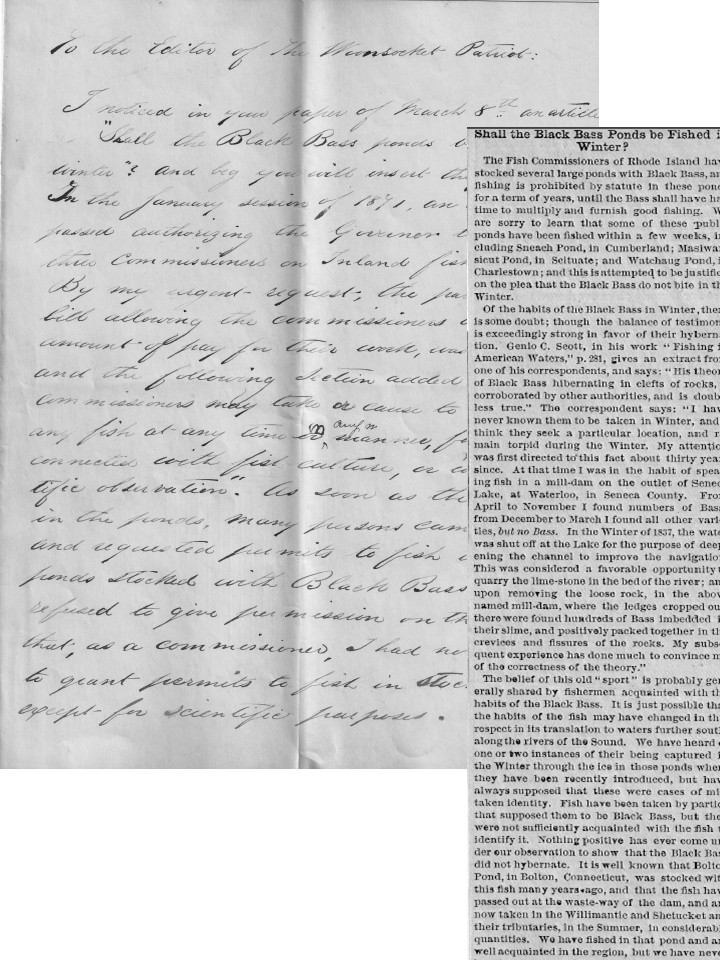
Letter from a commissioner and newspaper column from the Woonsocket Patriot fisheries (Clouds Hill Museum Collection)
In that same year, Samuel Wilmot arrived from Newcastle, Ontario, in Canada, with 9,000 impregnated salmon ova costing $348.47. These were put into the hatching boxes. Wilmot recommended “in order to allow the public to witness the operation, that a few salmon and trout ova should be hatched in the city; and through the courtesy of Messrs. Dowling and Monsell, an inexpensive apparatus ($14) was placed in their fish market on Exchange Place and a few salmon and trout ova placed therein. A small stream from the new water works was passed through the box. For the salmon, they were “the first hatched in Rhode Island for many a year. The crowds who have visited this miniature hatching box attest the interest the community feel on the subject.”
The commissioners were justly proud, as “Mr. Wilmot, who has visited all the fish-raising establishments in the country, stated that ours is a model for principle and detail, and could not be improved upon at present.”
Black bass, on the other hand, did not do well in 1871. Some 200 Black Bass adults at $1 per fish were ordered from C. P. Newman of West Winstead, Connecticut, to be delivered to East Greenwich alive and in good condition. They arrived October 9th, too late in the day to be stocked. Newman’s assistant was offered the use of a large spring on the Cowesett estate of Alfred A. Reed, Jr., and the fish were placed in it overnight. All but three died, and the commissioners sought a discount on the price – to no avail. They then tested the spring by placing 18 more Black Bass in the same waters and leaving them for four months, when they were stocked in Warwick Pond as healthy fish. This still did not produce a discounted price for the original fish, so the commissioners paid the original bill, and took all future business elsewhere,
The commissioners obtained 300 more Black Bass and stocked: (1) Steere, Hope and Poneganset, (2) Poneganset Reservoir in Glocester, (3) Searle’s and Spear’s Ponds in Foster; Scott’s Pond and the new reservoir in Lonsdale, and (4) Warwick and Gorton’s Ponds in Warwick.
The Second Annual Report concluded “the only possible chance for failure lies in the number of pickerel which swarm in all our waters. As it is out of the question to get rid of them, we can only hope for the best.” Pickeral, even today, are a fierce predator to smaller fish.
In the Third Annual Report (for 1872), under the heading, “State Hatching Establishment,” the report was not good. “The ponds in which the young fish were placed were not properly constructed, they requiring at least 4 feet of water and steep banks with considerable shade.” The amount of $293.19 was spent to rebuild the ponds. Furthermore, 50 percent of the ova were sterile. It helped that Samuel Wilmot sent 5,000 salmon ova guaranteed fertile for free.
The Commissioners of Fisheries of the New England States had started meeting together regularly, and pooled their orders, thus reducing the price for salmon spawn from $35 gold per thousand to $5 per thousand.
Also in 1872, Stephen F. Baird, United States Commissioner of Fish and Fisheries, met with the group to discuss distribution of the salmon ova presented to the United States by the Prussian government. Unfortunately, the project was a total loss, as extremely warm weather before shipping and unusual delays killed all the ova.
Stocking from the hatchery was done by Robert Holmes, the practical pisaculturist, with the assistance from the Providence and Worcester and the Providence and Stonington Railroads, “in permitting the transportation of these fish in their express trains.” Could the same arrangements be made today?
Black Bass were stocked in: (1) Yawgoo Pond in Hopkinton, (2) Ponegansett Pond in Warwick, (3) Carr or Bellville Pond in North Kingstown, (4) Miswick Pond in West Greenwich, (5) Yorker’s and Larkins Ponds in South Kingstown, and (6) Deep Pond in Exeter.
In 1874, the 4th Annual Report showed increased stocking efforts: 100,000 salmon eggs, purchased for $450 from Maine, had hatched 66,000 salmon. These were stocked in 1873, as follows: (1) 12,500 in the “Slatersville branch of the Blackstone River” at 14 locations, (2) 16,000 in the northwest branch of the Pawtuxet River at 18 locations between Hopkins Mills in Foster to Pontiac, (3) 8,000 in the southwest branch of the Pawtuxet River at 16 locations between Quidnick and River Point, and (4) 22,000 in the Pawcatuck River from Kingston Station to Carolina. In addition, 150,000 young shad had been placed in these three rivers, as well.
The Caledonia, New York, fish hatchery had supplied 30,000 trout spawn for $150. Unfortunately, only 6,000 hatched.
Again, Black Bass were stocked in area ponds: (1) two ponds on Block Island, (2) Easton’s Pond in Newport, (3) Johnson’s Pond in Coventry, (4) Wixaboxet Pond in West Greenwich, and (5) five already stocked ponds were restocked.
The commissioners in the report for 1873 stated that they wished:
“in connection with the subject of the distribution of fish in the various parts of the state, to return our best thanks to the Providence and Worcester, Providence and Stonington, Boston and Providence Railroad Companies for accommodations shown us at all times. Their officials have shown themselves interested in our work; and much of our success in transporting fish is due to them.”
In 1872, the problem of illegal fishing arose and the commissioners spent $18 to hire Pike and Atwood for service as police officers. In 1873, the budget item was $40 for “officers for watching ponds.” By 1874, the commissioners requested the General Assembly to pass a law providing closed seasons for fishing, which was enacted.
An interesting insight into the illegal fishing is shown in the following clipping from the Woonsocket Patriot newspaper (year unknown, but sometime in the 1870s) and rebuttal letter from Commissioner Alfred A. Reed, Jr. The clipping is a letter titled “Shall the Black Bass Ponds be Fished in Winter?” in which the writer references illegal fishing in Sneech Pond in Cumberland, Moscwansicut Pond in Scituate, and Watchaug Pond in Charlestown. The question being whether Black Bass would bite in winter or if they hibernate and ice fishing should be allowed for pickerel. Also, it is claimed that the commissioners had issued permits to a few people to fish these ponds. Reed’s rebuttal published in the Woonsocket Patriot read:
“I noticed in your paper of March 8th an article ‘Shall the Black Bass ponds be fished in Winter?’ and beg you will insert the following: In the January session of 1871, an act was passed authorizing the Governor to appoint three Commissioners on Inland Fisheries. By my urgent request, the part of the bill allowing the commissioners a certain amount of pay for their work, was left out and the following section added ‘Said Commissioners may take or cause to be taken any fish at any time in any means for purposes connected with fish culture, or for scientific observations.’ As soon as the ice formed in the ponds, many persons came to me and requested permits to fish in the ponds stocked with Black Bass. I refused to give permission on the grounds that, as a commissioner, I had no right to grant permits to fish in the stocked ponds, except for scientific purposes.
“During the month of December, the Commissioners had a meeting and discussed the subject of pickerel fishing through the ice in ponds stocked with Black Bass. Pickerel abound in all of the ponds stocked last year, and I have reason to believe that ponds stocked previously have also their share of Pickerel. The Black Bass placed in the various ponds were a year old, about seven inches in length, and the average number placed in each pond were about fifty. It is a well-known fact that a Pickerel will swallow a fish nearly half its own size; in view of this fact, what chance do the few Black Bass stand while the Pickerel inhabit the same waters, the latter fish being many times larger. It is true that many Pickerel caught in winter are full of spawn, and that the young fish, when hatched would make good food for the Black Bass, but is it not more probable that the Black Bass are so small and so few in number compared to the Pickerel, that they would be made food of, instead of the Pickerel supplying food for them.
“In view of this matter, the Commissioners decided, if the Pickerel could be caught without disturbing the Black Bass, the stocking of the ponds would prove a success. I do not consider it an established fact that the Black Bass will not take the hook through the ice.
“I have reliable information of one Black Bass taken through the ice. In October, I placed eighteen Black Bass in a spring with a muddy bottom, surrounded by a low stone wall, and have watched them during most of the winter. These did not hibernate, as I frequently saw them swimming under the ice – there is no doubt that they would hibernate in more northern states, but not in Rhode Island.
“The Commissioners, wishing to establish the fact whether the Black Bass would or would not bite through the ice in this state, decided to have some of the stocked ponds fished by some responsible person. After very careful consideration they decided to appoint a policeman of the City of Providence, accompanied by another person, to fish. A permit was drawn up in a proper and legal form, addressed to the several town councils, signed by the three Commissioners. This was the only instance that I have any knowledge of a permit being signed or granted.
“The Commissioners were informed of certain persons fishing in a stocked pond in Scituate, and they immediately sent two sheriffs to have the parties arrested; as no complaint was made, and failing ocular proof, the parties were not arrested. The law has not been violated since then on that pond. A gentleman from Cumberland seems to find fault with some persons fishing in stocked ponds in that town.
“Now, Mr. Editor, I think I know the gentleman. If I am not mistaken, he has spoken to me, and several times I have requested him to bring in a complaint – but I have not heard from him – very likely it is too much trouble for him to bring in the complaint.
“If the Gentleman from Cumberland who seems to take so much pleasure in finding fault with the Commissioners would like the position himself, I would gladly resign my office that he may be appointed. But, let me assure him that there is no pay connected with the commission. It is a position of hard work, no thanks, and no pay –
“One of the Commissioners”
The Pawtuxet fish-ladder was finally completed, built by French and McKenzie of Providence. There was a $500 over-run on the cost. Also in this year, P.C. Cranston received $50 for services as a fish warden in Pawtuxet. The first full-time employee of the Commission was also hired—William Colwell, “who gives his entire time to superintendence of the establishment” (i.e., the hatchery).
The next disaster to strike the state hatchery was when muskrats got into the 200,000 young salmon, which had hatched from 217,000 eggs. Enough were left to stock: (1) 35,000 in the Wood River, (2) 10,000 in the Pawcatuck River, (3) 12,000 in the Slatersville branch of the Blackstone River, (4) 25,000 in the south branch of the Pawtuxet River, and (5) 100,000 in the north branch of the Pawtuxet River.
In that same year:
“[I]n the middle of October, Professor Baird of the Smithsonian, U. S. Commissioner of Fisheries, had sent Rhode Island 100,000 California salmon eggs. In hatching these we were unfortunate, loosing fully one-third owing, we think, to the eggs being too far developed when shipped on their long journey.”
Trout hatching was more successful but still marred by loss. A total of 54,000 trout eggs were hatched with only a 5 percent loss. A total of 20,000 were stocked around the state; a number were put in the pond at the state farm; a small number were sold to private parties; and the rest were kept in small ponds at the hatchery to be stocked during the season. Unfortunately, the spring which fed the ponds dried up during the heat of the summer, and the river water, which was let into the ponds at 70 degrees, was too warm, so most of the fish died. Holding fish into the summer was not to be repeated.
Only one pond was stocked with Black Bass, since the major ponds of the state had been stocked previously and were providing excellent fishing. The commissioners also went to bat for legislation to protect river herring, and a law was passed to do so.
In 1875, the salmon stocking was as follows: (1) 15,000 to the Slatersville branch of the Blackstone, and (2) 110,000 to the Pawtuxet
This was the fourth year of salmon stocking, and the commissioners decided to give it one more year. There was discussion about access for the salmon; no mill dam owner had, as yet, built a fish way. There also was not a concentration of salmon at the river’s entrances, nor between the dams where they had been stocked; so the commissioners decided to try only once more.
Shad was more successful: “our success in shad has been excellent, as shown during the past season in the ample supply of our markets with fish from our own streams and in quantities to nearly equal the large demand.” A gratuitous supply of shad from the Hadley Falls Hatchery, Massachusetts, had been a great help.
The commissioners also recommended the passage of laws to limit the taking of Black Bass to only by hook and line; and to set dates for the fishing season for Black Bass and trout. These were enacted. The commission also squelched a plan to divide the inland waters of the state into three classes, with one-third of the waters open to fishing each year and the other two-thirds closed.
Also notable was the formation in 1875 of the State Association for the Protection of Game and Fish. It was described as “a society recently formed, now numbering some over one hundred members and constantly increasing, and destined to work much good, we are sure, in the community.”
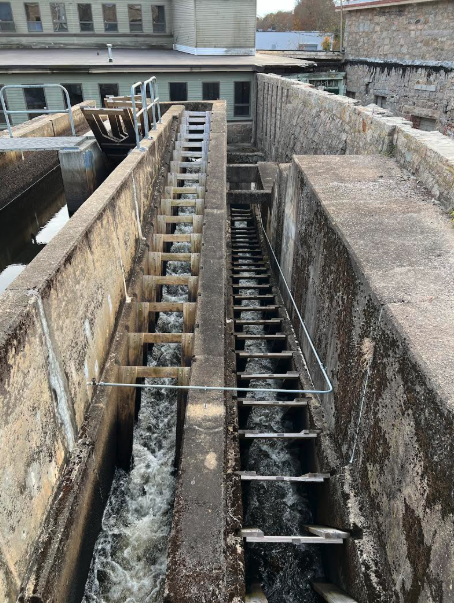
The Palisades Fish Ladder at the historic Peace Dale Manufacturing plant. The fish ladder is operated by the Rhode Island Fish & Wildlife(Christian McBurney)
By 1879, the report of the commissioners was predominantly regarding marine fisheries. It did state that Black Bass were everywhere in state fresh waters – including the Hope Street reservoir of the City of Providence! The next year, the report on freshwater fisheries was only one-half a page. During 1879, the commissioners looked into European carp as a viable fish for stagnant waters where other fish do not do well. The commissioners received 200 carp from U.S. Commissioner Professor Baird and “these were distributed to the best of our ability to twelve parties who had made application for them.” Carp can be found today in area ponds around Providence and Warwick.
Although the commission never successfully restored the Atlantic Salmon runs in Rhode Island rivers (we are still trying today), they certainly were influential in providing a wonderful freshwater fishery for Rhode Island and laying the groundwork for many of the programs used by today’s Division of Fish and Wildlife to continue the success of freshwater fishing in this state.
Note from the author: Fisheries Commissioner Alfred Augustus Reed, Jr. was the great grandfather of this article’s author. The data from the Annual Reports comes from his set of these reports; and the letter was written by him. The spring at his Cowesett estate still exists.
Sources:
Bibliographyan Historical Assessment of Anadromous Fish in the Blackstone River, by Betty Buckley and Scott W. Nixon, November 2001, University of Rhode Island Graduate School of Oceanography, Narragansett, Rhode Island. Final Report to the Narragansett Bay Estuary Program, Blackstone River Valley National Heritage Corridor and Trout Unlimited.
First Through Tenth Annual Reports of the Commissioners of Inland Fisheries, State of Rhode Island, 1870–1880, Providence Press Company, printers to the State. At the collections of Clouds Hill Museum, 4157 Post Road, Warwick.
Oliver P. Fuller, History of Warwick, Rhode Island, Settlement in 1642 to the Present Time (Providence: Angell, Burlingame & Co., 1875)
Letter to the Editor of Woonsocket Patriot from a Commissioner of Inland Fisheries, and related column from the same newspaper. These items were from a scrapbook and the name of the newspaper and dates are not indicated. From the Collections of the Clouds Hill Museum.
Welcome Arnold Greene, The Providence Plantations for 250 Years (Providence: J. A. and R. A. Reid, 1886)
Reverend David Benedict’s “Reminiscences #19,” published in the Pawtucket Gazette and Chronicle, July 29, 1853.
The Author

You Might Also Like