

In early 1778, from the headquarters of the Continental Army in Valley Forge, Pennsylvania, General George Washington’s aide-de-camp, John Laurens, wrote several letters to his father Henry who had recently succeeded John Hancock as the president of the Continental Congress. While most of the Continental Army was suffering through a harsh winter in makeshift huts, the British military enjoyed the security and comfort of the city of Philadelphia. The head-strong Laurens was lucky to be alive. At the battle of Germantown six months prior, in a failed effort by Washington to force the British out of Philadelphia, the reckless Laurens “did every thing that was necessary to procure” certain death, observed the Marquis de Lafayette.[1]
Educated in London and Switzerland and heavily influenced by British abolitionists, the 23-year-old Laurens arrived upon an idea to “reinforce” the ranks of the “Defenders of Liberty,” with a “number of gallant Soldiers.” The idealistic young soldier desired that his father, a prominent Patriot and large-scale slave owner, send him a number of “able bodied men Slaves” from Mepkin, the family’s rice plantation. Though raised in a slave society in South Carolina, John Laurens had grown to despise the institution. He believed freeing and arming slaves under the Patriot banner was morally just, for they were “deprived of the Rights of Mankind.”[2] John Laurens, without question, saw the hypocrisy of waging a war under the precepts of liberty and equality contained in the 1776 Declaration of Independence while maintaining a system of human bondage. At the height of his business career, elder Laurens brokered the sale of over 8,000 enslaved people from west Africa in the middle of the 1700s, including many from Rhode Island vessels, and his trading business made him one of the richest men in America before the Revolutionary War.[3]
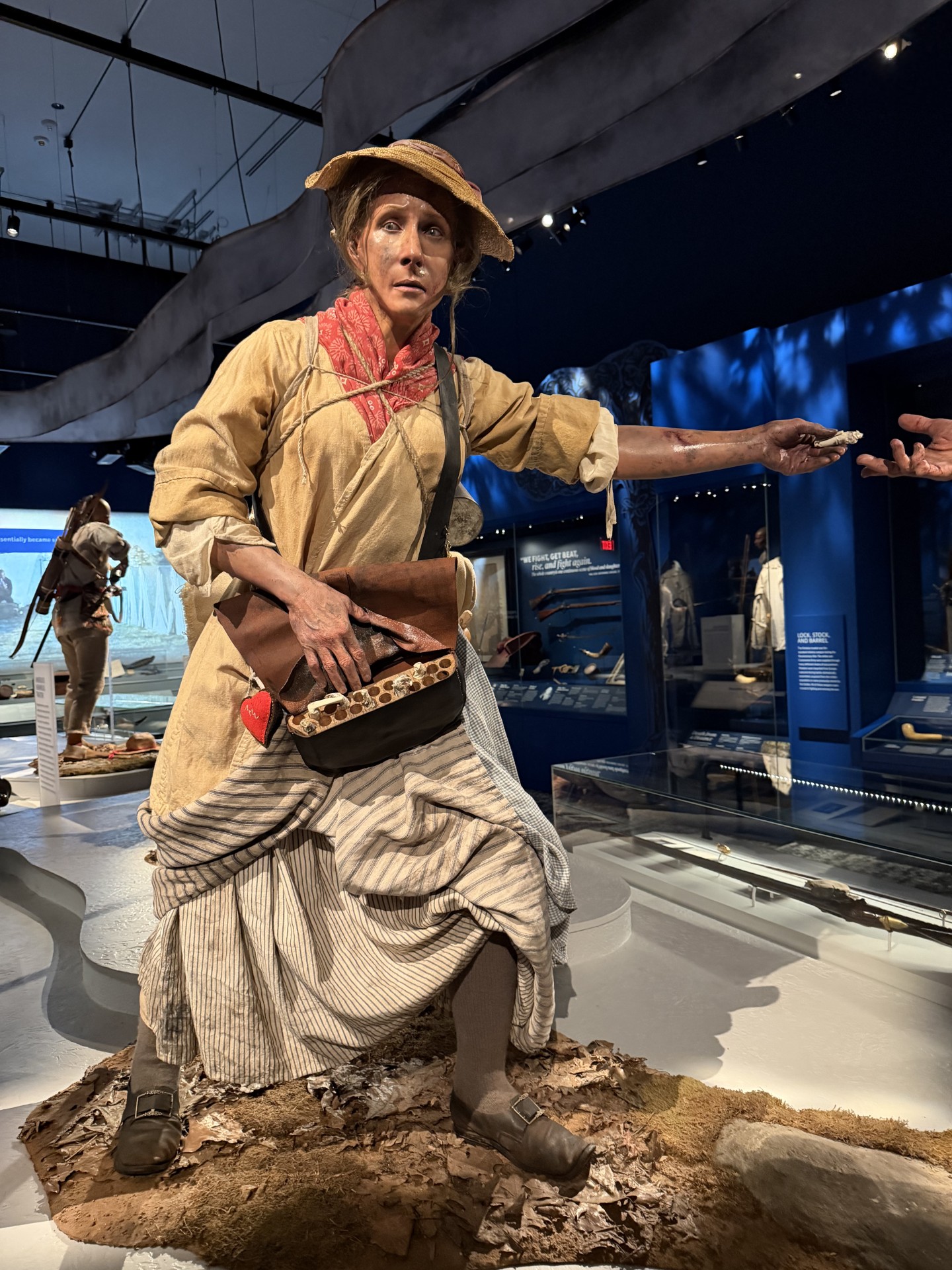
Anna Maria Lane was one of the few women known to have fought in the Revolutionary War. She was wounded at the Battle of Germantown and received a pension from the State of Virginia. The legislature noted that she had “performed extraordinary military service.” Her husband was a private in the Third Connecticut Regiment. (National Museum of the United States Army)
John Laurens was willing to forfeit the wealth that would be bequeathed to him. He told his father that he would turn down the considerable inheritance that was going to come his way for the opportunity to lead slaves from the plantation he grew up on. “Upon the whole my dearest friend and father, I hope that my plan for serving my Country and the oppressed Negro race will not appear to you the Chimera of a young mind deceived by a false appearance of moral beauty – but a laudable sacrifice of private Interest to Justice and the Public good.”[4] The elder Laurens did not necessarily share his son’s vision but he did eventually come to support his idea in 1779 when South Carolina faced a direct threat from the British Army and the Continental Congress supported it. However, Washington did not push for the proposal, and the South Carolina Assembly ultimately rejected the measure, which was “received with horror by the planters.”[5]
Though Laurens’ plan did not come into fruition during the winter at Valley Forge, another emancipation scheme got off the ground that started with Rhode Island officials and General James Mitchell Varnum. Writing to Washington, Varnum, before the war a prominent Rhode Island lawyer, maintained that a “battalion of Negroes can be easily raised” in Rhode Island. “Should that measure be adopted,” by the Assembly “the Service will be advanced.”[6] Washington agreed. John Laurens, aide-de-camp to Washington, drafted for Washington a letter to Rhode Island’s governor. On the same day, that letter was sent with Varnum’s note to Rhode Island Governor Nicholas Cooke.[7] Eventually, the First Rhode Island Regiment, led by Colonel Christopher Greene, a cousin of Nathanael Greene, was re-established. About 130 enslaved men obtained their freedom by enlisting in the regiment, which became a segregated unit composed of African American, Native American, and mixed race soldiers led by White officers. They served together until 1781, when the regiment was merged with the White 2nd Rhode Island Regiment. The Rhode Island Regiment served through the end of the war.[8] The exploits of the 1st Rhode Island Regiment, especially at the Battle of Rhode Island in 1778 as mentioned in 4th and 5th episodes of Burns’ monumental film, will prove to be fertile ground for teachers in the classroom.
Episode 4 (“Conquer by a Drawn Game,” January 1777–February 1778), chronicles the start of the third phase of the war beginning in 1777 with Washington’s encampment in Morristown, New Jersey. After New England and New York, this new phase of the Revolution dealt with the British attempt to subdue the middle colonies. Washington was determined not to engage the British as he had in New York in open battles. As Washington informed Congress, the military conflict needed to be waged as a war of posts.[9] This change in the mode of battlefield engagement was clear by the late summer of 1777 when British General William Howe decided to forego linking up with British troops descending from Lake Champlain and instead marched on Philadelphia, the seat of the government for the nascent nation. Up north, the wing of the British Army under General John Burgoyne was marching south, hoping to reach Albany. British Lieutenant Colonel Barry St. Leger was ordered to support this column by attacking Fort Stanwix in the Mohawk Valley in central New York.
A bright spot for the Patriots in the summer of 1777, unfortunately not mentioned in the documentary, occurred in Rhode Island, with the kidnapping of British General Richard Prescott, the commander of the roughly 6,000 British troops in occupied Newport. In a daring nighttime raid, Captain William Barton and a small part of Rhode Islanders kidnapped General Prescot from a farm in Middletown and scurried him across Narragansett Bay, setting up an exchange the following year for Major General Charles Lee who had been captured in New Jersey in late 1776.[10]
While Barton’s successful raid was a true military highlight, the fighting around Philadelphia in the fall of 1777 did not go well for the Continental Army. In a not-so-subtle letter sent to Congress on September 18, 1777, a week after a defeat at Brandywine, Alexander Hamilton urged the delegates to run. “If Congress have not yet left Philadelphia, they ought to do it immediately without fail, for the enemy have the means of throwing a party this night into the city,” wrote Hamilton to John Hancock, the president of Congress at the time.[11] On September 26, 1777, 3,000 victorious British troops marched into Philadelphia. The now mobile legislature met briefly in Lancaster, Pennsylvania, on September 27, before moving to York, Pennsylvania, by the end of the month for safety. The First and Second Rhode Island Regiments of Continentals courageously repelled an assault of German troops three times larger at the Battle of Red Bank on the Delaware River in Pennsylvania on October 24, 1777. The victory lifted Patriot morale but Greene and his men (including 52 soldiers of color) had to abandon the fort a few weeks later.[12]
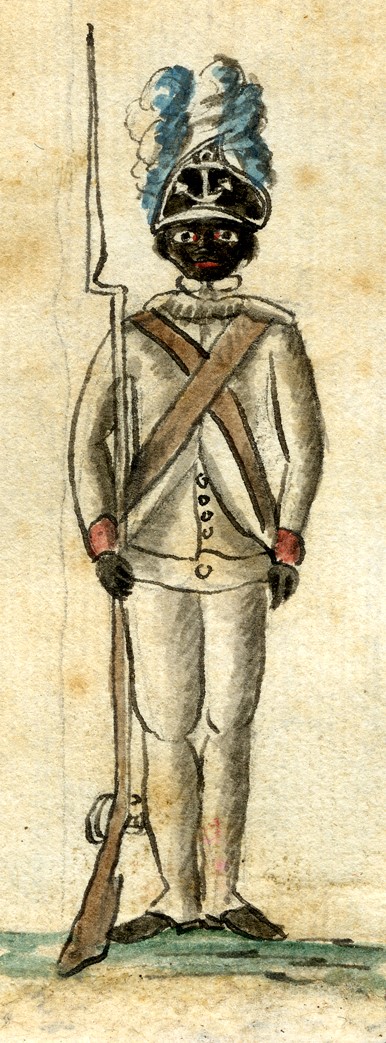
A Black private in the Rhode Island Regiment probably 1781 around the time of the Siege of Yorktown, drawn by a French officer, Jean Baptiste Antoine de Verger (Anne S. K. Brown Military Collection, Brown University Library)
Rhode Island teachers can use the military career of Nathanael Greene to discuss the key roles the “fighting Quaker” played in battles outside of Philadelphia, including at Brandywine (September 1777) and Germantown (October 1777). Though the October 1777 Battle of Saratoga did not feature any Rhode Island troops or commanders, it saved the Revolution and brought the French into the war.[13]
Teachers will need to go over the monumental victory at Saratoga of American generals Horatio Gates and Benedict Arnold and the surrender of British General John Burgoyne of almost 6,000 men. The victory led directly to two treaties between the United States and the French monarchy. The stated purpose of the Treaty of Alliance was to assure the “liberty, Sovereignty, and independence absolute and unlimited of the [said] United States.”[14] France renounced claims to the mainland of North America east of the Mississippi and to the Bermuda Islands if captured by America. In return, as noted in Article 7, France asked the United States to recognize whatever France might capture in the West Indies, a favorite spot for Rhode Island commercial vessels before the war. Teachers should make clear to their students that it was in Rhode Island that the partnership between the Americans and the French started out.
During this period, Washington relied heavily on Nathanael Greene’s considerable military skills. In February 1778, Washington relied heavily on Greene to “take Carry off & secure all such Horses as are suitable for Cavalry or for Draft and all Cattle & Sheep fit for Slaughter together with every kind of Forage that may be found in possession of any of the Inhabitants” in and around Philadelphia.[15] Starting in March 1778, Greene served as Quartermaster General, a post he held until 1780. As the film makes clear, “thanks to Nathanael Greene’s mastery of logistics and Washington’s continued appeals to state governors, by the end of March 1778, herds of cattle and sheep were plodding toward Valley Forge from several directions, along with wagon trains filled with everything from barrels of nails to brand-new uniforms and crates of bayonets and muskets.”
Episode 5, “The Soul of All America,” December 1777–May 1780) provides a way for teachers to discuss the British occupation of Newport (December 1776–October 1779), the naval campaign off the coast, and the Battle of Rhode Island. The film covers French Admiral Comte d’Estaing’s unsuccessful attempt to destroy the British fleet in August 1778. During a naval battle, the French fleet was severely damaged by what was probably a hurricane. Much to the chagrin of the Americans, especially the Irish Catholic commander and New Hampshire native John Sullivan, the French fleet retreated to Boston for repairs, forcing Sullivan’s siege forces to abandon plans to take Newport.[16] However, the Americans still needed to fight their way off Aquidneck Island and this fighting became known as the Battle of Rhode Island.
The military conflict on August 29, 1778, in Portsmouth, as historian Patrick Conley has noted, constituted the largest land battle in New England with at least 8,000 troops engaged, including the First Rhode Island regiment.[17] On the ground in Portsmouth was John Laurens of South Carolina, who, while unable to raise and lead a regiment of former slaves in his native South Carolina as he desperately desired, was able to witness first-hand the impact of Black troops fighting for the Patriot cause. The First Rhode Island Regiment helped to repel three charges by enemy forces. Continental troops executed a successful evacuation and inflicted heavy casualties on the British in the process.
Eventually, after the British decamped in October 1779, Newport was occupied by the French. As told in Episode 6, the final episode, “The Most Sacred Thing,” on July 11, 1780, five French “warships and a host of transport vessels had emerged from the fog that blanketed the harbor at Newport, Rhode Island, and some 4,600 officers and men under the Comte de Rochambeau came ashore.”
The important role of American privateers on the high seas is discussed in episode 5. Historian Christian McBurney’s book, Dark Voyage: An American Privateer’s War on Britain’s African Slave Trade (Westholme, 2022), which chronicles the privateer Marlborough as it sailed from Rhode Island to the coast of Africa and attacked both British slave trading posts and slave ships, will prove invaluable.
The fourth and final phase of the war, the southern campaign (1779–1781), meticulously covered in the film’s final episodes, provides a way for teachers to once again engage with the consequential military career of Nathanael Greene. “My first object will be to equip a flying army to consist of about eight hundred horses and one thousand infantry. I see little prospect of getting a force to contend with the enemy on equal grounds, and therefore must make the most of a kind of partisan war.”[18]
In late 1778, the British took Savannah, Georgia, followed by the major port city of Charleston, South Carolina, in May 1779. Charleston and Savannah were viewed by the British as platforms for campaigns in their colonies of east and west Florida and the Caribbean. The move south by the British was an attempt to defend their valuable sugar producing islands in the Caribbean against French and Spanish encroachment. Indeed, the major British sugar islands (Jamaica, Barbados, and the Leeward Islands) were always viewed as greater prizes than the North American colonies and, after the French entrance into the war, these islands had to be defended.[19] The French, for their part, viewed the American Revolution as an opportunity to regain some of trade curtailed by its loss to the British during the Seven Years’ War. For a time, the British managed to defend their Caribbean possessions, even picking off St. Lucia from the French, and defend their southern colonies in North America. In South Carolina, for example, the British Army under Lord Cornwallis, along with Colonel Banastre Tarleton’s Legion, also struck a disastrous blow on General Horatio Gates, the hero of Saratoga, at Camden, South Carolina, in August 1780.
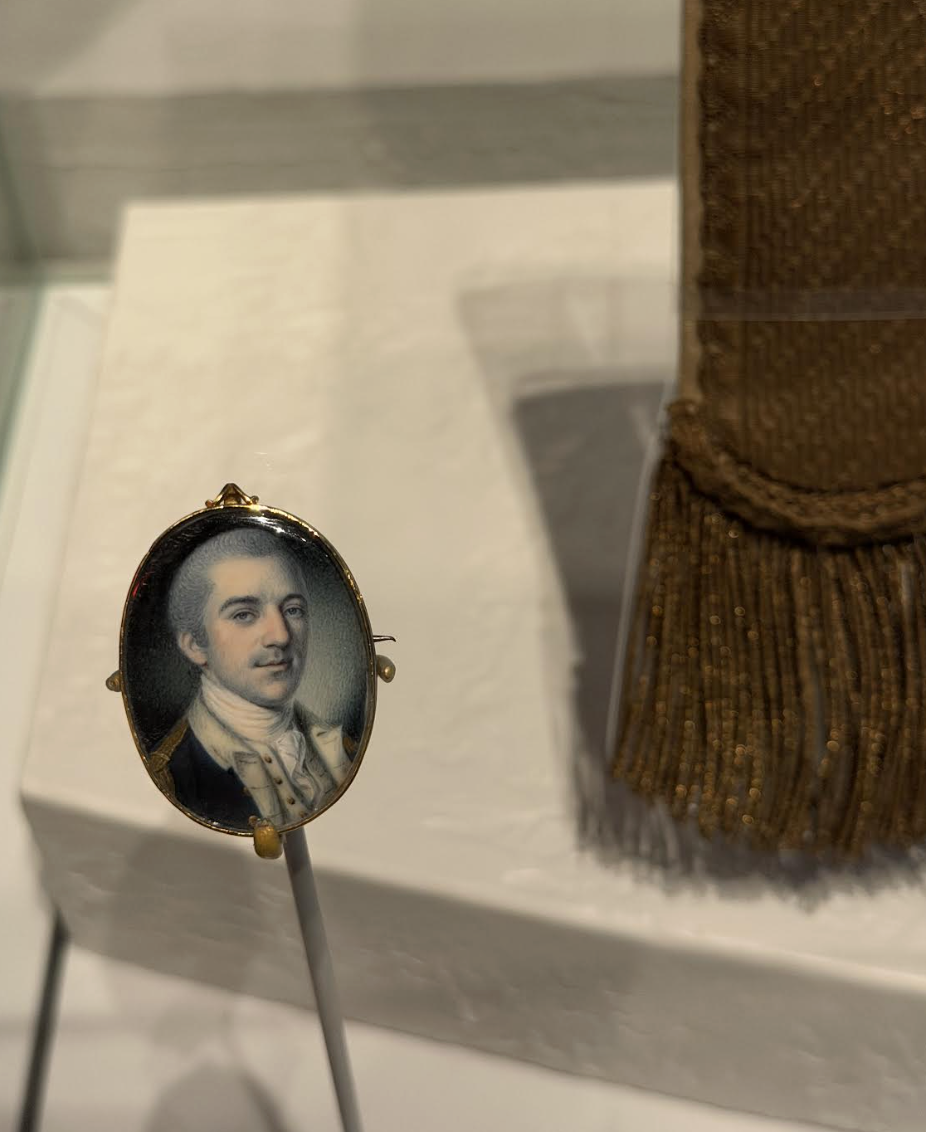
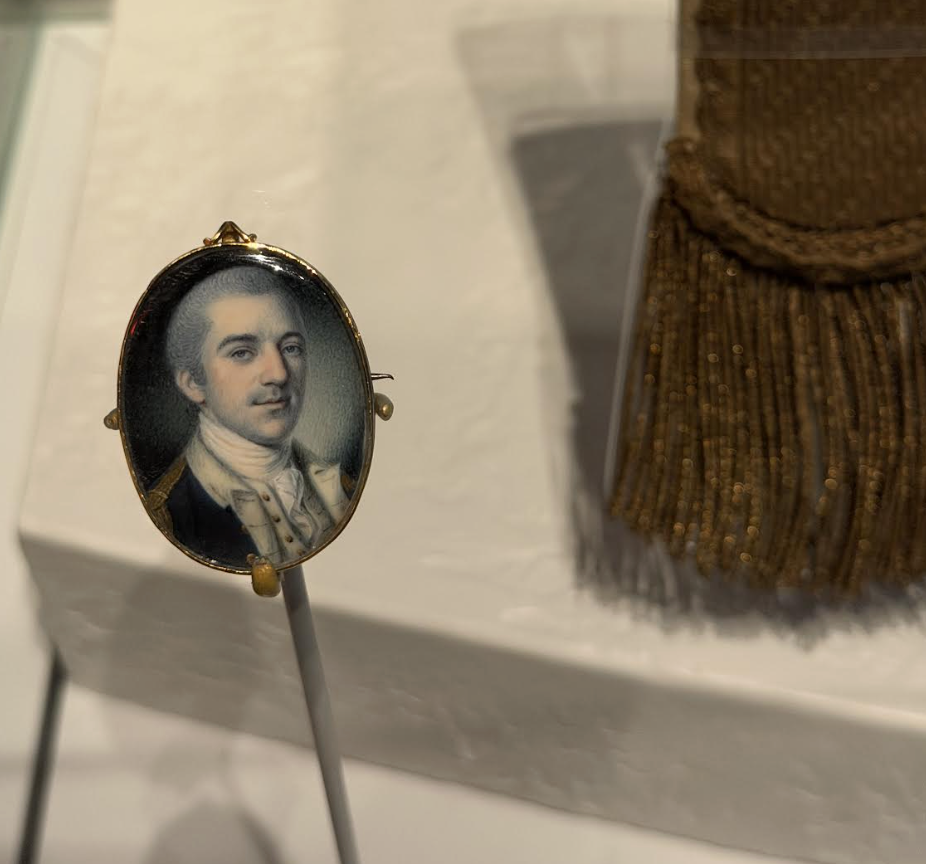
A miniature of Lieutenant Colonel John Laurens by Charles Willson Peale (ca. 1784, held by the National Portrait Gallery) and an epaulet worn by Lieutenant Colonel Alexander Hamilton. Both aides to General George Washington expressed opposition to slavery and led an assault on an important redoubt during the Siege of Yorktown (Display at the National Museum of the United States Army)
Throughout 1781, Greene steadily drove the British army back to an isolated position at Charleston, which they abandoned the following in December 1782. Although defeated at the battles of Guilford Courthouse, Hobkirk’s Hill and Eutaw Springs, this series of costly victories for the British Army, similar in many ways to Bunker Hill in June 1775, set the stage for their surrender at Yorktown in October 1781.[20]
Teachers should bring in Greene’s frustrations with Virginia Governor Thomas Jefferson in the spring of 1781 for failing to adequately support his army.[21] By May 1781, British forces under the command of the traitor Benedict Arnold had joined with a larger British force under Lord Cornwallis to totally disrupt the Patriot government in Virginia. In early June, Jefferson was forced to flee the scene just a few weeks later, barely escaping capture at his Monticello home from British troops.[22]
The Rhode Island Regiment, formed in early 1781 from a consolidation of the First and Second Rhode Island, played a crucial role at the siege of Yorktown, participating in the decisive night assault on a key British position. Lieutenant Colonel Commandant Jeremiah Olney took command after Colonel Christopher Greene’s death in May 1781. Reflecting on the end of the war, Thomas Paine wrote in his final Crisis essay (#13), “the times that tried men’s souls are over and the greatest and completest revolution the world ever knew, gloriously and happily accomplished.”[23]
To round out the story after the American victory at Yorktown and the signing of the Peace of Paris in 1783, Burns briefly chronicles the drafting and ratification of the Constitution in 1787. Though Rhode Island failed to send delegates to the Constitutional Convention in the summer of 1787, teachers can access four volumes pertaining to the intense and protracted debate over the Constitution that occurred in the state from 1787-1790.[24] As Patrick Conley, noted in a play on words for Henry Lee III’s tribute to George Washington upon his death, Rhode Island was “first in war, and last in peace.”[25] Overall, a successful independence movement against the British did not clearly solidify the meaning of the new union. A long road, filled with twists and turns, leading as often to disruption as to closer ties, was to mark the end of the 18th century.[26]

The Comte de Rochambeau, the commander of French forces in Newport and at the Siege of Yorktown. Artist is unknown (National Portrait Gallery)
Notes:
[1] As quoted in Gregory D. Massey, “The Limits of Antislavery Thought in the Revolutionary Lower South: John Laurens and Henry Laurens,” The Journal of Southern History 63 (August 1997), 509. [2] John Laurens to Henry Laurens, January 14, 1778 in John Rhodehamel, ed., The American Revolution: Writings from the War of Independence (Library of America, 2001), 410. [3] See Sean M. Kelley, The Voyage of the Slave Ship Hare: A Journey into Captivity from Sierra Leone to South Carolina (University of North Carolina Press, 2019). Kelley documents the slave ship Hare (1754 to 1755), which was owned and operated by the Vernon brothers from Rhode Island, on a journey from Newport to Sierra Leone and back to the United States. Captured at sea during the war, Henry Lauren’s release from a British prison was, ironically, orchestrated by Richard Oswald, the principal British owner of Bunce Island in west Africa where the majority of slaves that Lauren’s brokered sales for, including for Rhode Island merchants, came from. See Bob Ruppert, “Henry Laurens’ 15 months in the Tower,” Journal of the American Revolution (September 2015): https://allthingsliberty.com/2015/09/henry-laurens-15-months-in-the-tower/. [4] John Laurens to Henry Laurens, February 2, 1778 in Rhodehamel, ed., The American Revolution, 412. [5] Quoted in Douglas R. Egerton, Death or Liberty: African Americans and Revolutionary America (Oxford University Press, 2011), 83. It is important to point out that Burns’s film somewhat misrepresents Henry Laurens’s views on his son’s proposals. In 1778, the older Laurens did not outright reject the proposal and in 1779 he supported it. When asked his opinion, Washington contended it was “a moot point, unless the enemy set the example.” See Washington to Henry Laurens, March 20, 1779, Founders Online, Washington Papers, https://founders.archives.gov/documents/Washington/03-19-02-0533. [6] James Mitchell Varnum to George Washington, January 2, 1778, in ibid., https://founders.archives.gov/documents/Washington/03-13-02-0104. [7] George Washington to Nicholas Cooke, January 2, 1778, in ibid., https://founders.archives.gov/documents/Washington/03-13-02-0095. [8] See Christian McBurney’s informative article “Rhode Island Soldiers of Color at Red Bank, Monmouth and Valley Forge,” in the Journal of the American Revolution (January 2025), https://allthingsliberty.com/2025/01/rhode-island-soldiers-of-color-at-red-bank-monmouth-and-valley-forge/. See also this informative timeline of the regiment put together by Robert Geake and published by the editor of the excellent Battle of Rhode Island website: https://battleofrhodeisland.org/timeline-of-the-1st-rhode-island-regiment-landing-page/. See also Robert Geake and Loren Spears, From Slaves to Soldiers: The 1st Rhode Island Regiment in the American Revolution (Westholme Publishing, 2016). [9] Nathanael Greene to George Washington, March 24, 1777, Founders Online, Washington Papers, https://founders.archives.gov/documents/Washington/03-08-02-0678, [10] See Christian M. McBurney, Kidnapping the Enemy: The Special Operations to Capture Generals Charles Lee & Richard Prescott (Yardley, PA: Westholme Publishing, 2013). See also Christian McBurney, George Washington’s Nemesis: The Outrageous Treason and Unfair Court-Martial of Major General Charles Lee during the Revolutionary War (Savas Beatie, 2020). [11] Alexander Hamilton to John Hancock, September 18, 1777, Founders Online, Hamilton Papers, https://founders.archives.gov/documents/Hamilton/01-01-02-0282#:~:text=If%20Congress%20have%20not%20yet%20left%20Philadelphia%2C,of%20throwing%20a%20party%20this%20night%20into. [12] See https://history.house.gov/People/Continental-Congress/Meeting-Places/. See also Christian McBurney, “Rhode Island Soldiers of Color at Red Bank, Monmouth and Valley Forge,” in the Journal of the American Revolution (January 2025), https://allthingsliberty.com/2025/01/rhode-island-soldiers-of-color-at-red-bank-monmouth-and-valley-forge/. [13] For more on Greene see Gerald M. Carbone, Nathanael Greene: A Biography of the American Revolution (Palgrave Macmillan, 2008); Terry Golway, Washington’s General: Nathanael Greene and the Triumph of the American Revolution (Henry Holt, 2005); Gregory D. Massey and Jim Piecuch, eds., General Nathanael Greene and the American Revolution in the South (University of South Carolina Press, 2012). See also The Papers of General Nathanael Greene, edited by Richard K. Showman and Dennis M. Conrad (University of North Carolina Press, 1976-2005). [14] See: https://www.archives.gov/milestone-documents/treaty-of-alliance-with-france [15] George Washington to Nathanael Greene, February 12, 1778, Founders Online, Washington Papers, https://founders.archives.gov/documents/Washington/03-13-02-0430 [16] As chronicled in the film, in 1779, Sullivan led a brutal military campaign against the Iroquois Nation in western New York, destroying more than forty Iroquois villages. Washington wrote: “The immediate objects are the total destruction and devastation of their settlements and the capture of as many prisoners of every age and sex as possible. It will be essential to ruin their crops now in the ground and prevent their planting more.” See George Washington to John Sullivan, May 31, 1779, Founders Online, Washington Papers, https://founders.archives.gov/documents/Washington/03-20-02-0661. The rationale for Sullivan’s raid was not discussed in the film. The cause was the Iroquois making numerous raids against White settlements in the Mohawk Valley in upstate New York and Cherry Valley in Pennsylvania, resulting in the killings of hundreds of settlers, including women and children. The Iroquois also destroyed the towns of Patriot allies, the Oneida and the Tuscarora nations. For works on this topic, see Glenn F. Williams, Year of the Hangman, George Washington’s Campaign Against the Iroquois (Westholme, 2005); Andrew A. Zellers-Frederick, “Retribution in Pennsylvania: The 1780 British Counter-Offensive to the Sullivan-Clinton Campaign,” in the Journal of the Americal Revolution (Oct. 2025), https://allthingsliberty.com/2025/10/retribution-in-pennsylvania-the-1780-british-counter-offensive-to-the-sullivan-clinton-campaign/. [17] See Patrick T. Conley, “The Battle of Rhode Island, August 29, 1778: A Victory for the Patriots,” Rhode Island History 62 (Fall 2004), https://www.rihs.org/assetts/files/publications/2004_Fall.pdf. For the most detailed description of the campaign and battle, see Christian M. McBurney, The Rhode Island Campaign: The First French and American Military Operation in the Revolutionary War (Westholme Press, 2011). [18] Nathanael Greene to George Washington, October 31, 1780, Founders Online, Washington Papers, https://founders.archives.gov/documents/Washington/03-29-02-0023. [19] See Andrew Jackson O’Shaughnessy, An Empire Divided The American Revolution and the British Caribbean (University of Pennsylvania Press, 2000). [20] Nathanael Greene to Joseph Reed, March 18, 1781, which is perfect for classroom use, can be found here: https://teachingamericanhistory.org/document/letter-to-joseph-reed/. [21] See Nathanael Greene to Thomas Jefferson, April 28, 1781, Founders Online, Jefferson Papers, https://founders.archives.gov/documents/Jefferson/01-05-02-0697 [22] See the short but informative article on the Monticello educational page: https://www.monticello.org/research-education/thomas-jefferson-encyclopedia/jack-jouetts-ride/ [23] Summary of key excerpts that can be used in the classroom can be accessed here: https://americainclass.org/sources/makingrevolution/independence/text1/painecrisis13.pdf [24] See volumes 24-26 dealing with Rhode Island plus supplemental volume in the monumental Documentary History of the Ratification of the Constitution: https://csac.history.wisc.edu/publications-2/dhrc/. [25] Conley, First in War, Last in Peace: Rhode Island and the Constitution, 1786–1790 (Rhode Island Bicentennial Foundation, 1987). See also Patrick T. Conley, Democracy in Decline: Rhode Island’s Constitutional Development, 1776-1841 (Rhode Island Historical Society, 1977; new edition 2019 with preface by Erik J. Chaput) and Erik J. Chaput and Russell J. DeSimone, “Providence Merchants Influence the State to Ratify the U.S. Constitution in 1790,” The Online Review of Rhode Island History (2015), http://smallstatebighistory.com/providences-merchants-influence-state-ratify-u-s-constitution-1790/.For teachers looking to round out a lesson on Rhode Island and the Revolution, this essay by historian John Landry will work well in the classroom: “Did Rhode Island Matter in the American Revolution?,” The Online Review of Rhode Island History (2024), http://smallstatebighistory.com/did-rhode-island-matter-in-the-american-revolution/.
[26] See James Roger Sharp, American Politics in the Early Republic: The New Nation in Crisis (Yale University Press, 1993).
The Author

You Might Also Like