

[Note from the editor: Jedidiah Morse (1761-1826) prepared surveys of each of the states of the new United States in the 1780s. He prepared one for Rhode Island in 1789; it was printed in Elizabethtown, New Jersey.
I set forth most of Morse’s survey on Rhode Island. I omitted extended discussions of Rhode Island’s history of its settlement and of its religious denominations.
Jedediah Morse was born in Woodstock, Connecticut, in 1761. He attended Yale College and became a Congregational minister and geographer. He was the father of Samuel Morse, a talented painter and the inventor of the telegraph.
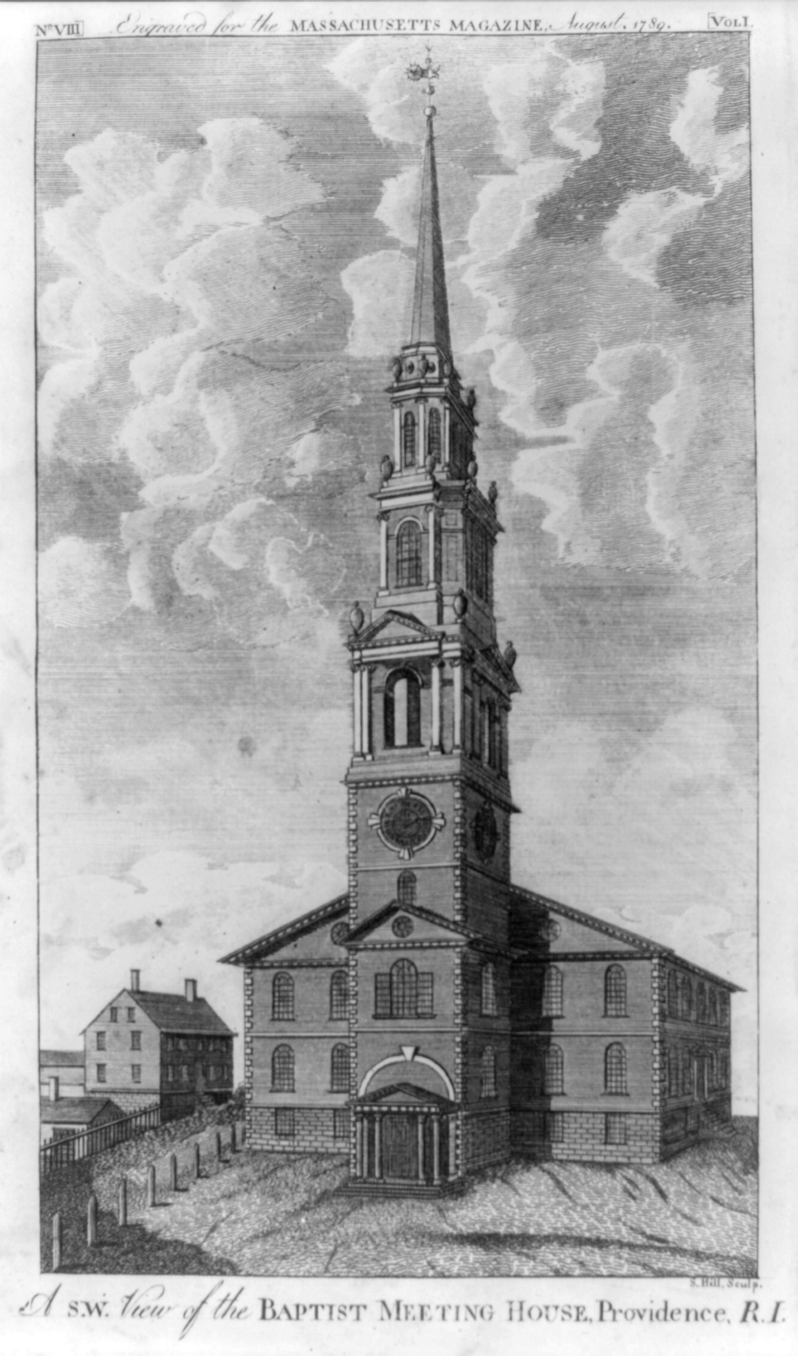
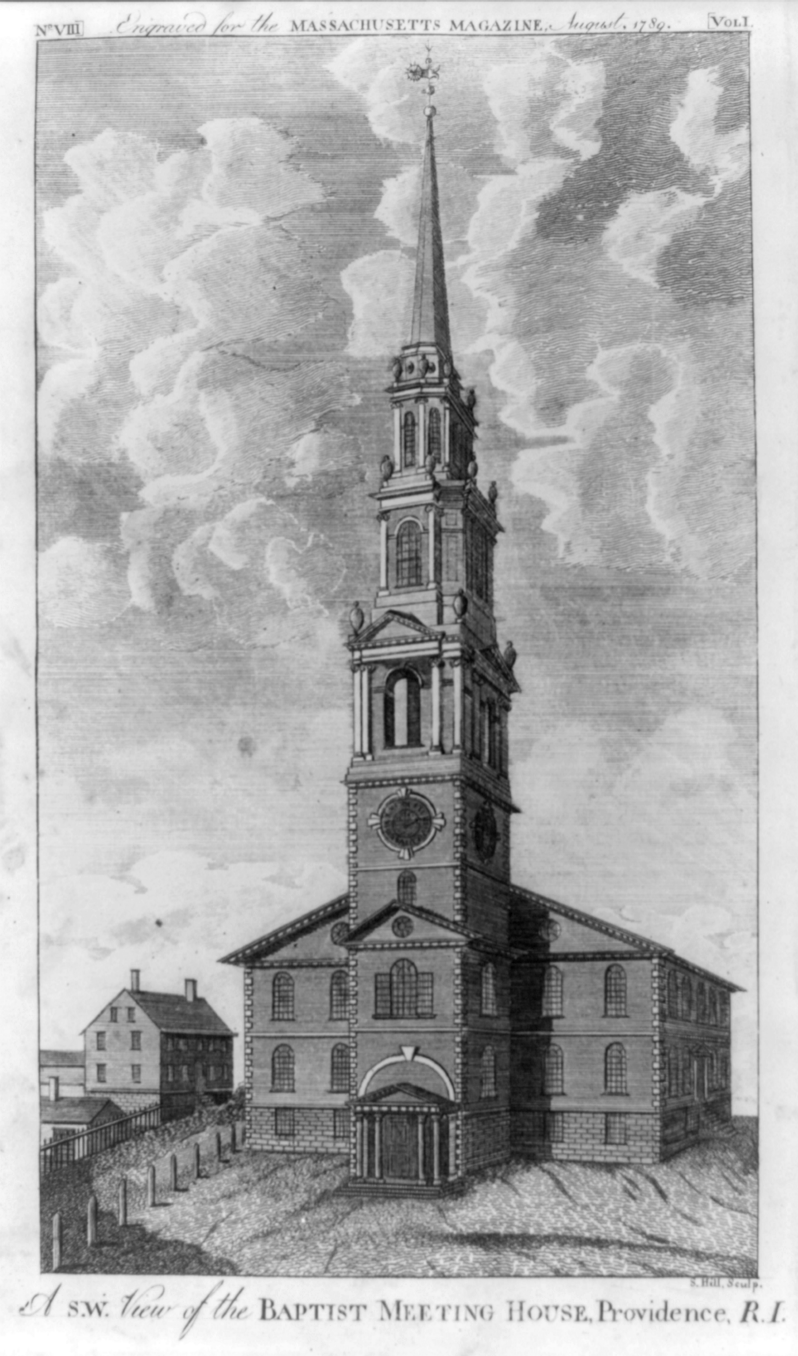
“A S.W. View of the Baptist Meeting House, Providence, R.I.” (Library of Congress)
Due to his traditional Congregationalist background, Morse had certain prejudices against Rhode Island. At the time, the Congregational church was the established church in Massachusetts and Connecticut. Most citizens in those states had to pay a fee for the church’s establishment. Morse looked askance at Rhode Island for it not having a mechanism for funding the state’s churches. The Baptists, which he deals with in some detail, in particular opposed paying the fee and having Congregationalist declared the established church of Connecticut and Massachusetts. Of course, Rhode Island had a long tradition of having no established church and tolerating other faiths.
Morse also deeply opposed the Rhode Island General Assembly issuing its own paper money in the mid-1780s. At this time, after the end of the Revolutionary War, Rhode Island was in a deep recession. The issuance of the paper money allowed state debtors, mostly farmers, to pay their debts to creditors. The creditors suffered, as the paper money was worth less than ten percent of its face value. But the General Assembly’s approach worked for Rhode Island; the state did not undergo internal strife, as did its neighbor Massachusetts, which experienced Daniel Shays’s Rebellion by farmers in western Massachusetts. Still, the issuance of the paper money was strongly opposed by most elites outside of Rhode Island, including by Morse in several places below. (Once Rhode Island’s debts were repaid, it agreed to join the new United States and adopted the U.S. Constitution. But that did not occur until May 29, 1790.)
Morse was pleased that Rhode Island had passed legislation gradually ending slavery (in 1784) and ending Rhode Island’s participation in the African slave trade (in 1787). However, Morse did not then realize that the state’s slave trade law was not enforced by state officials, so that some merchants and ship captains in Newport, Bristol and Providence continued to invest in slave trading voyages until the federal government banned the slave trade in 1808.
It is also obvious that Morse had little knowledge of the Narragansetts and other Indian nations in Rhode Island.
When Morse says something that I consider to be particularly outrageous, I have added the word in brackets, “wow!” There are five of them; you can search for the term: wow!
I have made a few revisions to the text, mostly changing hundreds of what look like the letter “f” to the letter “s.” Enjoy!]
Aquidneck Island [called Rhode Island]:
It is a noted resort for invalids from southern climates [i.e., the southern states and British Caribbean islands]. The island is exceedingly pleasant and healthful; and is celebrated for its fine women. Travelers, with propriety, call it the Eden of America.
It suffered much by the late war [i.e., the British occupation during the Revolutionary War]. Some of its most ornamental country seats [i.e., large farm houses] were destroyed, and their fine groves, orchards, and fruit trees, wantonly cut down. The soil is of a superior quality. Before the war 30,000 sheep commonly fed upon this island; and one year there were 37,000. Two years ago there were not 3,000 sheep upon the island.
Climate:
Rhode Island is as healthful a country as any part of North America. The winters, in the maritime parts of the State, are milder than in the inland country; the air being softened by a sea vapor, which also enriches the soil. The summers are delightful, especially on Rhode Island [i.e., Aquidneck Island], where the extreme heats, which prevail in other parts of America, are allayed by cool and refreshing breezes from the sea.
The disorders most prevalent, are consumption and the dysentery. These are not so much owing to the climate, as to intemperance and imprudence. [Note from the editor: Wow! Knowledge of the causes of disease was limited at this time]
Soil and Productions:
This State, generally speaking, is a country for pasture and not for grain. It, however, produces corn, rye, barley, oats and flax, and culinary plants and roots in great variety and abundance. Its natural growth is the same as in the other New England States. The western and northwestern parts of the State are but thinly inhabited, and are barren and rocky.
In the Narragansett country [mostly consisting of South Kingstown, North Kingstown and Narragansett] the land is fine for grazing. The people are generally farmers, and raise great numbers of the finest and largest neat cattle in America, some of them weighing from 16 to 1800 weight. They keep large dairies, and make butter and cheese of the best quality, and in large quantities for exportation.
Narragansett is famed for an excellent breed of pacing horses. They are strong, and remarkable for their speed, and for their excellency in enduring the fatigues of a long journey. [Editor’s comment: George Washington owned a Narragansett Pacer.]
Trade:
Before the war, the merchants in Rhode Island imported from Great Britain, dry goods; from Holland, money; from Africa, slaves; from the West Indies, sugars, coffee, and molasses; and from the neighboring colonies, lumber, and provisions. With the money which they obtained in Holland, they paid their merchants in England; their sugars they carried to Holland; the slaves from Africa, they carried to the West Indies, together with the lumber and provisions procured from their neighbors; the rum distilled from molasses, was carried to Africa to purchase negroes; with their dry goods from England they trafficked with the neighboring colonies. By this kind of circuitous commerce, they subsisted and grew rich.
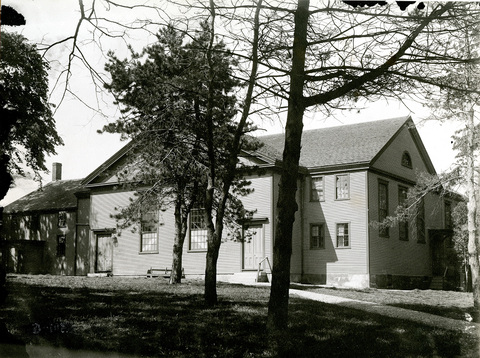
Society of the Friends Great Meeting House, Newport (Providence Public Library Digital Collections)
But the war, and some other events have had a great, and in most respects, an injurious effect upon the trade of this State. The slave trade, which was a source of wealth to many of the people in Newport, and in other parts of the State, has happily been abolished. The legislature has passed a law prohibiting them [i.e., Rhode Island seamen] from going to Africa for slaves, and selling them in the Weft India islands; and the oath of one seaman, belonging to the ship, is sufficient evidence of the fact. This law is more favorable to the cause of humanity, than to the temporal interests of the merchants who had been engaged in this inhuman trade.
The prohibition of the slave trade, and the iniquitous and destructive influence of paper money, combined with the devastations of a cruel war, have occasioned a stagnation of trade in Newport, which is truly melancholy and distressing. The salutary influences of a wise and efficient government, it is hoped, will revive the desponding hopes of the people in this beautiful city, and place them in their former affluent and respectable situation.
The present exports from the State are flax seed, lumber, horses, cattle, fish, poultry, onions, cheese, and barley. The imports, consisting of European and West India goods, and logwood from the Bay of Honduras, exceed the exports. About 600 vessels enter and clear annually at the different ports in this State.
Indians:
There are about 500 Indians in this State. The greater part of them reside at Charlestown. They are peaceable and well disposed towards government, and speak the English language.
Chief Towns:
Newport. Its harbor, which is one of the finest in the world [wow!], spreads westward before the town. The entrance is easy and safe, and a large fleet may anchor in it and ride in perfect security. The town lies north and south upon a gradual ascent as you proceed eastward from the water, and exhibits a beautiful view from the harbor, and from the neighboring hills, which lie westward upon the Main.
West of the town is Goat Island, on which is a fort. Between this island and the town is the harbor. Front or Water Street [now Thams Street] is a mile in length and level. Newport contains about 1,000 houses, built chiefly of wood, and 5,530 inhabitants.
It has nine houses for public worship: three for the Baptists, two for Congregationalists, one for Episcopalians, one for Quakers, one for Moravians, and a synagogue for the Jews.
The other public buildings are a State House, and an edifice for the public library. The situation, form and architecture of the State Hose, give it the preference to most public buildings in America. It stands sufficiently elevated, and a long wharf and paved parade lead up to it from the harbor.
The building for the Library consists of one large room, thirty-fix feet long, twenty-fix feet broad and nineteen feet high, where the books are kept, with two small offices adjoining. . . . In the year 1747, Abraham Redwood, Esq. gave 1,294 volumes, valued at 500 sterling, as the foundation of a library in Newport. Several other valuable donations were afterwards given. . . . This elegant building is now much out of repair, and one third of the books in the library were either carried off or destroyed by the British during the war.
Providence is situated on Providence River, about thirty miles northwest of Newport. It is at present by far the most flourishing town in the State. It contains 700 houses, and upwards of 4,300 inhabitants. Its public buildings are a college [University Hall at what is now Brown University], an elegant church for Baptists, two for Congregationalists, besides others for other denominations. This town carries on a large foreign trade, and an extensive and gainful traffic with the surrounding country. The town is situated on both sides of the river, and is connected by a commodious bridge. The inhabitants of Providence, the last year, manufactured 100,000 yards of cloth, more than in any year since the peace. This cloth, at a moderate valuation, will amount to 20,000 Dollars.
This town [Providence], and Newport, and a few others, have, from the first, firmly opposed the late iniquitous measures of their infatuated legislature [i.e., the issuance of paper money].
Bristol is a pleasant little town, about sixteen miles north of Newport, on the Main. It has an excellent soil, and is almost as remarkable for the production of onions, as Wethersfield in Connecticut. [Editor’s note: I did not know Bristol was known for producing onions.]
Fishes:
In the rivers and bays are plenty of sheepshead, blackfish, herring, shad, lobsters, oysters, and clams; and around the shores of Rhode Island, besides those already mentioned, are cod, halibut, mackerel, bass, haddock, &c. &c. to the amount of more than seventy different kinds, so that in the seasons of fish, the markets are alive with them. Travelers are agreed that Newport furnishes the best fish market in the world. [Wow!]
Religion:
The constitution of the state admits of no religious establishments, any further than depends upon the voluntary choice of individuals. All men professing one Supreme Being, are equally protected by the laws, and no particular sect can claim pre-eminence. This unlimited liberty in religion is one principal cause why there is such a variety of religious sects in Rhode Island.
The Baptists are the most numerous of any denomination in the state. In 1784 they had thirty congregations. These, as well as the other Baptists in New England, are chiefly upon the Calvinistic plan as to doctrines, and independents in regard to church government. There are, however, some who profess the Arminian tenets, and are called Arminian Baptists. Others observe the Jewish or Saturday Sabbath, from a persuasion that it was one of the ten commandments, which they plead are all in their nature moral, and were never abrogated in the New Testament, and must at least be deemed of equal validity for public worship as any day particularly set apart by Jesus Christ and his apostles. These are called Sabbatarian, or Seventh Day Baptists. There are others who are called separate Baptists. The Baptists in general refuse to communicate with other denominations; for they hold that immersion is necessary to baptism, and that baptism is necessary to communion. Therefore, they suppose it inconsistent for them to admit unbaptized persons (as others are in their view) to join with them in this ordinate.
The other religious denominations in Rhode Island are Congregationalists, Friends or Quakers, Episcopalians, Moravians, and Jews. There is also a small number of the Universal Friends, the disciples of Jemima Wilkinson. [Editor’s note: search for her in our articles] Besides these there is a considerable number of the people who can be reduced to no particular denomination, and are, as to religion, strictly Nothingarians.
In some parts of this state, public worship is attended with punctuality and propriety, in others they make the sabbath a day of visiting and festivity; and in others they esteem every day alike, having no place of meeting for the purpose of religious worship. They pay no taxes for the support of ecclesiastics of any denomination; and a peculiarity which distinguishes this state from every other Protestant country in the known world is, that no contract formed by the minister with his people, for his salary, is valid in law. So that ministers are dependent wholly on the integrity of the people for their support since their salaries are not recoverable by law. It ought in justice, however, to be observed, that the clergy in general are liberally maintained, and none who merit it have reason to complain for want of support.
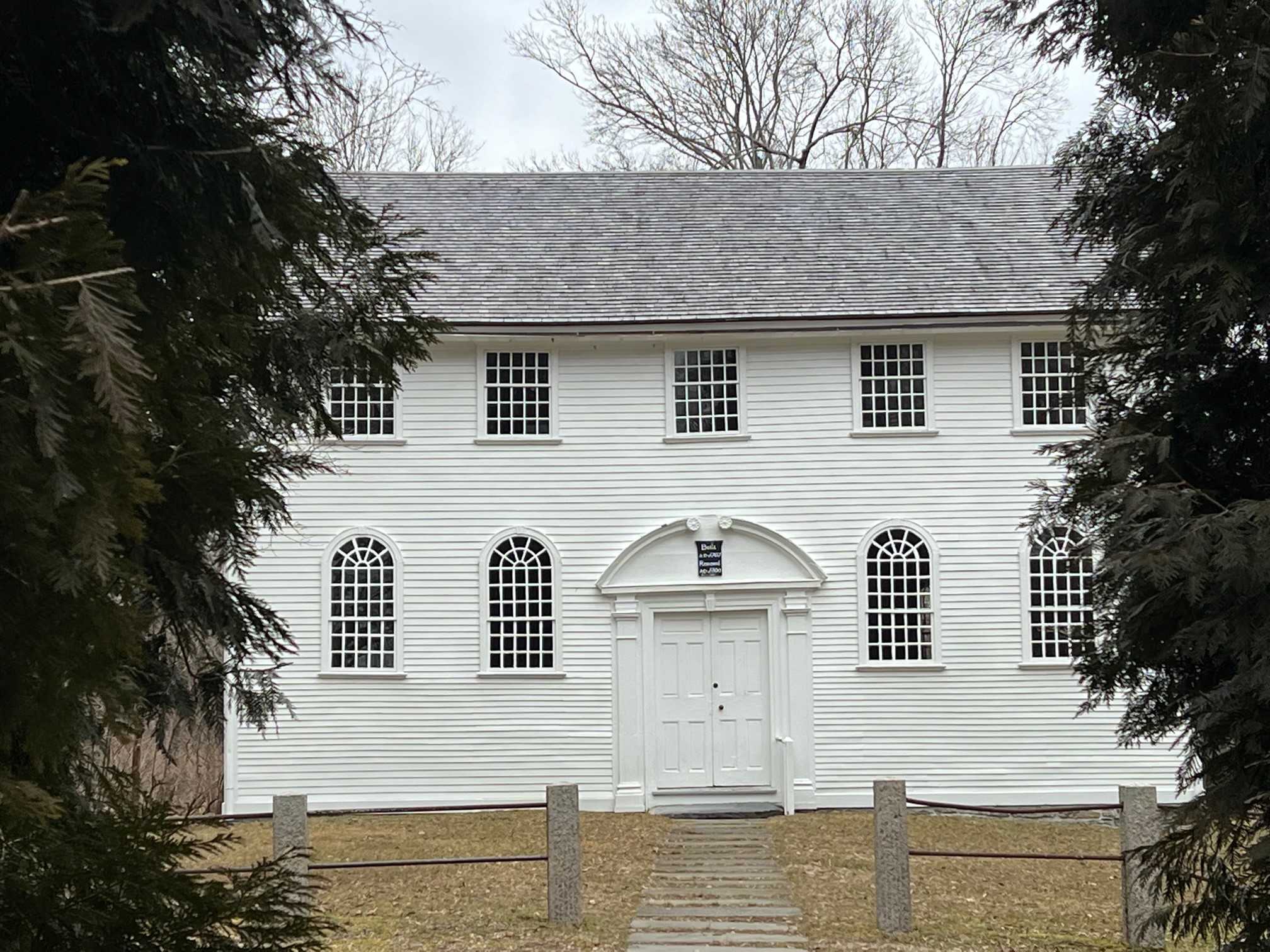
Old Narragansett Church. The Episcopal Church was originally located on the border of South and North Kingstown. It was moved to Wickford in 1800 (Christian McBurney)
Academics:
The literature of this state is confined principally to the towns of Newport and Providence. There are men of learning and abilities scattered through other towns, but they are rare. The bulk of the inhabitants in other parts of the state are involved in greater ignorance perhaps than in any other part of New England. [Note from the editor: Wow! It must be admitted that outside Newport and Providence, there were few public schools in Rhode Island.] (An impartial history of their transactions since the peace [meaning the issuance of paper money by the General Assembly], would evince the truth of the above observations.)
Rhode Island College (Now Brown University):
At Providence is Rhode Island College. The charter for founding this Seminary of Learning was granted by the general assembly of the year 1764, in consequence of the petition of a large number of the most respectable characters in the state. By the charter, the corporation of the college consists of two separate branches by the name of the Trustees and Fellows of Rhode Island College, with distinct, separate, and respective powers. The number of trustees is thirty-six, of whom twenty-two are of the denomination called Baptists, five of the denomination of Friends, five Episcopalians, and four Congregationalists. The same proportion of the different denominations to continue in perpetuum. The number of the fellows (inclusive of the president, who is a fellow ex-officio) is twelve, of whom eight are Baptists, the others chosen indiscriminately from any denomination of Protestants. The concurrence of both branches, by a majority of each, is necessary for the validity of any act, except adjudging and conferring degrees, which exclusively belongs to the fellowship as a learned faculty. The president must be a Baptist; professors and other officers of instruction are not limited to any particular denomination. There is annually a general meeting of the corporation, on the first Wednesday in September, at which time the public commencement is held.
This institution was first founded at Warren, in the county of Bristol, and the first commencement held there in 1769, at which time seven persons, alumni of the college, received the degrees of Bachelor of Arts.
The name of the college (Rhode Island College) to be altered when any generous Benefactor arises, who by his liberal donation shall entitle himself to the honor of giving the college a name. [Note from the editor: The Brown family would meet this standard in future years.]
In the year 1770, the college was removed to Providence, where a large, elegant building was erected for its accommodation, by the generous donations of individuals, mostly from the town of Providence. It is situated on a hill to the east of the town; and while its elevated situation renders it delightful, by commanding an extensive, variegated prospect, it furnishes it with a pure, salubrious air. The edifice is of brick, four stories high, 150 feet long, and 46 wide, with a projection of ten feet each side. It has an entry lengthwise with rooms on each side. There are forty eight rooms for the accommodation of students, and eight larger ones for public uses. The roof is covered with slate. From December 1776, to June 1782, the college edifice was used by the French and American troops for a hospital and barracks, so that the course of education was interrupted during that period. No degrees were conferred from 1776 to 1786.
From 1786 the college again became regular, and is now very flourishing, containing upwards of sixty students. This institution is under the instruction of a president, a professor of natural and experimental philosophy, a professor of mathematics and astronomy, a professor of natural history, and three tutors. The several classes are instructed in the learned languages, and the various arts and sciences.
The studies of the freshman year are the Latin and Greek languages, English grammar, and rhetoric. Of the sophomore, Guthrie’s geography, Ward’s arithmetic, Hammond’s algebra, Sheridan’s rhetorical grammar and lectures on elocution, Watts’s logic, and Cicero de Oratore. Of the junior, Horace, Kaim’s elements of criticism, Euclid’s elements, Atkinson’s epitome, Love’s surveying, Martin’s grammar, Philosophia Britannica, and Ferguson’s astronomy. Of the senior, Lucian’s dialogues, Locke’s essays on the human understanding, Hutchinson’s moral philosophy, Bolingbroke on history, and a review of all the studies of the several years.
Every year there are frequent exercises in speaking, and the various kinds of composition. There are two examinations, several public exhibitions for speaking, and three vacations annually.
The institution has a library of between two and three thousand volumes, containing a valuable collection of ancient and modern authors. [This is a]lso a small, but very valuable philosophical apparatus. Nearly all the funds of the college are at interest in the treasury of the state, and amount to almost two thousand pounds.
At Newport there is a flourishing academy, under the direction of a rector and tutors, which teach the learned languages, English grammar, geography, &c.
Societies:
A marine society was established at Newport in 1752, for the purpose of relieving distressed widows and orphans of maritime brethren, and of such of their society as may need assistance.
Curiosities:
About four miles northeast of Providence lies a small village, called Pawtucket, a place of some trade, and famous for lamprey eels. Through this village runs Pawtucket River, which empties into Providence River two miles east of the town. In this river is a beautiful fall of water, directly over which a bridge has been built, which divides the Commonwealth of Massachusetts from the state of Rhode Island. The fall, in its whole length, is upwards of fifty feet. The water passes through several chasms in a rock which runs diametrically across the bed of the stream, and serves as a dam to the water.
Several mills have been erected upon these falls; and the spouts and channels which have been constructed to conduct the streams to their respective wheels, and the bridge, have taken very much from the beauty and grandeur of the scene, which would otherwise have been, indescribably charming and romantic. [Note from the editor: Wow! Morse is an early environmentalist. He mentions some of the earliest mills in the country spoiling the view.]
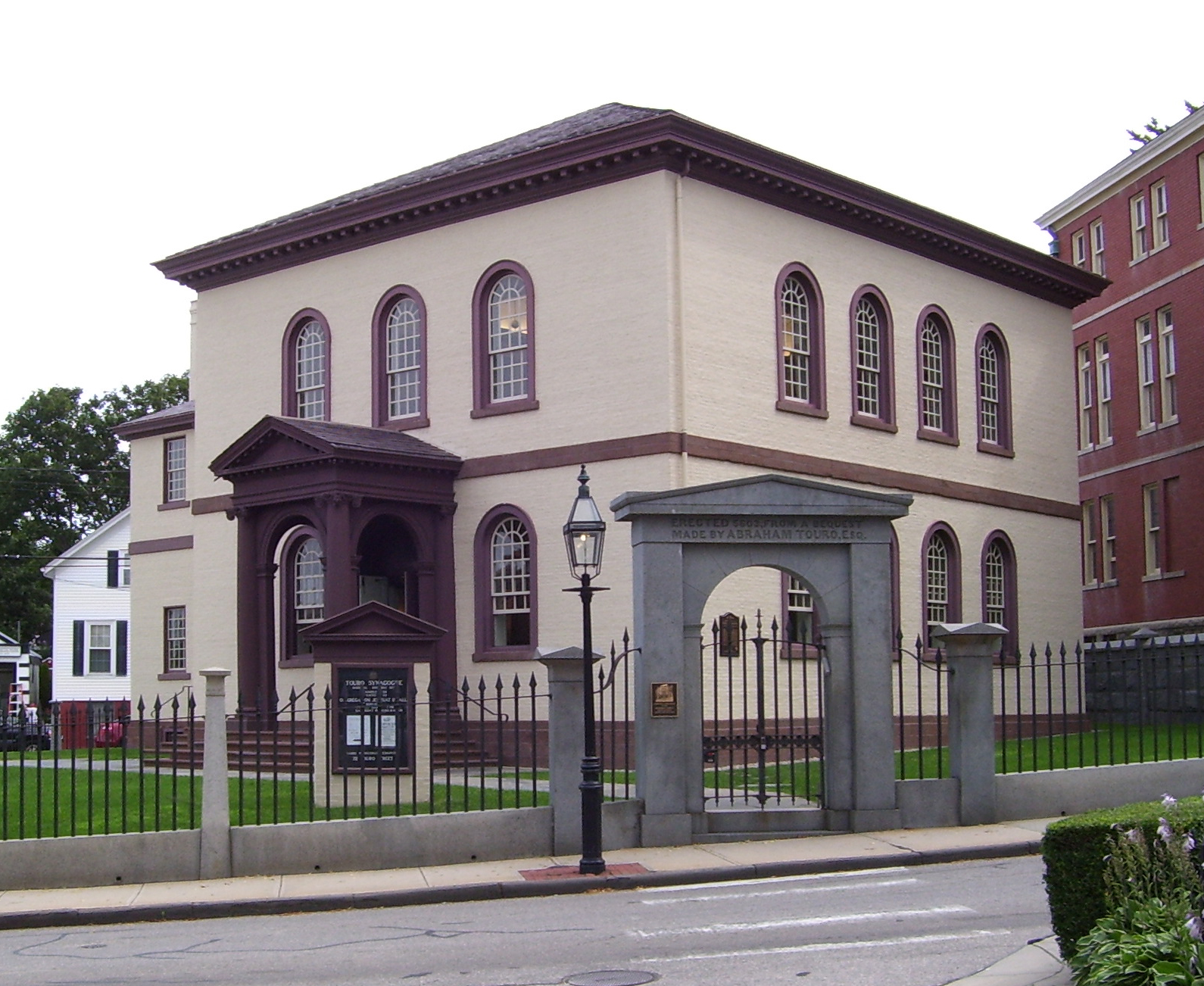
Touro Synagogue, Newport (Christian McBurney)
Constitution:
The constitution of this state is founded on the charter granted by Charles II in the fourteenth year of his reign; and the frame of government was not essentially altered by the revolution. The legislature of the state consists of two branches—a senate or upper house, composed of ten members, called in the charter assistants—and a house of representatives, composed of deputies from the several towns. The members of the legislature are chosen twice a year; and there are two sessions of this body annually, viz., on the first Wednesday of May, and the Last Wednesday in October.
The supreme executive power is vested in a governor, or in his absence, in the deputy governor, who are chosen annually in May by the suffrages of the people. The governor presides in the upper house, but has only a single voice in enacting laws.
There is one supreme judicial court, composed of five judges, whose jurisdiction extends over the whole state, and who hold two courts annually in each county.
In each county, there is an inferior court of common pleas and general sessions of the peace, held twice a year for the trial of causes not capital, arising within the county, from which an appeal lies to the supreme court.
The justices of the peace, as in other States, have cognizance of small causes; and since the revolution, their powers have been enlarged to an uncommon, if not dangerous, extent.
Paper Money:
. . . Enough has already been said upon the paper money injustice and political confusion which pervade this unhappy State. I will only observe that these measures have deprived the state of great numbers of its worthy and most respectable inhabitants; they have had a most pernicious influence upon the morals of the people, by legally depriving the widow and the orphan of their just dues, and otherwise establishing iniquity by law, and have occasioned a ruinous stagnation of trade. It is hoped the time is not far distant, when a wise and efficient government will abolish these iniquitous laws, and restore tranquility to the State.
You Might Also Like