

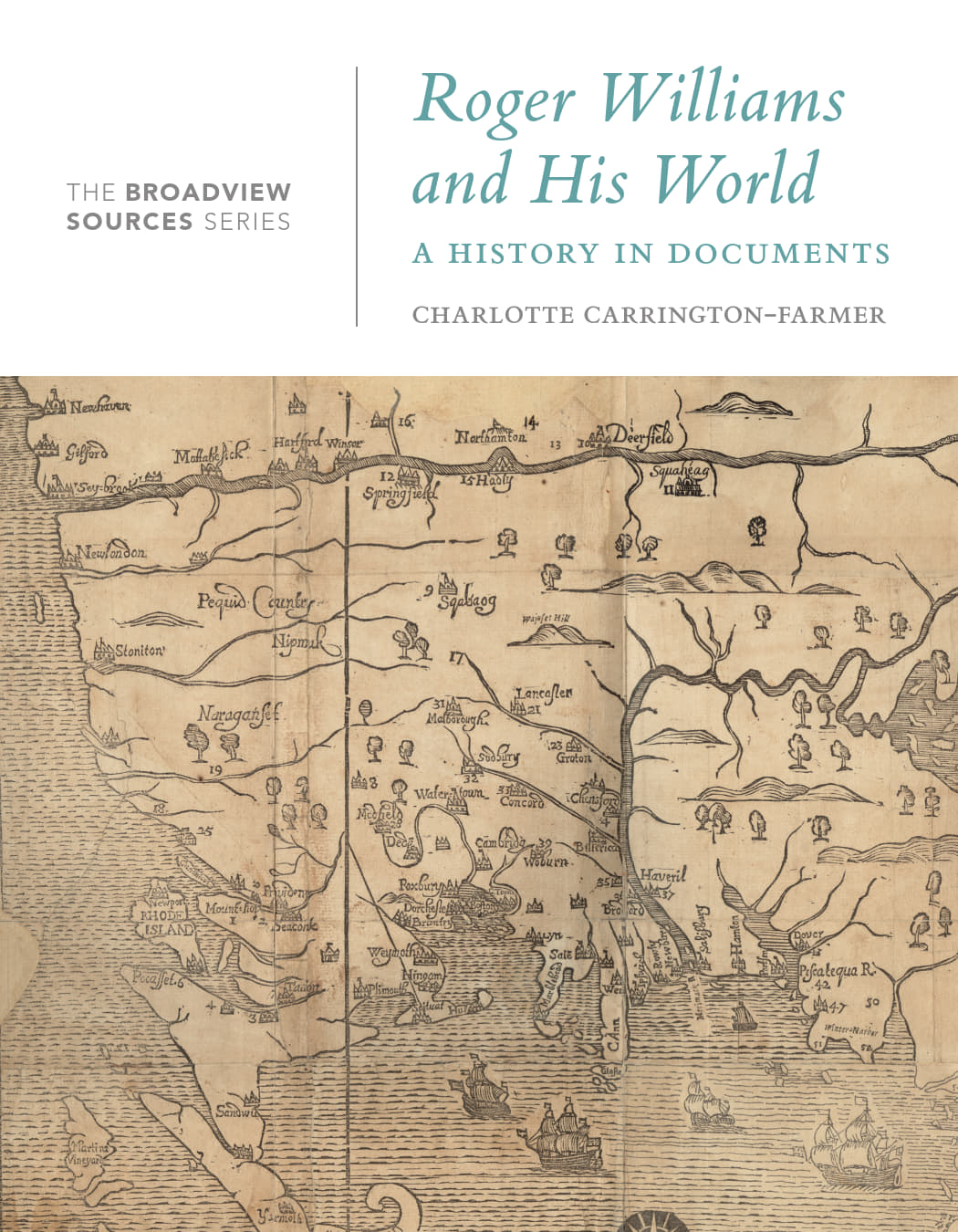
Roger Williams may be the most written-about person in 17th century New England, as pointed out in this anthology. Several books have addressed his remarkable career, including Edmund Morgan’s 1967 Roger Williams, The Church, and the State and John Barry’s 2012 Roger Williams and the Creation of the American Soul: Church, State, and the Birth of Liberty. A year before this collection came out, a remarkably similar anthology of Williams’ writings appeared, edited by Linford Fisher, Sheila McIntyre, and Julie Fisher.[1]
Williams’s prominence is for good reason. He was one of the most articulate leaders of the European colonization of Americas. Like John Smith and John Winthrop, he led the founding of a colony and future state. And, of course, he is counted among the founders of the four early towns of Rhode Island, along with Anne Hutchinson, William Coddington, and Samuel Gorton. The 2024 anthology emphasized Williams’s relations with tribes already present when he arrived in the future Rhode Island.
Unlike these other leaders, Williams had views that we can recognize as remarkably modern. As Barry and others suggest, Williams was perhaps the world’s first true liberal—in the classical sense of seeking governmental protection but insisting that these protectors not infringe on personal behavior. Other colonial leaders focused on building settlements under harsh conditions, and negotiating with skeptical English rulers. Williams did that along with advancing novel ideas about freedom.
This 2025 anthology, a hundred pages shorter than the earlier collection, is less concerned with Williams’s relations with the already-resident tribes. The two anthologies have substantial overlap in the documents included, but this collection is more conducive to understanding a crucial topic: how Williams became a liberal for his time. Where the earlier anthology ends with the “unraveling” due to King Philip’s War, this book ends with Williams’s writings on religious freedom.
This second anthology is also geared toward college students and non-specialists, with a long introduction and textual notes explaining concepts and people, as well as some updated and consistent spelling (I believe it could have done more). It comes from Charlotte Carrington-Farmer, a professor of history at Roger Williams University and the closest we have in the Ocean State to a tenured academic historian focused on Rhode Island.
The book takes a cautious approach on current academic controversies. It puts in a footnote the debate over whether the British King Charles II gave Rhode Island its extraordinarily liberal charter mainly to promote monarchy against Puritan Massachusetts; it merely invites readers to read Adrian Weimer’s strong argument.[2]
Nor does the book, unlike Barry’s and Morgan’s, extend Williams’s accomplishments beyond religious liberty into a general liberalism. It does accurately praise Williams for actually putting his novel ideas into practice, so different from the liberal writers who had minimal political authority.
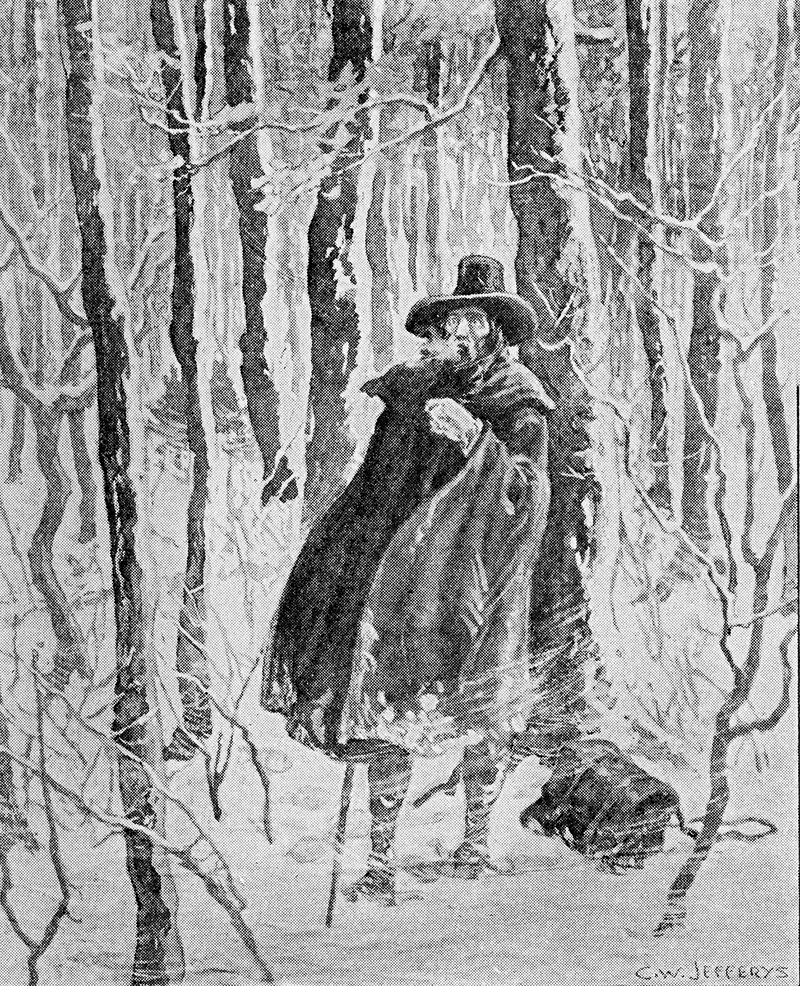
Roger Williams, after his banishment, imagined as trekking through the woods on his way to found Providence
Roots of Liberalism
Unlike the previous collection, this anthology starts with several documents on the religious persecution and burnings at the stake near where Roger Williams grew up in London. He came of age at a time of peace and prosperity in the wake of England’s 1588 victory over the mighty Spanish Armada, but one also of terrible acts against dissent by his government. What’s more, the monarch’s religious stance changed with each new ruler, as an excerpt from Williams’ later writings explain. The English Civil War of 1642 to ‘51 arose mainly from the monarchy attempting to prevent development, while Rhode Islanders had forty years of peace after the Pequot War of 1637-38. It was a fertile ground for the rise of liberalism: little outside threat, but rulers’ overzealous drive for conformity.[3]
The anthology also includes some vital documents for Williams’ putting this liberalism in practice. It excerpts from a fascinating letter he wrote in August 1636 to John Winthrop, a former and later governor of the Massachusetts Bay Colony. After establishing Providence, Williams struggled to enforce equality and liberalism in the budding colony, against those who expected him to dominate the village and determine who may enter.
It goes on to present excerpts from the great royal charter of 1663, which permitted Rhode Islanders to “hold forth a lively experiment …with full liberty in religious concernments.” The six pages devoted to the charter show that King Charles was concerned more with gaining loyalty from colonists than with liberalism per se. Williams had good timing, and he got what we wanted. The text is marred by a few typos (especially at the top of p. 83, “become” instead of “because”), but is otherwise worth reading.
The anthology also presents the key map showing the layout of Providence town lots in 1650. Unlike other New England villages circling a common green, Williams laid out the land parcels along a line. He also gave all the settlers, including himself, an equal share of land, though he did set his plot near the well, the main source of fresh water. It was a bold way of promoting liberalism. Instead of promoting a watchful community, with a privileged class responsible for everyone else, the layout left people on their own as equal individual households, free to live as they pleased.
The anthology would have benefitted from parallel documents in other colonies, to contrast with what Williams was doing. It would be powerful to present, for example, the Massachusetts Bay colony’s 1639 ruling against Robert Keayne. That decision concluded in a heavy fine for the “very evil” and “corrupt practice” of overcharging his customers and placing profit above the community’s needs. Just as Roger Williams was setting up a liberal government, neighboring governments were aggressively intervening for the community’s well-being.[4] The contrast is especially relevant now as we debate issues of social responsibility.
Also absent, perhaps appropriately, is the long view of Williams’s liberalism. Ironically, while he and his most vociferous followers, such as Samuel Gorton, focused on religious freedom, their liberal government enabled other Rhode Islanders to devote themselves to entrepreneurship. In successfully opposing the great developer William Coddington, who led the building up of Newport and sought to rule over all of the colony, they actually freed up economic opportunity for others.[5]
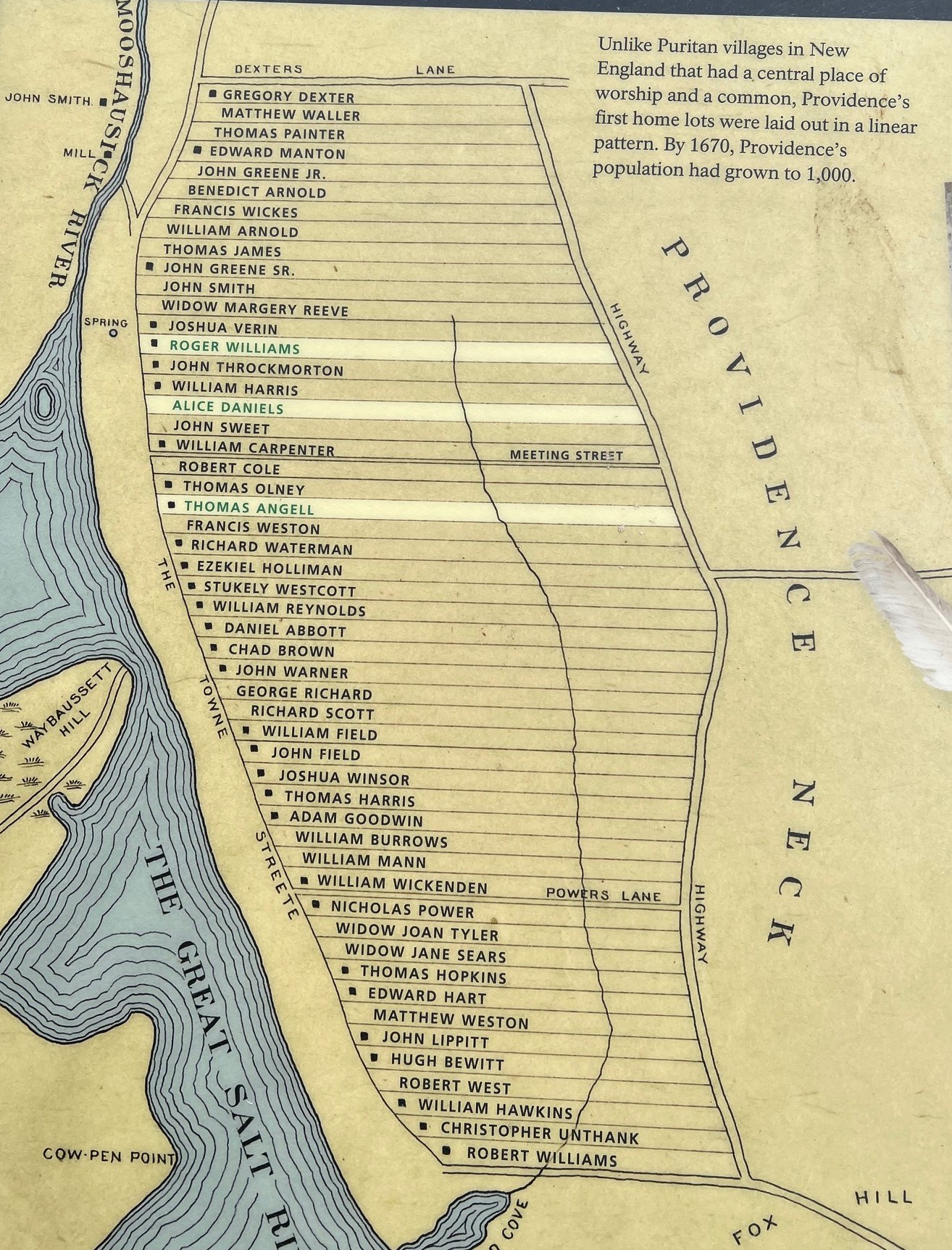
Roger Williams laid out Providence’s first home lots up what become College Hill. He offered equal allotments of land to all settlers, paving the way for increasing the percentage of men eligible to vote. Unusual for the time, two of the first nine lots were allocated to women, Alice Daniels and Margery Reeve (Roger Williams National Memorial Park)
The Liberal Leap
The many documents excerpted on religious freedom, especially the exchange with Anne Sadlier, remind us that Williams was both genial with others and focused on matters of conscience and salvation. He may have grown up as the son of a tailor, but his thoughts were on theology—without becoming a malcontented zealot who alienated the many people who disagreed with him.
Perhaps his deep religious commitment was essential. Back then, the only way to achieve liberalism was to break the assumption that we required a communal, hierarchical society where leaders, whether kings, lords, or governors, looked after the well-being (economic and spiritual) of everyone else. In debates with conventional leaders, it’s clear that Williams was mostly talking past his interlocutors, so strange and unexpected were his ideas.
After all, colonial society of the 17th century was concerned above all with order and obedience. Liberalism, it was assumed, would lead to anarchy and death for people still living on the edge of survival. But Williams had the confidence to believe otherwise, as well as the hardiness and resilience to live in the poverty that resulted from his devotion. His long-suffering wife, Mary, who shared that deprivation, also gets some due here.
In a 1655 open letter to fellow residents of Providence, Williams emphasized that his liberty of conscience did not extend to the disorder and disobedience that everyone feared.
There goes many a ship to sea, with many hundred souls in one ship, whose weal and woe is common, and is a true picture of a commonwealth…. It hath fallen out sometimes, that both papists and protestants, Jews and Turks, may be embarked in one ship; upon which supposal I affirm, that all the liberty of conscience, that ever I pleaded for, turns upon these two hinges—that none of the papists, protestants, Jews, or Turks, be forced to come to the ship’s prayers of worship, nor compelled from their own particular prayers or worship, if they practice any. I further add that I never denied, that notwithstanding this liberty, the commander of the ship ought to command the ship’s course, yea, and also command that justice, peace, and sobriety be kept and practiced.[6]
Williams was the first to disprove that fearful assumption with an actual functioning society. He was nowhere near as articulate as John Locke, often seen as the founder of liberalism, but with luck and persistence, he succeeded.
The anthology also shows Williams’s shrewd practicality in navigating the religio-political controversies of the time. In a 1670 letter to the Governor of the Plymouth colony, he suggested that his colony’s liberality was good for the rest of New England. Rhode Island was attracting the “distressed souls” who would disrupt the civil peace if they stayed in other colonies.
Of course, liberalism became the dominant political approach of the entire future United States, and it has developed a great deal since the 17th century. Society in Rhode Island and in most of the world no longer holds the prejudices that Williams had against the tribal peoples and others, and we rightly see slavery as a terrible offense. But we can still credit Williams with a major advance in human betterment, and this anthology demonstrates his originality.
Notes:
[1] Christian McBurney, “Book Review: Linford D. Fisher, Sheila M. McIntyre, and Julia A. Fischer, Reading Roger Williams: Rogue Puritans, Indigenous Nations, and the Founding of America, A Documentary History, The Online Review of Rhode Island History, March 30, 2025, https://smallstatebighistory.com/book-review-linford-d-fisher-sheila-m-mcintyre-and-julia-a-fisher-reading-roger-williams-rogue-puritans-indigenous-nations-and-the-founding-of-america-a-documentary-history/. [2] Adrian Weimer, A Constitutional Culture: New England and the Struggle Against Arbitrary Rule in the Restoration Empire (University of Pennsylvania Press, 2023) especially ch. 7; and Evan Haefeli, “How Special Was Rhode Island: The Global Context of the 1663 Charter,” in Chris Beneke, ed., The Lively Experiment: Religious Toleration in America from Roger Williams to the Present (Rowman & Littlefield, 2015), ch.1. [3] For details, see my “Roger Williams: Founder of Economic Development,” The Online Review of Rhode Island History, March 15, 2024, at https://smallstatebighistory.com/roger-williams-founder-of-economic-development/. [4] Jonathan Levy, Ages of American Capitalism (Random House, 2015), 17-18; and Margaret Newell, From Dependency to Independence: Economic Revolution in Colonial New England (Cornell University Press, 1998). [5] For details, see my “Roger Williams: Founder of Economic Development.” [6] Charlotte Carrington-Farmer, ed., Roger Williams and His World: A History in Documents (Broadview Press, 2025), pp. 164-65.The Author

You Might Also Like