

Christopher Greene was one of Rhode Island’s greatest heroes of the Revolutionary War, but his life was tragically cut short. He was appointed a lieutenant in the Kentish Guards, an independent company formed in East Greenwich in September 1774. He became a captain and commanded one of two divisions under Colonel Benedict Arnold in the legendary Expedition to Quebec that began in October 1775. He led his men in the arduous journey through the Maine wilderness, but he was captured in the failed assault on Quebec on December 26, 1775. After being a captive for more than a year, he was exchanged and appointed colonel of the First Rhode Island Regiment of Continentals. He commanded the First and Second Rhode Island Regiments of Continentals at the spectacular American victory in the defense of Fort Mercer in New Jersey on the Delaware River on October 22, 1777.

Colonel Christopher Greene (Library of Congress)
At Valley Forge, Greene was probably the main driver behind the reorganization of the First Rhode Island as a segregated regiment allowing enslaved Rhode Island men to enlist and obtain their freedom by doing so. The First Rhode Island (informally called the Black Regiment) also had free veterans of color from the First and Second Rhode Island who had served in 1777, including Narragansett Indians and men of mixed race descent. Greene left Valley Forge to recruit enslaved men in Rhode Island and supervised their training at East Greenwich. Greene commanded a brigade at the Battle of Rhode Island on August 29, 1778, while his First Rhode Island soldiers of color bravely helped to repel three assaults by enemy troops. The First and Second Rhode Island Regiments were merged into a single regiment, the Rhode Island Regiment, as of January 1781, and Greene assumed its command. The soldiers of color were transferred to two oversized, segregated companies.
Sadly, as a result of a bold raid by irregular Loyalist troops based near British-occupied New York City on May 14, 1781, Greene and others of his regiment were surprised at the Davenport House near Yorktown, New York. Greene was killed, as was Major Ebenezer Flagg of Newport, and six soldiers of color from the regiment (others were killed, wounded or taken prisoner in the raid too). Greene was buried at a nearby cemetery in Yorktown, New York.
Christopher Greene was born in 1732, the son of Judge Philip Greene and Elizabeth (Wickes) Greene of Warwick, Rhode Island. When his father passed away when he was 29, Christopher inherited his father’s main house and family business—a grist mill and a saw mill.
The following two lists below set forth Christopher Greene’s property. The first list, taken in 1779, was for town tax purposes. It included Greene’s real property and some of his personal property. The second list is an item-by-item inventory of his personal property taken after his untimely death in May 1781. It appears to show what an “upper middle class” family would have possessed at this time.
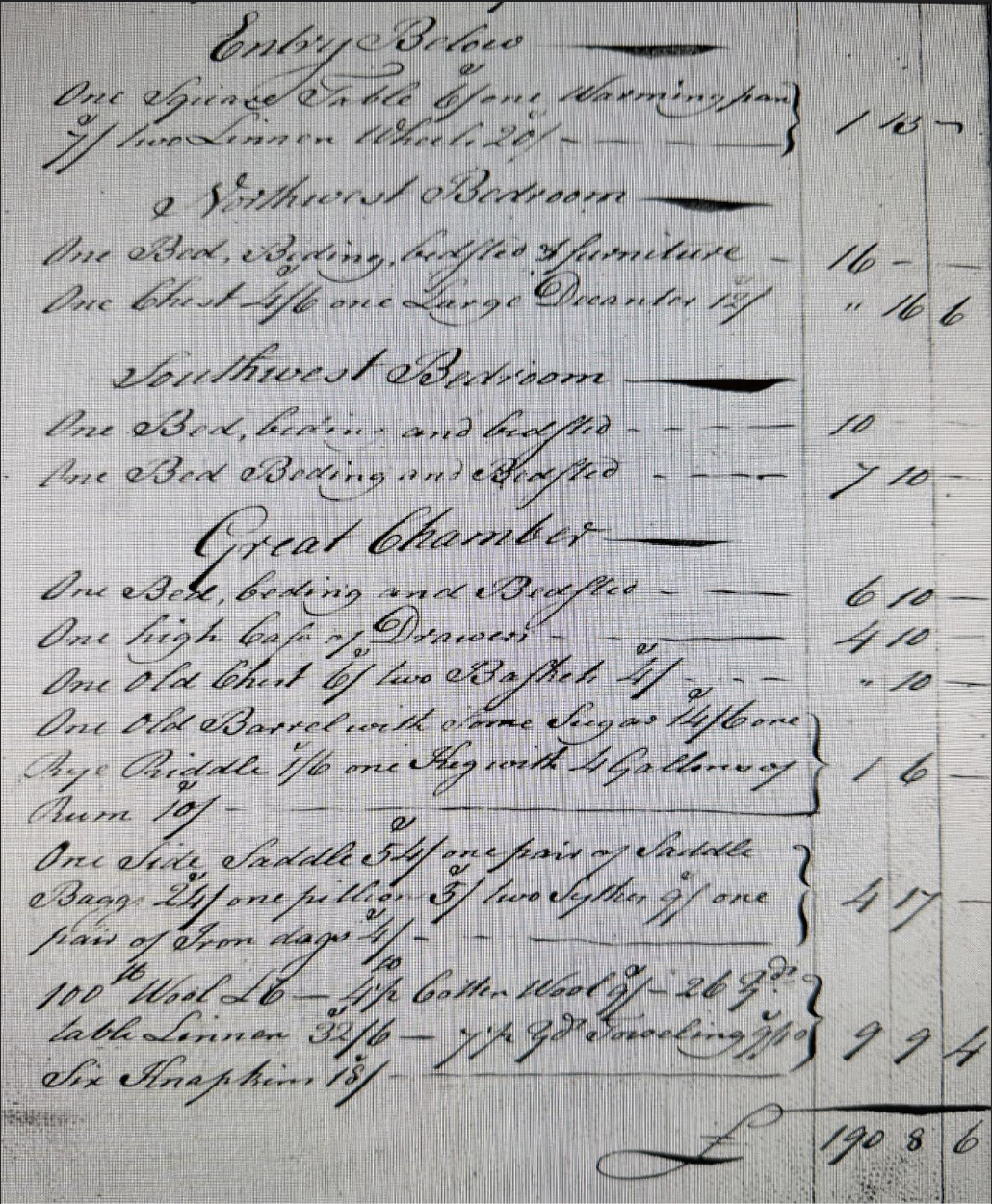
Page from the List of Inventory of Colonel Christopher Greene’s personal property, June 29, 1781 (Peter Fay)
In Rhode Island’s 1774 census, as set forth in the Rhode Island State Archives, Christopher Greene is reported as heading a household in Warwick consisting of eleven people, including a Black woman, a Black girl, and an Indian girl. While the Indian girl was most certainly a free servant, in 1774, most Black people in Rhode Island were enslaved. The laws covering the two lists set forth below required that any enslaved person be included in the list of personal property. No enslaved person is listed in either of the two lists. This indicates that Greene did not hold enslaved people in 1779 and 1781. It seems likely, then, that he did not in 1774 either, but he could have emancipated his enslaved people after 1774 and before 1779.
I have corrected the spelling, capitalization, and punctuation in the two lists, given the typical lack of attention to such matters in eighteenth century writing.
I have also added some commentary in brackets and italics.
Naturally, some words from the eighteenth century are obscure today. I obtained the definitions of the following words in brackets using an online version of Samuel Johnson’s 1773 dictionary: pillion; tow; and peck. I used AI to search for the meanings of the following words: stillyards; spider; and iron dag. I have not found the definition of the term “priddle,” but I am not sure I have the correct spelling of it either. I have not found the definition of “brass skims.”
List of Real and Certain Personal Property of Christopher Greene in Warwick, Rhode Island, in 1779
Source: Cherry Fletcher Bamberg and Diane MacLean Boumenot, eds., Warwick, Rhode Island Taxes, 1779 Estimates of Rateable Estate and The 1798 Direct Tax (Rhode Island Genealogical Society, 2024), page 39.
Col. Christopher Greene Rateable Estate in the Town of Warwick Exhibited this 29 Day November 1779:
360 acres of land, two dwelling houses, 2 small barns, 1 crib, 1 grist mill, 1 saw mill
20 acres of English meadow, cuts 10 tons of hay
8 acres of low meadow, cuts 6 tons of fresh hay
16 acres of tillage [i.e., farmland], will produce 15 bushels corn per acre
3 acres of orchard, will make 15 barrels of cider
5¼ acres of pasture, will feed 15 cows
The remainder is woodland and scrub land
3 horses, 7 [probably 2, see second list] oxen, 4 cows, 4 two yrs old [probably cows], 3 yearlings [probably cows], 40 sheep, 6 hogs, 5 shotes
[Christopher had 360 acres of land, but only 16 acres of it was farmed to grow crops, 28 acres was farmed for hay, and a bit more than five acres were used as pasture for cows, oxen, sheep and horses. He was not a commercial farmer]
11 Oz [ounces] of Plate [i.e., silver plate] [This amount of silver established Christopher as a man of some means]
In Debt in hard money 448 Dollars [This high amount of debt would have reduced the amount of his taxable property]
Exhibited by his Son by Reason he [i.e., Christopher Greene] was not at home
[signed] As witness my hand Job Greene [Job Greene, Christopher’s eldest son, managed his affairs while Christopher was serving as a colonel in the Continental Army]
List of Personal Property of Christopher Greene in Warwick, Rhode Island, in 1781
Source: Town of Warwick Probate Records, Wills Etc., Vol. 4, 1778-1797, pages 8-13 and page 35, Warwick Town Hall. The author thanks Peter Fay for finding this source and providing me a copy of the two inventory lists.
An Inventory of the Goods Chattlee [Chattel,] Right and Credits of Colo. Christopher Greene Late of Warwick in the County of Kent, etc., dec’d [deceased], Appraised by us Whose Names are here under Written on Fryday the 29th day of June 1781
[Note from the author: The values of each item are in pounds (£), shillings (e), and pence (d) as of 1774 (before paper money was issued and declined in value); there are 20 shillings to a pound]
To 2 Notes on hand: £97, 15 [This was money owed to Christopher]
1 dictionary and one bible: £0, 15, 0 [Apparently, Christopher and Elizabeth owned no other books. As will be seen below, they also did not possess any wall hangings or pieces of art]]
The Great Room Below [i.e., the first floor]
1 feather bed, bedding & bedstead & 1 desk: £7, 10, 0 [a servant may have slept in this bed on the first floor]
1 arm chair 4e, five banister backed chairs 20e: £1, 10, 0
6 framed chairs 18e, six common chairs 15e: £2, 17, 0
1 large table 16e, one tea table20e, one tea table 10 e: £2, 6, 0
1 small looking glass [mirror] 21e, five China plates 16e, one set China coffee cups & saucer 7e/6d, one set of tea cups 6e: £2, 4, 6
Closet Below [i.e., first floor]
1 China bowl 20e, two soup dishes 3e/6d, 1 large platter 1e/6d, three plates 2e/3d, four small plates 2e: £1, 9, 3
1 tea pot 14e, two bowls 1e/6d, one cream pot 3e, two large platters 5e, five small platters 9e: £1, 16, 1
One coffee pot 19e, one Tea pot 16e, one metal pot 1e/3d, one bowl 18d, one small plate 16d, two salt [shakers] 3e, one tea cannister 6e, one pepper box 6e, one large mug 2d, one small stone pot 1e, three cases knifes & forks 17e, six large silver spoons 7e/2s, seven small silver spoons 12e, 80lbs of Cheese 24e, two meal bags 2e 6d: £6, 18, 2
[Subtotal:] £124, 1, 0
Brought forward [from the Closet] and Continued £124,1, 0
One pair shears 18d, one case with 9 bottles containing 3 gallons of rum 14e, two brass candlesticks 4e, two small bottles 6d, 32 candles 24e, two boxes and other small articles 6d, 33lbs of tallow 22e: £3, 5, 8
Entry Below [i.e., entry hallway on the first floor]
One square table 6e, one warming pan 7e, two linen wheels 20e: £1, 13, 0
Northwest Bedroom [probably on the second floor]
One bed, bedding, bedstead & furniture: £16 [beds and bedding were quite expensive]
One chest 4e, one large decanter 12e: £0, 16, 6
Southwest Bedroom [probably on the second floor]
One bed, bedding and bedstead: £10, 0, 0
One bed, bedding and bedstead: £7,10, 0
Great Chamber [probably on the second floor]
One bed, bedding and bedstead: £6, 10
One high case of drawers: £4,10
One old chest 6e, two baskets 4e: £0, 10, 0
One old barrel with some sugar 14e, one rye priddle [sp.?] 1e/6d, one keg with 4 gallons of rum 10e: £1, 6, 0
One side saddle 5e/4d, one pair of saddle bags 24e, one pillion [a soft saddle behind a horseman for a woman to sit on] 5e, two scythes 9e, one pair of iron dags [a dagger like tool?] 4e: £4, 17, 0
100lbs wool £6/4e, cotton wool 9e, 26 yards table linen, 32e/6s, 7 yards toweling 9e/10d, six napkins 18e: £9, 9, 4
[Apparently, Christopher and Elizabeth liked to keep some of their valuable items in one of the bedrooms, including part of their supply of rum]
[Subtotal:] £190, 8, 6
Brought forward and Continued £190,8,6
Kitchen Chamber [probably on the first floor]
One bed, bedding and small bedstead: £5
One bed & bedding £4, one loom, warping barrs, tackling, etc. £4: £8
[Servants would have slept in the two beds in the Kitchen Chamber on the first floor; the loom and other equipment would have been used for weaving]
6lbs tow [flex or hemp beaten and combed into a filamentous substance] 2e/3d, one table, some old barch (birch?), and baskets 2e/6d: £0, 4, 9
Kitchen Below [probably on the first floor]
4 pewter platters & other pewter 35e, 1 tin coffee pot 2e, three iron candlesticks, 1e/6d: £1, 18, 4
One brass ladle 9d, one brass skims [?] 6d, one earthen pan 3d, one earthen bowl 2d, one earthen cream pot 16d: £0, 2, 2
One small table 4e, one meal chest 4e, one wooden wheel 6e, three trays, four pails and other wooden ware 26e, 8d: £2, 0, 8
Six old chairs 9e, two pairs flat Irons 8e, one pair stillyards [a scale for weighing goods] 3e, ½ pair of large stillyards 6e, one bake kettle 4e, two small iron pots 3e, one tea kettle 3e, two great iron pots 6e, one pair hand Irons 8e: £2, 10, 0
One fire slice & tong 2e, 3d, one gridiron 1e, 1 pair wool cards 3e, one hatchet 10e, two small boxes 1e, three bridles 9e, one sickle, four bottles and other ware 2e/6d: £1, 8, 9
One iron basin 1e/3d, one spider [cast iron cookware] 2e, one small iron skillet 1e/3d, one large iron kettle 15e: £0, 19, 6
[Subtotal:] £212,12,10
Brought forward and Continued £212,12,10
Kitchen Cellar [probably in the cellar]
One small cheese press 7e, one bread trough 3e, one old barrel and old barrel with sides 7e/6d, one old barrel with some soap 16e, one old hogshead and other old casks 6e, one small tub 6e: £2, 0, 0
Cellar Chamber [probably in the cellar]
1 meat cask with some pork 27e, 1 ditto [meat cask] with beef 51e/6d, one ditto [meat cask] with smoked meat 50e/6d, one chest, one cradle and other lumber 9e: £6,18, 0
[This meat was likely stored in the coolest part of the house, underground]
Saw Mill [an out building]
2 small iron bars 4e/8d, four saw mill files 6e, one saw set, marking irons and rule [ruler for measuring] 9e: £0, 19, 8
[This does not seem like a lot of equipment for a working saw mill]
Grist Mill [an out building]
3 axes 16e, one carpenter addle 4e, one small drawing knife 3e, three augers 18e, one collar and harness 13e/6d, one hammer 1e/3d: £2,15 , 9
8 mill pecks [one fourth of a bushel] 2e/6d, two mill gudgeons 5e/6d, two wheel gudgeons 7e, one harrow tooth and other iron 1e/2d, one pair beetle rings & other hoops 3e/7d: £0, 19, 9
Some old iron 9e, one old log chain 6e/2d, one iron bar 5e/9d, three old hhsd [hogsheads] 8e, three ox yokes 13e/6d, two old chests 7e, two scoop shovels 9e, some old iron 1e/8d, two old barrels 1e/6d, one small grindstone & crank 18e: £3,11, 4
[The above must be equipment used in a grist mill. There is not a lot of it. The mill stone must have been treated as real property and so was not required to be listed here]
[Subtotal:] £229,17,4Brought forward & Continued £229,17,4
Upper House Cellar & Barn [This must be in the second house, which perhaps was in bad repair and hardly used, except for the cellar and barn. It must have been located near the apple orchard.]
5 hogsheads 30e, one cider shovel 1e/6d, one cider trough 4e, some white pine shelves for sashes 15e: 2, 10, 6
Lower Barn [an out building]
1 horse harrow 10e, two pitchforks 5e, 2 old plows 8e/6d, one sleigh & harness for 2 horses £6: £7, 3, 6
[During a time when winters were much colder than they are today, a sleigh for riding in the snow was a important item]
Cribb [an out building used in farming operations]
1 new plow 15e, two old hogsheads 3e, 2 old barrels 1e/3d, three old rakes 2e, 1 pair hay poles 1e/6d, three hoes 18e/6d, six calf skins and one colt skin 9e/3d, 1 old broad axe 6e, one half bushel and 1 peck measure 3e/6d: £2, 15, 0
Farming Tackling
1 cart and clovis & pin: £8
1 part drafts without wheels: £0, 12, 0
Livestock
2 yoke oxen: £24
7 milch [milk] cows: £25, 4, 0
5 yearlings [probably cows]: £10
3 calves [probably cows]: £3
17 ewes & lambs: £7, 13
10 other sheep: £3
One mare & yearling colt: £16, 10
6 Large Swine: £5,12, 6
5 Small ditto [swine or hogs]: £0, 15, 0
Some Poultry 34e: £1, 14
[This was not farming on a commercial scale; most of the farm products and horses were likely consumed or used by the family and servants]
[Subtotal:] £348, 6, 10
Brought forward from the Other Side £348,6,10
James Greene Son of Wm Moses Lippitt Jr.
NB: the aforesaid written Inventory was appraised as things were in the year 1774
James Greene, Son of Wm
Moses Lippitt Jr.
Kent Co., Warwick, June the 30th 1781
James Greene Esq. and Capt. Moses Lippitt Jr. both of Warwick in the Country of Kent & came before the Town Council of Warwick and on solemn oath declared that they had taken and appraised all the articles contained in the aforesaid written according to the best of their judgement, and that the same contained all the personal estate of the late deceased Colo. Christopher Greene, as was shown & set forth to them by the Administrator Mr. Job Greene.
Mr. Job Greene likewise appeared before the Council and on solemn oath declared that he had shown & set forth to the above mentioned gentlemen all the personal estate of his of his late deceased father Colo. Christopher Greene that had come to his hands’ possession or knowledge, and that if anything more hereafter should come to his hands’ possession or knowledge he would cause the same to be added to the afore written Inventory.
Whereupon the Council seconded the Inventory
Witness J. Jerauld, Court Clerk
Registered July the 18th 1781
By J. Jerauld, Court Clerk
[As indicated above, Colonel Greene’s inventory was taken on June 29, 1781. The next day, June 30, the Warwick Town Council met at Christopher Greene’s house, reviewed the inventory list, perused Greene’s house and property, and approved the inventory list. See Warwick Town Council Minutes, June 30, 1781, in Cherry Fletcher Bamberg, ed., Warwick Town Council Records, 1781-1801 (Rhode Island Genealogical Society, 2013), 2-3.
[On March 1, 1782, Job Greene submitted to the Warwick Town Council a second inventory list that contained additional items of personal property from his father’s estate as of the date of his death. See Warwick Town Council Records, March 1, 1782, in ibid., 5. Most of the items were items that Colonel Greene brought with him on campaigns with the Rhode Island Regiment. Accordingly, those items were not yet back at Greene’s house when the inventory was first taken on June 29, 1781.]
An Addition to the Inventory of the Estate of the Late Colo. Christopher Greene taken by James Greene, Esq. and Capt. Moses Lippitt.
[Virtually, and perhaps all, of the items listed below were carried by Colonel Greene during his service as colonel of the Rhode Island Regiment. As such, it is interesting to note what a senior officer carried with him. Some items may have been purchased by other officers and not reflected in this list.]
1 Old Uniform Coat, 9e. One pair of broad cloth britches [a variant of breeches] & 1 broad cloth waistcoat, 54e: £3, 3, 0
1 pair leather breeches, 12e. Herapines [?] waistcoat, 3e. 1 Jane Coat & Waistcoat, 18e. One pair flannel drawers, £1, 6e: £1, 14, 6
4 shirts & 4 stocks, 48e. Two towels and 4 pillow cases, 3e, 6d. 1 pair demity [spelling?] breeches, and 1 demity waistcoat, 18e: £3, 9, 6.
3 pair worsted hose, 15e. Two pair cotton hose, 10e. One pair thrd [spelling?} hose, 3e. £1, 8, 0. 1 pair old yarn mitt, 3d. One pair appoloth [?], 12e. 1 plain London brown coat, 9e: £1, 1, 3
1 pair boots, 24e. One penknife, 9e. One pocket handkerchief, 4 sh. £1, 5, 1
1 camp bedstead, 36e. Two blankets, 14e. One old sheet, 1e. One mattress, 18e. £3, 9, 0
4 cakes hard soap, 9d. One pair velvet breeches, 6e. 1 velvet jacket, 4e, 6d, £3, 11, 3
1 small piece of a blue broad cloth & some pieces of shalloon, 1d. One saddle, 48e. One bridle & ___ [illegible], 6d. £2, 15, 0
1 pair old holsters, 3e. One old Great Coat, 11e. One pair silver shoe buckles, 12e. One pair gold sleave buttons, 9e. £1, 15, 0.
Cash in silver, £9, 5, 0.
One order on the General Treasurer for £218, 5, 0. [This is a substantial amount. It may be for back pay, amounts personally loaned by Greene to the regiment for its operations, or both.]
Warwick, October 10, 1781. Total: £243, 1, 7
James Greene, son of Wm
Moses Lippitt, Jr.
The within names gentlemen (to wit James Greene, Esq. & Capt. Moses Lippitt came before the town council of Warwick on the 3rd day of June 1782 and on solemn oath declared that the articles contained in this Inventory was appraised by them according to the best of this judgments.
Accepted by the Council.
Witness, J Jerauld, C. Clerk
Registered the 8th day of June 1782
By J. Jerauld, Town Clerk
The Author

You Might Also Like