

Along scenic Ministerial Road sits a wild borderland that bends toward Worden Pond, thick with mountain laurel and rhododendron. There, south of Kingston village two centuries ago, lived an extraordinary woman named Sylvia Tory. (Historical records alternate between the spellings Tory, Torrey, and Torey. This article adopts “Tory” for simplicity and to preserve her cultural identity.)
Records show she was brought from Africa as a child, lived to a legendary age, and told fortunes in a small cabin deep in the woods. While folklore long remembers her as a “witch,” the archival record reveals a defiant waymaker who carved out a life at the edge of a changing world.
Her memory survived not because she stood at the center of Kingston society, but because she lived at its edge, physically, socially, and historically.
In November 1849, the Providence Journal, followed by newspapers across the country, published this obituary:
REMARKABLE LONGEVITY. In South Kingstown, on the 1st inst., Sylvia Tory. She was probably the oldest person in the State by several years. She was a native of Africa, and imported a slave into Newport at the time the brick market was building, at the age of eight years. She has resided in South Kingstown for the last eighty years, and was on the day of her death in the enjoyment of perfect health. But being left alone in her house, her clothes accidentally took fire and caused her death. For the last seventy-five years she has been known all over the county of Washington as “Old Sylvia Tory the fortune-teller.” The deceased was more than one hundred and twelve years old.[1]
The obituary’s chronology, however, is difficult to reconcile with other contemporary evidence. Newport’s Brick Market, designed by architect Peter Harrison, was authorized in 1760, with construction beginning in 1762. Wilkins Updike, writing separately at the time of Sylvia’s death, recorded that she had been purchased by Robert Robinson, who died in January 1761. Updike estimated that Sylvia had been fourteen or fifteen when she was sold and placed her birth around 1734 or 1735. Her exact age therefore remains uncertain, as does the accuracy of the obituary’s association of her arrival with the construction of the Brick Market.[2]
Whatever her exact age, Sylvia persevered through a full life. She survived the Middle Passage on the slave ship that took her from Africa as a child and spent decades enslaved by Matthew Robinson. Despite these beginnings, she eventually secured her freedom and a permanent homestead of her own. To understand how an African-born woman achieved landownership in this era, it is necessary to examine the local plantation system that initially defined her legal and social boundaries.
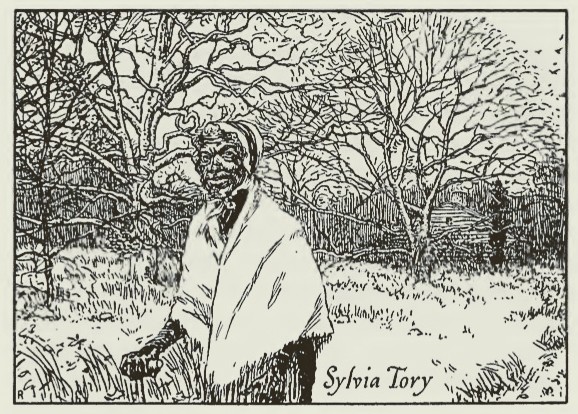
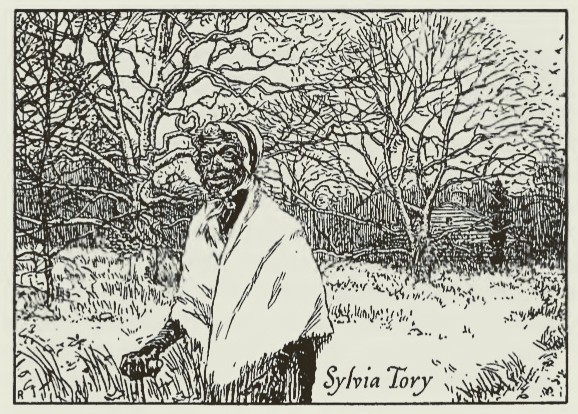
Drawing of Sylvia Tory by Mrs. Samuel Rodman (Thomas R. Hazard, Jonny-Cake Papers, 1915)
A Center of Rural New England Slavery
Popular memory often treats the colonial North as separate from the history of slavery. The reality is much grimmer, as slavery was important to South Kingstown (which then included Narragansett) and southern Rhode Island. South Kingstown functioned as an agricultural supplier for the triangular trade, linking its dairy and horse-raising farms to Caribbean sugar plantations and Newport’s shipping wharves. By the mid-eighteenth century, South Kingstown held the highest concentration of enslaved Africans in rural New England.[3]
The interior of colonial southern Rhode Island held a wealthy class of landowners known as the “Narragansett Planters,” who established large agricultural estates dependent on enslaved labor. Families such as the Robinsons, Hazards, Gardners, Potters, and Updikes controlled hundreds, and occasionally thousands, of acres of land. Their wealth, political influence, and social status were derived directly from the labor of the people they claimed as property.
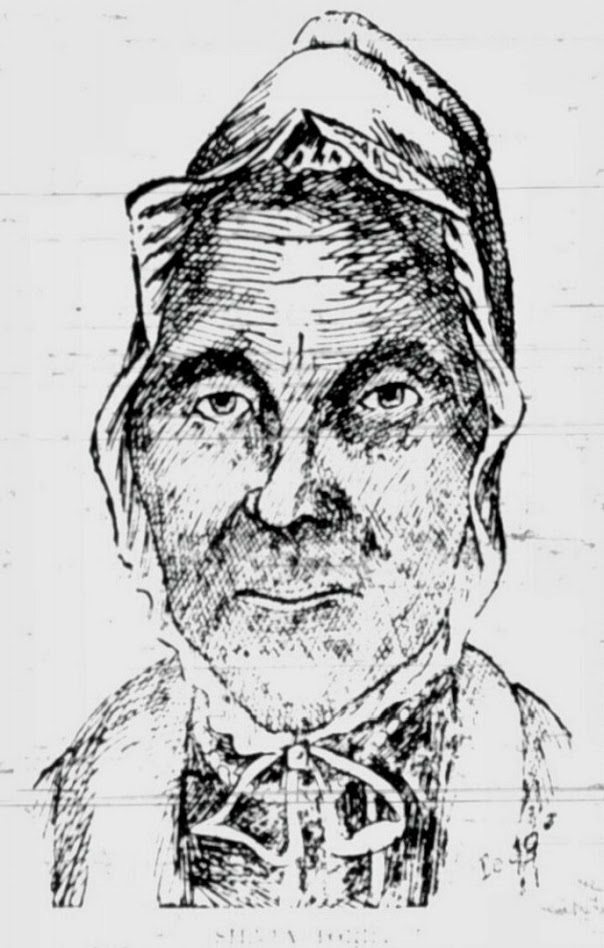
Drawing of Sylvia Tory (Narragansett Times, April 22, 1892)
The heyday of the Narragansett Planters was relatively short, from 1730 to 1775. But the economic legacy of slavery persisted in the region long after Rhode Island introduced gradual emancipation in 1784.
About five miles from the Ministerial Woods, in the early-to-mid nineteenth century, the Hazard family operated a textile mill in the village of Peace Dale that became a leading producer of coarse “kersey,” called “negro cloth,” that was shipped to the South to clothe enslaved laborers. As historian Christy Clark-Pujara has demonstrated in the case of Rowland Gibson Hazard, the boundaries between antislavery sentiment and the slave economy were complex and contradictory: while wintering in New Orleans in 1841 to market Peace Dale cloth, Hazard actively intervened to secure the freedom of dozens of jailed northern Black sailors, even as his Peace Dale mills continued to profit by provisioning southern plantations. Freedom inSouth Kingstown remained deeply tied to the broader slave economy it helped supply.[4]
Within the landscape of the regional slave economy, Sylvia Tory established her home in the Ministerial Woods. Sylvia’s family story shifts the focus away from the planter mansions and down to the granite ledges of Tobey Neck in the Ministerial Woods of modern-day West Kingston. In a region heavily shaped by human bondage, Sylvia and her descendants established one of the longest continuous lines of Black landownership in Rhode Island, a multigenerational legacy of persistence written into the local landscape.
The Collapse of Hopewell
In the mid-eighteenth century, the land surrounding the Ministerial Woods was influenced by two distinct figures: Matthew Robinson (son of Robert Robinson) of Hopewell Lodge and Dr. Joseph Torrey of the Congregational Church. The Congregational Church in South Kingstown was established at Tower Hill in colonial times. Services formally shifted to the village of Little Rest, today Kingstown, beginning in 1819, and the present meetinghouse was constructed in 1820 and dedicated the next year. Dr. Torrey, a devoted Congregationalist, was the enslaver of Cuffe Tory, who married Sylvia while she was still enslaved.[5]
Robinson, a lawyer, educator, and bibliophile, was the victim of a violent assault in Newport in 1750 by merchant John Banister, an event that may have prompted his retreat from the port city to an agrarian life. “On his estate, which is near the spot where now stands the railroad station in Kingston, he built an elegant mansion, after the style of an English lodge, which he called ‘Hopewell.’”[6] While he built Hopewell into a symbol of planter status, the Revolutionary War disrupted his finances. The British blockade crippled the export economy of the Narragansett Planters, transforming the large estate into a financial burden.
Robinson died insolvent in 1795, his wealth depleted during the post-war economic shifts. This financial collapse directly impacted Sylvia Tory’s legal status. Viewed legally as an asset within a bankrupt estate, she was manumitted by Robinson’s final will, gaining her freedom on land that Torrey’s earlier lawsuits had left undeveloped. Robinson’s will explicitly freed: “my Negro Slave called Sylvia Cuff Torreys Wife.”[7]
This legal phrasing clarifies an important personal detail: Sylvia used the surname Tory because she was married to Cuffe Tory, maintaining her husband’s name even while enslaved by a different master. When she left Hopewell in 1795, a period when Rhode Island’s enslaved population was rapidly declining, she was likely reuniting with her husband to navigate their independence together.[8]
Christian McBurney pointed out to me that the federal census for Rhode Island indicates that Matthew Robinson had residing at his estate eight free people of color and no enslaved people. If true, it would likely mean that Sylvia had been freed by 1790. But, as McBurney pointed out, it appears that the census information was inaccurate, as Robinson’s will he prepared shortly before his death in 1795 specifically emancipated an enslaved Sylvia. In the same census, “Cuff Torey” is listed as heading a family of four in an independent household—was Sylvia living there in 1790?

Photograph of Ministerial Road in West Kingston in the town of South Kingstown. Now also called Route 110, the six-mile road connects US Route 1 with Kingstown Road (Route 138) in West Kingston. It is one of Rhode Island’s nine scenic highways and is renowned for its mountain laurels—and its ties to Sylvia Tory (Rhode Island Department of Transportation)
Sylvia’s Family
The freedom that Sylvia gained in 1795 did not automatically extend to her children. For over a decade, her daughter Bethany and her grandchildren remained enslaved by Matthew’s cousin, Benjamin Robinson. The transition to freedom for this branch of the family involved a free Black man named Cupid Brown.
A recollection from a local newspaper details a transaction from September 1808 for Bethany and her five children: Experience, Cubit [sic, Cupid], Joseph, Mariah, and Sarah. Benjamin Robinson sold his legal rights over the family to Cubit [sic, Cupid] Brown of Exeter, who was explicitly designated as a “yeoman,” a term indicating a free property owner.[9] Given this status, it is possible that Brown was a family member or spouse purchasing his relatives to secure their freedom from the Robinson estate, using a formal deed of sale to achieve manumission.
Archival records outline a substantial household. Sylvia’s husband, Cuffe Tory, was a central partner in their efforts. A 1984 historic preservation report identifies him as a fisherman, providing insight into their early livelihood.[10]
Cuffe used the “Driftway,” the path that became Ministerial Road, to reach the salt ponds and the bay. He belonged to a class of independent Black maritime laborers who relied on local waters to sustain their families. He also took on agricultural work, traveling east to Boston Neck to labor on the estate of Lieutenant Governor George Brown before returning home with his earnings.[11]
Thomas B. Hazard, a South Kingstown diarist known as “Nailer Tom,” recorded in his diary for February 5, 1813, that he had been informed that “Cuff Toary” was buried “yesterday” [sic], placing the burial on February 4. The date falls within a spotted fever epidemic that affected South Kingstown between 1810 and 1814.[13] It is possible that Cuffe died during this outbreak, leaving Sylvia to manage their homestead with her children.
The Quaker Trustee
Sylvia’s continued presence was shaped by the specific topography of Tobey Neck, a rocky, upland tract near present-day Curtis Corner and Ministerial Road.[14] Marked by glacial activity, shallow soil, and granite ledges, the land was poorly suited for large-scale farming.
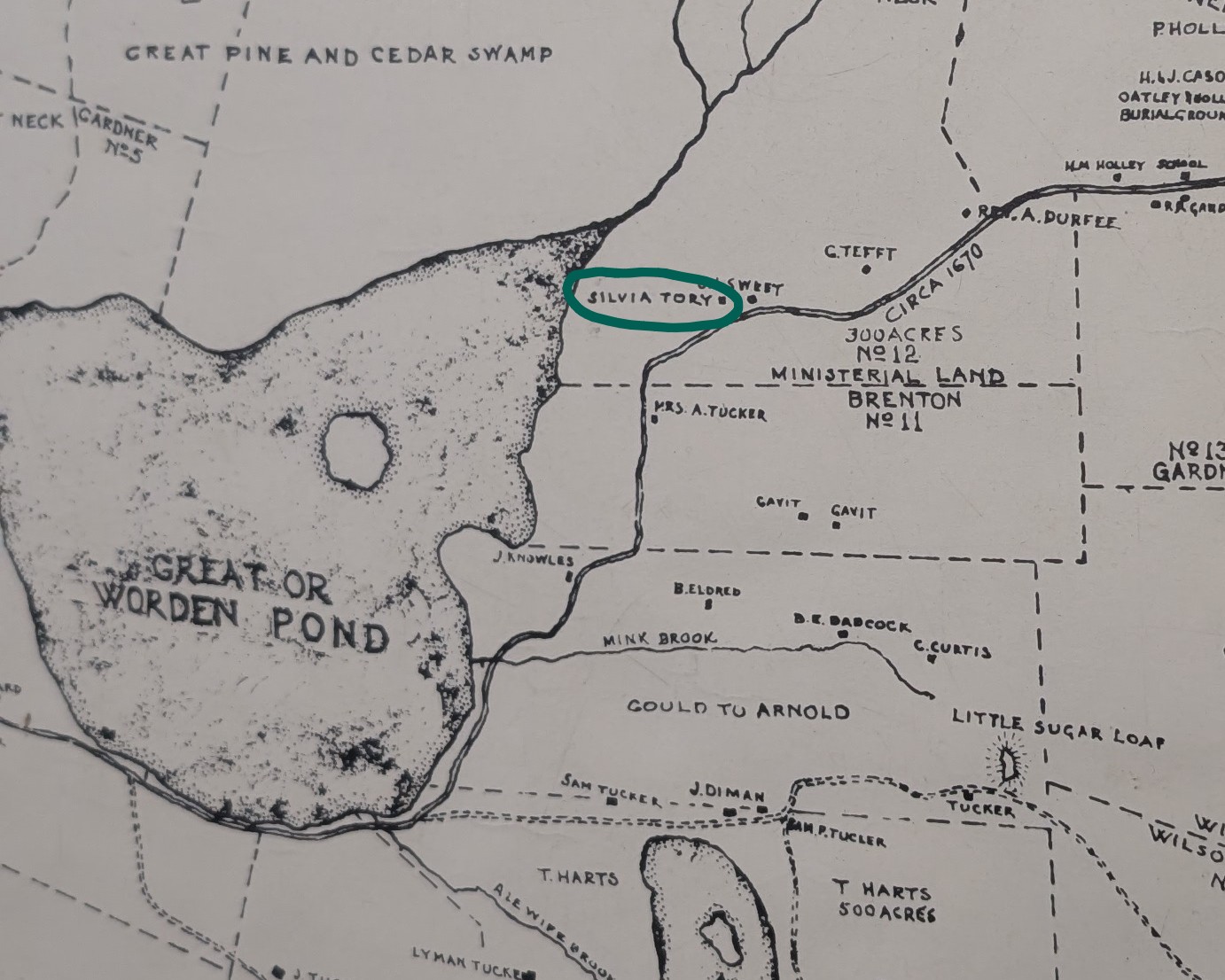
A portion of the 1857 Walling Map of South Kingstown, with the location of Sylvia Tory’s house circled (Peace Dale Library wall map)
The Ministerial Lands were originally set aside to support a town minister. They became locked in a decades-long legal battle between the Congregational minister Dr. Joseph Torrey, then of Tower Hill, and the Anglican minister Rev. James McSparran, of St. Paul’s Church. Torrey finally won the 28-year-long case in 1752.[15] The Ministerial Lands were eventually sold off to support the Congregational Church. While wealthier families like the Potters owned the prime northern parcels near the village of Kingston, the stonier southern tracts became home to working families.
Obtaining a formal legal deed to her home was a rare accomplishment for a formerly enslaved woman in nineteenth-century Rhode Island. When the town auctioned the Ministerial Lands in 1821, the surveyor explicitly noted a “reservation” for the house Sylvia already occupied.[16] Though she had established a physical presence and social standing, she lacked formal title to the property. To secure it, she appears to have worked with a local Quaker tradesman, Andrew Nichols.
Nichols purchased the rocky acreage where Sylvia lived during the auction. Rather than evicting her, he held the land in trust, allowing her to repay the purchase price over time, possibly using income from domestic work and fortune-telling. In 1826 and 1833, Nichols formally transferred the deeds directly to her.[17]
Deconstructing the “Witch”
In the years following her freedom, Sylvia became a figure of local legend. Thomas Robinson Hazard, known locally as “Shepherd Tom,” recalled in his Jonny-Cake Papers visiting her around 1820. He wrote of three young men, himself among them, daring one another to seek prophecy from an aged figure they viewed with wonder. He called her a “spirit medium or witch,” revealing both admiration and the racialized mysticism of his era. She spoke to them of their “future life . . . more in truth than fiction.”
His friend, Adam Babcock, received only a warning: “Don’t you by no means go east.” Babcock then traveled east, became ill, and died soon after. In Shepherd Tom’s telling, the warning proved true, and Sylvia was elevated from village character to durable folk figure later called the Witch of Ministerial Woods. The title reflected local reverence and helped carry her name into poetry and lore.[18]
Caroline Hazard, of Peace Dale, Rhode Island, whose grandfather was Rowland Gibson Hazard, was an author and later president of Wellesley College. In 1894 she wrote of Sylvia in her Narragansett Ballads:
Deep in the wood an old crone dwells,
An aged dame so hoary,
And all the future she foretells,
The wise old Sylvia Tory.[19]
John Williams Haley, in 1931, described her in The Old Stone Bank History of Rhode Island, as sharp-witted and visited by young people seeking guidance. She read fortunes over tea leaves, assuring hopeful girls of suitors, households, and futures to come. She always concluded with a promise that they would “live happy ever after, in a fine home on a high hill with wood on one side and water on the other.”[20] The forward to Haley’s book states that “facts have been obtained from such sources as early histories, old documents, clippings, records, and tracts.” He does not provide any specific citations in his book, so this characterization should be understood as a cultural retelling, not a primary source.
These literary depictions portray a respected local figure, but they present an incomplete picture. Stripped of nineteenth-century supernatural framing, the folklore suggests a woman of keen social intelligence, environmental resourcefulness, and a necessary awareness of local dynamics.
Historical records counter the narrative that Sylvia lived in isolation or poverty. Her grandson, Prince Robinson, appears in 1831 probate records as an independent farmer. His estate inventory included oxen, sheep, cows, and sixty bushels of corn, demonstrating a successful agricultural livelihood.[21]
The family also demonstrated notable longevity. While her 1849 obituary stated Sylvia was over 112 years old, estimates of her age varied from 104 to 115. Her daughter, Bethany Robinson, lived to be 101, passing away in 1870.[22]
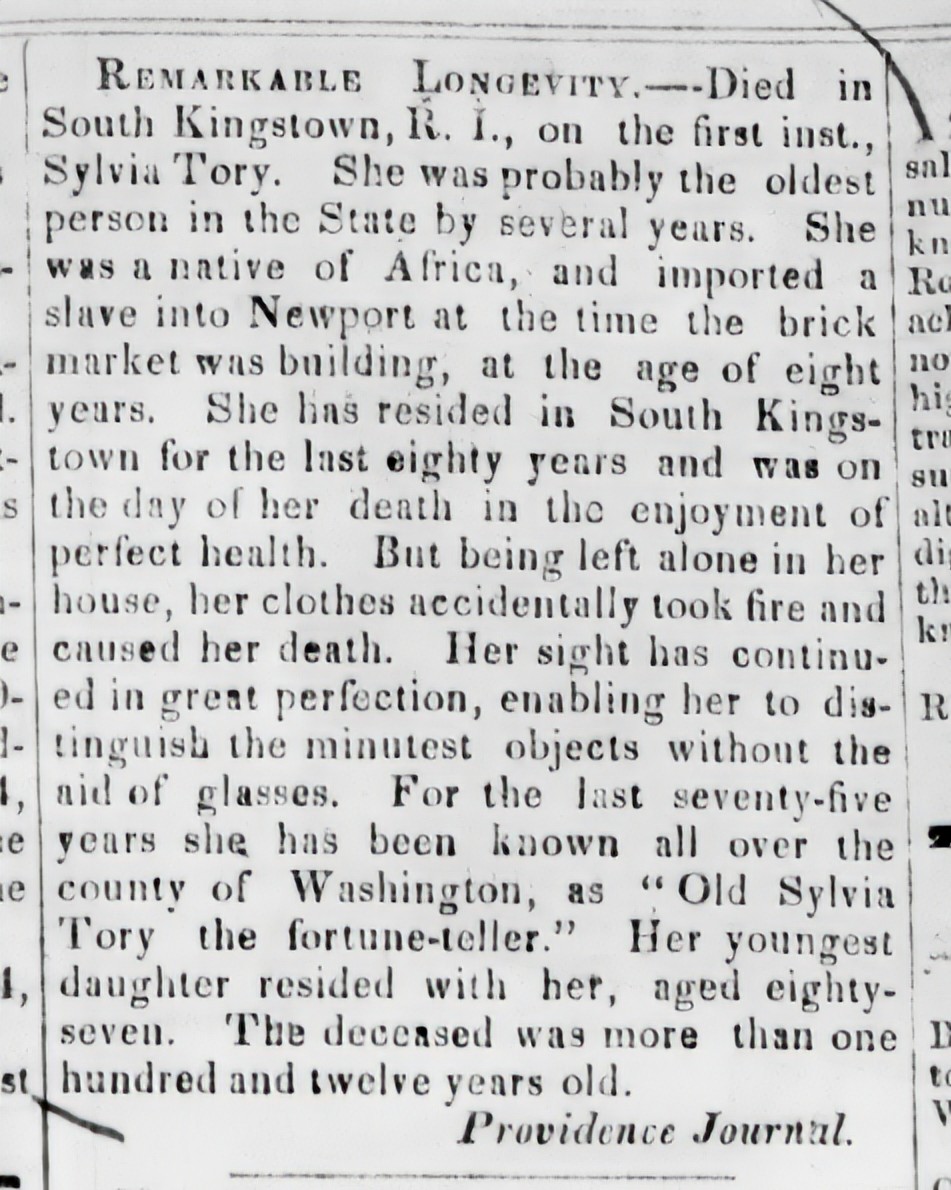
An obituary for Sylvia Tory (Providence Journal, Nov. 5, 1849)
The family line continued through subsequent generations. Sylvia’s granddaughter, Sylvia Hazard, later moved to Westerly to work for decades in the household of U.S. Congressman Nathan F. Dixon. Her connection to her hometown remained strong; upon her death in 1879, her burial in the family plot was attended by the congressman himself.[23]
This history highlights a continuous line of Black landownership in the Ministerial Woods. The land Sylvia purchased passed to her daughter Bethany, then to her grandchildren and great-grandchildren. Land evidence records show the property remained within the family for 147 years, spanning from the 1820s until it was sold by George R. Watson in 1973.[24] An 1880 survey by James N. Arnold notes a small, four-grave family burial plot marked by simple stones in the woods “among whom are those of the celebrated Sylvia Torrey, her children and a grandchild.”[25]
To recognize this history, the Witness Stones Project honored Sylvia and Cuffe Tory with a ceremony at the Kingston Congregational Church in June 2023. Local historian and actor Sylvia Ann Soares portrayed Sylvia Tory, bringing oral tradition back into the local landscape.[26]
While the planter families documented their names in formal histories, Sylvia Tory’s legacy remains anchored in the land she claimed and held.
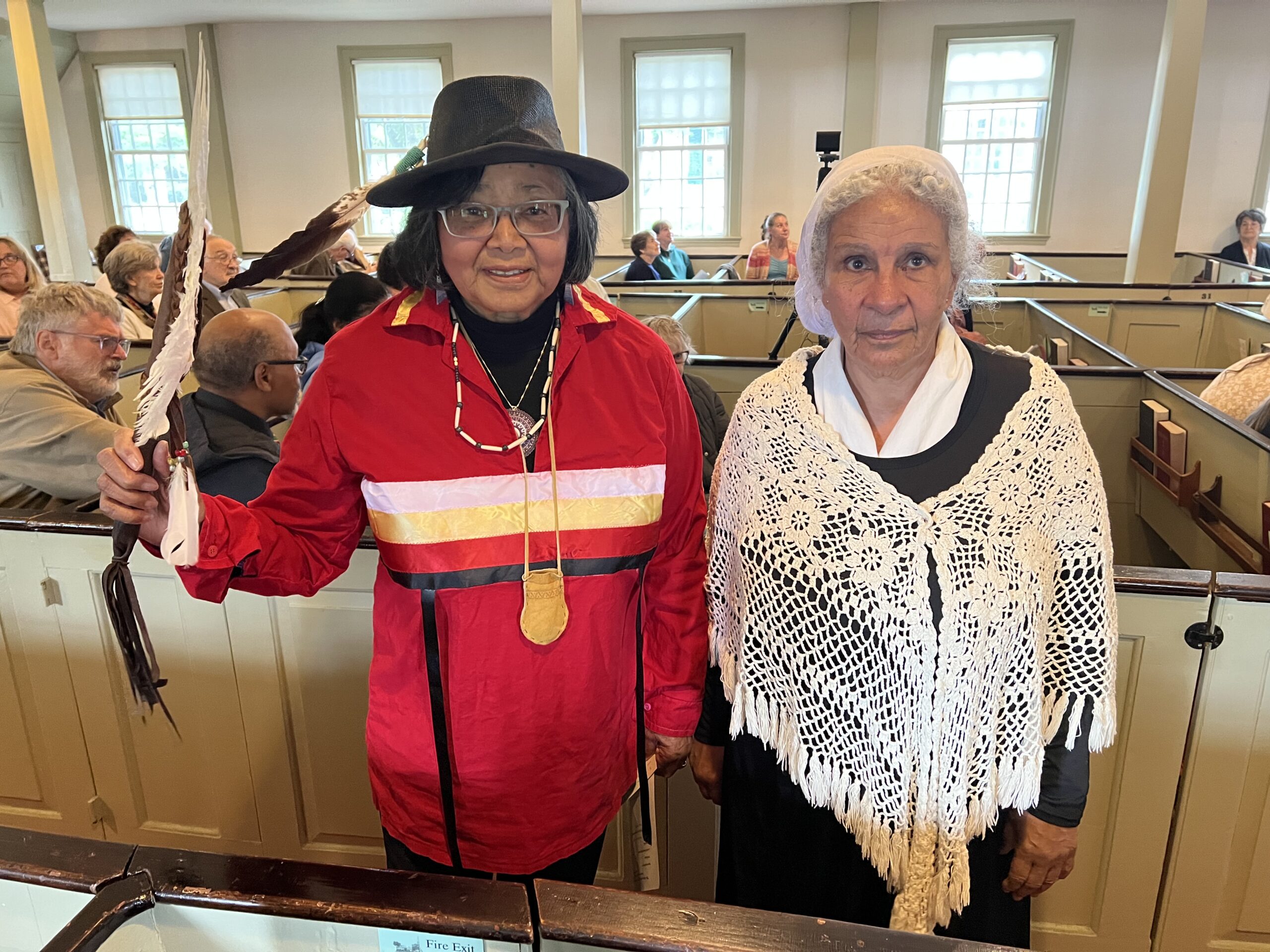
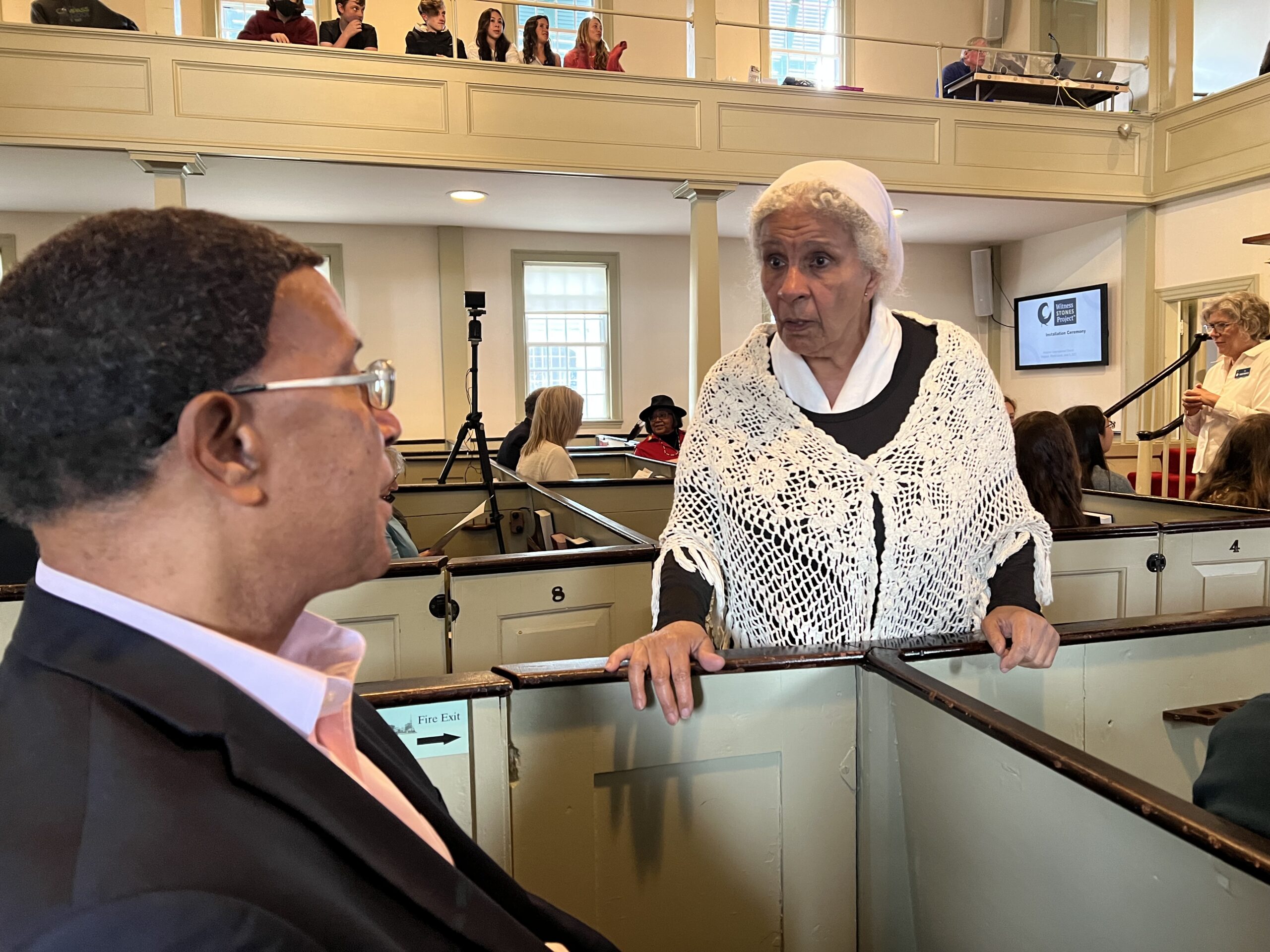
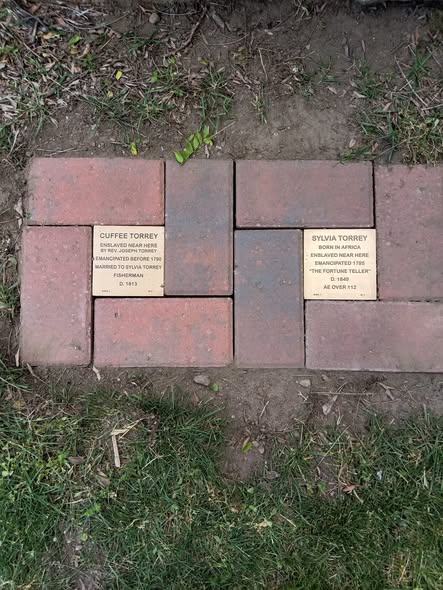
Photographs from the Witness Stones Installation for Sylvia and Cuffee Tory at the Kingston Congregational Church on June 5, 2023. The woman in the white shawl is Sylvia Ann Soares who reenacts Sylvia Torry. The man in the first photograph is Historian Laureate Keith Stokes and the woman on the left in the middle photograph is Dr. Joyce Stevos of the Pokanoket Nation, a Rhode Island educator, historian and community leader (Christian McBurney Photographs)
Notes:
[1] Providence Journal, “Remarkable Longevity,” November 5, 1849. [2] “Obituary of Sylvia Torry,” Wilkins Updike Papers, MSS 770, Box 1, p. 44, Rhode Island Historical Society. [3] Christy Clark-Pujara, Dark Work: The Business of Slavery in Rhode Island (New York: New York University Press, 2016), 10–28. [4] Christy Clark-Pujara, “The Business of Slavery and Antislavery Sentiment: The Case of Rowland Gibson Hazard—An Antislavery ‘Negro Cloth’ Dealer,” Rhode Island History 71, no. 1 (2013). [5] “RI 1 – Cuffee Torrey,” Stopping Stones, accessed June 26, 2026, https://stoppingstones.org/ri-1-cuffee-torrey/. [6] Phoebe Bean, “A 1750 Walnut Stick Attack,” Rhode Island Historical Society, October 6, 2016, https://www.rihs.org/a-1750-walnut-stick-attack/. [7] Will of Matthew Robinson, Proved 1795, South County History Center. [8] Clark-Pujara, Dark Work, 10–28. [9] “Old Times in South Kingstown,” Narragansett Times, April 22, 1892. [10] Rhode Island Historical Preservation Commission, Historic and Architectural Resources of South Kingstown, Rhode Island (Providence: RIHPC, 1984), 14. [11] Thomas Robinson Hazard, The Jonny-Cake Papers of “Shepherd Tom” (Boston: Printed for the Subscribers, 1915), 208. [12] Thomas B. Hazard, Nailer Tom’s Diary; Otherwise, The Journal of Thomas B. Hazard of Kingstown, Rhode Island, 1778-1840, ed. Caroline Hazard (Boston: The Merrymount Press, 1930), 398. [13] Joseph Comstock, “Spotted Fever in Rhode Island, 1810–14,” Boston Medical and Surgical Journal 73, no. 12 (October 19, 1865): 237, https://doi.org/10.1056/NEJM186510190731203. [14] Gates, Leighton & Associates, Inc. and Whiteman & Taintor, The Ministerial Road Stewardship Plan, prepared for the Rhode Island Scenic Roadways Board (Providence, RI: Rhode Island Scenic Roadways Board, 1999), 6. [15] Wilkins Updike, A History of the Episcopal Church in Narragansett, Rhode Island: Including a History of Other Episcopal Churches in the State (Boston: D.B. Updike, 1907), 1:65–83. [16] Survey of Ministerial Farm by Robert F. Noyes, 1821 South Kingstown Land Evidence Records, South County History Center. [17] Deed from Andrew Nichols to Sylvia Torrey, February 3, 1826, South Kingstown Land Evidence Records, South County History Center. [18] Hazard, Jonny-Cake Papers, 247. [19] Caroline Hazard, Narragansett Ballads with Songs and Lyrics (Boston: Houghton, Mifflin and Company, 1894), 36. [20] John Williams Haley, The Old Stone Bank History of Rhode Island, vol. II (Providence: Providence Institution for Savings, 1931), 127–128. [21] Inventory of the Estate of Prince Robinson, 1831, South County History Center. [22] Record for Bethany Robinson, Rhode Island Deaths, 1870, South County History Center. [23] “General News, Sylvia Hazard,” Narragansett Times, August 8, 1879. [24] Deed from George R. Watson, et al., to Albert C. Woodmansee and Dorothy M. Woodmansee, December 11, 1973, South Kingstown, RI, Land Evidence Records, Book 115, pp. 286–287, South Kingstown Town Hall. [25] John E. Sterling and James Lucas Wheaton IV, South Kingstown, Rhode Island Historical Cemeteries, ed. Cherry Fletcher Bamberg (Greenville, RI: Rhode Island Genealogical Society, 2004), entry SK153 (“Sylvia Torey Lot”). [26] Southern New England Conference United Church of Christ, “Witness Stones Installation Ceremony,” Event Detail, June 5, 2023, https://www.sneucc.org/eventdetail/17436370.The Author