

As Rhode Island celebrates 250 years of independence as a state, it’s worth reflecting on why independence mattered. After all, hundreds of Rhode Islanders died in the Revolutionary War, many more suffered serious wounds, and even those who escaped gunfire lived under terrible stress and deprivation. The fighting disrupted the lives of tens of thousands of civilians, and devastated several towns. Newport, by far the largest town in 1770, never recovered its pre-war dominance. The end of fighting brought an economic depression, as the war had decimated the fleet, and the British empire cut off access to its prosperous Caribbean colonies.[1]
Did independence accomplish enough to justify all this suffering? Back in 1776, the Canadian colonies refused to join us in leaving the Empire. They gained their independence gradually, without fighting, starting in 1867 with limited autonomy, then in 1931 with their own foreign policy. They now have full rights as a country, though they continue as a constitutional monarchy under the British royal family. Could we have done the same?
The immediate answer is that independence was inevitable here. Unlike in Canada, most Rhode Islanders were determined to leave the empire, especially as the British had resisted early rebellious acts with a strong-arm response. Certainly some Rhode Islanders were “Tories” who preferred to remain loyal subjects of the great empire. But the majority of residents had grown tired of the outside control and were willing to suffer to get free of it. After all, most of their ancestors had come to avoid outside interference and to achieve an open society, so independence came easily to them.
It’s true that few people expected the war to be so bloody and destructive, and to last several years. But Rhode Islanders kept at it and were ready to continue even after the great victory at Yorktown.[2]
So historically, the question is moot. While the fighting in the southern colonies was close, and might have ended differently if not for the brilliance of Nathanael Greene and other rebel leaders, the British realized early on that Rhode Island and other New Englanders were determined to leave. That’s why the fighting shifted south after 1776.
Still, it’s worth considering what Rhode Island accomplished, in exchange for its great suffering.
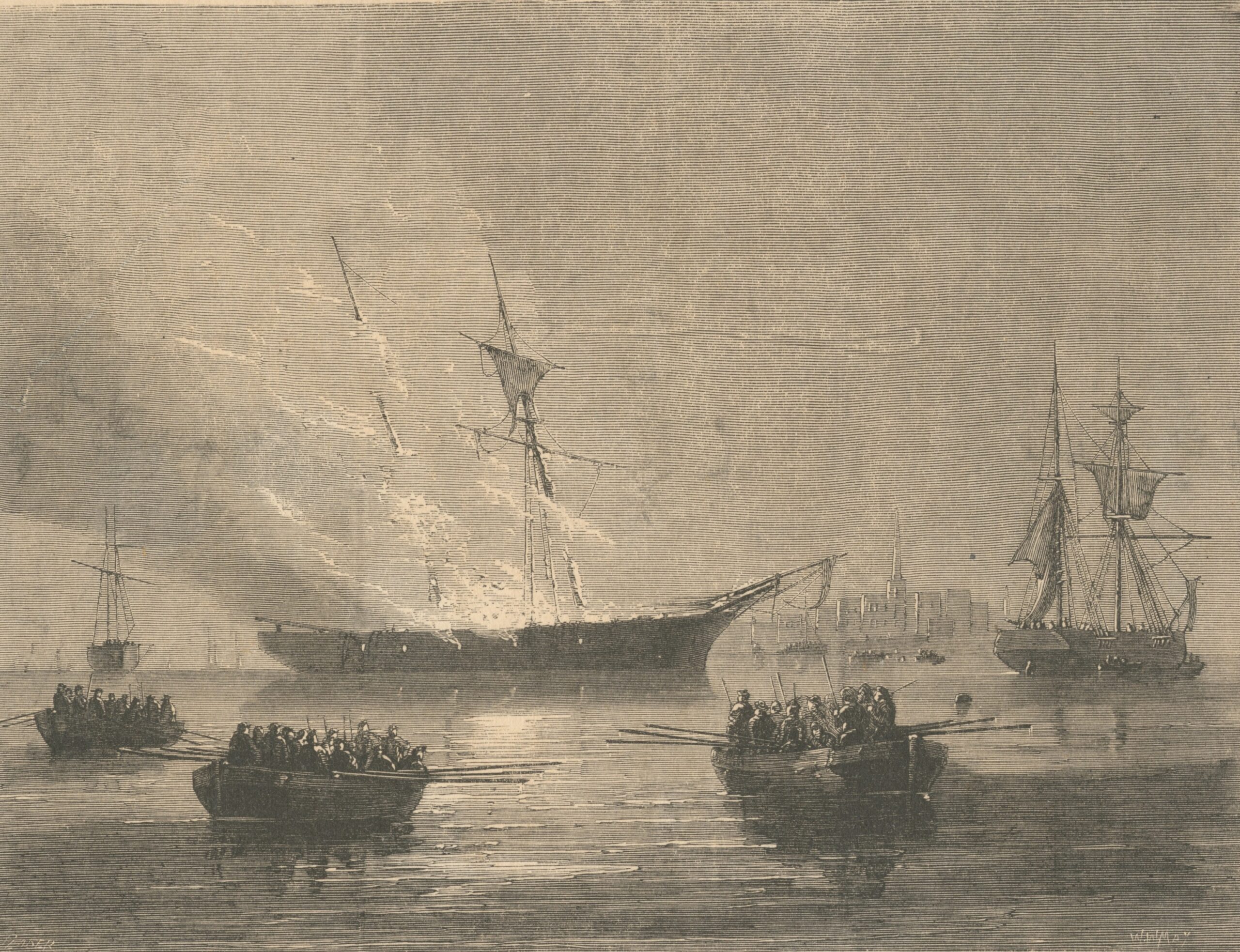
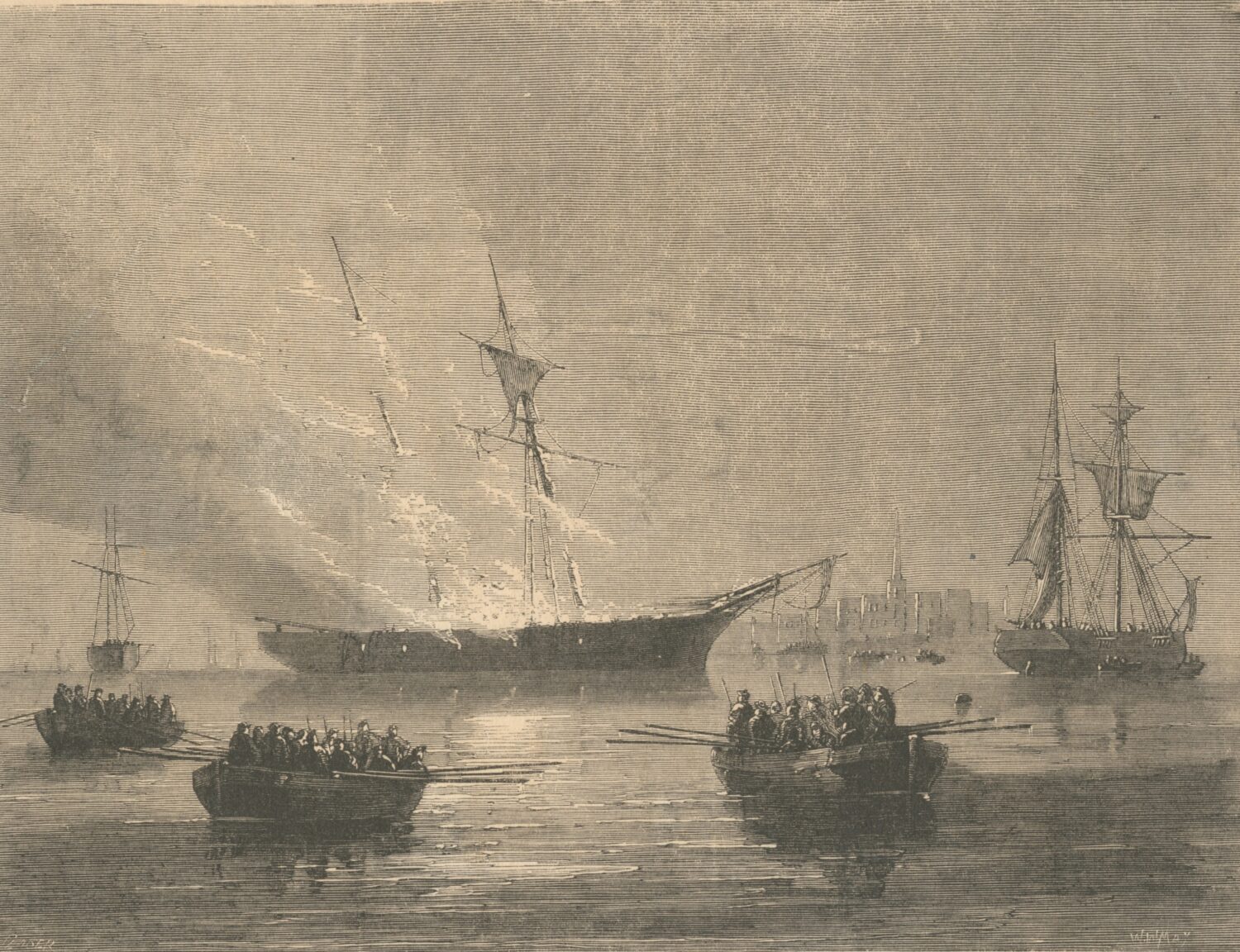
A nineteenth-century view of the burning of the HMS Gaspee off Namquit Point. The Gaspee looks more like a clipper ship than the small two-masted revenue schooner that it was. Also no other sailing vessels were in the vicinity (New York Public Library Digital Collections)
Economic Independence
The first gain was economic self-determination. That mattered because the aspirations of merchants here clashed with plans in London. Fundamentally, British overlords saw Rhode Island as a colony, existing mainly to serve the needs of the homeland. Their mercantilist policy wanted colonies to provide resources that Britain lacked, and in turn to buy goods and services from British ports. After the French & Indian War, carried out partly to protect British settlers in North America, it was only natural for the British to expect colonists there to pay more in taxes to cover the expense of fighting.
Unfortunately, Rhode Island, and most of New England, had nothing that the British really wanted, no lucrative cash crops such as tobacco or sugar. The beaver population had long since collapsed; the only thing of value were tall trees in New Hampshire prized by the British navy. Rhode Islanders relied instead on commercial services, especially shipping—but the home country already had plenty of ships to do that.[3] A 1764 “Remonstrance,” from Governor Stephen Hopkins to the British board of trade, is worth quoting at length:
The colony of Rhode Island includes…about thirty miles square, and of this a great part is a barren soil not worth the expense of cultivation. The number of souls in it amounts to about 48,000, of which the two seaport towns of Newport and Providence contain near one third. The colony hath no staple commodity for exportation, and does not raise provisions sufficient for its own consumption. Yet the goodness of its harbors, and its convenient situation for trade, agreeing with the spirit and industry of the people, hath in some measure supplied the deficiency of its natural produce, and provided the means of subsistence to its inhabitants.
Governor Hopkins wrote to oppose British plans to impose a tax on molasses, as this restriction would have undermined the livelihood of many Rhode Island merchants.[4] The slave-based Caribbean colonies raising sugar yielded molasses as a bothersome by-product—sugar-making was too lucrative to turn molasses into something beneficial. So they traded molasses to northern merchants in exchange for various goods that the latter collected all along the eastern seaboard. A century and a half before it became perhaps the richest place in the world per capita, Rhode Islanders were happy to do the dirty, low-paying work of processing molasses into rum.
As part of their strategy of serving customer needs, the colony’s merchants also engaged in the terrible “triangle trade.” They sent ships to Africa, traded rum for stolen black Africans, and then brought them to Caribbean and other colonies to sell as slaves, in exchange for molasses. But as Hopkins explained elsewhere, only 4 percent of Rhode Island-based voyages handled slaves; the rest carried other goods. Slave-trading could be quite profitable, but it was also risky, and most Rhode Island merchants put their investments largely in non-slave ventures.[5]
The empire refused to bend on the molasses tax, so Rhode Islanders stepped up their smuggling and other means of evasion. That refusal was hardly surprising, given how British overlords had treated the region in the previous century. Back then, they called the colonization of New England a mistake — Oliver Cromwell dubbed the region “poor, cold, and useless.” They seriously considered uprooting all the white settlers in New England and moving them to the thriving British holdings in the Caribbean.[6]
As for Rhode Island’s extraordinarily liberal charter in 1663, it now seems that King Charles II granted it mainly because he sought a friendly base against the Puritan colonies in the rest of the region. After all, English Puritans had led the civil war that had chopped off his father’s head.[7] In 1685 his brother and successor, James II, revoked that charter and merged all the region’s colonies with New York and New Jersey into the Dominion of New England. Fortunately three years later, the British Parliament rebelled for other reasons, and replaced the king as part of their “Glorious Revolution.”
Taking advantage of the change, Rhode Islanders and their neighbors quickly reasserted their previous charters. But they saw firsthand how fickle monarchies could be. Clever diplomacy by Rhode Island governors, along with some luck, kept the colony largely autonomous for decades. Newport in particular flourished for decades as a center for shipping. As Margaret Newell has argued, the region gradually went “from dependency to independence”—to competing directly with British commerce for revenue.[8]
Accordingly, British economic officials cared little for Rhode Islanders’ economic aspirations. By early 1776, with Rhode Island and other colonies in open rebellion, the empire sent James Wallace and a fleet of ships to stop the rampant smuggling in Narragansett Bay.[9]
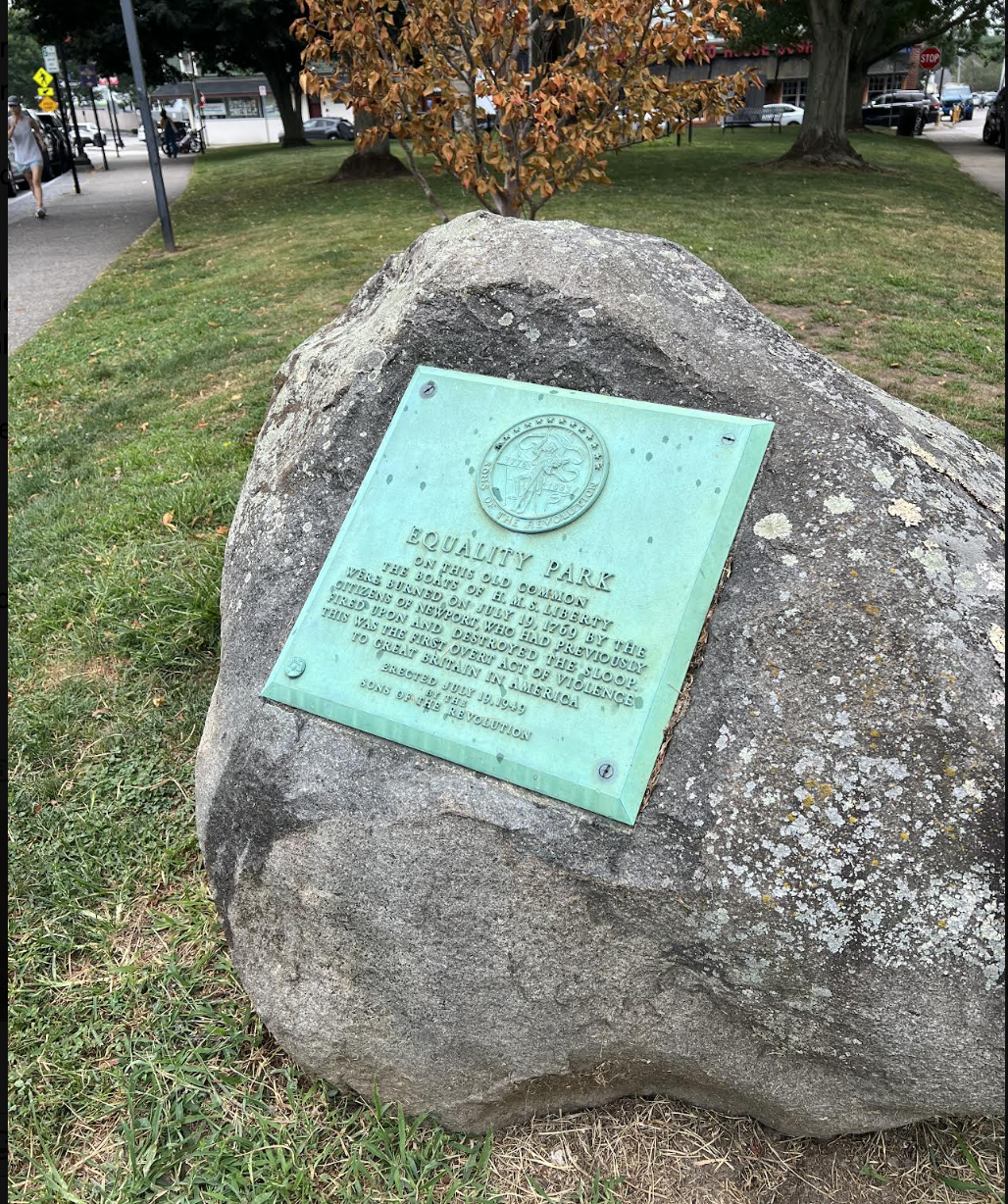
“On this old common the boats of H.M.S. Liberty were burned on July 19, 1769 by the citizens of Newport, who had previously fired upon and destroyed the sloop. This was the first overt act of violence to Great Britain in America. Erected July 19, 1949 by the Sons of the Revolution.” (Christian McBurney)
It’s important to note that independence was disastrous for the native Indian tribes that had survived European expansion before 1770. Local autonomy was for whites; the Narragansetts, the largest remaining tribe in Rhode Island, lost most of its land and then, after the Civil War, were “detribalized.” If the British empire had kept control, it may have slowed this process and the western migration of many Rhode Islanders into Indian territory. The process may have been inevitable – after all, Canada eventually also pushed most its tribes into the remote northern reaches. But independence probably hastened the marginalization.
If Rhode Island had lost the war and stayed in the empire, it would have found its development stunted. The British would never have allowed Moses Brown and Samuel Slater to set up the first mechanized textile mill in the New World – after all, Slater had stolen British designs in order to do so. The colony would have stayed small and poor, reliant on British industry. If and when immigrants came, they would have gone elsewhere than Rhode Island, which would have had little to offer without the industry that developed after Slater’s success.
Without its industrial heritage, instead of the second most densely populated state in the union, Rhode Island would now be only lightly settled. It’s easy to forget that until the heavy industrial immigration of the 1870s, Vermont had a greater population than did the Ocean State. Also, many of the most ambitious Rhode Islanders, seeing little opportunity here, would have left the colony to seek fortunes in western settlement.
As for the slave trade, which unfortunately flourished in Newport and other colonial Rhode Island harbors, it’s unlikely the British empire would have stopped it early. After all, the empire had no fundamental opposition to slave trading, and British merchants stole far more Africans than Rhode Islanders ever did. The British empire banned the slave trade only in 1807, the same year that the United States did.
Under continued British rule, even the liberalism that Roger Williams championed would likely have gone away, as the British would have enforced loyalty to the Crown. And rather than bother with such a small polity, the British probably would have merged the colony with neighboring Massachusetts or Connecticut. No Canadian province is as small as the Ocean State, as even little Prince Edward Island has twice the land mass. And without much industry, Massachusetts and Connecticut wouldn’t have become magnets for immigrants either. Rhode Island would now be as economically substantial as Canada’s sparsely populated, commercially stunted maritime provinces.
Political Independence
The second gain was political self-determination. We call the war for independence a revolution because it brought a radical alteration in political and social structure. Instead of elites dominating here with rigid class divisions as in Britain, Rhode Islanders achieved a remarkably open society. We now criticize the Revolution for granting suffrage only to white men who owned land, but even that extension was extraordinary and unprecedented at a time when feudal-style aristocracy still dominated.
Benefitting from that extension, small farmers from the northern and western parts organized the “Country Party” and wrested control of state government away from urban merchants. The British empire never would have allowed the uneducated rabble to control government, but after the Revolution, democracy started to replace the longstanding aristocracy. And once we started to have democracy, it was only a matter of time before we continued the extension to white men without property, to men of color, and to women. Britain and its remaining colonies adopted democracy over time, but it took them longer, and they still have something of a lingering culture of aristocracy.[10]
The new democracy came with a dedication to liberty. More than any other state, Rhode Islanders continued their deep-seated aversion to central control. As Patrick Conley has explained, the Country Party was strong enough to prevent the state from joining the new federal union (the United States) until winning assurance of a Bill of Rights. Rhode Islanders joined that union only because it had severe limitations on its power, giving the states enormous autonomy, and even then the vote to join was a close call.[11]
Independence thus gave Rhode Islanders an unprecedented degree of social equality. No longer could elites dictate how governments, and society generally, should run things.[12] Because of that openness, the state could enlist the energies of many people in the society to overcome problems along the way.
Crucial Self-Confidence
The third, and arguably most important gain, was in self-confidence. Rhode Islanders had helped to overcome the mightiest empire on earth. If we could do that, we could do anything. From that great victory, long celebrated with fanfare in Bristol, came many grand achievements in the decades following, not just the daringly adaptive Slater mill but also the seemingly preposterous Corliss steam engine. Even Governor William Sprague’s dashing (if failed) maneuver in the Civil War’s First Battle of Bull Run came from this confidence.
That confidence was not just valuable in itself, but also in what it meant for Rhode Islanders. In colonial times, most people didn’t want to come here. Aside from Jews and Quakers seeking tolerance, people preferred to settle in places with an orderly, stable government. Rhode Islanders, after all, had crazy ideas about individual liberty, and they let almost anyone in.
As a result, most Europeans settling here came from other colonies. They were the trouble-makers, the malcontents who couldn’t accept the conformism expected in other places. As Roger Williams in 1670 told the leaders in Connecticut, Rhode Island’s toleration was good for the other colonies, because “distressed souls” would come here rather than stay and disrupt the civil peace where they first landed.[13]
People from other colonies were less charitable. A Dutch minister in early New York, complaining that Rhode Island had granted freedom to Quakers, called it the sewer of New England, “the asylum for all those that are disturbed for heresy,” and “the sink into which all the rest of the colonies empty their heretics.”[14]
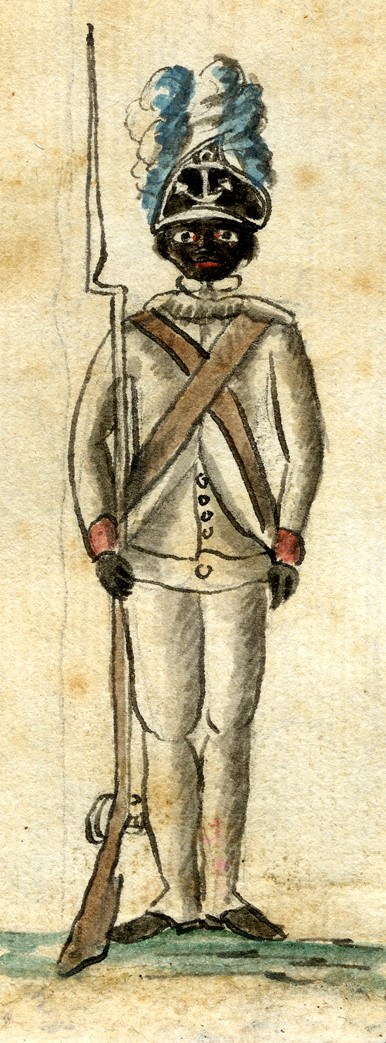
A Black soldier of the Rhode Island Regiment standing at attention and holding a musket, drawn by Antoine de Verger, a French army officer after the Siege of Yorktown in the Fall of 1781. Verger would have seen Black, Indian and mixed race soldiers, mostly from Rhode Island, from this regiment when the French army occupied Newport from July 1780 to June 1781 (Anne S.K. Brown Military Collection, Brown University Library)
Rhode Islanders were thus self-selected for individual daring, and that went beyond religious innovations such as the Baptists and the gender-neutral Universal Friend. To gain the full potential of that disposition, they needed the shot in the arm that independence provided.
That daring paid off in the century that followed. Rhode Islanders took the lead in building great industries. By 1900, befitting its great new wealth, they built the magnificent statehouse with the “Independent Man” on top. In the twentieth century, Rhode Islanders lost some of that daring as success made them complacent; they also worked to turn those riches into a strong safety net. But we still have a solid tradition of entrepreneurial daring, which helps to justify why this tiny state remains separate from neighbors.
Independence thus gave both the confidence and the freedom to choose our own destiny. Faraway British leaders saw Rhode Island contemptuously as a small, troublesome colony. It thus needed independence even more than the other American colonies. Rhode Islanders had to figure out how to govern themselves along the way, and it helped that the other states gradually adopted their liberalism. (We actually have a better claim to the “spirit of America” than Massachusetts.)
Rhode Islanders liked to go their own way, even if others saw them as provincial, and even if doing so was a mistake. In 1930, for example, as the economy here and elsewhere sank into depression, the New England states got together to form a regional body to address the crisis. All of them, that is, except for Rhode Island, whose governor initially said no thanks, we’ll handle this ourselves.[15]
Overall, as the Remonstrance pointed out, the state’s comparative advantage is in the spirit and industry of its people. We have some excellent assets, especially ocean access through Narragansett Bay, which has led to a “blue economy.” We have strong tourism from fine beaches, well-preserved history, a mild summer climate, and a good quality of life overall. But that’s not what’s going to enable us to maintain or even expand our population in the future. What makes us affluent, besides the good fortune of belonging to the United States of America, has been our daring, independent entrepreneurial streak.
This year, the celebration of the semi-quincentennial of independence has been far less boisterous than the bicentennial in 1976. Maybe that’s inevitable, as people take the successful revolution for granted (250 years is a long time). Our current political polarization hasn’t helped. But it’s still worth taking a moment to appreciate the sacrifice of our forebearers, especially here in Rhode Island. We gained a lot from independence.
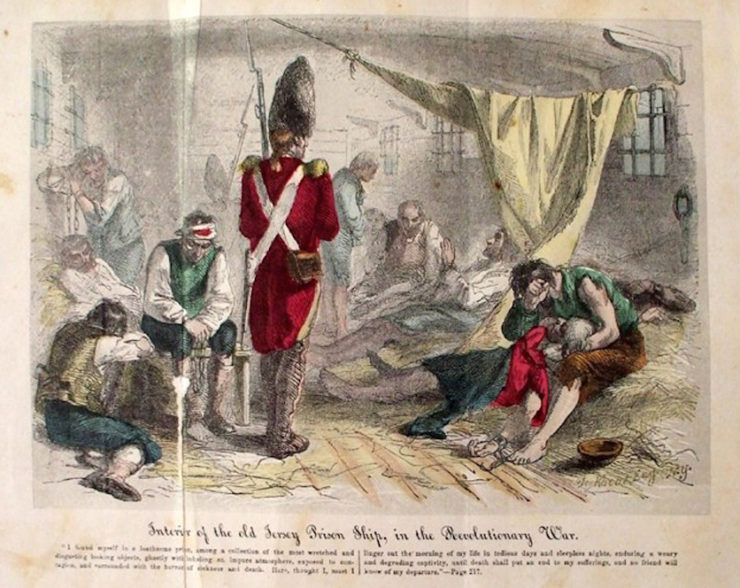
A British army guard watches over miserable American prisoners on the Jersey stationed off Brooklyn. Due to over-crowding, poor food, and mixing healthy prisoners with sick ones, thousands of Americans, including many Rhode Islanders, died on the Jersey (Library of Congress)
Notes:
[1] We don’t know how many Rhode Islanders died in the Revolutionary War. An estimated 27,000 Americans lost their lives in the conflict, and many Rhode Islanders enlisted in Continental, state, county and independent regiments and other outfits, so a number around 1,000 is plausible. [2] Rhode Island in general played a minor role in the war, but not for lack of trying. It was hampered by its small size, in both land mass and people, as well as (initial) concerns about jeopardizing its extraordinarily liberal charter. See my “Did Rhode Island Matter in the American Revolution,” Online Review of Rhode Island History, July 8, 2023, https://smallstatebighistory.com/did-rhode-island-matter-in-the-american-revolution/; as well as “Why Captain Wallace Failed to Prevent the Revolutionary War,” Online Review of Rhode Island History, March 20, 2026, https://smallstatebighistory.com/why-captain-wallace-failed-to-prevent-the-revolutionary-war/. [3] In the previous century, New Englanders had exported ordinary farm products to feed hungry enslaved people in Britain’s rich sugar colonies of the Caribbean. But that trade had slackened by the 1760s with the settling of colonies closer south to the latter. Jonathan Levy, Ages of American Capitalism (New York: Random House, 2021), 30-32. [4] Stephen Hopkins, “Remonstrance of the Colony of Rhode Island to the Lords Commissioners of Trade and Plantations, Jan. 1764,” in John R. Bartlett, ed., Records of the Colony of Rhode Island and Providence Plantations, vol. 6 (Providence: A. C. Greene & Bros., 1861), 378-83. Technically, the British empire was actually lowering the existing tax on molasses, while greatly increasing its enforcement. The net result, if Rhode Islanders actually obeyed, would be devastating blow to the colony’s economic competitiveness. [5] Rhode Island merchants probably stole more Africans than any other future U.S. state, but British merchants stole twenty times more. J. Stanley Lemon, “Rhode Island and the Slave Trade,” Rhode Island History, vol. 60 (Fall 2002), 95-104. [6] Margaret Newell, “The Birth of New England in the Atlantic Economy,” in Peter Temin, ed. Engines of Enterprise: An Economic History of New England (Cambridge: Harvard Univ. Press, 2000), 12-13. [7] Adrian Weimer, A Constitutional Culture: New England and the Struggle Against Arbitrary Rule in the Restoration Empire (Philadelphia: Univ. of Pennsylvania Press, 2023), ch. 7. [8] Margaret Newell, From Dependency to Independence: Economic Revolution in Colonial New England (Ithaca: Cornell Univ. Press, 1998). Her book focuses on Massachusetts, with little to say about Rhode Island, but her overall point certainly applies to the Ocean State. [9] For details on this anti-smuggling effort, see “Why Captain Wallace Failed to Prevent.” [10] The Country Party immediately began printing paper money to help farmers pay off debts to merchants, an experiment that worked well for a while. Daniel Jones, The Economic and Social Transformation of Rural Rhode Island, 1780-1850 (Boston: Northeastern Univ. Press, 1992), ch. 1. [11] Patrick T. Conley, First in War, Last in Peace: Rhode Island and the Constitution (East Providence: R. I. Publication Society, 1987). If the U.S. Senate had been apportioned by population, not by states, as some advocate now, Rhode Island likely would not have joined. Rhode Islanders saw the United States as a federated republic, “these united states,” not a single unified country. [12] For the larger argument about democracy as an unintended result of independence, see Gordon Wood, The Radicalism of the American Revolution (New York: Random House, 1991), especially ch. 13.. The Continental Army’s desperate decision to rely on the rabble for soldiers forced leaders to accept a great deal of post-war equality. [13] Letter to Major John Mason (Connecticut) and Governor Thomas Prence (Plymouth), June 22, 1670, excerpted in Charlotte Carrington-Farmer ed., Roger Williams and His World (Peterborough, Canada: Broadview Press, 2025), 166.The Author

You Might Also Like