


On May 13, 1911, in a moving obituary for the famed abolitionist Thomas Wentworth Higginson, the editors of the Providence Journal emphasized the “beloved” reformer’s steadfast commitment to improving the “public welfare.” In 1841, after graduating from Harvard at the age of 18, Higginson pursued a graduate degree in theology from the Harvard Divinity School, eventually becoming the minister of the Unitarian church in Newburyport, Massachusetts, before moving to the Free Church in Worcester. To the very end of his long life, Higginson, who lived in Newport for a time after the Civil War in a boarding house at the corner of Mann Avenue and Kay Street, “retained a deep interest in his fellow-men.” Higginson was guided in his work by a keen “judgment” and deep “sense of humor.”[1]

Higginson, a prolific author and poet, wrote for decades for prominent literary publications, including Atlantic Monthly magazine, and helped to bring the poems of the recluse Emily Dickinson to the world. An avid traveler, Higginson was an in-demand lecturer, traversing the United States and Europe to discuss antislavery, abolition, labor, and women’s rights. In 1877, he took over editing the Woman’s Journal, a position he held for the next fourteen years. He published Common Sense About Women in 1881, which he dedicated to his daughter, Margaret.
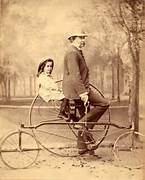
Thomas Wentworth Higginson with his daughter (Yale University)
In addition to his pen, he wielded a sword during the Civil War, leading the first all-Black unit in South Carolina and Florida. Before that, in the 1850s, he was a member of the not-so-secret “Secret Six,” a group of abolitionists that offered financial support to the abolitionist John Brown, who led a failed attempt to capture a federal arsenal at Harpers Ferry, Virginia, and spark an uprising of enslaved people in 1859, and was soon after hanged by federal authorities.
In A Man on Fire, historian Douglas Egerton makes the various “worlds” of Thomas Wentworth Higginson come alive. Higginson’s was a “life marked by numerous struggles for social justice and progressive causes, from abolitionism to women’s rights, from religious tolerance to socialism, and from physical fitness for both genders to temperance” (p. 1).
Egerton, a prolific author and long-time professor of history at LeMoyne College, is well-positioned to chronicle Higginson’s fascinating life as the 19th century reformer employed the “written page, his eloquent voice, his Sharps rifle, and, on one occasion, even a makeshift battering ram” in an abortive attempt to free Anthony Burns, a fugitive slave from a Boston courthouse (p. 2). In a sermon after Burns’ rendition to Virginia, the fiery Higginson, echoing the old charge from Dorrite Seth Luther declared, the “way to make principles felt is to assert them—peaceably, if you can; forcibly, if you must.”[2] As Egerton carefully explains, Higginson was a “Garrisonian who both voted and accepted as necessary the use of violence, and an activist who refused to prioritize antislavery over women’s rights” (p. 109). After John Brown, “both friends and foes came to regard” Higginson “as the most radical white man in the country” (p. 136).
The author of nine acclaimed books, Egerton won the Lincoln Prize for Thunder at the Gates: The Black Regiments That Redeemed America (2016). Egerton has covered the origins of the Civil War (Year of Meteors (2010)) and the revolutionary period after the Confederate surrender at Appomattox (The Wars of Reconstruction (2014)). In recent years, he has chronicled the Adams family in Massachusetts throughout the 19th and early 20th century in Heirs of an Honored Name (2019). Earlier in his career, Egerton produced two landmark works on slave insurrections in early America: Gabriel’s Rebellion (1993) and He Shall Go Out Free: The Lives of Denmark Vesey (1999; rev. 2004). Higginson, a student of American history, wrote about these slave insurrections in the pages of the Atlantic Monthly magazine,[3]
As Egerton brilliantly shows in his new book, Thomas Wentworth Higginson was never one to back down from a fight. When many abolitionists were unwilling to even contemplate violence against the Slave Power, Higginson picked up a rifle and went to the battleground of Kansas in the middle of the 1850s. Even after John Brown was captured by Virginia authorities, Higginson was willing to entertain the idea of a jailbreak for Brown and several other captured raiders. Through engaging writing and deep research, including an impressive utilization of Higginson’s personal papers and a close reading of Higginson’s vast volumes of written works, Egerton makes Higginson come alive for modern readers. A sensitive biographer, Egerton is attuned not only to the major events and episodes in Higginson’s long life, but also to his relationship with his beloved mother, his brothers, his wives, and his daughter Margaret. Students of Rhode Island history will be interested in Egerton’s treatment of Higginson’s Newport days after the Civil War.

Thomas Wentworth Higginson in a uniform of a colonel in the Union Army
Born into a Boston Brahmin family, Higginson outlived many of the social activists of his day, living until 1911. Each of the book’s eleven chapters recounts periods in Higginson’s life starting with his early years at Harvard, then Harvard’s Divinity School and his time as a minister. The restless Higginson championed many causes during his long life including abolition, temperance, civil rights, and women’s rights. Unlike many of the social reformers of his time, he was also an accomplished author and was acquainted with all of New England’s literati, including Julia Ward Howe (a Portsmouth, Rhode Island resident), John Greenleaf Whittier, William Lloyd Garrison, Ralph Waldo Emerson, Lucretia Mott, and the celebrated Samuel Clements (Mark Twain).
Reflecting on his path to military service, Higginson wrote that he had been an “abolitionist too long, and had known and loved John Brown too well, not to feel a thrill of joy at last finding myself in the position where he only wished to be.”[4] In his diary on November 23, 1863, Higginson wrote: “As I approach the mysterious land [South Carolina] I am more & more impressed with my good fortune in having this novel & uncertain career open before me when I thought everything was definitely arranged. My dear mother was wrong in regretting that I exchanged the certain for the uncertain. Everything I hear of this new opportunity the more attractive it becomes.” My “lot in the 51st regiment [Worcester regiment] was too smooth.” Here is, “on the contrary, a position of great importance; as many persons have said, the first man who organizes & commands a successful Black regiment will perform the most important service in the history of the War.”[5]
Upon his retirement from military life in November 1864, he resided with his first wife Mary, an invalid, in Newport until her death in 1877. He served for a time on Newport’s school board. During his time in Newport, he authored a novel loosely about town life, Oldport Days (1873). He also penned Army Life in a Black Regiment (1870), an account of his time as colonel of the 1st South Carolina’s Volunteers that is still reprinted today.
Arriving in Newport he renewed his social activism that had been curtailed during his wartime service. Almost immediately he became active in the effort to desegregate Newport’s public schools. In this effort he became acquainted with Newport’s well-known Black reformer, George T. Downing.[6]
Newport was a resort town that attracted many people of national and international reputation. As Higginson remarked about Newport, “there were more authors habitually grouped in that city than anywhere else in America,”[7] For Higginson, Newport was an ideal place. He could readily get to Boston by train, when necessary, while also partaking of the town’s substantial cultural organizations.
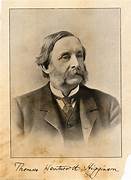
Thomas Wentworth Higginson as an elderly man, ca. 1905 (Library of Congress)
Higginson’s time in Newport coincided with an intense dispute within women’s rights circles over the 15th Amendment, which provided suffrage for Black men but not women. Higginson, though a firm supporter of women’s suffrage, advocated support for the revolutionary amendment with the thought that the right to vote for women would eventually come. Reformers Elizabeth Cady Stanton and Susan B. Anthony thought differently and organized against its passage causing a split in the suffrage ranks.[8]
During his Newport days, Higginson was involved with the Redwood Library and Athenaeum, the exclusive Reading Room in which he became a member in 1877, and the Town and Country Club. Through these and other social organizations he not only associated with the leading literary men and women of the country, but also Newport residents Alexander Agassiz and Raphael Pumperly.
In October 1874, Higginson, along with other leading men of Newport, invited George Downing to give his well-known talk on the life of the late Senator Charles Sumner at Newport’s Opera House. When Downing finished, Higginson appeared on stage and gave an account of his experience with Sumner. While an adopted son of Rhode Island, in 1876 he gave a stirring talk showing his pride in his adopted state. Speaking of the country’s centennial exposition at Philadelphia, the Newport Daily News reported “Col. Higginson spoke of the many things that aroused a Rhode Islander’s pride, and his allusion to the Corliss engine was applauded.”[9]
On May 12, 1911, in the First Parish Church in Cambridge (Unitarian), six Black soldiers from Higginson’s South Carolina Civil War unit, carried his casket into the church, followed by a “great throng of the military, civic, and literary” life of New England, including fellow Civil War veteran Charles Francis Adams, Jr.[10] They were there to celebrate the life of a man who was never afraid to enter the fray, work for justice, help the downtrodden, courageously challenge societal norms, and worked hard to improve the lives of those around him and the nation as a whole. Egerton’s biography captures the man and his work, and as Egerton’s book title denotes, Higginson was truly a man on fire. This is a book that deserves a wide readership.
Notes:
[1] Providence Journal, May 11, 1911. [2] Thomas Wentworth Higginson, “Massachusetts in Mourning,” A Sermon, Preached in Worcester, on Sunday, June 4, 1854. Accessed online at https://higginson.unl.edu/writings/twh.wri.18540604.html. [3] Higginson’s essay on Denmark Vesey appeared in the Atlantic Monthly in June 1861. His essay on Gabriel’s Revolt appeared in the Atlantic Monthly in September 1862. [4] Thomas Wentworth Higginson, Army Life in a Black Regiment (1870), 5. [5] An excerpt from Christopher Looby (ed.), The Complete Civil War Journal and Selected Letters of Thomas Wentworth Higginson (Chicago: University of Chicago Press, 1999). Accessed online at https://press.uchicago.edu/Misc/Chicago/333302 [6] See Erik J. Chaput and Russell J. DeSimone, “The End of School Segregation in Rhode Island,” The Online Review of Rhode Island History, Oct. 28, 2016, at https://smallstatebighistory.com/end-school-desegregation-rhode-island/. [7] Rockwell Stensrud, Newport, A Lively Experiment, 1639–1969 (Newport, RI: Redwood Library and Athenaeum Publications, 2006), 336. [8] This story is well told in Elizabeth C. Stevens, “’A Crisis in Our Cause’: The Fifteenth Amendment and the Newport Woman Suffrage Convention of August 1869,” Newport History, vol. 93, Iss. 282 (2020). Available at: https://digitalcommons.salve.edu/newporthistory/vol93/iss282/4 [9] Newport Daily News, May 31, 1876. [10] Providence Journal, May 13, 1911.
The Author

You Might Also Like