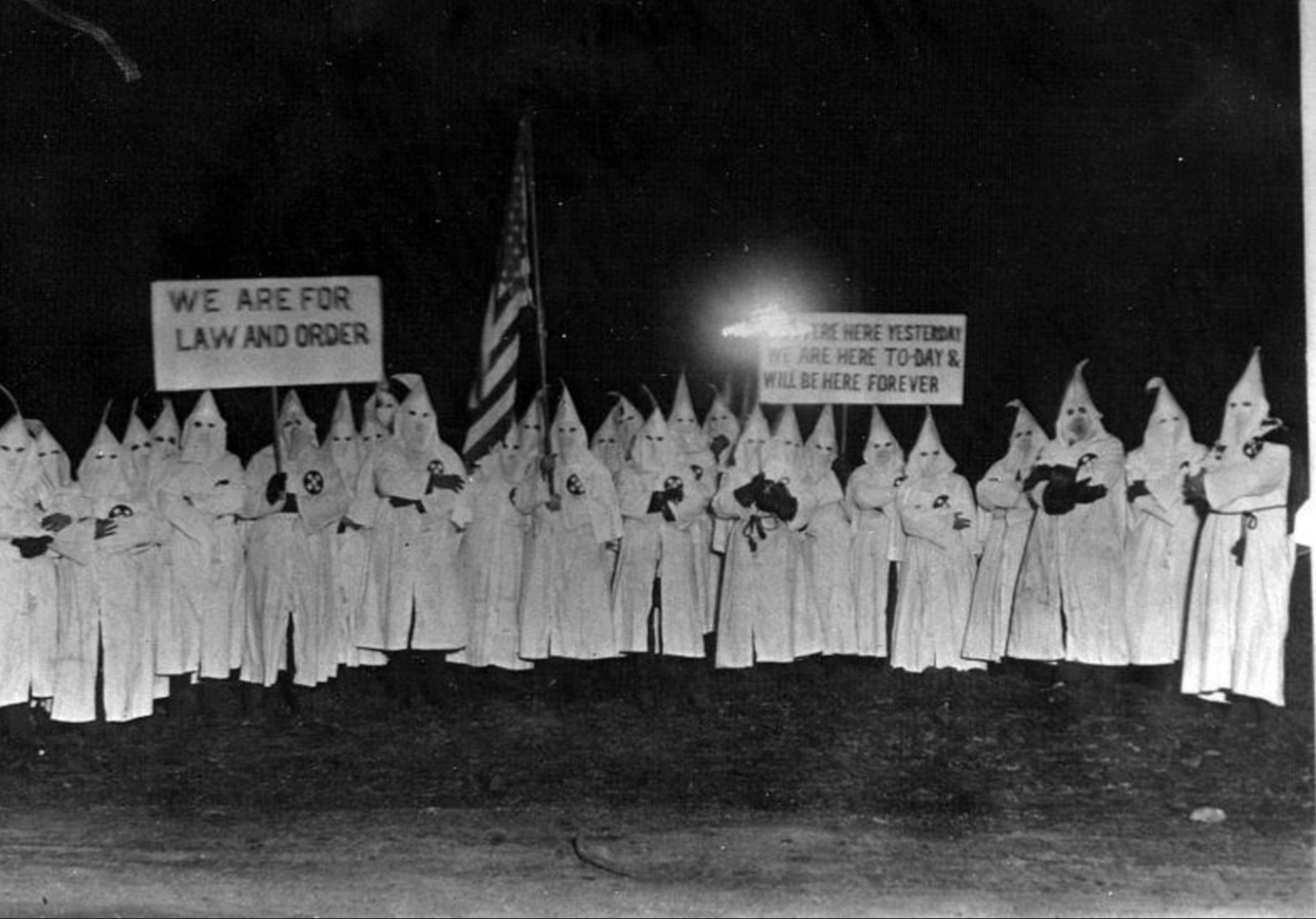


Rhode Island’s First Light Infantry (called the FLI for short) was disintegrating fast. It was 1927, more than a century after its 1818 founding, and it was able to count less than 25 members. It seemed certain that the Infantry would become merely a part of history—until boys and men suddenly began coming to enlist in hordes. Hundreds of interested individuals, both young and old, quickly filled the member lists of the FLI and many Rhode Islanders couldn’t figure out why. Confusion reigned again—then slowly dissipated—when the next public event of the FLI was announced alongside a notation that tickets could be purchased from an organization calling itself the Knights of the Ku Klux Klan.
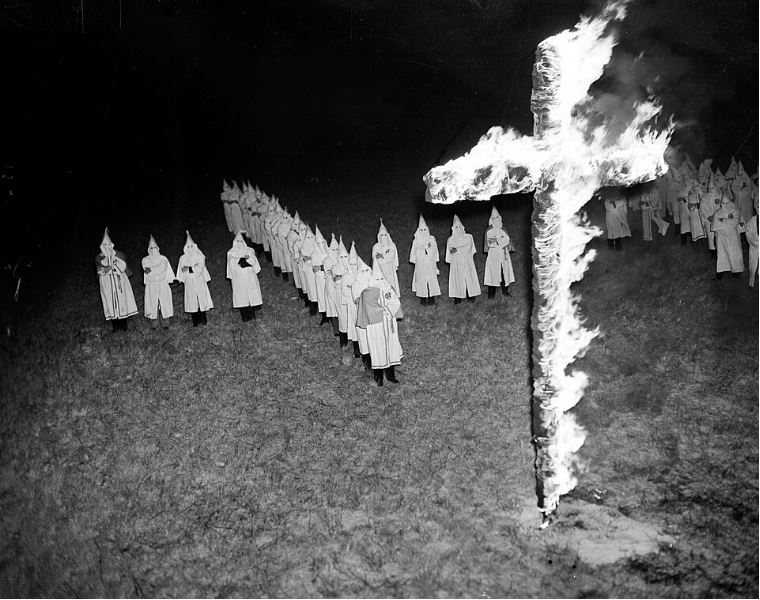
Klan burning cross in Florida, 1939 (Library of Congress)
Founded in Tennessee in 1865, during the reconstruction of a South that many who leaned toward white supremacy did not like, the KKK had no tolerance for Blacks, Catholics, Jews, or anyone foreign-born. Clad from head to toe in hooded white robes, with their faces concealed, the KKK began a legacy of cross-burning and terrorization.
From Tennessee, the KKK spread out across the nation. By 1871, South Carolina was experiencing one of the most deadly campaigns of domestic terrorism that had ever been recorded on American soil. However, the flames of the Klan began to flicker for the next few years until reignited during the 1920s. The decade brought forth a resurgence of the 19th-century efforts of the Klan to gain strong footholds in every corner of America. This time, the idea surged forward fluidly. Oklahoma was quickly invaded by the organization. Membership exploded in Maine. Eventually, Indiana could claim the most powerful branch of the KKK in the country, with up to 40 percent of its native-born, White, Protestant men believed to be on the roster.
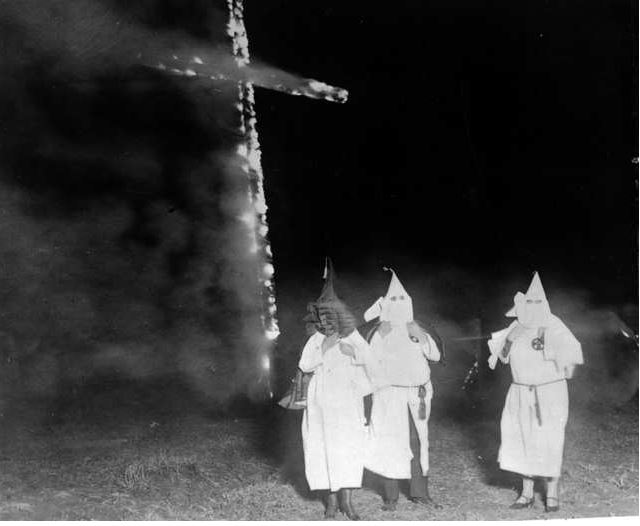
Klan burning a cross in Colorado, 1921 (Denver Library)
Historically, Klan membership has been highest in the southern and Midwestern states. During the 1920s, membership was estimated to be 30,000 in Oregon and 195,000 in Ohio. Between 1915 and 1944, membership estimates counted 60,000 in Florida and 240,000 in Indiana. At its height, the Klan was able to claim about 4 percent of the American population as members.
From Tennessee, the KKK spread out. As early as 1923, Klan literature was being passed around Rhode Island. In 1924, Klansman Morris S. Westervelt came from New Jersey with his wife and two children and settled into a cottage in Arnold’s Neck so that he could serve as King Kleagle (the Klan word for chief recruiting officer) of the newly established Providence County Klan. To conduct his work for the organization, he rented an office at 535 Broad Street in Providence. The tug-of-war between those who supported the Klan and those who didn’t was so constant that The Rhode Island Pendulum allotted an entire open forum column, throughout 1924, for Westervelt and his adversaries to wage a war of words against each other in print.
On June 21 of that year, an all-day Klan rally was held in Foster. With KKK members from across the east coast present, about 8,000 people listened to scheduled speakers and satisfied their hunger with a clam chowder dinner. Several hundred people were initiated into the Klan that day, in the light of a massive burning cross. Three days later, three crosses were erected and set afire in Exeter as about 100 residents of Washington County were initiated into the Klan before a crowd of about approximately 1,000 people. On July 16, Westervelt organized an all-day rally at Foster Center, which again drew a crowd of about 8,000. Another open-air event—a Klan ceremony—was held in Foster ten days later. By now, Ku Klux Klan branches had been organized in most areas of Rhode Island.
On the evening of October 30, 1924, the Rhode Island Klan’s last “barn meeting” of the year was held in a structure near Frye’s Corner in East Greenwich. When temperatures dropped, meetings held in barns and outdoors would be scheduled at more comfortable venues. The Klan orchestrated a gathering of nearly 500 in Coventry on January 7, 1925. A band had been secured for the occasion and an oyster supper served. A Klan dinner-dance was held at Rhodes-on-the Pawtuxet in Cranston on January 30, 1925, drawing nearly 1,000 attendees.
During the autumn of 1925, hoping to fuel Klan interest within the Ocean State, a Klan organizer came to stay in Warren for several weeks. A cross was erected and burned there on the common as he endeavored to recruit new Klansmen. During his stay, an informative KKK meeting was held at the Grand Army of the Republic Hall on State Street. Although several curious people attended the meeting, the overwhelming consensus was that the area was not in favor of the Klan. However, there were Rhode Islanders who did indeed decide to become members of the KKK.
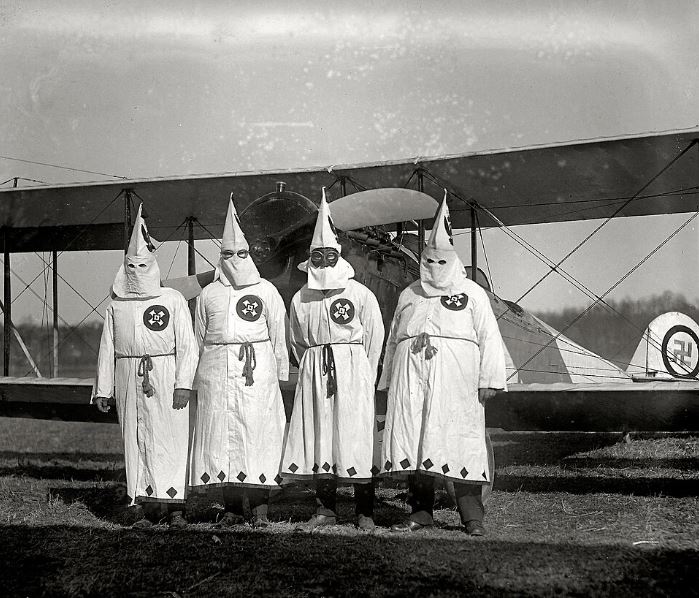
Klan with plane in Virginia that would be used to drop KKK literature to those below, 1922 (Library of Congress)
The Apponaug Church was filled with Klan members on the evening of December 6, 1925, when the organization presented a purse of money to 51-year-old Reverend Stephen Henry Talbot. There were Klan weddings, baptisms and funerals taking place around Rhode Island by this time. In October of 1926, 41-year-old John Algernon Domin, of George Street in Cranston, was elected Exalted Cyclops–which is KKK-speak for leader–of the Klan’s Rhode Island branch in Providence (designated Roger Williams Klan). Employed as a motorman for The Rhode Island Company, Domin often passed out Klan literature from the street car he worked on. The literature verbally attacked certain politicians and the Roman Catholic Pope.
By this time, the Klan in Rhode Island numbered between 2,000 and 3,000 members. It included politicians, businessmen, and even clergymen.
Twenty-eight-year-old Reverend Orlo Marion Brees had come to Westerly to lead the Niantic Baptist Church in January of 1924. In July of 1925, he joined the Washington County Klan. By the winter of 1926, the church had accrued a debt and still owed over $1,500 on its mortgage. On Christmas Eve of that year, the church hosted a holiday program for the children. At the close of the event, eighteen Klansmen suddenly marched into the church and handed Brees a check for the amount needed to pay off the mortgage. Brees made a short speech before the congregation paraded out to the churchyard and assembled around a large cross which had been erected. The Klansmen formed a circle around it as it blazed. The Kleagle held a portion of the mortgage to the flames while Brees burned the remainder of the document.
In April of 1927, Brees appeared in full KKK regalia to lead the funeral service of 54-year-old Charles Augustus Crandall at River Bend Cemetery in Westerly. Crandall, employed as a carpenter at the W.C. Hiscox Company, had expired on the floor of his home at 24 Stanton Street in Pawcatuck at 11:45 in the evening, on April 21, after returning from a social event at the Veterans of Foreign Wars Hall. A member of the First Baptist Church of Westerly, he had just taken off his coat and hung it up when he collapsed due to a hemorrhage. At the cemetery, the Klan gathered at the entrance and marched toward the Crandall family plot. There, the deceased was surrounded by white-robed mourners.
On the evening of September 9, 1925, about 2,000 people gathered at Grant’s Field on Stillwater Road in the Smithfield village of Georgiaville to attend the wedding of a 22-year-old Arthur Leroy Edson of North Scituate and 18-year-old Ruth Evelyn Arnold of Johnston. It was allegedly the occasion of the first Klan wedding within the state. The couple marched through a double line of 150 white-robed Klansmen, toward a flower-laden alter which had been constructed with a radiating electrical cross upon it, as well as an American flag and a banner designed with a Christian emblem. A red-hued light illuminated the darkness that shadowed the ceremony. Two young flower girls walked ahead of the bride and groom, carrying bouquets of calla lilies, followed by two older girls carrying dahlias. Behind the couple, walked the hooded clergyman, who would perform the wedding ceremony.
The clergyman began by reading a Bible text from John. Two Klanswomen then sang a duet before the clergyman continued with another Bible passage; the fifth chapter of Ephesians. After the couple were declared man and wife, hundreds of white roses were tossed into the air by the guests, falling to cover a large area of the field. A collection of over $133 was then taken up and presented to the newly married couple.
A national speaker for the KKK was present at the wedding and he took the occasion to lecture on the importance of patriotism, abstinence from alcohol, and a willingness to defy anything which was not White, American or Protestant. The attending Kleagle then addressed those present, urging all who were not yet members to sign on the dotted line, as 300 people went on to do before the evening was over.
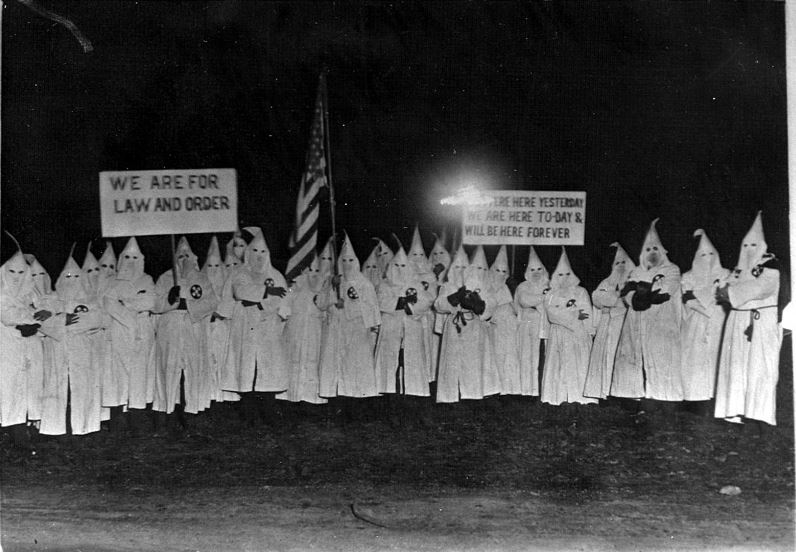
Klan gathering in Washington, D.C., 1922 (Harry S. Trueman Library & Museum)
Some who joined the Klan soon sought an exit. One Westerly farmer penned a letter in 1926 which read, “Am writing to inform you that from this day I do not consider myself a Klansman and also hand in resignation as Captain of same. When I took my oath as Klansman, I vowed to support superior officers and, if there was any differences, that I would leave the Klan and return all paraphernalia of the Klan. That is just what I am going to do. No more muddy or dusty roads for me.” The writer went on to say, “I joined the Klan because I thought it was right, and was ridiculed by my friends. I now think it is wrong and am willing to face more ridicule to do what I think is right.”
That same year, 35-year-old John Erhart Schlemmer of Smithfield became a Klansman. A fruit grower by trade, he soon left the organization as he wasn’t in agreement with some if its ideas.
On July 1, 1927, approximately 10,000 people attended another Klan even at Grant’s Field. Thirty-year-old Protestant minister Ernest Drake led the prayer before lectures were given and the many refreshment booths enjoyed.
Klan enrollment continued to go up in Rhode Island and people were no longer shocked to see crosses burning on hills, or throngs of white-hooded men circled in fields. Each branch of the Klan conducted an average of one meeting per week. They also gathered en masse at births, burials, and marital unions. In October of 1927, over 500 mourners attended the funeral of Frederick M. Smith in Acotes Hill Cemetery in Glocester. The 64-year-old had left his home to go hunting on October 10. He was discovered the next morning in the woods near his house in Hopkins Mills, dead of a gunshot wound. Seventy men and women of the Klan, all clad in full regalia, stood in a line near the chapel during the service.
Austin Church Barney, an Army veteran of the Great War, a military cook, and a draftsman at Brown & Sharpe, had joined the Klan in 1924 when he was 38 years old. He served as drillmaster of the organization, training the “Klavalier”—the KKK’s secret police—to act as a guard to the Grand Dragon, another name for the leader of the KKK in each state. In May of 1927, he stopped attending meetings and drills.
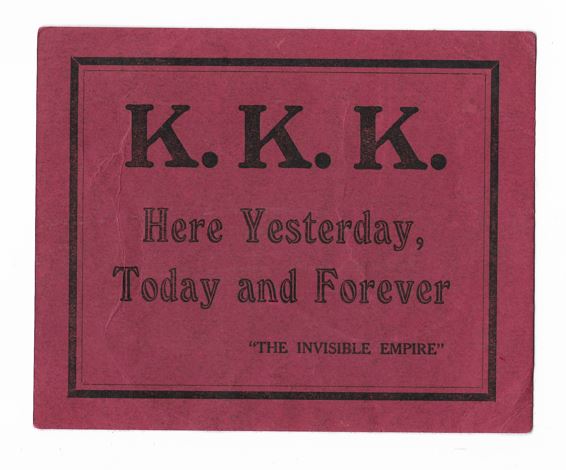
Cardboard ads to be passed out by local KKK members (Author’s Collection)
On December 10, Barney went to authorities and dropped a bombshell. The Ku Klux Klan was making an attempt to gain total control of Rhode Island’s First Light Infantry. And it was allegedly not a single geographic endeavor. The plan, he said, was for the organization to take over militia units nationally. The House of Representatives’ House Committee on Militia sent him back into the Klan to gather information regarding its relation to the FLI.
During March and April of 1928, a three-week hearing was conducted by the committee into alleged Ku Klux Klan activity within companies E, F and H of the Rhode Island First Light Infantry. Results of the investigational hearing would be presented to the Legislature. Affidavits were collected, including one with the author’s name kept confidential. The witness was a former member of Roger Williams Klan and an enlistee of the First Light Infantry. He stated that, on December 9, 1927, he went to 76 West Friendship Street where the Roger Williams Klan regularly held their meetings. He alleged that one of the members, who also served as First Sergeant of the First Light Infantry, spoke about the militia unit during a Klan meeting and that, immediately, 17 members of the Klavalier signed up. He went on to state that, the following week, 125 Klansmen joined the FLI. “There are at present over 250 men on the rolls of the FLI. Over 200 of them are Klansmen,” he wrote. He went on to assert, “I have been informed by the Klan that the object of the Klan joining the FLI is to get control of the independent military forces of the State and the National Guard if possible.” He added that “All the officers in the Roger Williams Klan, with the exception of the secretary, are members of the FLI” and that “Several members of the FLI who are not Klansmen were obliged to join the Klan to keep their membership in the FLI.”
Affidavits from four members of the First Light Infantry indicated that all but one of the companies were deeply involved in the Klan and that recruits were obliged to join the Klan before being enrolled. They stated that the plan was for the KKK to gain control of the militia’s personnel as well as the equipment housed at the armory. It was alleged that questions on the FLI recruit application included: Have you or any member of your family been a member of the Catholic Church? What country were you born in? Were your parents born in the United States? It was also stated that Klan fees were regularly collected—and Klan applicant questionnaires passed out—at First Light Infantry meetings.
While the hearings were taking place, Reverend Brees was discharged from his duties at the Niantic Church after he was accused of engaging in an adulterous relationship with a female congregation member. His wife, the former Nina McBride, soon filed for divorce, charging gross misbehavior with a church member. Said to have served the Klan as a Kleagle, a Kligrapp (the Klan word for secretary), a Klokard (the Klan word for lecturer) and a spiritual leader before breaking free of the organization, he accused the Klan of framing him. He proceeded to provide the public with a list of every Klansman in Washington County. The list of men, which numbered 681, included 55-year-old Samuel Richmond Avery, an undertaker from Main Street in Hope Valley, who vehemently denied the charge. Also on the list, according to Brees, was a 26-year-old son of Avery, and professional violinist Paul Rietzel, who lived on William Street in Westerly and allegedly served as a Klan secretary.
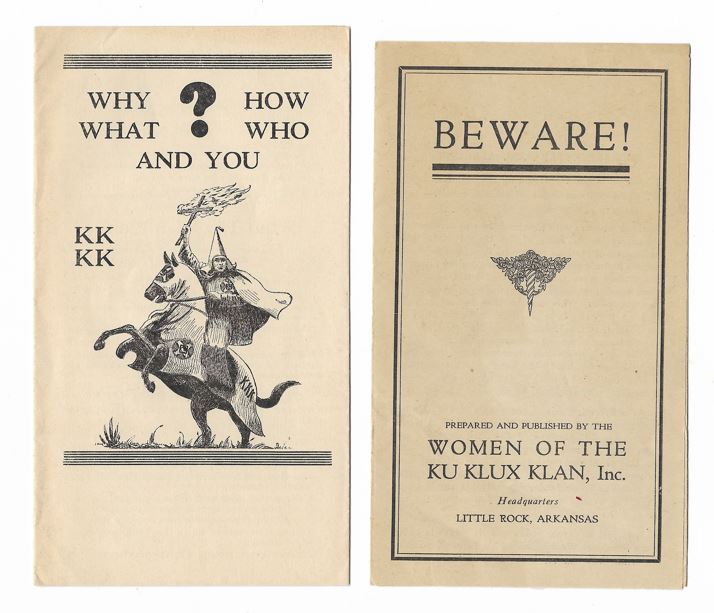
Literature to be given out to local members of Women of the Ku Klux Klan (Author’s Collection)
Grand Cyclops Domin was among those called to testify at the General Assembly’s hearings. He stated that he had never recruited Klansmen to join the FLI and wasn’t aware of anyone who did. He downplayed the dark reputation of the Klan, explaining they were merely a Protestant organization of people who supported the right of everyone to practice whatever faith they adhered to. Expanding on what information he was willing to share, he recalled another Klansman telling him that he was one of Goodnough’s men—referring to Deputy Prohibition Officer Henry E. Goodnough—and that he had the goods on the state’s bootlegging operation. He allegedly told Domin that Adjutant General Arthur C. Cole was one of the men at the head of Rhode Island’s rum-running ring.
Clarence Cleasby of Lexington Avenue in Cranston also testified. The former secretary of the Kent County Klan, he listed off several members of the Rhode Island General Assembly who he claimed were favorable to the Klan. They included Republican Senator Harry A. Sanderson of Johnston, and 63-year-old Republican Senator Robert Goddard McMeehan of East Providence—who was a department store owner and would serve as secretary of the Washington Bridge Commission—and 61-year-old Senator Charles Stone Weaver of Shannock. Weaver had been elected to serve as Richmond town constable in 1920. He also served on the Richmond Town Council, the School Committee and as Shannock postmaster. Until his retirement in 1925, he had operated a bakery.
Cleasby also named Jury Commissioner and former senator of Portsmouth, 45-year-old Arthur Almy Sherman, as one who was said to be in good favor with the Klan. Sherman, who would serve as Town Clerk of Portsmouth and State Jury Commissioner, was a die-hard Republican until the party refused to endorse him. When the Democratic Party offered him their support, he quickly switched alliances.
Senator Sanderson argued that he had openly condemned and criticized the Klan and had never had any kind of alliance with them.
Senator McMeehan, who was a member of the Protestant Episcopal Church, the Masons, the Odd Fellows, and the Knights Templar, served as vice president of the Providence Business Men’s Association and Rumford Grange. A former cotton goods manufacturer, McMeehan denied that he had ever promised to support the Klan and knew nothing regarding any of their goals. When asked if he had ever heard of the Klan influencing the election of any official to the General Assembly, he stated, “I heard that the Klan helped put through the election of Adjutant General Arthur C. Cole.” Interestingly, McMeehan’s wife—the former Alice May Hardy—was featured in an article that appeared in The Fiery Cross in 1924. A newsletter printed in Indiana from 1922 to 1925, The Fiery Cross was billed as “America’s Leading Klan Publication.” Inside, one could find rooms for rent “to Protestant Americans” and KKK memorabilia for those who were “100% American.” Items for sale included red, white, and blue KKK pennants, as well as rings, billfolds, key chains, and flags bearing Klan emblems. Klan fireworks “especially prepared for open-air Klonklaves” could be ordered here, as well as musical Klan bands and copies of songs such as “I’m A Klansman, Hooray” and “Awake, Ye Klansmen.” Klansmen seeking to carry jackknives were provided with information on how to order a Keen Kluxer Knife, or a Knifty Knife.
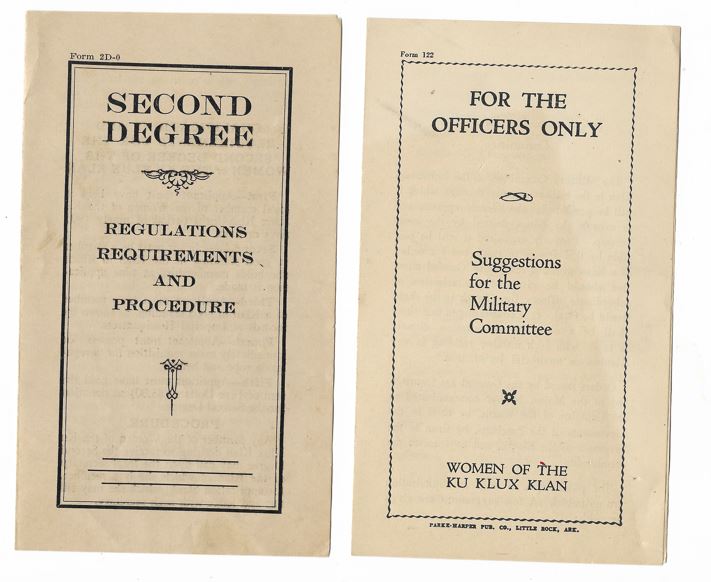
More literature to be given out to local members of Women of the Ku Klux Klan (Author’s Collection)
The interview with McMeehan’s spouse began, “The loyal wives of the Protestant members of the Rhode Island state senate are firmly determined to carry on until their husbands, now in exile in Rutland, Mass., can return to Providence and smash the power of the Roman Catholic Church over state affairs.” It described the efforts of politician’s spouses during a six-month filibuster between Rhode Island’s Catholic democrats and Protestant Republicans. McMeehan’s wife was interviewed in the office of their store at Broadway Six Corners. As she discussed running the establishment while her husband was gone, she said, “”I’ll stick till doomsday if need be, if it will help any.”
Roswell Arthur Calin of Johnston, a 30-year-old paint salesman, testified that he had handed over ten dollars to join the Klan. He alleged that, after attempting to join the First Light Infantry, he was informed by someone in the organization that a Klansmen would have to vouch for him before he could enlist. He reported that three-quarters of the FLI was made up of Klansmen and that he became aware of the Klan’s efforts to gain control of the FLI through information provided to him by Schlemmer and 41-year-old East Providence mail clerk Everett Tillinghast Messenger. Calin stated that he attended the organization’s scheduled meetings at Altair Hall, at 118 Elmwood Avenue in Georgiaville, and Odd fellows Hall in Coventry, and that he ceased attending meetings in 1927.
Schlemmer also testified. He said that he had also been told of the Klan’s interest in gaining control of the armory. Recalling the day he went to enlist in the FLI as requested, he said that he entered the machine gun company’s room at the armory and recognized about 75 fellow Klan members. When he informed a member of the FLI that he was there to enlist, one of the Klansmen announced “He’s alright. He’s a white man”—Klan-speak for a person who has the proper qualifications to be a member of the KKK.
Clarence Sawyer Cleasby of Lexington Avenue in Cranston also took the stand. The 40-year-old, who would serve as secretary of the Cranston Chamber of Commerce and engage actively with the YMCA, had also served as Kleagle for the Newport, Bristol, and Kent County Klaverns. Cleasby had requested to be exempt from the World War I draft due to defective vision and the need to support a wife and child. He was employed as an auditor. He had once worked as a cashier for a bond company and would later become a roofing salesman and a medicine peddler. He testified that the South County Klan met in a small building they owned in the Dunn’s Corners area of Westerly. He said that the Newport Klan met at the Middletown Town Hall and that the Kent County Klan met at Odd Fellows Hall in Coventry.
Cleasby recalled that Reverend Brees had been secretary of the South County Klan and that Daniel O. Bowler was secretary of the Newport Klan. He counted Westerly Klan members to fall between 650 and 700, and the highest number of the Kent Klan being 646 members around 1926. He estimated the Newport Klan to have about 200 members. Among those he knew as Klansmen, Cleasby named 52-year-old Warwick police chief Ellis Albro Cranston, Coventry police chief William Longridge, and East Greenwich police chief Carl Straight.
Cleasby admitted having passed out circulars that had been given to him by the Grand Dragon, which requested general information regarding an individual’s religious affiliation, opinion of the Klan, and their feelings concerning each member of the House of Representatives and the Rhode Island public school system. He stated that the Klan wanted control of the public schools, from the superintendents right down to the teachers.
Banished by the Klan due to his affiliations with the American People’s Church and unfrocked New Bedford pastor Guy Willis Holmes, Cleasby had only experienced life as a Klansman for a few months. Claiming that he regretted having ever gotten involved with the KKK, he identified practically every person on a list of FLI members as Klansmen.
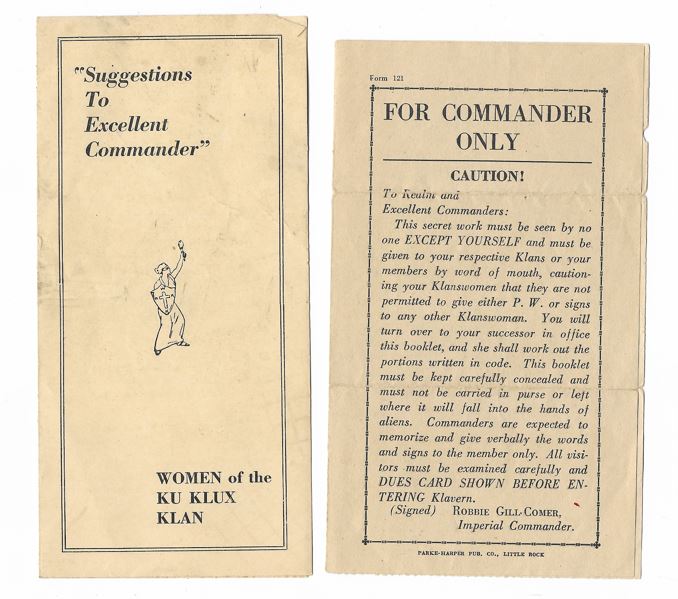
More literature to be given out to local members of Women of the Ku Klux Klan (Author’s Collection)
Orton Edward McGarrett, a 48-year-old life insurance agent and gunsmith from Centredale, testified that he had joined the Klan at the invitation of Captain John T. Kenyon, a member of the First Light Infantry. He stated that he had been attracted to the organization’s principles at the time. His duty as a Klansman, he explained, was that of a Ward Major—making efforts to get as many Protestants into public office as possible. Having severed his ties with the Klan, McGarrett announced that the organization kept what was called a “dark list”—a secret roster of Rhode Island businessmen who were KKK members but served in that capacity confidentially as there was a likelihood that their affiliation might negatively affect their business interests. McGarrett testified that Kenyon had once told him that Bishop William A. Hickey had control of the Armory and that the First Light Infantry was being filled with Klansmen to take that control away.
Clifford B. Hawes, who joined the Klan—as well as the FLI—in September of 1927, admitted that he had been discharged from the Lord Shipping Company in Providence during World War I after he was accused of spreading German propaganda. He claimed the entire matter was a frame-up. At the close of his testimony, he was informed by a member of the House that he should be ready to return to the stand at any given time. Hawes explained that, as he worked as an auto mechanic, he would appreciate having time to clean up before being called in to testify again. The House member suggested that, if he were that dirty, perhaps he could simply use his Klan robe to cover himself up.
Ralph Francis Harber of Pawtucket, a 30-year-old reporter for The Providence Journal and veteran of The New Bedford Times, testified that he paid fifteen dollars to join the Klan. Others had claimed to have paid an initial ten-dollar fee, eight dollars of which went toward the cost of the white robe and hood while the remainder was divided between the local branch and national branches of the KKK. After one joined the KKK, a six-dollar yearly fee allowed the individual to retrain his membership. Harber stated that, soon after becoming part of the organization, two Klansmen invited him to join the FLI.
Frederick T. Remington, a 45-year-old Klan member and resident of Warren Street in Providence, refused to answer questions which would result in Klan information being revealed. Serving as secretary of the Roger Williams branch, he explained that the Klan prohibited disclosure of certain information. Described as being the most arrogant and challenging of the Klan members put on the stand, he denied that he had ever given any information regarding a relationship between the Klan and the FLI to Austin Barney, as Barney had testified, because there was no such relationship in existence. He explained that he was not on friendly terms with Barney and insisted that he had told him nothing. He also accused Harber of lying, alleging that Harber was never a member of the Klan and had never paid money to join.
One of the most important testimonies came from John William Perry, a former sergeant in the 56th Artillery Supply Company during World War I. When asked if he was a member of the KKK he responded, “You bet your life.” The 33-year-old served as the Klan’s Great Titan. Posed against questions pertaining to his career with the New London police force—from 1919 to 1922—Perry testified that he resigned from the force on October 26, 1923 due to the negative publicity that fell over him when he was wrongly accused of misbehavior with a prostitute. Evidence was later presented to show that Perry was suspended from the force on September 20, 1922 after information came to light concerning an adulterous affair with the wife of a naval officer.
Perry testified that his parents were American-born and of the Protestant faith—requirements for being a member of the Klan. He shed tears on the stand as he described how, after his father died on September 12, 1925, his Catholic brother-in-law had him buried in Saint Mary’s Catholic Cemetery in New London against his Protestant father’s wishes. “I loved my daddy,” he said. On October 26, 1926, Perry had his father disinterred and reburied in Waterford’s Jordan Cemetery. His mother, who passed away in 1910, remained in her grave at Saint Mary’s.
Once again, evidence was presented that showed Perry to be a liar. Both of his parents were Portuguese—his father from Madeira and his mother from the Azores. In addition, they were both Catholic and Perry had been baptized at Saint Mary’s Catholic Church.
Perry stated that, as a member of the Klan, he stood for values such as “white American womanhood” and keeping his blood “as white as my daddy gave it to me.” He initially refused to supply the name of Rhode Island’s Grand Dragon, but finally relented, stating that the man’s name was F. W. Franks and that everyone in the Klan called him “Ted.” He read the Klan’s oath aloud to the committee and listed the organization’s allegiances to causes such as white supremacy.
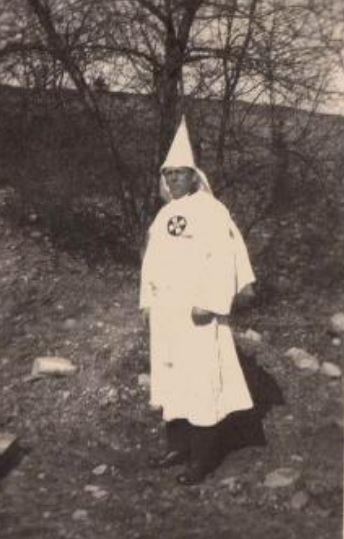
Unidentified man in Klan regalia (Author’s Collection)
Other individuals involved in the hearings included 42-year-old Captain Grafton Gardner Greenleaf of the FLI. The owner of an automobile repair shop, he claimed to have joined the Klan in October of 1927 but soon severed his connections. He testified that when he expressed interest in joining the FLI, he was informed by that organization’s commanding officer—Colonel Harold A. Braman—that he would have to join the KKK first. Braman forcefully denied any connections to the Klan and stated that Greenleaf’s mention of him was a slanderous lie. He claimed that he had no knowledge of any KKK plan to take over the FLI until he was informed of such by Arthur Cole on March 16, 1928.
Toward the close of the hearings, Perry was recalled to the stand. He failed to attend, explaining that he was under a doctor’s care. He was later arrested and charged by the State of Rhode Island with perjury. He was acquitted of the charges in 1929 and continued to serve as Rhode Island’s Grand Titan until he removed to Connecticut and began working as a preacher. He died at Lawrence & Memorial Hospital in New London on February 13, 1934, allegedly from the effects of wounds he received in the war.
As a result of the hearings, the First Light Infantry’s commander in chief was ordered to take immediate action to purge all Klan influence from the organization. The Second Battalion of the First Light Infantry, which utilized the Cranston Street State Armory for drilling purposes, was ordered by the regiment’s commander to surrender its arms before being relieved of its duty.
On June 23, 1928, yet another evening Klan wedding took place at Grant’s Field. That same month, Alabama senator J. Thomas Heflin came to Grant’s Field to speak at an open-air Klan meeting. Admission was fifty cents. On September 21, 1929, a Klan lawn party took place at Reynolds Farm on Post Road in East Greenwich. While the House hearings may have thrown a bump into the Klan’s smooth slide toward control of the First Light Infantry, they didn’t hinder enrollment in the KKK. Members introduced their children to the organization’s policies and many female Rhode Islanders worked tirelessly in the Women’s’ Klan Auxiliary. Klan meetings always began with attendees singing The Star Spangled Banner. The Pledge of Allegiance would follow, along with all those congregated singing America.
Over time, many Rhode Islanders grew weary of membership in the Klan. One Westerly woman who attended the Central Baptist Church and gave much of her time to organizations such as the Westerly Emblem Club, the Westerly Fire Department Ladies Auxiliary, the Red Cross, and the March of Dimes, had served as Kligrapp for the Klan. She penned a letter on October 21, 1929 which read, “Please accept my resignation from the office of Kligrapp on December 31. At which time, the books will be audited and ready to be turned over to the newly elected Kligrapp. This will give you ample time to secure a new secretary.”
While some members left, others remained part of the white-hooded order. On January 19, 1931, Laura Frances (Briggs) Matteson passed away and was laid to rest at East Greenwich Cemetery. The 82-year-old had been a member of the United Protestant Church of East Greenwich, and the Women’s Klan Auxiliary. That same year, Arthur Cole resigned from his position as Adjutant General to concentrate on his business pursuits. The First Light Infantry eventually merged with the Rhode Island State Guard.
As the years went on, many former Klansmen saw their past come back to haunt them. In 1952, Brees—who was no longer a reverend—was a Republican candidate for state senator of New York. Copies of an old Providence newspaper disclosing his involvement in the Ku Klux Klan were being distributed by his opposition. Brees sought to explain himself during a meeting of Republicans in the social hall of Saint Mary’s Church in Binghamton, New York, that February. Holding one of the newspaper copies being passed around, he stated that he had only served as a Klansman for a short time in 1927 and that he had joined when the organization was in its “propagation stage.” He claimed that he “got out” after he realized the character of the Klan. “I learned that I wanted no part of that organization,” he said. A 60-year-old Brees took his fifth wife—33-year-old stenographer Alice Gregory—in 1957. His gravestone, laid upon his death in 1980, reads “Poet, Statesman, Orator.”
It’s been nearly a century since the height of the Ku Klux Klan movement in Rhode Island. The sight of burning crosses in farmer’s fields, and ministers wearing white hoods, are no longer common here. After a complete failure in attempting to gain control of our state militia, the Klan seemingly deflated their full-blown efforts to dominate Rhode Island.
Sources:
The Woonsocket Call: March 19, 1928; April 3, 5, 10, 14, 21, 1928; June 23, 1928, August 20, 1924
The Westerly Sun: November 1, 1927; March 8, 18, 22, 29, 1928; April 1, 4, 5, 6, 11, 12, 13, 15, 19, 1928; May 27, 1928; June 24, 1928; January 8, 1929
The Pawtucket Times: March 28, 29, 20; April 3, 4, 5, 13, 1928
The Narragansett Times, January 8, 1926
The Warren and Barrington Gazette: September 11, 1925
Rhode Island Pendulum: November 13, 1924, December 10, 1925, January 22, 1931
The Fiery Cross: September 5, 1924
1920 Rhode Island State Census
1930 Rhode Island State Census
1928 Rhode Island Directory
Rhode Island Birth Records
Rhode Island Death Records
Find A Grave, at www.findagrave.com
The Author

You Might Also Like