

Today, when only two rail lines exist across Rhode Island, the main Amtrak line and the Providence and Worcester tracks, and stations on these routes are very limited, it may come as a surprise to learn that in 1892, fourteen rail lines snaked their ways throughout the state, carrying passengers and freight to many small towns.
A trip to Newport from Providence? Not a problem, for the Providence-Warren-Bristol train could connect you to the Old Colony and Newport Railroad, and take you right into Newport. How about an excursion to the shore on the west side of the Bay? From the West Kingston Station stop on the New York-Providence-Boston Railroad, you boarded the Narragansett Pier Railroad, which took you into Narragansett near the Casino. If you wanted the popular shore resorts and shore dining halls of Warwick at Rocky Point and Oakland Beach, the Warwick and Oakland Beach Railroad would take you swiftly to the shore destinations.
If north-western Rhode Island was your destination, you had a variety of choices. From Providence, you could ride northwards on the Providence and Worcester line to Woonsocket or Millville, Mass. (Millville seemed to be one of the regular destinations for travelers where they were met by stage or private carriage and transported to Slatersville). From Woonsocket, the Woonsocket and Pascoag Railroad took the passenger through Globe Village, Forestdale, Nasonville and Harrisville to Pascoag, where the line ended. The New York and New England Railroad also ran a line to Pascoag as the Providence and Springfield Railroad. This left Olneyville, travelled along the west side of the Woonasquatucket and Georgiaville Pond to Primrose and on to Graniteville and Pascoag, the end of the line.
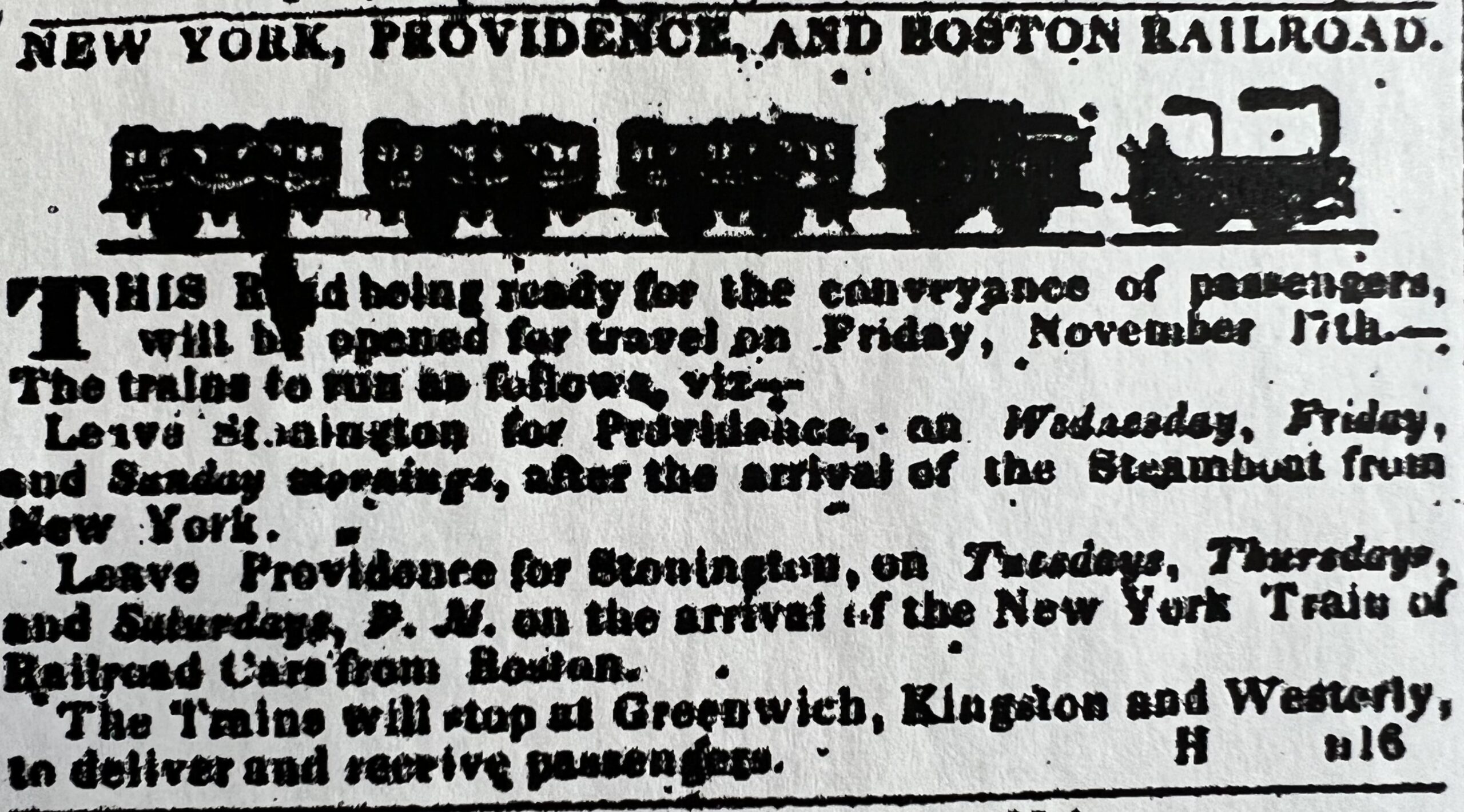
An advertisement for passengers for the New York, Providence and Boston Railroad about Nov. 16, 1837. The ad states that the train, after departing Providence, stops at “Greenwich, Kingston and Westerly” (South County History Center)
In 1843, the Providence Journal estimated the cost of the Providence-Woonsocket Railroad to be $1,000,000. This was a huge investment at the time. In May 1844, the General Assembly session granted a charter, and on August 9, 1847, the locomotive “Lonsdale” arrived in Providence. By September 1847, freight service had started; and on October 25, 1847, the formal opening of the line occurred. In 1878, the branch line from Valley Falls opened.
Another New York and New England railroad line left the Olneyville section of Providence south through the Oaklawn section of Cranston, into West Warwick through Westcott, Riverpoint, and Quidnick, into Coventry through Anthony and Coventry Center, to Summit and Greene, and on into Connecticut to Oneco and Plainfield. The Pawtuxet Valley Branch Railroad left the main line (New York – Providence – Boston Railroad) in Cranston and went to Howard, Pontiac, and into West Warwick to Westcott. Here, it followed the north branch of the Pawtuxet River to the village of Hope. Thus, the middle section of the state was covered to the Connecticut line.
A little further south, the Wood River Branch Railroad served the mills of the Hope Valley area. A short spur, it left the main line at Wood River Junction. When the 1938 hurricane hit, the line was under the ownership of Senator Roy Rawlings of Richmond. After the storm, this rail line no doubt carried lumber cut off his lands.
On the east side of the Bay, the East Providence branch of the New York-Providence-Boston Railroad, with two spur lines, provided coverage for the eastern side of the state. One spur ran via Rumford to Attleboro to rejoin the main line; the other went up the east side of the Seekonk River, around the east side of Pawtucket, crossing the main line just east of Central Falls at the state line, and then joining the Providence and Worcester Railroad at Valley Falls.
The extreme northeast corner of the state was served by the Rhode Island and Massachusetts Railroad, which left Valley Falls, ran along Abbott Run, passed through Diamond Hill, and crossed into Massachusetts.
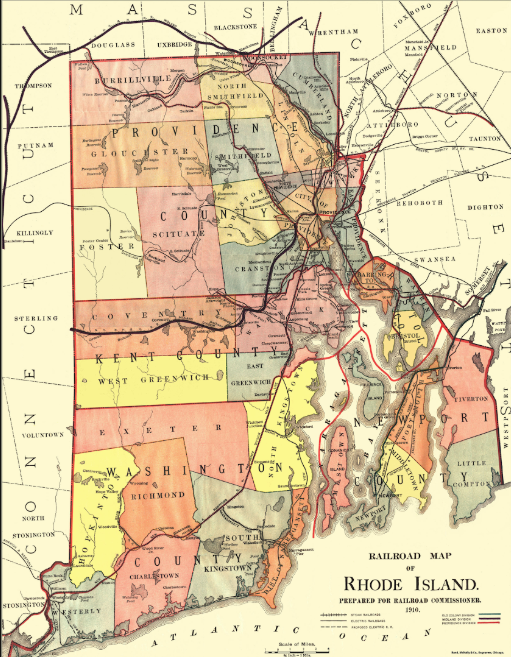
This 1910 map shows various railroad lines criss-crossing Rhode Island
Many of these lines were built to transport raw materials and finished goods from the mills along Rhode Island’s rivers: Pascoag and Harrisville on the Harris River; Hope, Anthony, Quidnick, Riverpoint, and the other mill villages on the Pawtuxet River; the mills along the Blackstone and Woonasquatucket Rivers; and Hope Valley and Coventry Center.
Some lines served both passenger traffic and mills. From Wickford Junction, a short spur line ran to the water at Poplar Point in Wickford, where passengers could then take a steamship to Newport. This line passed directly behind the Rodman Mills for their convenience. The Hazards were the main owners of the Narragansett Pier Railroad. This spur line off the New York-Providence-Boston Railroad and having a station at West Kingston, served beachgoers from Providence and elsewhere; and the Hazards also used the line to carry products manufactured at their Peace Dale mills. Other lines were primarily for passenger traffic, such as the Warwick and Oakland Beach line.
In addition to hauling mill supplies and goods, many of the lines transported other products. Granite was carried from the quarries of the Diamond Hill area, Graniteville in Harrisville and Johnston, and the Coventry Center Jackson Quarry on Foster Ledge. Lumber came from area saw mills. Trains also carried farm products, supplies for stores in area villages, and more.
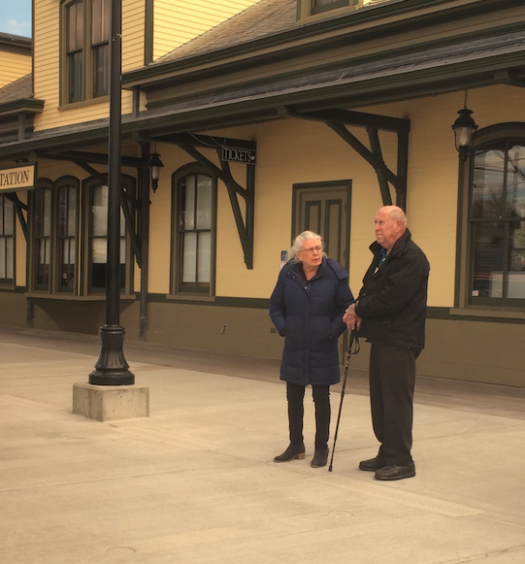
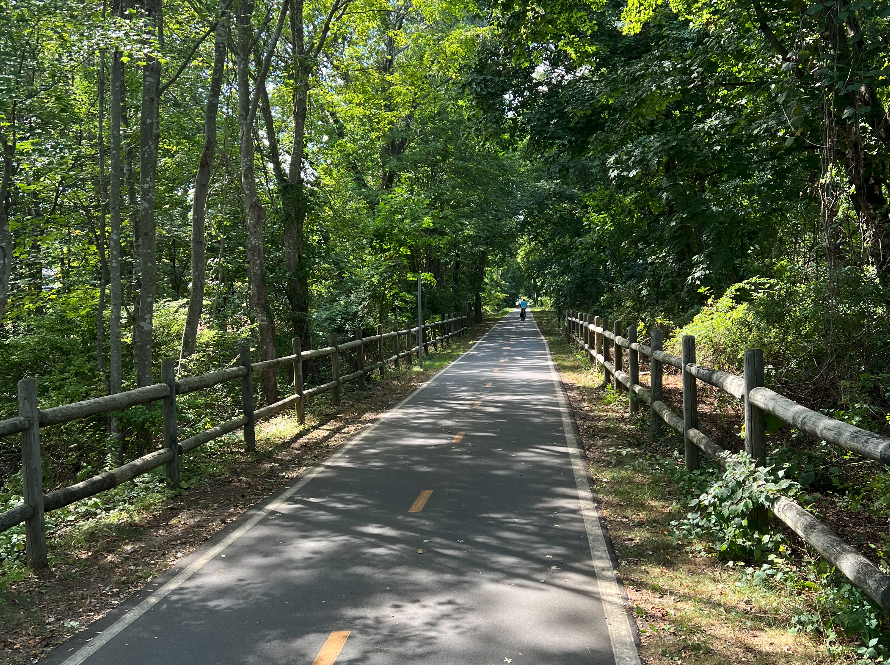
Today, some of these routes are still in use—but without their rails and long lines of cars. The Narragansett Pier Railroad right-of-way is now a walking and bicycle path wending its way through the scenic woodlands of South County starting at the Amtrak train station (the Victorian country-style building looks today almost exactly the way it was when its construction was completed in 1875) in West Kingston and ending at Narragansett Pier. The paved pathway crosses the Chipuxet River in the Great Swamp and Ministerial Road through lovely rhododendron groves, traverses the Tri-Pond Park in Peace Dale, and passes through Peace Dale and Wakefield on its way to Narragansett.
On the rail bed of the Providence to Danielson route of the New York and New England Railroad, you can enjoy hiking, bicycling, and for part of the route, horseback riding. The trail is paved through Cranston to western Coventry, with a number of trail heads where parking is available. At Coventry Center, the parking includes space for horse trailers, and the trail in that area includes a dirt path alongside for the horses.
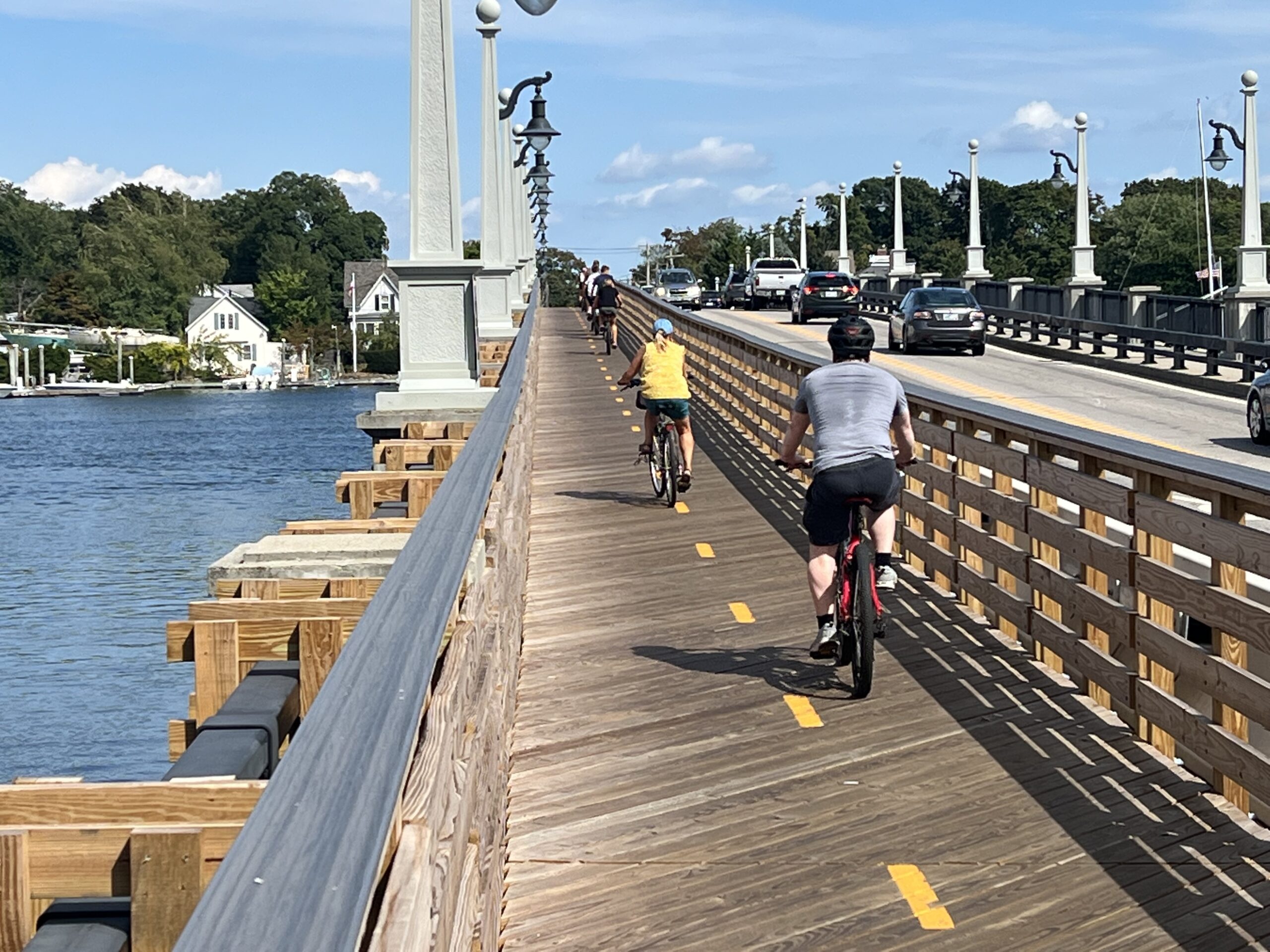
The East Bay Bike Path from Providence to Colt State Park in Bristol follows the railroad right-of-way of the Providence-Warren-Bristol Railroad for much of its route. Another paved bicycling and walking path, it offers scenic water views along the way. In addition, the ride passes through historic Warren and ends in historic Bristol; along the way are numerous historic marker describing lost towns and businesses.
Also in the East Bay area, portions of the Old Colony and Newport Railroad line are still used, as the popular Newport Dinner Train runs regularly a short distance out of Newport and back. The Old Colony line, built in 1863, connected Newport to Fall River and beyond. In 2007, the Sakonnet River Rail Bridge that connected the two cities was demolished. Thirteen miles of track out of Newport remain. Trains depart from a little red train station on America’s Cup Avenue in Newport near the Save the Bay Hamilton Family Aquarium.
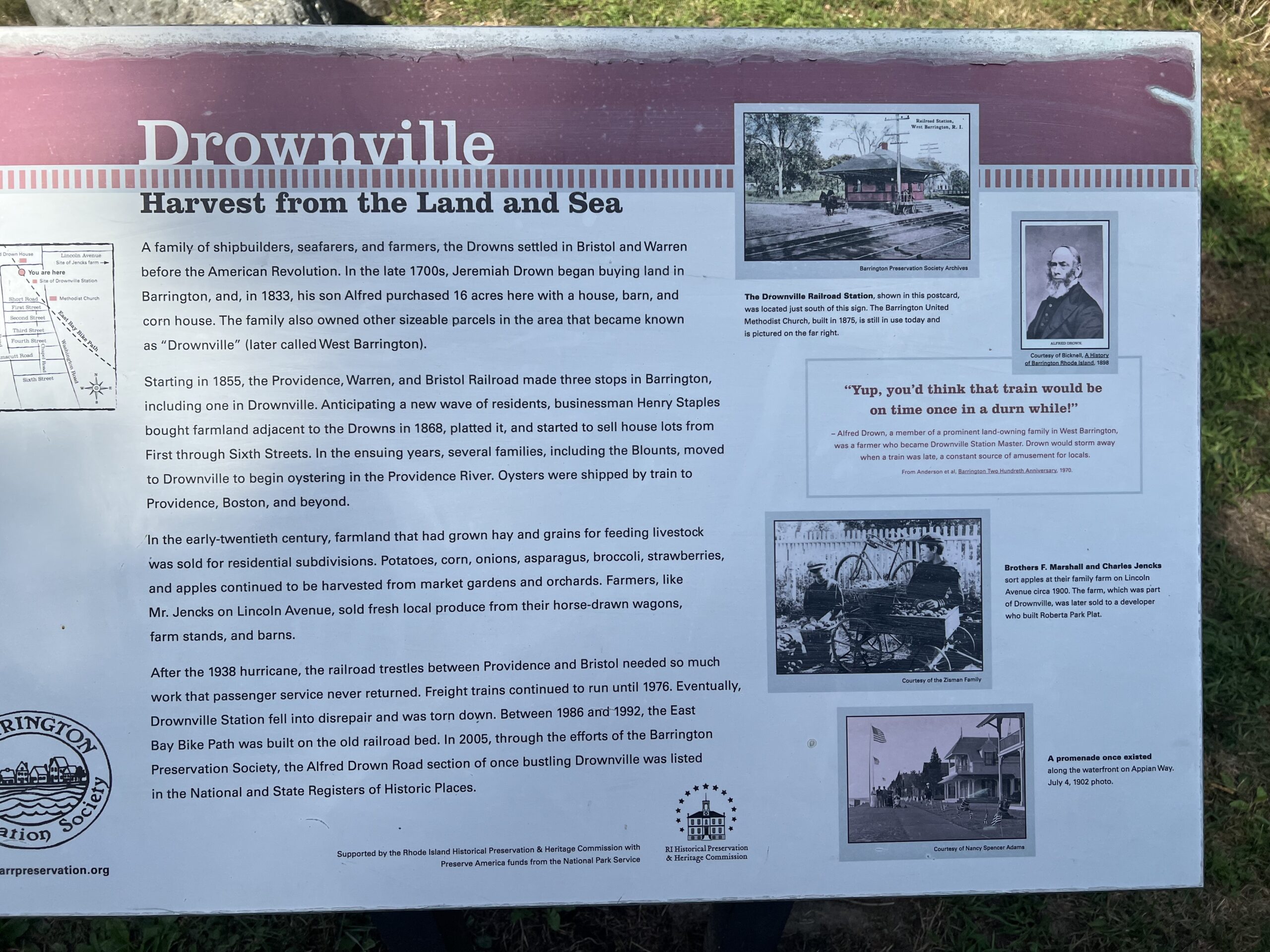
These photos are all from the East Bay Bike Path. The bridge is in Barrington, the woods are in Barrington, and the historic marker is on the path. The shot of the river is from Warren. (Photos by Christian McBurney)
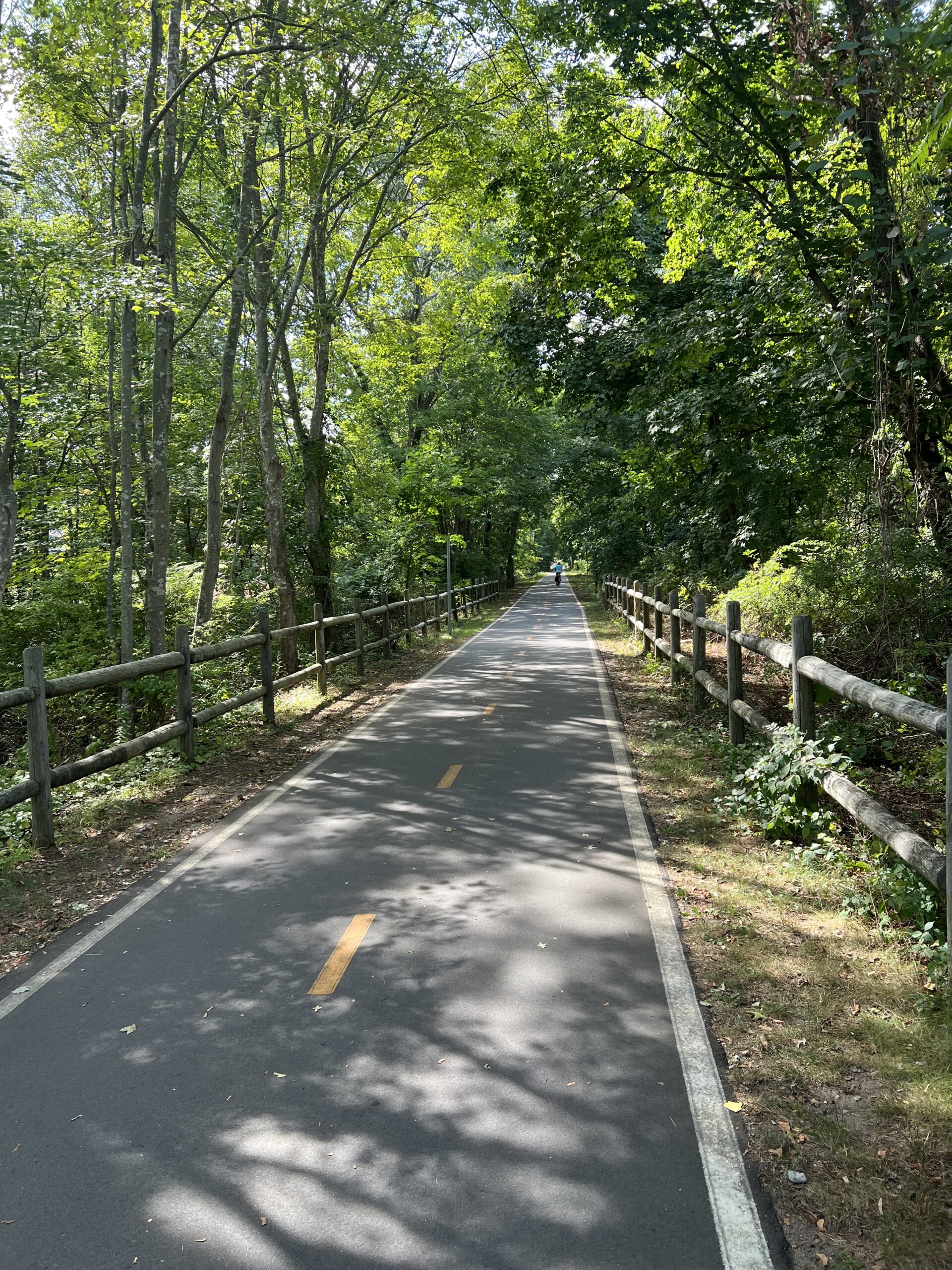
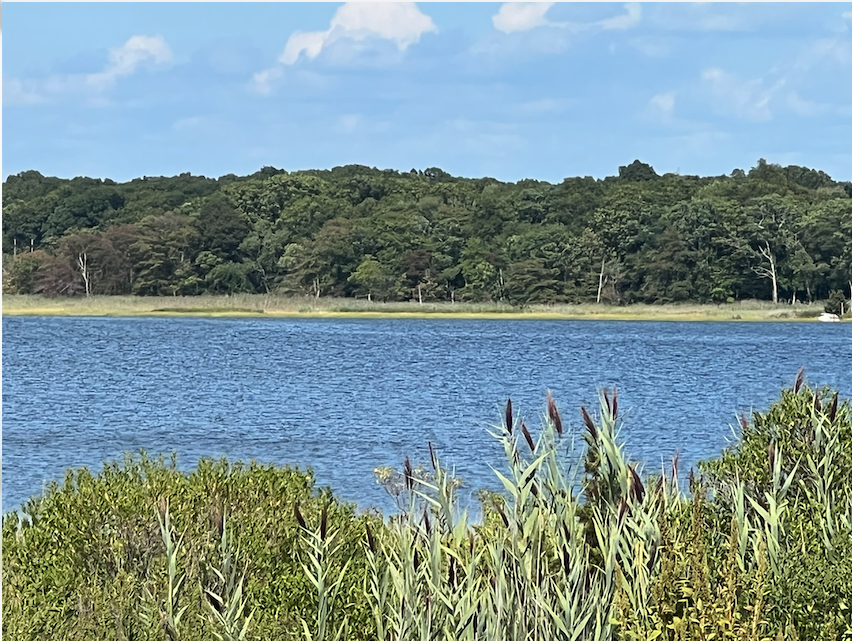
If you look carefully while driving along some of the state’s roads, you can see evidence of the old rail lines. Along Route 5 south of the intersection with Route 7, there is still evidence of the roadbed of the Providence to Springfield branch of the New York and New England Railroad. The spur line into Wickford behind the Rodman Mills is now incorporated into the park around Belleville Pond and forms a natural hiking path.
The Rails-to-Trails movement in the United States focused attention on many of these old rail lines, preserving their routes for the enjoyment of the public. In 2003, there were 1,012 rail-trails in the U.S. with a total mileage of more than 11,000—and more planned. The next time you use one of the trails, or notice alongside a road the remains of a rail line, think back to the days when train travel was a rapid and vital means of moving people and goods across the Rhode Island countryside.
The Author

You Might Also Like