

Most of this article is an inventory of the items that Newport merchant John Manley owned at the end of 1776 at his modest home in Newport on Touro Street, facing what is now Washington Square Park. John wrote the detailed inventory because he was attempting to be financially reimbursed by the state of Rhode Island for his losses suffered during the British occupation of Newport.[1]
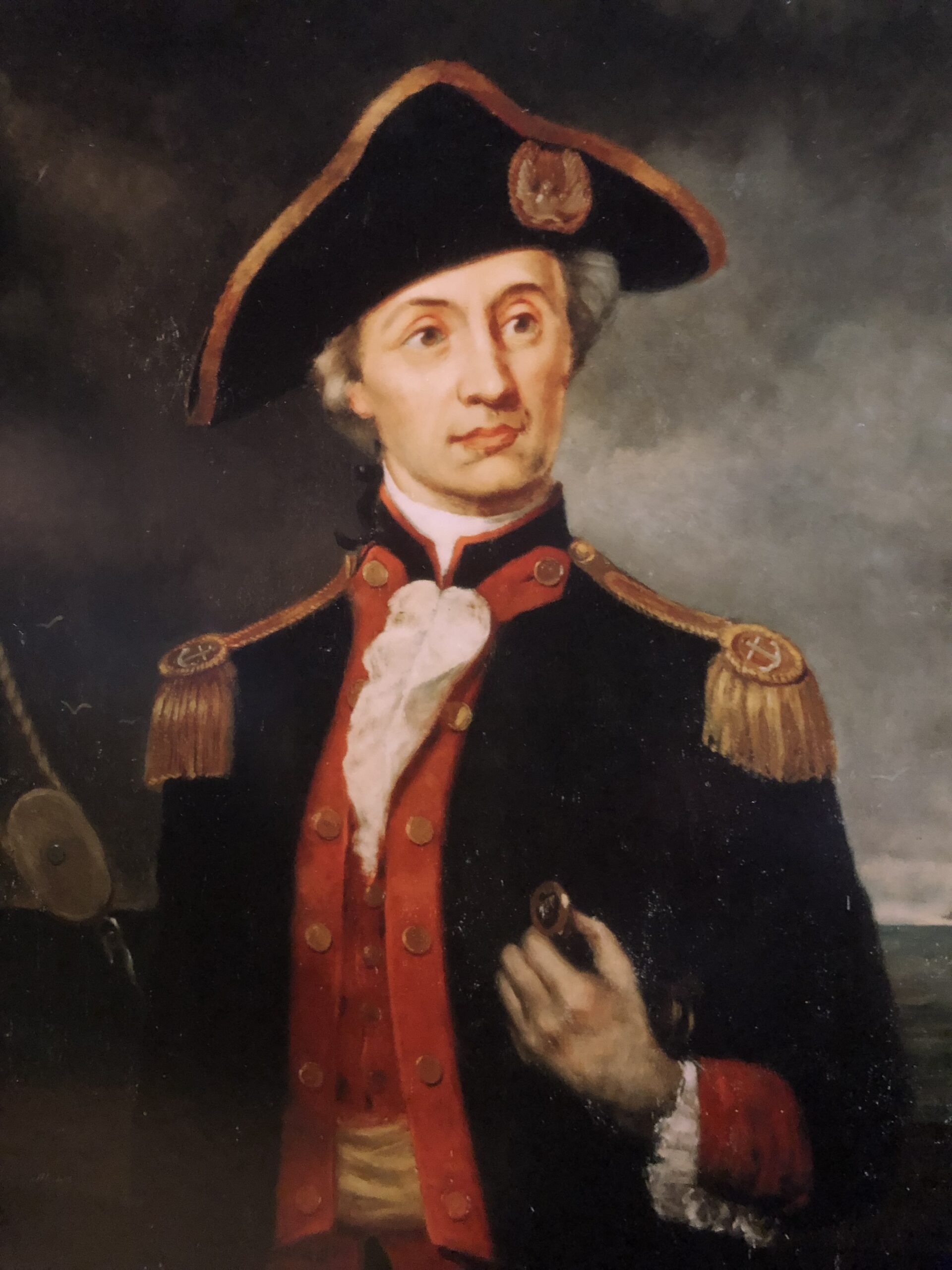
The American War of Independence began on April 19, 1775. In turn, the British occupation of Newport began on December 8, 1776, when British troops arrived in the city from warships in Narragansett Bay. The British would stay for almost three years, departing on October 25, 1779.
In 1776, John Manley was a Deputy Continental Agent for the Continental Navy. In general, he purchased items related to the construction and fitting out of new Continental Navy ships, and the repair and fitting out of existing Continental Navy ships, in Newport and Providence. The existing ships included the frigates Columbus and Alfred, the sloop Providence, and the brig Hampden. The frigates under construction in Providence were the frigates Warren and the Providence. During this period, America’s greatest navy hero of the Revolutionary War, Captain John Paul Jones, was in Newport awaiting his next mission and having the Alfred re-fitted by Manley. The Newport Historical Society has Manley’s account book of Manley supplying Captain John Paul Jones with supplies and equipment in preparation for Jones sailing out of Newport.[2] (John Manley of Newport should not be confused with the more famous Continental Navy captain from Gloucester and Boston, Massachusetts, of the same name).
Manley tells his story in a paragraph following his inventory list. Manley wrote in part:
“Being attached to the Cause of America [I was] often threatened by [Tories] as being a Rebel & Traitor. And Immediately on the Arrival of the Enemy [on December 8, 1776], I was Informed of [i.e., on] by the Tories as one being in the Continental Service & on the 3rd day of their Arrival Orders were dispatched to the [British] main Guard to Look me up & Carry & put me in the Provost [jail].”
Manley here reveals that he remained in Newport even after its occupation by the British army, even though he was well known in Newport as an agent for the Continental Navy. This was a strange decision by Manley. Perhaps he was not willing to leave his empty house to be plundered by enemy troops.
Manley continues: “Getting Intelligence of their desire [to arrest me] I formed my Escape & was Obliged [to] leave everything as before Mentioned [i.e., listed in the inventory] to their Devastation.” Thus, Manley left his house, shop and distillery with their contents behind. Somehow Manley left Newport and escaped from the island. He likely took a small boat to get off the island, perhaps one owned by a friend. In short time, the British would limit the use of small boats on Aquidneck Island in an effort to prevent such escapes.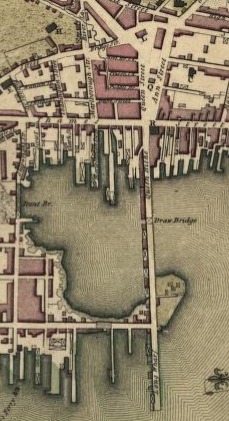
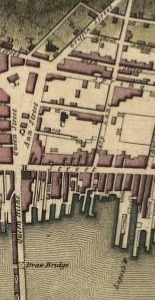
Excerpt from Charles Blaskowitz’s map of Newport, 1777, showing the location of John Manley’s house on what is called Anne Street (Library of Congress)
Manley and other Newport residents had several days warning that a large fleet was sailing from New York City, with Newport as the likely destination.[3] Yet he did not flee the island until three days after the British occupied the port town. He did manage to put on board a small amount of Continental Navy supplies on December 6. And he created a longer list which he dated as of December 8, 1776, and which he entitled, “Articles left in the Continental Store in Newport when the Enemy Took Possession.”[4]
Manley took his family to Providence, where he continued his job as Continental Navy agent. From Providence, he wrote letters from 1777 to 1780, including to Captain John Paul Jones.[5]
Manley wrote at the end of his inventory list that the enemy had “taken up my House for a Barrack.” Being identified as a “rebel,” it appears Manely lost all the contents of his house.
The inventory below is incredibly detailed. One wonders if Manley took the inventory after the time the British landed in Narragansett Bay and before he fled Aquidneck Island, in anticipation of his filing a claim.
The Rhode Island 1774 census indicates that John Manley headed a household of four: two adult males, one boy, and one adult female.[6] Presumably, one of the male adults was John Manly and the adult woman was his wife, Temperance. The boy was likely their son, William. The other adult male could have been one of their parents. They were all White people; no people of color were listed at the household in the census.
It appears that John Manley had been a small and moderately successful merchant in Newport. The house he describes had two stories and six rooms. On the first floor, he had a parlor “next to the street;” a keeping room (with a closet); a keeping room chamber (with a closet); and a chamber “next to the street.” There was also a kitchen, likely in the rear of the house on the first floor. On the second floor, what must have been a commodious bedroom contained a large feather bed, a trundle bed for two, and a straw bed. The feather bed was likely for father and mother, and the trundle bed was for the two children.
Manley had a small shop in the first floor of his house. He sold (in order of value of his inventory) coffee, sugar, flour, and salt. He also sold more unusual items such as a compass, a telescope, small arms, a glass lantern, and cooper’s tools. He did not have a wide variety of goods that larger merchants would have kept in their stores.
Manley had a modest amount of silver—a total of 14 silver spoons of various sizes worth just over £5. He had no silver teapots or tankards. Wealthy men typically kept a lot of silver as a way to save money. The Manleys had a lot of pewter utensils, which were more practical, but still held some value.
The most valuable item the Manleys kept in their house was a large feather bed, valued at £10. Its bedding was also pricey. It was expensive to sleep well. The second-most valuable item was “A Library of Books about 50 Volumes” valued an £9. The Manleys enjoyed being well-read. There were two spinning wheels.
The house had 39 chairs, six tables and two desks. The kitchen was filled with dozens of various instruments. That was all impressive. None of the furniture, however, seemed to have been particularly fancy. By contrast, historian Marian Mathison Desrosiers, in her book on successful Newport merchant John Banister, found that Banister had purchased expensive furniture from members of the Townsend and Goddard families of highly-skilled carpenters, a tall clock probably made by the highly-skilled clockmaker William Clagget, and a portrait of his wife from renown portrait painter Robert Feke.[7] Manley did not acquire any of those items. He had one set of framed drawings on his walls, but no others. He did not own a carriage or even a saddle. He was within easy walking distance of Newport’s wharves, however.
Still, while not living in luxury, the British officers who stayed in the Manley house during the three-year British occupation were likely pleased by its comforts.
Manley mentions that he owned a “Distilling House” on Dyer’s Wharf that was twenty-by-thirty feet. It was not large, but it was impressive that he owned a building for distilling molasses into rum. He did not appear to claim it as a loss.
The most disturbing items Manley lists were two enslaved people. He wrote, “Left One Negro Woman; Kill’d by hard Usage.” Manley here is suggesting that the British had worked a woman he had enslaved so hard that she died. Manley also wrote, “Left one Negro boy, about 18 years of Age, Carried Away.” Manley here is suggesting that the British had taken with them a young adult male Manley had enslaved. Both claims that Manley makes here are dubious. Some enslaved people in Newport self-liberated themselves and joined the British army, serving in a support capacity (such as taking care of horses or digging fortifications).[8] It is notable that for these two “losses,” Manley did not place a dollar figure on either one or name either enslaved person.
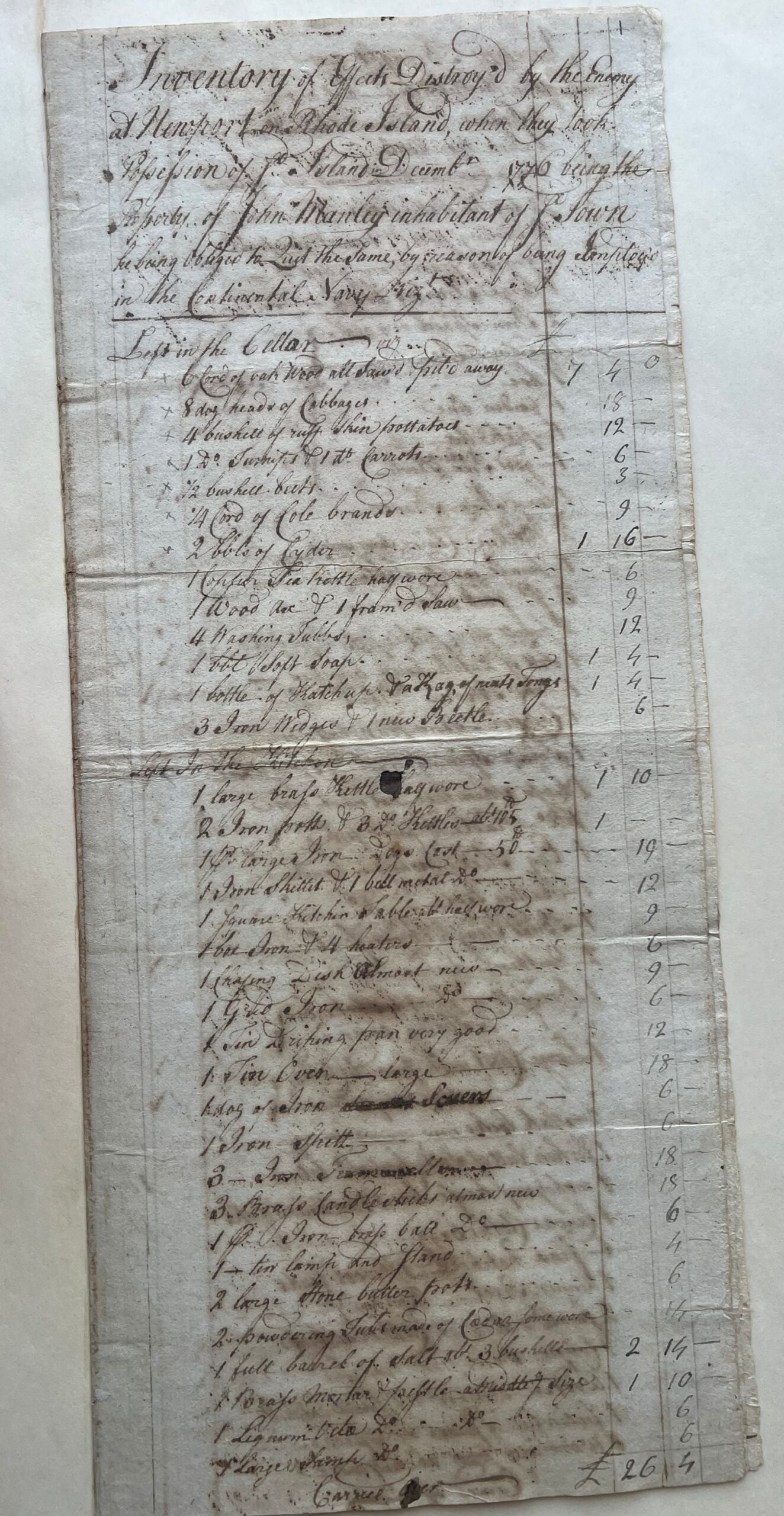
First page of John Manley’s list of household items that he lost during the Revolutionary War (Rhode Island State Archives)
As noted above, in the 1774 census, no people of color were reported as residing at Manley’s house. Perhaps he purchased the two enslaved people in 1775, once he stated work as an assistant Continental agent. Or perhaps he avoided telling the census taker about them. In his inventory, Manley listed “two maple bedsteads complete” in the Shop Chamber. The two enslaved people presumably slept on those beds.
John and Temperance were buried next to each other in Newport’s Common Burial Ground. John’s gravestone indicates he died on July 21, 1787 at the age of sixty years. John’s five-page inventory of his estate in the Providence probate records indicates that he made a full recovery from his financial debacle arising from the war.[9] The inventory further suggests that the Manleys resided in Providence for ten years, from 1777 to 1787. After John’s death, Temperance moved to Little Compton, where she made three purchases of land, for a total of 160 acres. She resided in Little Compton for fifteen years before her death in 1802.[10]
William Manley inherited his parents’ property. And he raised a family in Little Compton, as did many of his descendants. One Newport history book states that John Manley, “an Englishman,” had first “settled in Little Compton.” He must have moved to Newport later. A Little Compton history book indicates that John Manley came from England and married Temperance on August 21, 1762 at Trinity Church.[11] Another source indicates that their son, William, was baptized at Trinity Church on Jan. 30, 1767.[12]
I asked the talented Bert Lippincott of the Newport Historical Society if he could, without exerting too much effort, find out where the Manley house located in Newport. Bert found a good clue. He reviewed the Newport Historical Society’s copy of the 1774 census. Next to John Manley’s name was a notation made by Professor Elaine Forman Crane, which she wrote when researching her fine book about colonial Newport, A Dependent People. Crane placed Manley in the vicinity of what is now 29 Touro Street (near the Jane Pickens Theatre at 49 Touro Street). Thus, Manley’s house appears to have faced Washington Square in Newport near the Old Colony House. Bert added that Ezra Stiles’s 1758 map of Newport shows at the location on Touro Street a row of two-story houses whose owners are not identified.
Inventory of Effects Destroy’d by the Enemy at Newport on Rhode Island, when they took Possession of ye Island in December 1776 being the property of John Manley inhabitant of ye Town he being obliged to Quit the Same, by reasoning of being employ’d in the Continental Navy, viz:
[I have rearranged the order of the rooms so that important rooms appear up front in this list]In the Parlour, viz, next to the street
1 3-foot black walnut Table almost new: £1, 4, 0
1 maple Desk (old but all whole) and in the head a parcel of Valuable papers relating to a [illegible] of Land I had Deponding in Holland: £1, 4
6 Shirts some worn in the Drawers of the maple desk: £0, 14, 0
Also 2 Diaper [?] 6/4 Table Cloths, 1 Damask 8/4 Table Cloths, 4 Diaper Towels, 2 Pillow Cases: £1, 18, 0
1 Low Case of Drawers old & in the Drawers of Ditto, 3 Pair of Breeches, some worn, 3 Jackets, some worn, 2 Pair New Canvas Trousers: £3, 12, 0
4 Leather bottom Chairs some Defaced: £0, 12, 0
1 Round about Chair: £0, 9, 0
2 flag bottom [i.e., rush seating] Slat back [i.e., with two or more horizontal or vertical slats as back support] Chairs: £0, 8, 0
1 Set of Shovel Tongs & Poker new: £0, 18, 0
1 Pair Dogg of Cast Iron & 1 Pair Chimney Brasses: £2, 16, 0
1 gauging rod & proof glass: £0, 9, 0
1 Looking glass 14 inches by 7 inches mahogany frame: £0, 12, 0
1 box full of garden seeds value 20e: £1, 0, 0
1 Neat mounted 4 foot India Joy [?] cost 12/6 [illegible]: £0, 17, 0
1 maple Tea Table: £0, 6, 0
1 Counter pan for large table: £0, 9, 0
A Bag of Leaden Bullets 20 weight: £0, 10, 0
1 leaden ink stand: £0, 2, 0
1 Chest of Cloths Containing, viz: 4 White plain Shirts some worn and 2 ruffled Shirts, all of cloth yt cost 2/6 yard: £1, 10, 0
3 Pair yarn Stockings: £0, 6, 0
2 Pair Worsted Stockings & 4 Pair thread stockings: £0, 18, 0
1 blue broad Cloth coat: £1, 4, 0
1 White broad cloth coat: £1
1 brown Cloth Jacket: £0, 12, 0
2 flannel Cloth Jackets: £0, 9, 0
1 Great Coat of broad Cloth some wear: £1, 0, 0
3 linen [?] night caps & 1 cotton night cap: £0, 4, 0
1 [Genoa?] Velvet Jacket & Breeches: £1, 10, 0
1 pair Shirting Ches____ home Spun 24 yd cost 4/yd: £4, 16, 0
1 ps. White Holland 14 yards for shirts cost 2/4 yd: £1, 12, 6
1 Checkered Cotton Shirt: £0, 6, 0
1 blue broad Cloth Jacket Embroidered: £1, 10, 0
1 Pair Breeches for Cloth Jacket: £1, 4, 0
1 Case of new Cauncets [?] 3 in the cave [?]: £0, 12, 0
6 large table silver Spoons & 6 silver tea Spoons: £4, 10, 0
2 Pair Sheets very good, home spun: £1, 10, 0
1 Calico gown for self & 1 Chints [?] gown of my Wife’s: £2, 8, 0
1 Pair Stripped flannel qt 3 yds cost 3/9: £4, 6, 3
Left in the Glass case in same room, viz:
A Library of Books about 50 Volumes, value 30 the least farthing: £9, 0, 0
3 qt Quilt Writing paper cost 2/6 qt: £0, 7, 6
3 qt fools Cap, cost 20e: £1, 0. 0
1 Journal & Ledger, new Vellom bound, 3 qt & 4qt: £0, 18, 0
1 Madeira Basket with Cover full of garden Seeds, Some Remnants of flannel & Broad Cloth, Value about 15/: £0, 15, 0
In the Keeping Room
1 Pair of Shovel Tongs & poker (but little wear): £0, 12, 0
1 Pair hand Irons, a common Size: £0, 12, 0
1 two armed Chairs: £0, 9, 0
5 flag bottom Chairs, very good: £0, 15, 0
2 Looking glasses, 12 inches by 10 inches mahogany frames: £1, 4, 0
1 Ivory head cane (and India Joint): £0, 6, 0
1 8 foot maple table; half worn: £0, 12, 0, 0
1 oval Tea Table, some Defaced: £0, 6, 0
1 Pair Bellows almost new: £0, 5, 0
1 pipe box of maple: £0, 1, 0
1 hunting whip: £0, 1, 6
1 Child’s Chair & 1 Oval maple Tea Table: £0, 8, 0
In the Closet in Same Room
½ dozen large Coffee cups & Saucers: £0, 3, 0
1 mahogany Waiter about 12 inches Diameter: £0, 6, 0
1 Case of 3 Croteel [?] Razors: £0, 7, 0
1 Shaving box & Brush & Turkey strap; 1 Sett of Shoe brushes: £0, 1, 6
1 Stone 2 gallon jug full of West India rum: £0, 5, 0
1 Small Stone Jug & Lamp feer: £0, 3, 0
1 Tinder box with all the accoutrements, 1 Knife box with 1 dozen of white bone handles, ditto, knives, and forks: £0, 12, 0
2 guinea Table matts, 1 hard metal coffee pot, 1 Small mahogany waiter about 6 inches diameter, 2 half-pound tin Cannisters full of tea, 1 pair of Glasses: £0, 12, 0
½ dozen white Stone soup plates: £0, 4, 0
4 delf plates: £0, 1, 0
1 Metal Tea pot & 3 Stone pots: £0, 7, 0
1 Delf Bowl & 1 earthenware bowl: £0, 3, 0
1 2-quart beaker glass & 1 glass can [?]: £0, 6, 0
2 pair Wine glasses & 2 quart Beaker for wine: £0, 3, 0
1 large White Stone Soup Dish & 1 Delph [Delft ware, Dutch ceramic] Soup Dish: £0, 2, 0
1 pewter Funnell: £0, 4, 0
1 quart bottle of Rose water, 2 empty quart bottles, 1 Case of Croteel Soap about 2, 1 [bone?] for Razors: £0, 5, 0
1 black earthen Sugar pot: £0, 1, 6
2 quart Decanters: £0, 3, 0
2 Silver Table Spoons: £0, 18, 0
2 pewter Table Spoons, 2 tin Extinguishers: £0, 1, 0
1 Brass flat candle Stand with globe lamp: £0, 3, 0
1 Tin Candle Box: £0, 3, 0
2 China Butter plates: £0, 2, 0
2 China Slop bowls & 1 China quart punch bowl: £0, 4, 0
In the Keeping room Chamber, viz:
1 Two armed Chair: £0, 12, 0
8 flag bottom chairs: £1, 4, 0
2 of [illegible] Wool & 3 [illegible] of Cotton Do: £0, 13, 0
1 Large hamper with Cover Containing 6 [illegible] of flax & 4 of Tow: £0, 7, 6
1 old broad Cloth Coat half wore: £0, 14, 0
1 half Bushell full of Burgamot oranges dried & value one Dollar
1 high Child’s Chair & 1 Candle Stand
1 Corner Cupboard made to remove, cost 6 dollars
1 [illegible] hanging up, a Quantity sweet herbs
1 under bed & 1 feather bed & bed stead, etc.
1 Suit of Civitons [?] of furniture
Check = £4, 7
In the Closet of said Room:
1 Green Umberello [umbrella?] new cost 36e
1 Epitomy Mariner’s Compass & Calendar – all new value, 1 Scale & Case of Instruments – all new: value 30e
1 Large Stone Jarr; full of Mamlet [marmalade probably] cost 20e
Left in the Entry or GangWay, Viz:
160 bunches of Onions: £1, 16, 0
1 glass side Lanthorn [lantern]: £0, 2, 0
2 leather fire buckets: £1, 4, 0
1 Churn & 1 peck measure: £0, 4, 0
1 Chair & 1 Keg Lamp black: £0, 3, 0
1 Cedar pickle Tubb: £0, 1, 0
1 bag White Beans about ½ bushel: £0, 12, 0
Left in the Chamber next the Street, viz:
1 new Small Spinning Wheel: £0, 18, 0
2 Chairs Slip back flag bottomed: £0, 9, 0
1 Pair home Spun Sheets: £1, 4, 0
1 peck dried Sage: £0, 2, 0
1 neat Checkered Board: [blank]
Left in the Bed Room, Viz:
2 Trundle Bedstead with Straw bed & h__llrass: £0, 12, 0
a Bolster [cushion] & 2 pillows: £0, 9, 0
1 Pair blankets & Cover lid on blankets, all very good: £1, 10, 0
1 Pair flannel Sheets, all very good: £0, 6, 0
1 large Bedstead with Baibs [bed rails?] & Curtin rods, 1 feather bed about 45 [inches in height?]: £10
1 Straw Bed for Ditto: £0, 6,
1 Pair Dutch Blankets almost new: £0, 9, 0
2 Callico Bed quilts some wear: £0, 12, 0
1 Pair Sheets, almost new: £0, 18, 0
1 bolster & 2 pillows with Cases thereon: £0, 15, 0
1 Small Square table: £0, 6, 0
1 Dutch Looking Glass. 10 Inches by 8 inches: £0, 6, 0
1 black Leather Trunk, containing half pound of wax Paper & Stand, & parcel of Valuable papers of Accounts: £0, 12, 0
1 new Cloth Jacket hanging up: £0, 12, 0
1 hair plush jacket Some wear: £0, 9, 0
2 Pair Breeches: £1, 14, 0
2 Stripped holland Shirts almost new: £0, 12, 0
1 Cloth Coat very much worn: £0, 1, 0
1 Close Stool & new pan for Stool: £0, 15, 0
1 Slat back chair: £0, 3, 0
1 pair men’s Shoes almost new: £0, 4, 0
1 Large Slate framed for Cyphering: £0, 4, 0
1 Pair Taylor’s Shears: £0, 2, 0
2 dirty shirts in the Clothes bag hanging up: £0, 9, 0
1 Pair Drawers & 2 Pair Stockings: £0, 6, 0
1 Callimanco [?] Quilted petticoat some wear: £0, 12, 0
Left In the Kitchen
1 large brass Kettle half worn: £1, 10
2 Iron pots & 3 Iron Kettles at 10e, 5d: £1
1 [illegible] large Iron Dogs Cask 50 [illegible]: £0, 19, 0
1 Iron Skillet & 1 bell metal Skillet: £0, 12, 0
1 square Kitchen Table at half worn: £0, 9, 0
1 box Iron & 4 heaters [?]: £0, 6, 0
1 Chafing Dish Almost new: £0, 9, 0
1 grill [?] Iron: £0, 6, 0
1 Tin Dripping pan, very good: £0, 12, 0
1 Tin Oven large: £0, 18, 0
1 dog of Iron Scissors: £0, 6, 0
1 Iron Spit: £0b 6, 0
3 Iron [illegible]: £,0, 18, 0
3 Brass Candlesticks almost new: £0, 18, 0, 0
1 [illegible] Iron brass ball almost new: £0, 6, 0
1 tin lamp and fland: £0, 4, 0
2 large Stone butter pots: £0, 6, 0
2 powdering Tubs made of Cedar some wear: £0, 14, 0
1 full barrel of Salt & 3 bushels [of salt]: £2, 14, 0
1 Brass mortar & [facstle] a [illegible] of size : £1, 10, 0
1 Lignum etc. [facstle] [illegible] of size: £0, 6, 0 [Historian Marian Desrosiers wrote to me, “Lignum is short for lignum vitae, a hard wood from an evergreen tree in the Bahamas, Jamaica, and Honduras in the 18th century, useful for blocks on sailing vessels, as a dye, and as a medicine.”]
1 Large Lamp [facstle]: £0, 6, 0
2 Sieves, 1 Lawn & 1 hair Ditto: £0, 6, 0
1 Iron tea Kettle: £0, 6, 0
1 [illegible] Copper Kettle, would hold a gallon: £0, 12, 0
½ dozen tin pally pans: £0, 4, 0
1 Rolling pin, & 1 new Water pail: £0, 3, 0
1 frying pan very good: £0, 6, 0
1 large Ironing board: £0, 3, 0
1 iron spade very good, £0, 6, 0
1 garden Rake, 1 hoe, 1 garden line, 2 pick Axes, 1 good Iron scoop shovel: £0, 9, 0
1 large Iron Basin: £0, 3
2 Kitchen Chairs Some wear: £0, 3, 0
1 small maple Table: £0, 3, 0
3 Pair flat Irons: £0, 15, 0
2 Small Stone pickle pots, 10 pickles: £0, 12, 0
1 Sett of Dutch house brushes: £0, 6, 0
1 new Broom & 1 hand Duster: £0, 1, 0
1 Copper Stew pan half worn: £0, 9, 0
1 small Spinning Wheel & 1 long Wheel: £1, 0, 0
1 brass Shimmer not much wear: £0, 3, 0
1 Brass ladle & flesh fork: £0, 4, 0
1 Egg Slice mahogany handle: £0, 2, 0
1 basting ladle mahogany handle, 1 Bread Trough & bread peal, 2 Earthen dishes: £0, 6, 0
1 Box full of Sweet herbs, a sliding cover, 1 Large Chest with some of old Cloths about 25e value: £1, 5, 0
2 Stock locks new – 8 inches-: £0, 12, 0
1 firkin full of Salt, beef about 60: £0, 18, 0
1 mahogany knife box & 1 dozen Knives & forks: £0, 12, 0
1 Canvas Cloths bag: £0, 2, 0
1 flax hatchell [a combing tool for wool] & 1 Pair wool Cards: £0, 18, 0
1 Linen Reel (a Cock Reel): £0, 6, 0
2 Small & 2 Large Cloths Baskets: £0, 6, 0
1 Copper Sauce pan very good: £0, 3, 0
1 wooden Dipper & 1 small hatchet: £0, 2
1 firkin full of peas about 3 pecks: £0, 3, 0
1 Warming pan about half worn: £0, 6, 0
1 Iron Table: £0, 1, 0
1 Chopping knife: £0, 2, 0
2 Wooden Trays & 3 wooden bowls: £0, 1, 6
1 Large Safe for cold meat, 1 new Clothes line: £0, 6, 0
3 Candles in table Drawer: £0, 2, 0
1 hand Saw & mallet & Chisel: £0, 12, 0
1 Pair Kitchen Bellows very good: £0, 3, 0
1 Pair Tongs & Shovel; large & 1 Iron [illegible]: £0, 12, 0
1 Cedar Dye Tub: £0, 2, 0
In the Pantry, viz:
3 large pewter Dishes about 6 inches each is 18e: £3, 12, 0
4 small pewter Dishes about 2 inches each 8: £0, 12, 0
6 pewter 10 inch plates, 5, 33 of pewter: £4, 0, 0
3- 2 quart pewter Basins: £1, 16, 0
2- 1 quart pewter basis and 2 pint Ditto: £0, 18, 0
3 pewter porringers: £0, 9, 0
1 pt hard metal basin & ½ dozen Ditto plates: £1, 16, 0
1 Case of gallon Bottles 9 in the case: £0, 15, 0
Full of West India Rum cost 3e, 6d, [gallon?]: £1, 11, 6
Also a shelf full of Vials & gallipon with some medicine in them which cost 16e/6d: £0, 16, 6
½ dozen round bottles empty: £0, 1, 6
2 bottles full of pickled Stertions [Sturgeon?]: £0, 4, 0
1 mahogany Tea board 18 inches Diameter: £0, 9
1 Ironing grate & 1 hat ease with hat in it some wear, 1 Woman’s Stove & copper pan new: £0, 18, 0
2 Large Stone Jugs of 6 quarts each empty: £0, 12, 0
2 Vinegar jugs with vinegar in them about 2 quarts: £0, 2, 6
1 jug full of Ink: £0, 1, 6
1 Cheshire Cheese about 16 inches, cost 15d: £0, 14, 0
1 Tin 3 pr milk Kettle: £0, 6, 0
1 pewter Measure of half pint, 1 pewter measure gill pot: £0, 4, 0
Left in the Cellar
6 Cord of oak Wood all Sawed & put away: £7, 4, 0
8 dozen heads of Cabbages: £0, 18, 0
4 bushels of russet thin potatoes: £0, 12, 0
1 bushel of Turnips & 1 bushel of Carrots: £0, 6, 0
½ bushel beets: £0, 3, 0
¼ Cord of Coal brands: £0, 9, 0
2 barrels of Cider: £1, 16, 0
1 Copper Tea Kettle half worn: £0, 6, 0
1 Wood ax & 1 framed saw: £0, 9, 0
4 Washing Tubs: £0, 12, 0
1 bottle Soft Soap: £1, 4
1 bottle of Katchup & a Keg of neats Tongs: £1, 4, 0
3 Iron Wedges & 1 new Beetle: £0, 6, 0
Left in the Shop, viz:
1 ½ barrel of Flour cost 18 [illegible]: £3, 12, 0
1 ½ barrel of Sugar Cost 54 [illegible]: £5, 8, 0
1 bag full of white beans & 2 bushels: £0, 6, 0
1 Firkin full of Indian meal & meal Bag: £0, 3, 0
1 barrel full of Salt – qt 3 bushels: £2, 14, 0
1 Glass lantern & about. Half a firkin of Butter: £0, 18, 0
1 Pair Shoes & Books & 1 Pair Silver Spurs: £0, 12, 0
2 P of brass Scales & 1 Large [illegible] with a tin Seal & 1 half [illegible]: £0, 18, 0
1 Sett of Brass weights complete: £0, 18, 0
1 Pair new Scates [skates?] & 1 P Gallow [?] Shoes: £0, 9, 0
about 30 lbs. of old Copper & 50 lbs. of old pewter: £6, 0, 0
2 flag bottom Chairs & 1 Pair Boot straps: £0, 6, 0
10 yards of Canvas; 4 Empty Coffee bags: £1, 10, 0
1 bag of Coffee about 98 cost [illegible]: £4, 18, 0
1 Ship’s Compass & 1 Telescope: £0, 18, 0
2 Small arms & 1 Cartouche box: £1, 16, 0
1 old Chest Containing a parcel of joiner’s & cooper’s tools, Several Locks, Marlin Spikes [?], Flints – gunpowder, value about 15 dollars: £4, 10, 0
1 Sett of Serna Curtin Rods complete: £0, 12, 0
Left in Shop Chamber
2 Maple Bedsteads complete: £2, 8, 0
1 under bed & 1 large Bear skin: £0, 12, 0
1 Large map framed: £0, 9, 0
2 flag bottom Chairs: £0, 6, 0
2 Sett of Bed Rails & 1 Set of Iron Curtin Rods: £0, 18, 0
½ dozen prints framed with glass: £0, 18, 0
In the Garrett: £11, 16, 0
½ [cord] of redwood & logwood
Some broken chairs & some old window frames with glass in them – value 20e
1 Table Hall & Blocks, Value 30e
Left in the Yard: £2, 0, 0
1 Wheel barrow almost new, 12e
2 wood horses, 10e
2 Iron bound Puncheons, 24d
1 Grind Stone, 10e
Also my Garden full of Saus [sauces?], value about 6 dollars
£2, 16
[Other]
Left One Negro Woman; Kill’d by hard Usage
Left one Negro boy, about 18 years of Age, Carried Away
One Distilling house Standing upon Dyer’s Wharf 30 feet by 20 feet Adjoining to Samuel Freebody & That Francis Bradley [probably Brinley] Lived in many years but now Burnt
Left in a Store of Jonathan Tillinghast’s:
1 barrel Sugar about 11 [illegible] neat in Cost 54e[Pound?]
Left in a Store of Old Mr. Holmes, Viz: £81, 1
2 barrels flour & 1 keg of peas, ½ bushel: £3, 18
1 hogshead [illegible] 10 gallons, cost 3e/4d
Abt 10 gallons Molasses in a hogshead, cost 1e, 6d gallon
£211, 17, 3
£179, 6, 4
————–
£391, 3, 7
John Manley
These may certify whom it may Concern. That I the Subscriber appointed D Continental Agent for the Navy at Newport in 1776 and had Refitting the Continental Vessels, viz, Ships Columbus & Alfred, Brig Henry [??], Sloop Providence, also the new Frigates, Warren & Providence; & Being attached to the Cause of America were often threatened by [illegible] as being a Rebel & Traitor. And Immediately on the Arrival of the Enemy, I was Informed of by the Tories as one being in the Continental Service & on the 3rd day of their Arrival Orders were dispatched to the main Guard to Look me up & Carry & put me in the Provost [jail]. Getting Intelligence of their desire I formed my Escape & was Obliged leave everything as before Mentioned to their Devastation. Who had before taken up my House for a Barrack & [Forewarned?] me moving off any _____ [illegible] at my Peril. Attest. John Manley
[Written on the side:] Newport, May 16, 1782, personally appeared Mr. John Manly and made Oath to the Truth of the foregoing Accounting by him Subscribed before
I thank Bert Lippincott of the Newport Historical Society and Rhode Island historian Marian Mathison Desrosiers for providing me with some secondary sources for this article about the Manleys. Marian also reviewed a draft and made some helpful suggestions.
Notes
[1] . The original of the inventory is held by the Rhode Island State Archives. See General Assembly, Revolutionary War, Claims for Damages, 1776-1781, pages 64 to 68, Rhode Island State Archives. [2] See William Manley Account Book, 1806, vol. 1772, Newport Historical Society. The entries for November 1776 includes a cash payment to Captain John Paul Jones related to the sloop Providence. [3] See Christian M. McBurney, The Rhode Island Campaign: The First French and American Operation in the Revolutionary War (Westholme, 2011), 12-14. Esek Hopkins, the commander-in-chief of the Continental Navy, failed to order to sail out of Providence and Narragansett Bay the Continental Navy’s frigates before the Royal Navy arrived and blockaded Narragansett Bay. See ibid. [4] See in William James Morgan, ed., Naval Documents of the American Revolution, vol. 7 (Naval History Division, 1976), 383 and 410. The original lists are in the possession of the Newport Historical Society. [5] See John Manley to Captain John Paul Jones, Feb. 12, 1777, Providence, in ibid., 1176; John Manley to Rhode Island Board [Council] of War, May 30, 1777, Providence, in ibid., vol. 8, 1044; John Manley to Captain John Paul Jones, June 1, 1777, Providence, in ibid., vol. 9, 2; John Manley to Joshua Huntington, May 20, 1778, Providence, in ibid., vol. 12, 402; John Manley in Providence to Nicholas Tillinghast in Newport, June 18, 1780, Box 44A, Folder 9B, Item 29, Newport Historical Society. The editors of the Naval Documents of the American Revolution extracted items from Manley’s accounts held by the Newport Historical Society with the Alfred and Warren and placed them in an appendix. See Morgan, ed. Naval Documents, vol. 7, Appendix A, 1329-32. [6] See Rhode Island 1774 Census, Newport section, Rhode Island State Archives. [7] See Marian Mathison Desrosiers, John Banister of Newport, The Life and Accounts of a Colonial Merchant (McFarland, 2017), 148-50. Desrosiers found that John Banister purchased a tea table for £12.9, two cedar desks for £62, a tall clock from John Goddard (“probably housing William Claggett timing mechanisms”) for £160, and the Robert Feke portrait for £200. See ibid., 249. Banister had other art on his walls as well. Ibid., 250. [8] See Christian McBurney, “Freedom for African Americans in British-Occupied Newport, 1776-1779, and the ‘Book of Negroes,’” Newport History 87, no. 276 (summer/fall, 2017), 1-39. [9] Providence Wills and Probate Records, vol. 7, 177-78 (will, dated Dec. 30, 1768) and 179-84 (inventory, dated March 8, 1788). [10] See “Temperance Turney Manley,” Little Compton Women’s History Project, Little Compton Historical Society, https://littlecompton.org/historical-resources/little-compton-womens-history-project/temperance-turner-manley/. This source also suggests that Temperance came from Swansea, Massachusetts. [11] See Richard M. Bayles, History of Newport County, Rhode Island (L. E. Preston & Co., 1888), 965; Benjamin F. Wilbur, Little Compton Families (Little Compton Historical Society, 1967), 425-28. [12] See James N. Arnold, ed., Vital Records of Rhode Island, 1636-1850, First Series, Births, Marriages and Deaths (Narragansett Historical Pub. Co., 1891), vol. 10, 513.The Author

You Might Also Like