

Many Americans are aware of the Founding Fathers’ contradictory owning of enslaved individuals while fighting in word and deed for liberty from the “slavery” imposed upon them by Great Britain. The cases of Washington’s reluctance to emancipate those laborers at Mount Vernon during his lifetime, and Jefferson’s moral failure when he took an enslaved woman to bed and fathered six children, have been the subject of high profile biographies written with unimpeachable scholarship. The research by these authors added important work to the canon of American history.[1] More recently, those lesser known Founding Fathers, the officers who led the Continental Army to victory, have also come under scrutiny as new histories and biographies are written.
According to historian Gene Procknow in a recent article, of the 29 major generals who served in the Continental Army, over half were enslavers. Some like General William Moultrie of South Carolina, William Smallwood of Maryland, and Robert Howe of North Carolina, enslaved hundreds on their plantations. Northern generals who were slave owners tended to own at most a handful of slaves.[2] But as Procknow has noted:
The proportion of the major generals who advocated ending slavery is not certain. The contradiction between fighting for political liberty and fighting for personal liberty did not seem to manifest itself (or be important enough) in the minds of this group of Revolutionary leaders.[3]
Procknow also observed that the number of slaveholders among the Continental Army generals was only slightly lower than among the signers of the Declaration of Independence. He added
Contrary to popular perceptions, both Northerners and Southerners owned slaves. All six of the major generals from states south of the Mason Dixon line owned slaves while five out of seventeen Northern major generals owned slaves. Rather than regionalism, slave ownership most closely correlated with income; the wealthiest major generals owned slaves. Like civilian slave owners, the major generals either used slaves as exploited labor or as house servants.[4]
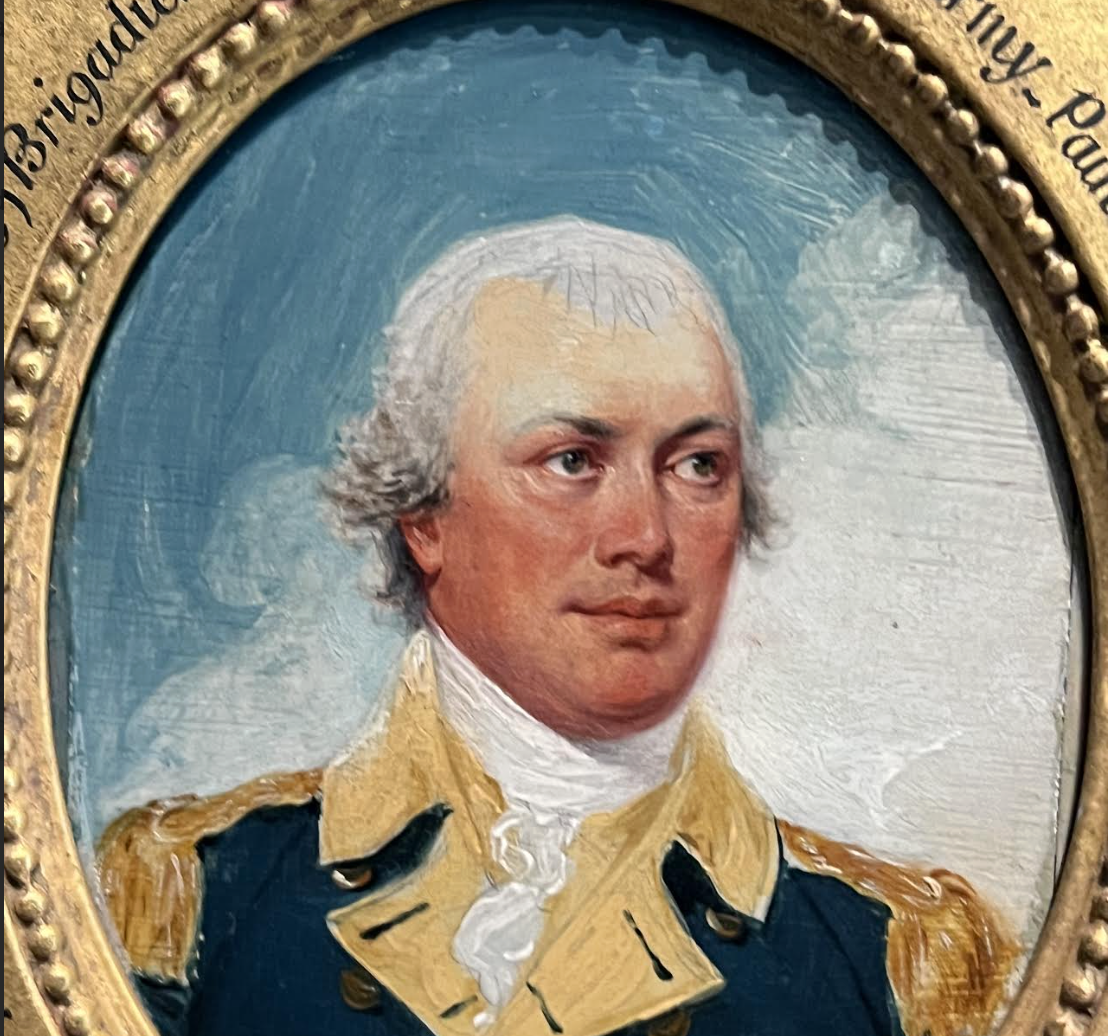
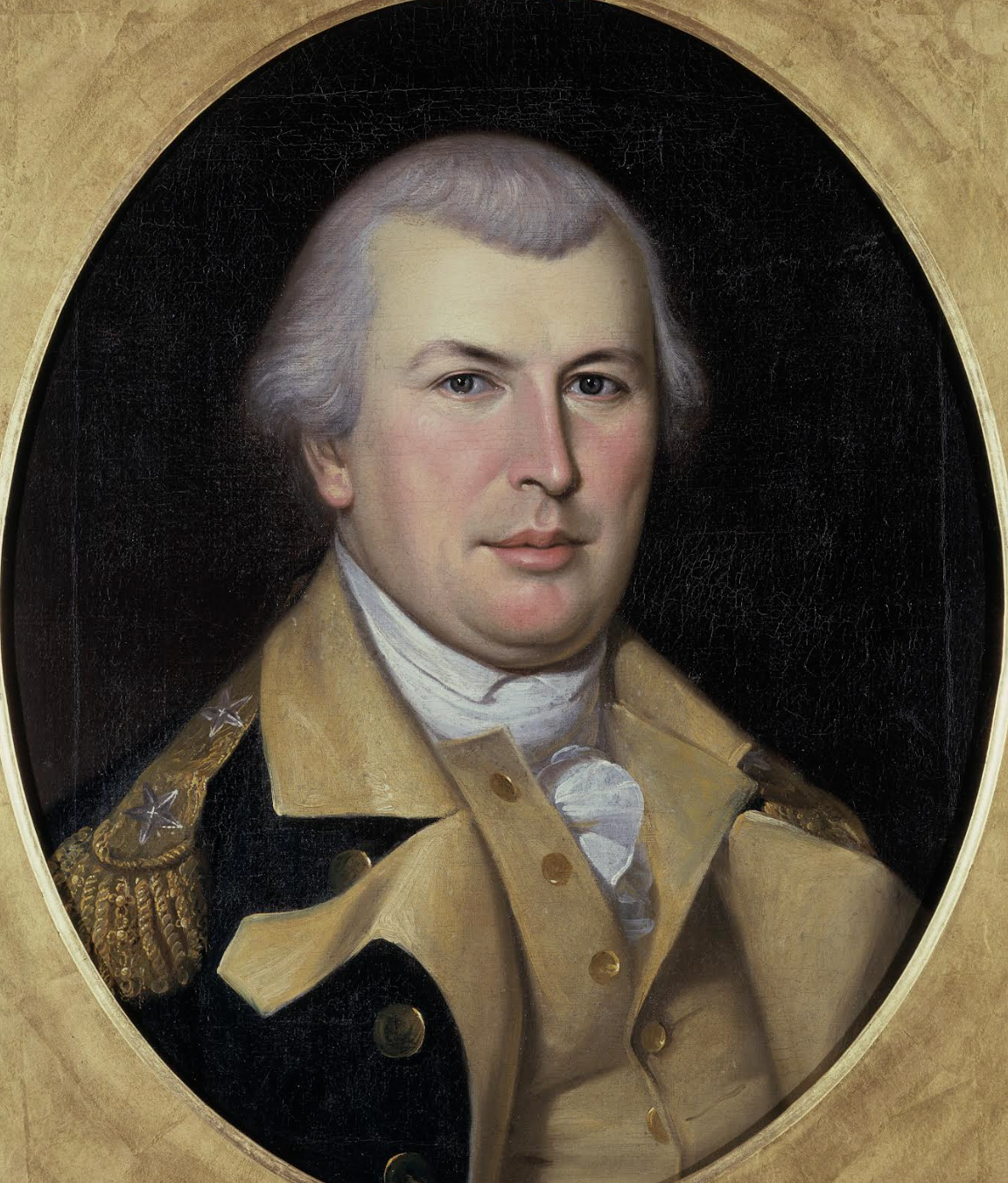
General Nathanael Greene, the Rhode Island born, co-founder of the Kentish Guards, and commander of Rhode Island’s forces during the Siege of Boston at the start of the American Revolution, is among those on whom this shadow of enslavement has fallen. Greene was an officer whom many military historians believe became the best tactician of any general on either side of the war. But for some scholars, public historians, and online influencers in the twenty-first century, this shadow dims any accomplishments on the field or in civilian life, as well as any legacy left in the framework of the new Republic.
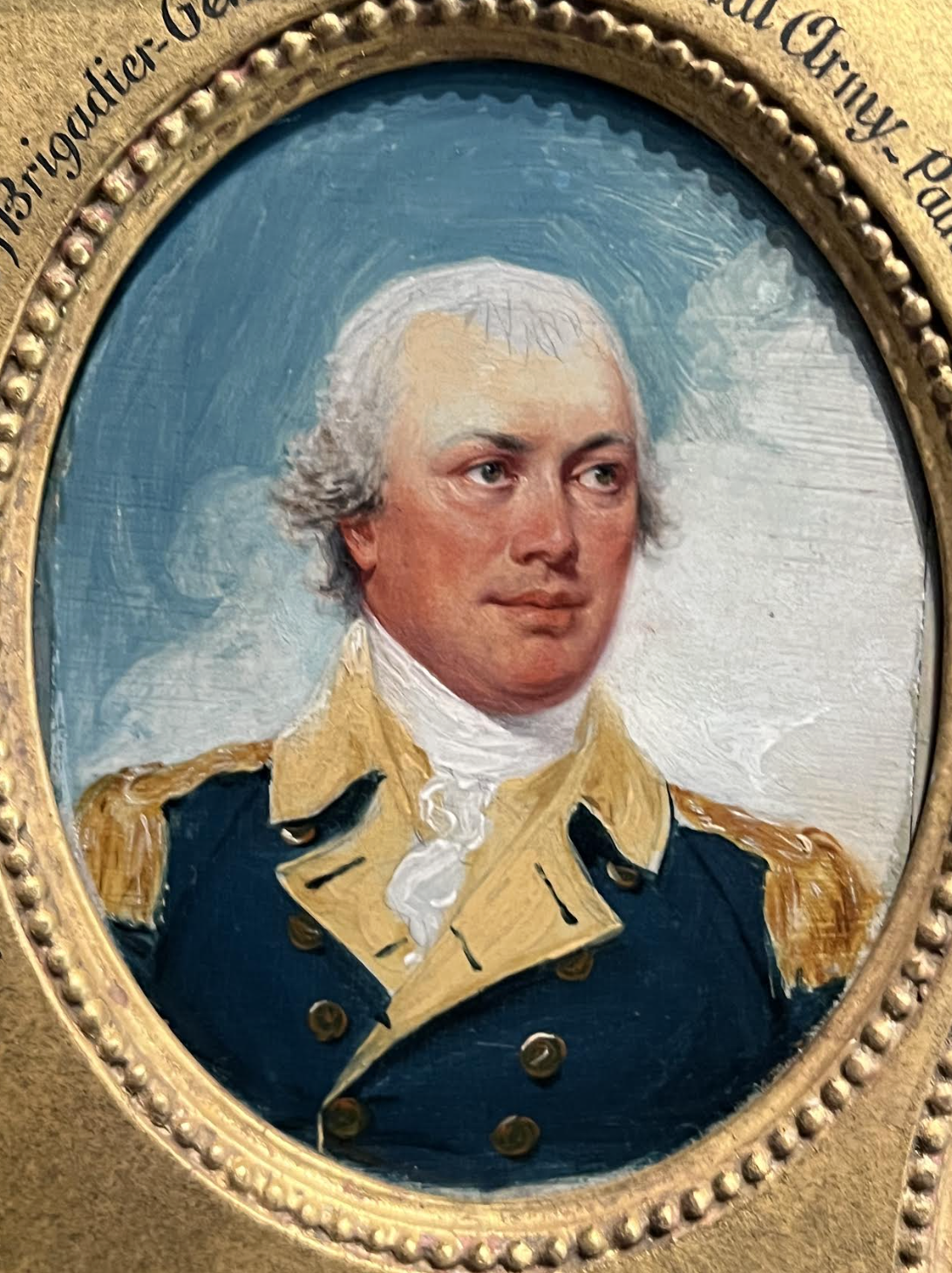
Major General Nathanael Greene by John Tumbull, ca. 1792 (Yale University Art Gallery)
It is worth objectively examining then, the life of the general, the Greene family, and their involvement with enslavement, and letting the facts of the matter speak for themselves.
Nathanael Greene appears to have been raised in a household without enslaved laborers. His father and namesake, a Quaker preacher at the Greenwich meeting house,[5] does not appear to have had domestic servants at his home in Potowomut. We will show, however, that among the iron works and forges, the wharf, warehouses, and the store that the family owned; enslaved workers were indispensable. The procurement of enslaved individuals early on among the roots of the family branches that settled in Potowomut and Coventry is fairly well documented. Warwick historian Don D’Amato wrote that the first forge was “built by slaves” of patriarch James Greene, but documentary evidence is incomplete.[6] The papers of his son, John Greene, hold accounts for enslaved men loaned out for work, including for “the use of Prince” on three occasions between 1745 and 1747.[7] On October 7, 1746, John Greene recorded a debt for “my negroe killing hogs,” and that year as well as the following, he collected wages for “my John shearing sheep.”[8]
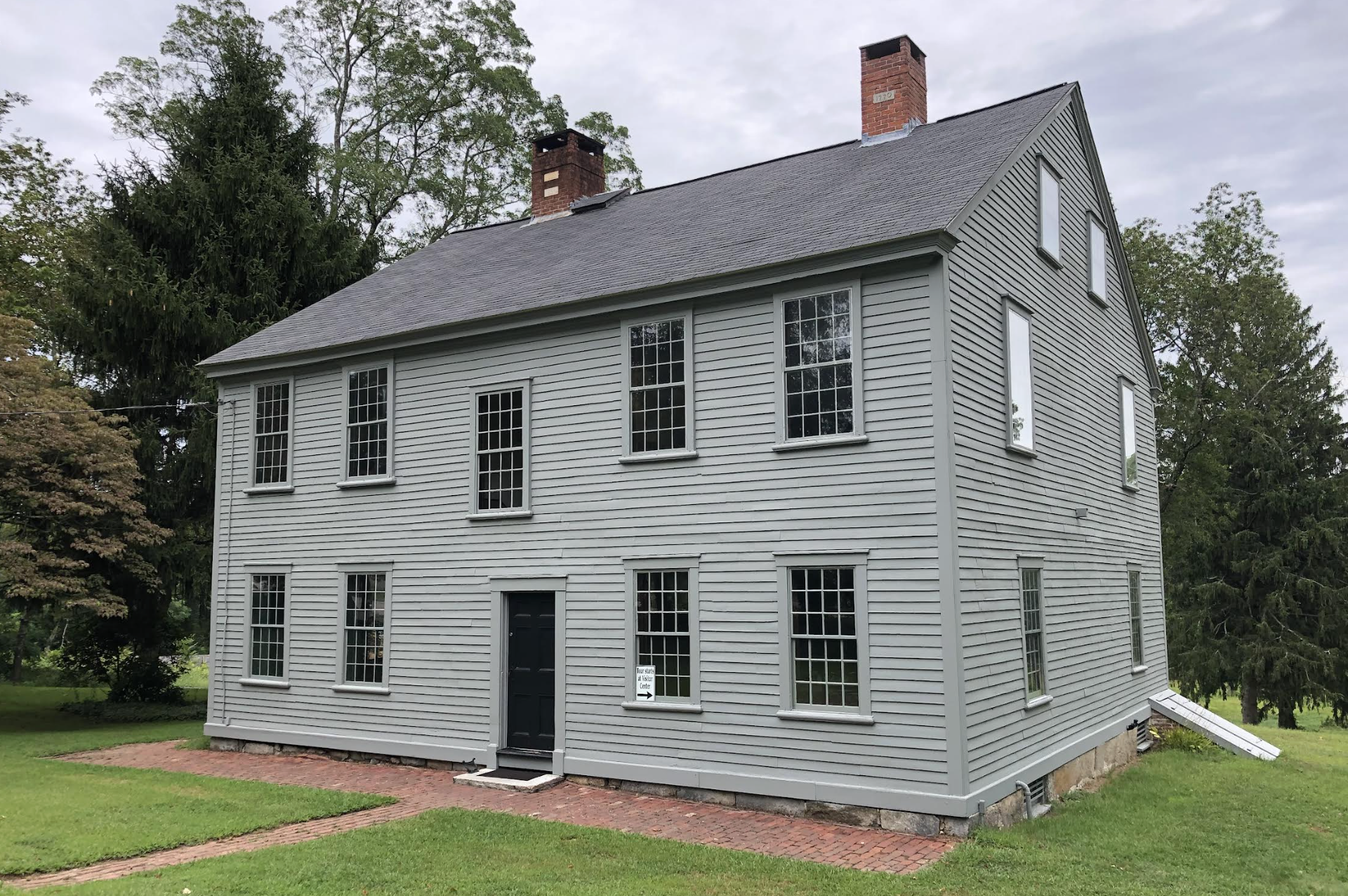
The Nathanael Greene Homestead in Coventry, Rhode Island, 2019 (Christian McBurney)
From 1741 Nathanael Sr. and his brothers, John, and Rufus, also seem to have held a handful of enslaved workers working at the family’s forge, mills, and mercantile businesses that flourished during the mid-eighteenth century. As early as 1762, Rufus, and his two sons, Russell and Abraham Greene, contracted with East Greenwich merchant Silas Casey for the profits from a voyage of the Sloop Seaflower. The family owned outright, or had a partial interest with Casey, in numerous vessels. They included the sloops Caty, Hope, Black Burt, and the aforementioned Seaflower. The investors shared the expense of outfitting the vessels, as well as the enslaved laborers. The enslaved laborers were listed under the category of expenses, paid to the owners of those who worked two or three days loading or unloading the ships, and occasionally serving as mariners.[9]
In 1765 Nathanael’s eldest brother, Captain Benjamin Greene, sailed the sloop Marigold for Silas Casey, the East Greenwich merchant, as well as a handful of other investors. The cargo of salt, sugar, rum, and potatoes yielded a profit of 645 pounds.[10] Silas Casey, who owned a sprawling farm on Boston Neck would continue this partnership in the coming years as the younger generation of Greenes came of age and expanded their family businesses.
Nathanael Greene grew up with seven brothers. Born on August 7, 1741, he was the fourth male born in the family. As young men, the Greene brothers would have worked on their father’s farm, clearing land, plowing fields, and planting seeds. Nathanael worked at his father’s mills and likely stoked the furnaces of the forge and learned to hammer and shape iron into useful implements using tools during a tutelage of hard work. When it came to learning to read and write, he was largely self-educated, with some help from friends and mentors, such as Newport minister Ezra Stiles.[11]
Nathanael’s father established a second forge on the Pawtuxet River in the inland community of Coventry. In 1770, the elder Greene built a fourteen-room house to better manage the workforce at this forge, which was made up of many of the men from the estimated one hundred families that lived in the village.[12] After his father’s death in November 1770, at the age of 29, Nathanael was chosen among the family business partners to move into the house in Coventry known today as Spell Hall.
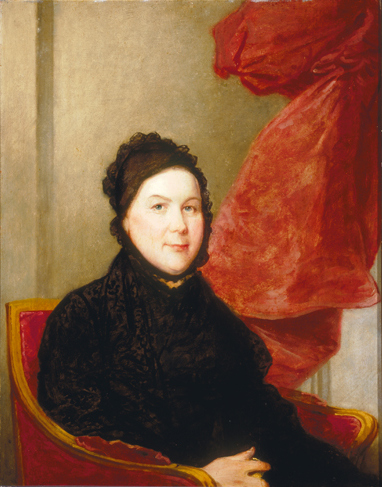
Catharine Littlefield Greene, ca. 1809, by James Frothingham (Wikimedia)
According to his biographer, Gerald Carbone, Nathanael found the isolated village a dismal place, full of smoke and noise from the dozens of workers just hundreds of yards away and downhill from his new household. His major consolation was the large library he amassed of some 250 volumes. He continued the simple life of hard work managing the forge and reading in his spare time.[13]
Several people of color are listed in the ironworks store ledger, including “Jack Negro” of Coventry, and Mary Sambo.[14] Greene’s account for his company in the ledgers of merchant Silas Casey includes a listing for April 1773 for “two prs of worsted hows [hose] for Nat’s boy.[15] This would seem to indicate that Nathanael Greene had at least one servant in the household at this time. It was not uncommon in Rhode Island on the eve of the American Revolution for a man of Nathanael’s stature to hold one or two enslaved persons. Apparently, Nathanael would have used the boy to perform personal services for him. In doing this, Nathanael set a pattern in his life of having a personal servant of color.
The 1774 Rhode Island census reveals that the Greene family of Kent County lived lives of the privileged, including using enslaved domestic workers. Nathanael’s uncle, Richard Greene, was so notorious for his lifestyle, and the and number of black and white servants he had on hand, that he was nicknamed “King Richard.”[16] In 1774, three black people lived at his Warwick residence. Another uncle, Benjamin, had six black people in his household. Governor William Greene, a distant elderly uncle with whom Greene had a fond friendship, had four black people in domestic service in 1774. Judge Philip Greene, another distant uncle, had nine black people residing in his home.[17] All of these black people were likely enslaved. Many of them would be shared over time throughout the family households and businesses.
Nathanael was close to his brothers, as well as to his extended family. In 1779, his cousin Christopher Greene expressed in a letter to Nathanael, his gladness that you are happy and willing to keep up that Brotherly affection and esteem that the family has been remarked for.…[18]
With the dispute with Great Britain growing in intensity, William Greene’s home became a haven for Whigs determined to lead the colony’s legislature toward liberty.[19] It was at the future governor’s home that Nathanael Greene would meet Caty Littlefield, the young woman who would eventually become his wife. Caty Littlefield was the niece of Catharine Greene, wife of William Greene. When Caty’s mother died, she was but eight years old. Soon after Catharine Greene sent for her from her family’s Block Island home. Caty’s aunt raised her in the Greene mansion house on Love Lane in East Greenwich.
After her marriage to Nathanael Greene on July 20,1774, Caty established their home at Spell Hall, but with the war and her husband’s sustained absences, she did not stay there permanently. She also often had prolonged stays at her uncle William Greene’s estate, or the farm in Westerly owned by Nathanael, as well as the Littlefield’s family home on Block Island.
As will be shown below, at least four enslaved domestic workers inhabited the Coventry house during the Revolutionary War. Their lives became as uprooted and fluid during these years as the Greene’s and many other families during the conflict.
Caty Greene often followed Nathanael to his encampments. She gave birth to their first child, George Washington Greene during the Siege of Boston. She was with Nathanael during the first brutal winter of Valley Forge and often travelled if only for the sake of a brief period of time together before her husband was called away on a campaign; including a sojourn late in the war to Savannah.
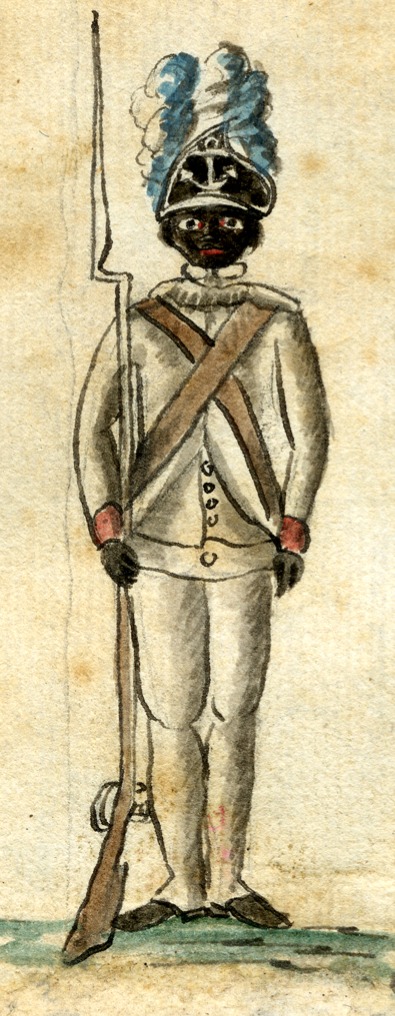
Black Soldier in the Rhode Island Regiment of Continentals, by the French army officer Jean Baptiste Antoine de Verger, probably in 1781. The soldier may have obtained his freedom by enlisting in the “Black Regiment” in early 1778 (Anne S.K. Brown Military Collection, John Hay Library, Brown University)
More than one thousand black men and women were at Valley Forge as well. They included an estimated 700 to 750 soldiers of color in the Continental Army, as well as an estimated hundreds of laborers, waggoneers, cooks, personal servants, and musicians who were not formally enlisted in the army. People of color swelled the encampment to make it the third largest “city” in the colonies that winter.[20]
When at home in Coventry, Caty Greene was often in the latter stages of pregnancy or recovering from giving birth. She relied upon domestic servants during these times. When healthy, and when she took excursions to the Littlefield home on Block Island, or to the farm in Westerly, it is likely she had the services of an enslaved servant or two in train.
Nathanael Greene’s brother, Jacob, and Jacob’s wife and children, inhabited Spell Hall consistently during this time. Jacob was born at Potowomut and was Nathanael’s older brother. He grew up learning to manage his father’s forge and would marry his cousin Margaret, daughter of his uncle Jabez Greene. In 1758, Nathanael Greene Sr. had purchased the property of James, his deceased brother, after Jabez inherited the homestead. This homestead was adjacent to Uncle Richard’s estate of Hopelands. Jabez Greene built a new house on land across the lane from Jacob and his sister’s estate, which he called the “Grange,” completing a kind of family compound.
Jacob Greene & Co. became one of the family businesses owned by brothers Jacob, Nathanael, Christopher, Elihu, William, and Perry.[21] The merchant business outfitted several vessels including the Fortune, which in 1771 was detained and plundered of its cargo of sugar and rum on orders of Lieutenant William Dudingston, commander of the British revenue schooner Gaspee. The Gaspee was subsequently burned to the water line by raiders from Providence fed up with Dudingston’s high-handed ways on the night of June 9, 1772. The incident is proudly touted by Rhode Islanders as an early precursor to the American Revolution.
The Greenes continued to partner with Silas Casey of East Greenwich. As with earlier ventures, expenses for the voyages included charges for the use of enslaved men.[22] For example, Casey’s ledger book in September 1773 under the heading of Jacob Greene, lists a payment of sugar for use of “Jacob’s boy,” as well as mention of an “order for Negro Boston.”[23]
Once the Revolutionary War began in April 1775, the Greene brothers’ businesses continued to grow, with the forge producing sheet anchors and cannon for Continental vessels and privateers. The Greenes held stakes in three privateers, a brig named the General Stirling, and two sloops, one christened Greenwich, the other, General Greene.[24] Fellow merchants such as Silas Casey also took partial shares of the financial interests in the privateering vessels.
As operator of the family mercantile firm, Jacob Greene’s business from 1775 shows that he had as customers several individuals of color, including Job Sambow (or Sambo), who in November 1776 became indebted for the coffin of his mother, and Casar Sweet, who paid for lodging in 1776.”[25] Two individuals named Cato and “Bat” Hunt appear among the brothers’ accounts in separate ledgers.[26] They were likely both men of color.
A well-document woman of color named Black Betty is listed on the accounts of William Greene in 1775.[27] She was a servant of John Greene of Coventry later during the war. Further, she was documented on Warwick Neck in the company of Mrs. Lippitt, mother in-law of Christopher Greene, among the officers and militiamen occupying the Neck for the defense of the State.[28] At the close of the war, Black Betty reappears in Jacob Greene’s ledger as having been inoculated at the expense of Nathanael Greene.[29]
During the war, General Nathanael Greene would also come to rely upon the use of personal servants, including formerly enslaved men from within the regiments, and from his own home. Wartime Correspondence between Caty, her husband, Nathanael, and his brother Jacob, during the conflict, provides the best picture of this period.
In May of 1780 General Greene wrote to Jacob who was then overseeing the household and forge at Coventry. Nathanael asked Jacob to send him a specific boy of color named John to act as servant during his campaign in the Carolinas. General Greene, as with other officers, had a slew of black and white aides and servants providing assistance to him in the field. It is not known if Nathanael’s request was satisfied.
Writing from Coventry on July 13, 1780 Jacob Greene reported:
Mrs. Greene has returned from Block Island. She will Give you Accompt [account] of the Family Matters…Mrs. Greene Says your Christa is a Good houslav and wishes you To Make use of him for that Purpose as She Cannot Spare John. She will send Sidney the First opportunity.[30]
Jacob is referring here to three enslaved men—Christa, John, and Sidney. Caty was to send Sidney to serve as a “waiter” or personal servant to Nathanael Greene. It is by no means clear, but it appears that Christa (the “good houseslav”) was already with Nathanael in the field. The specific duties of a personal servant for an officer included cooking, cleaning the officer’s quarters, bathing, and dressing the officer, and tending to his personal grooming. In addition a servant might run errands and deliver messages containing orders to fellow officers.
Greene’s letter to Colonel Peter Gansevoort, commander of the Third New York Regiment in July 1780, more clearly spells out what uses Greene had in mind.
You have a boy in your Regiment who was with Major [Ichabod] Burnet a while last winter, and who I want to get to live with me as a family servant; and shall be exceedingly oblige to you, if you be so kind as to send him to me.
It is very difficult to get good…servants, especially such as are industrious and honest, both of which this lad appears to be and they are the more necessary in my family, as they have great opportunities of conveying away public papers, and many other things of the highest importance…The boys name is Mathew Cozens.[31]
(When referring to “his family,” Greene is referring to his military officers and core group of aides, as well as to their servants, both enlisted and not enlisted.)
It is clear that Nathanael saw in John, as he did with Mathew, a potential far beyond that of a household slave.
Servants of color did play critical roles on occasion as undetected couriers and even as spies during the Revolutionary War. They relayed messages, and often used the guise of being sent on daily tasks to gather intelligence for the Army. The most organized of these contributed to the intelligence gathering network labeled the Culper Ring and supported key officers with confidential information. These individuals seemingly passed through British lines unnoticed, given the tendency of the enemy to view enslaved people or servants as having little potential threat to operations.[32] Such servants were used by both sides.
A letter from Colonel Henry Lee Jr. to General Greene, dated August 18, 1781, explained the role of two Black men who worked as spies for the enemy and he asked that a Black man on the Patriot side be used to help capture the two enemy spies.
A Mr. Moore, brother to Col. James Moore manages the intelligence for the enemy. He has two of his Negroe fellows constantly passing and repassing. He suggests that if a sensible negroe who knew the men were engaged secretly to act for us, he might easily entrap the two fellows which might lend to important communications.[33]
It is not known if anything came of Lee’s suggestion.
One well documented servant of Nathanael Greene’s during the war was George Sambo. A free man of likely of Black and Indigenous heritage, Sambo came from East Greenwich. He enlisted in the Ninth Rhode Island Regiment of Continentals in early 1776, and in the First Rhode Island Regiment of Continentals in May 1777. Sambo had survived the Battle of Rhode Island and the brutal winter encampment at Valley Forge. In the spring of 1778 while at Valley Forge, he began serving as a waiter to General Greene. Sambo served with Greene during the Rhode Island Campaign and later in New York, where he died on October 1, 1779.[34] In this instance, Greene used an enlisted man as his personal servant.
We can conclude from Jacob’s letter quoted from above that Greene may have had at least two servants from his Rhode Island home during the southern campaign: Christa, the good house slave mentioned above, and Sidney. There is no conclusive evidence that the second personal servant named Sidney was actually sent to the South to serve with Nathanael, but it is very possible he was. It is also not certain that Christa was then with Nathanael; Jacob’s wording is somewhat ambiguous. But it does appear that Christa was then with Nathanael.
The National Park Service has also raised speculation that another enslaved man may have served with the general. The enslaved laborer who became known as Ned Simmons was born on a Carolina plantation in 1763. The National Park’s website for Cumberland Island states that Simmons “became the enslaved boy of Nathanael Greene at an early age.” It is likely that he was born on the Boone plantation of South Carolina, whose plantation was confiscated during the war. The website also speculates that Simmons may have been at Greene’s side on the southern campaign.[35]
The idea of Ned Simmons being beside the General during his campaign seems more hopeful speculation on the part of those wishing to associate Simmons with the Revolution. It seems more likely that Nathanael Greene assumed the ownership of Ned Simmons when the Georgia legislature voted to appropriate five thousand guineas “to be used in purchasing the estate for General Nathanael Greene in recognition of his contributions to the war” on April 13, 1782.
Nathanael Greene appears to have been initially skeptical of the effort by his third cousin, Christopher Greene of Warwick, to raise a regiment from enslaved men of Rhode Island for the Continental Army in February 1778. “Will he succeed?” Nathanael questioned, in a letter to his brother that winter. But later, as general in command of the Southern Army, he supported such efforts in South Carolina. Greene wrote to the governor of South Carolina, John Rutledge, of the success such an endeavor would bring if the enlistees were guaranteed their freedom after the war. As noted by historian Gene Procknow,
Greene…offered a persuasive pecuniary argument to the Governor of South Carolina that arming blacks would allow the Patriots to recapture from the British the most agriculturally fertile regions and restore the war-ravaged economy.[36]
Writing to Governor Rutledge, the General stated clearly:
The natural strength of this country in point of numbers, appears to me to consist much more in the blacks, than the whites. Could they be incorporated and employed for its defence, it would afford you double security. That they would make good soldiers I have not the least doubt and am persuaded that the State has it not in its power to give sufficient reinforcements without … them.[37]
The Governor, out of deference to Greene, placed the proposal before the South Carolina assembly but it was rejected, having gained support among a dozen or so legislators, but “about 100 against.[38]
As noted by historian Terry Golway, Greene made major contributions to the American cause during the Revolutionary War as well as challenged the very perception of warfare:
Greene had been sent to the South at an hour of extreme peril, with orders to stop the enemy’s finest general… He did so with scant resources, no personal knowledge of the terrain ,and no small amount of local hostility. But he was not without his own devices. He was relentless, he was organized, and he was disciplined. He understood that the war was about ideas and perception. As long as he could field an army, he could and would not be beaten.… Nathanael Greene’s name became linked not to a battle but, fittingly to an idea, a new method of warfare. “We fight, get beat, rise and fight again” he wrote. In doing so, time and again, he won, and he won at a time when all might have been lost.[39]
At the close of the war, in gratitude for Nathanael Greene’s efforts, the states of South Carolina and Georgia donated plantations to Greene. The state of Georgia gave Greene Mulberry Grove, an existing plantation outside of Savannah. Established by General James Oglethorpe in 1736, the plantation’s name signifies its early effort to establish a silk trade from Savannah by cultivating the silkworms from the grove of Mulberry trees planted on the property.[40] The venture having failed, it was converted to a rice plantation and went through several owners. The last owner, the loyalist Lieutenant Governor John Graham, fled Georgia and the property was subsequently confiscated by the State of Georgia.
Greene also invested in land on the Cumberland Islands with the merchant Joseph Banks and investor Ichabod Burnett in early 1783. In a deed dated August 11, 1783, Nathanael Greene was sold an undivided interest on nine tracts on the Cumberland Islands. Historian Mary R. Bullard speculates that Greene’s initial interest in the islands was to enter the timber industry.[41]
When Greene obtained these potentially valuable lands, he was deeply in debt for having used his personal funds and personal credit to buy clothing and supplies for his troops during the Southern Campaign on promissory notes from the same Joseph Banks. But it turned out that Banks defrauded him. For Nathanael Greene, this meant that rather than glory, the years after the Revolutionary War were fraught with desperation and the prospect of landing in debtor’s prison. He left his growing family in rented homes in Newport while he travelled to Philadelphia to lobby Congress for reimbursement of money he was due. Greene pursued Banks until he found that another one of Bank’s victims had murdered the bankrupt merchant just days before. After the Greenes tragically lost their youngest daughter Catharine to illness during these years, creditors knocked on the door for the cost of the casket even as the couple mourned.[42]
Biographers from his grandson to the present day have reasoned that the fears of debt and imprisonment led Nathanael Greene to use enslaved labor on the plantations he was awarded. Greene had once supported the enlistment of enslaved South Carolina blacks in exchange for their freedom. Now, after becoming a plantation owner after the war, he became the largest slave owner in the Greene family.
Greene succinctly explained his dilemma to Philadelphia Quakers. He wrote “On the subject of slavery, nothing can be said in its defence,” yet at the same time he admitted that:
the generosity of the southern states has placed an interest of this sort in my hands, and I trust their (the enslaved) condition will not be worse but better. They are, generally as much attached to a plantation as a man to his family, and to remove them from one to another is a great punishment.[43]
While the United States had won the war, the new nation was thrust into a long period of financial crisis. As the Articles of Confederation never authorized Congress to tax or level fees and fines upon the population or states, Congress’s funding was never stable. Without a national bank to lend the government money and a steady source of income to Congress, and with the British market closed, the fledgling nation faced a prolonged period of financial destabilization.
Writing from Savannah on November 1, 1782 to Major John Habersham, Greene explained:
Since my return from Carolina I have been endeavoring to get some Person to stay at Mulberry Grove, by advertising it to be let, rent free, but have not yet succeeded. Some object to its being too remote from Town, and consequently exposed to Murderers and Robbers; but I hope that objection will soon be obviated, and that I shall find some careful Family to live there, unless in the mean-time, you determine to send some Negroes to settle it, which would doubtless be the most eligible plan. The Land was planted last year, and would require little labor to prepare for the next…[44]
General Greene would later write to Hugh Rutledge, Speaker of the South Carolina House of Representatives, acknowledging his need for enslaved labor.
the lands formerly belonging to Mr. Boone are to be vested in me by the Commissioners for the sales of confiscated estates as part of the grant made by the Assembly…There will remain, a balance of the original grant of twelve hundred and fifty pound Sterling. This balance I should be glad to receive in the negroes belonging to the place…The Land without the means of cultivation will be but a dead interest. Those negroes belonging to the estate will be of more value to me than anyone else, but it will be entirely out of my power to purchase them unless the State will make the conditions of pay favorable to my wishes.[45]
Greene’s plan to use slave labor to reduce his debts came under criticism from Quaker reformer Warner Mifflin, who took pains to remind the General of his religious roots and moral character. “I hope I may speak my mind freely to thee without offence,” Mifflin wrote, adding “if I am not deceived in thee I believe thy disposition will bare it especially if thou believes it comes from one that really desires thy lasting wellbeing.…”[46]
Mifflin recounted some of his own activism during the war, and reminded Greene of a promising letter Greene had written:
Thereof which I thought contained a noble sentiment, and as thou mentioned, a hope you should fix Liberty on so broad a basis, that it would be lasting tho thou said nothing respecting Black people, yet as the Grand Struggle was for Liberty and thou took thy Commission from Congress who had in their declaration set forth in such clear terms its being the Natural right of all men[.] should thou after all thy Conduct countenance slavery it would be a stigma to thy Character in the Annals of History….
Having heard of the gift from the South Carolina legislature, Mifflin urged Greene to take a public stand against slavery
If thou publickly should protest against having the Labor of slaves thereon there might be a degree of consistency appear in thy contending for others to enjoy what thou holds so dear to thy self that is Liberty the odiousness of Slavery it would I think appear almost an undervaluement to thee to attempt her[e] to paint it in its true Colours.[47]
Should Greene persist in his plans, the writer warned of adverse consequences:
If on the other hand you should purchace a Number of slaves and place thereon, or if thou should tenant the same to those who are slave Holders and thou receive the Profits of the Slaves Labour their unrewarded toil it would in its consequences tend to encourage the Petty Tyrants of America to hold on their Oppression, also to strengthen the infamous trade to Africa, and so draw down renew’d displeasure from Heaven.…[48]
Nathanael Greene ultimately purchased fifty-eight enslaved individuals for the plantation.[49] As a result, some historians today regard Greene as a man who “changed his views on slavery when it suited his economic interests.”[50]
Having advertised fervently, but finding no one willing to rent or oversee the plantation, Nathanael and his family left Rhode Island, departing Newport in May 1784 for the long journey to Mulberry Grove.
Perhaps the larger truth was that Greene had convinced himself that he could be a benevolent slave holder. The plantation of Mulberry Grove with its fine Georgian manor standing among moss-covered oaks must have seemed far removed from the smoke-filled rocky landscape of the forge works in Coventry. To Greene, it seemed like a paradise:
The garden is delightful. The fruit trees and flowering shrubs form a pleasing variety…mocking birds surround us evening and morning. The weather is mild, and the vegetable kingdom progressing to perfection.[51]
Despite his effusive praise of the plantation, Greene struggled to make profit from the land. When the first two crop years of the plantation yielded less than desired, he attempted to increase logging operations on the islands, even writing to the Marquis de Lafayette for a commission to supply the French Navy with timber.[52]
Nathanael Greene died unexpectedly on June 19, 1786, suffering from heat stroke after a long day of taking an investor on a tour of the Mulberry Grove property. After his death, the enslaved who were part of the plantation faced an uncertain future with the heirs who inherited the plantations . . . and them.
The children of Nathanael Greene who had been raised in a household with enslaved domestic servants would have acquired a comfortable familiarity with the life of leisure and social graces of the Georgian plantation society. As will be shown, their choice of lifestyle expanded the family’s ties to enslavement from Georgia all the way to Rhode Island in the decades after the general’s passing.
Notes:
[1] The author refers the reader specifically to four books that illustrate these complex lives: His Excellency, George Washington by Peter J. Ellis and Washington, A Life by Ron Chernow address the ownership of enslaved people at Mount Vernon and elsewhere. The Hemingses of Monticello by Anette Gordon-Reed, as well as her work with Peter Onuf in Most Blessed of the Patriarchs, are essential reading for a more complete understanding of the complex beliefs of Jefferson regarding enslavement. Both Washington and Jefferson believed that slavery and the slave trade would eventually become untenable and end of its own accord. [1] Gene Procknow, “Slavery Through the Eyes of Revolutionary Generals”, November 7, 2017, Journal of the American Revolution, https://allthingsliberty.com/2017/11/slavery-eyes-revolutionary-generals/. [2] Gene Procknow, “Slavery Through the Eyes of Revolutionary Generals”, November 7, 2017, Journal of the American Revolution, https://allthingsliberty.com/2017/11/slavery-eyes-revolutionary-generals/. [3] Ibid. [4] Ibid. [5] Gerald M. Carbone, Nathanael Greene: A Biography of the American Revolution (New York: Palgrave/Macmillan, 2008), 5-6. [6] Don D’Amato “King Richard Greene and Joseph Wanton,” February 2, 2005, The Warwick Beacon, [7] John Greene Papers, MSS 9001-G, Folder: Of Potowomut, 1731, 1745-1748, Rhode Island Historical Society. [8] Ibid. [9] Account books of Silas Casey, Book 1, 1762-1772, MS2008, Silas Casey Papers, Historic New England Archives. Casey’s books show the depth to which the Greene family was involved in Casey’s shipping ventures through at least two generations of the family from 1762 through 1783. [10] Ibid. [11] Theodore Thayer, Nathanael Greene, Strategist of the American Revolution (New York: Twayne Publishers, 1960), 20. [12] Ibid., 29. [13] Carbone, Nathanael Greene, 8-9. [14] Nathanael Greene & Company Ledger 1744-1774, MSS 464, Loose Volume, 183, 189, Rhode Island Historical Society. Mary Sambo of North Kingstown headed a family of four Indians in 1774. John R. Bartlett, Census of the Inhabitants of the Coloney of Rhode Island and Providence Plantations, 1774 (Providence: Knowles, Anthony & Co., 1858), 82. [15] Account books of Silas Casey, Book 1, 1762-1773, MS2008, Silas Casey Papers, Historic New England Archives. [16] Donald D’Amato, “King Richard and Joseph Wanton,” February 2, 2005, The Warwick Beacon https://www.warwickhistory.com/index.php?option=com_content&view=article&id=273:tories-qkingq-richard-greene-and-governor-joseph-wanton&catid=56&Itemid=125. [17] Bartlett, Rhode Island Census 1774, 62. Rhode Island was home to the highest percentage of Black population in New England at this time, about 6 percent. Ibid., 238. Most of them would have been enslaved. Rhode Island also had a large number of free blacks in Newport and Providence in the years leading up to the Revolutionary War. Ibid., 1-53. [18] Christopher Greene to Nathanael Greene, November 19, 1799, in Richard K. Showman, ed., The Papers of General Nathanael Greene (Chapel Hill: University of North Carolina Press, 1989), Vol. 5, 96. [19] Robert A. Geake, A Man of Uncommon Valor: James Mitchell Varnum and the Founding of the New Republic (Stone Tower Press, 2026), 35. [20] National Park Service, “Patriots of Color at Valley Forge,” Last updated August 7, 2023, https://www.nps.gov/vafo/learn/historyculture/patriotsofcoloratvalleyforge.htm. [21] Donald D’Amato ,“Jacob Greene and Co. in Apponaug,” Warwick, Rhode Island, Digital History Project, undated, https://www.warwickhistory.com/index.php?option=com_content&view=article&id=101:jacob-greene-a-co-in-apponaug&catid=43&Itemid=96. [22] Silas Casey routinely charged for the expense of “my man William,” or “my Walter” on accounts of these voyages. In September 1773, there is a reference to “my boy Moses” the Greene’s sloop Speedwell, and wages owed for time worked “last winter with Christopher Greene” are included in the ledger. Account Books of Silas Casey, Book 1, 1762-1773, MS2008, Silas Casey Papers, Historic New England Archives. [23] This may well be the man named Boston Carpenter who reportedly served as a waiter, or servant, to Colonel Christopher Greene for part of the war. (He did not formally enlist in the army, but may have still served in that capacity.) On his return to Rhode Island he gained a reputation as a horse whisperer among Rhode Island racehorse enthusiasts. See Andrew D. Boisvert, “Coventry Roots: Two African American Men of Coventry,” Patch, February 14, 2012, . https://patch.com/rhode-island/coventry/two-african-american-men-of-coventry-ri. [24] An Agreement was signed that included sixteen investors in the General Greene alone, Account Books of Silas Casey, May 18, 1774, Book 2, 1774-1782, MS2008, Silas Casey Papers, Historic New England Archives. [25] Sweet is also mentioned in a separate ledger of Perry Greene and Thomas Taylor, as “Casar Sweet of Potowomut.” See Perry Greene and Thomas Taylor Account Book, Jacob Greene Papers, MSS 462, Box 1, Folder 2, Rhode Island Historical Society. [26] Jacob Greene Account Ledgers, Vol. 1, in ibid. [27] Ibid. [28] Robert A. Geake, Fired A Gun at the Rising of the Sun, The Diary of Noah Robinson of Attleborough in the Revolutionary War (Privately printed, 2018), 66. [29] Jacob Greene Account Ledger, Vol. 2, Jacob Greene Papers, MSS 462, Box 1, Folder 2, Rhode Island Historical Society. [30] Jacob Greene to Nathanael Greene, July 13, 1780, in Richard K. Showman, ed., The Papers of General Nathanael Greene (Chapel Hill: University of North Carolina Press, 1991), Vol. 6, 93. [31] Nathanael Greene to Col. Peter Gansevoort, July 11,1780, in Ibid., 85. Cozens was a private in the 1st New York Regiment, enlisting on November 28, 1776 and serving until his discharge on November 26, 1780. Compiled Service Records, New York, RG93,M881, roll 0165 (under “Mathew Cousins” entry). [32] See Kate Egner, “Spies of the Revolutionary War, Subterfuge and Espionage During America’s Fight for Independence,” January 4, 2021 (updated October 2, 2025), American Battlefield Trust, https://www.battlefields.org/learn/articles/spies-revolutionarywar#:~:text=A%20more%20documented%20instance%20of,with%20the%20Marquis%20de%20Lafayette. [33] Henry Lee Jr. to Nathanael Greene 18, August 1781, in Dennis M. Conrad, et al., The Papers of General Nathanael Greene (Chapel Hill: University of North Carolina Press, 2000), Vol.11, 202. [34] See muster roll for Captain Thomas Arnold’s Detachment, June 2, 1778, Valley Forge, First Rhode Island Regiment, Revolutionary War Rolls, 1777-1780, Rhode Island, RG 93, M246, National Archives; muster roll for Captain Jonathan Wallen’s Company, Aug. 22, 1778, in ibid. For Sambo’s death on October 1, 1779, see payroll for Captain Thomas Cole’s Company, October 1780, in ibid.; A Return of the Casualties in Capt. Cole’s Company in Col. Greene’s Regiment for the year 1779, in ibid. Sambo was described as a Black man, and born in and a resident of East Greenwich, in a return of the Ninth Regiment of Rhode Island Continentals. See Broadside, Return of the Ninth Regiment, undated (probably 1776), Manuscripts, G1157 1777 No.26, Rhode Island Historical Society. [35] Mike Bezemek, “A Chance for Freedom,” Spring 2021, National Park Service, https://www.npca.org/articles/2856-a-chance-for-freedom. [36] Gene Procknow, “Slavery Through the Eyes of Revolutionary Generals” November 7, 2017, Journal of the American Revolution, https://allthingsliberty.com/2017/11/slavery-eyes-revolutionary-generals/#_edn8. [37] Nathanael Greene to John Rutledge, December 9, 1781, in Dennis M. Conrad et al., Papers of General Nathanael Greene (Chapel Hill: University of North Carolina Press, 2001), Vol. 10, 20’ [38] Carbone, Nathanael Greene, 209. [39] Terry Golway, Washington’s General, Nathanael Greene and the Triumph of the American Revolution (New York, Henry Holt and Company, 2005), 302,303. [40] Mulberry leaves are the only source of food for the silkworm. [41] Mary R. Bullard, Cumberland Island: A History (Athens: University of Georgia Press, 2003), 88. [42] Nathanael Greene to Major John Habersham, November 1, 1782, in Roger Parks, et al. Papers of General Nathanael Greene (Chapel Hill: University of North Carolina Press, 2005), Vol. 13, 578 Nathanael Greene to Major John Habersham, November 1, 1782, in Roger Parks, et al. Papers of General Nathanael Greene (Chapel Hill: University of North Carolina Press, 2005), Vol. 13, 578. [43] William Johnson, Sketches of the Life and Correspondence of Nathanael Greene (Charleston, SC, Privately Printed, 1822), Vol. 2, 451. [44] Nathanael Greene to Hugh Rutledge, in Dennis M. Conrad, et al. Papers of General Nathanael Greene (Chapel Hill: University of North Carolina Press, 2002), Vol.12, 133. [45] Johnson, Sketches, 478. [46] Warner Mifflin to Nathanael Greene, October 12, 1783, in Conrad, et al., Greene Papers, Vol. 13,155-159. Mifflin was a Quaker reformer who travelled about the country after freeing his own slaves, reminding Friends and foes alike of the Quaker doctrine throughout the 1770s. [47] Ibid. [48] Ibid. [49] Carbone, Nathanael Greene, 223. [50] Gene Procknow, “Slavery Through the Eyes of Revolutionary Generals,” November 7, 2017, Journal of the American Revolution, https://allthingsliberty.com/2017/11/slavery-eyes-revolutionary-generals/#_edn8. [51] Theodore Thayer, Nathanael Greene, Strategist of the American Revolution (New York: Twayne Publishers 1960), 441-42. [52] Ibid., 444.The Author

You Might Also Like