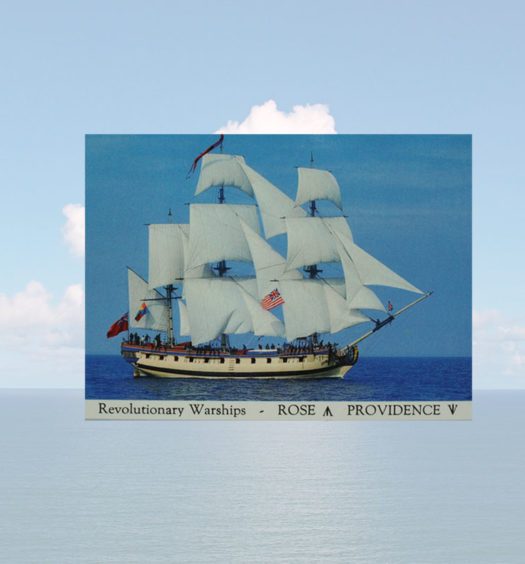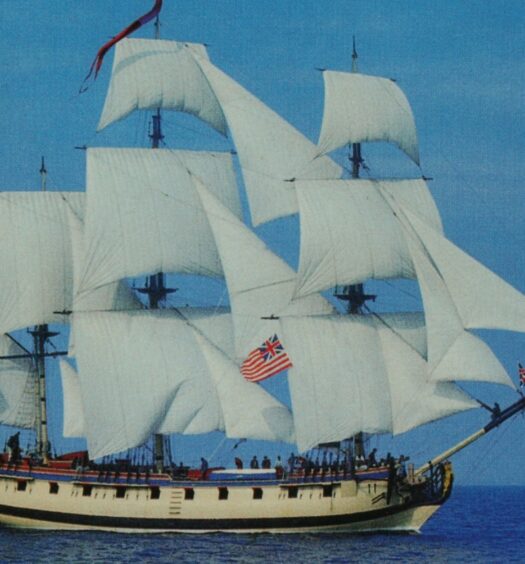
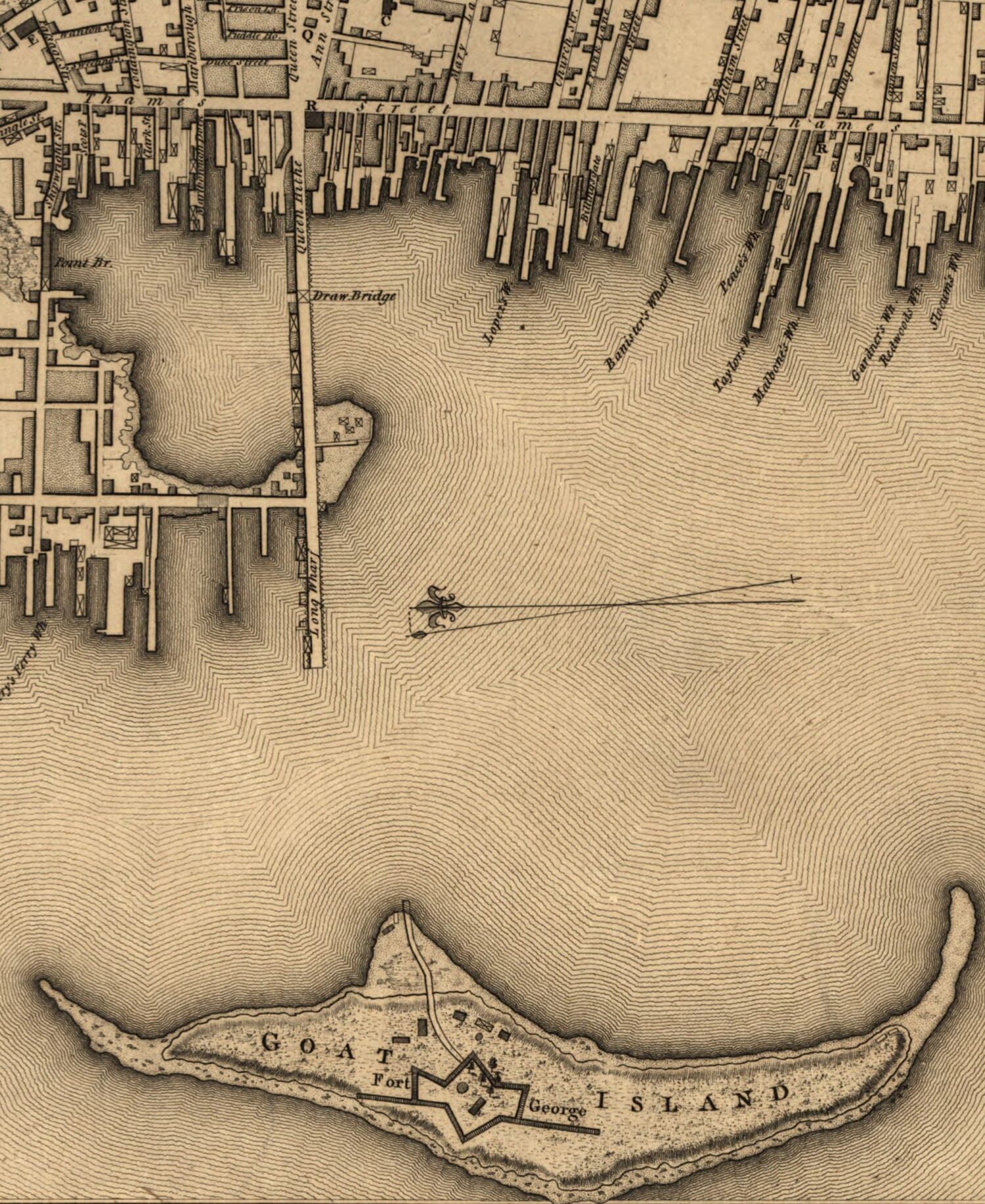


Griffin Greene of Warwick was a mechanical genius, despite having little formal education. His most impressive achievement: he made a water pump that was used to raise a sunken British warship from the bottom of Newport Harbor in 1780. This was before the age of steam engines.
Griffin Greene was born at Warwick on February 20, 1749. He was a cousin of Nathanael Greene, who would become a famous general of the Continental Army during the Revolutionary War, and was a distant relative of Christopher Greene, who would become the colonel of the First Rhode Island Regiment of Continentals, which would become renowned as the Black Regiment.
As was the case with most Rhode Islanders in colonial times, especially those living outside of Newport and Providence, Griffin received little formal education. He and a cousin, Jacob Greene, built a forge for the manufacture of iron. He married Sarah Greene, a sister of Christopher Greene.[1]
During the Revolutionary War, Griffin was firm Patriot. He served as a paymaster for the First Rhode Island Regiment from July 18, 1777 to May 31, 1778.[2] Why he left the army and never rejoined it is not known.
During the Rhode Island Campaign of July and August 1778, a powerful squadron of French Navy warships entered Narragansett Bay. The appearance of the French warships led the captains of the outgunned British warships to make preparations to scuttle them so that the French Navy would not capture them. The captains of the British frigates ordered their ships ashore to unload as much of the cannon, ammunition, and stores as possible. The 32-gun frigate Flora, under the command of Captain John Brisbane, did the same in Newport Harbor. Brisbane was the senior commander of the Royal Navy ships in the Rhode Island theater.
On August 5, two French warships rounded the northern end of Conanicut Island (Jamestown) and headed towards Newport to cut off the escape of four British frigates to the north. Each of the four British frigates realized they were trapped. Following orders from the commander of the Royal Navy ships, the captains ordered their crews to abandon ship and to set their ships on fire. Barrels of gunpowder were set on board with delayed fuses. Each of the frigates and one of the galleys were destroyed by huge explosions. While serving in a Boston artillery regiment, Paul Revere of the famous midnight-ride was stationed in Tiverton; shortly after one ship exploded in the Middle Channel, pieces of paper floated down into his camp signed by a British ship captain. Several days earlier, British naval commanders had scuttled and blown up a sloop and two armed galleys in the Sakonnet Channel when French frigates approached them.
On August 8, the British sank their last frigate and sloop in Newport Harbor. The frigate was the 28-gun Flora, the flagship of the senior Royal Naval officer, Captain John Brisbane. The Flora had provided cover and cannon fire during the British raid on Bristol in late May. Brisbane had several holes laboriously drilled by hand in the bottom of his ship, causing it to sink. The Flora sank in Newport Harbor in between Long Wharf and Goat Island. its cut-down masts were spotted by the French and were a warning of the obstacles the French would face if they forced their way into Newport Harbor.[3] Importantly, Captain Brisbane did not blow up his frigate, he merely sunk it.
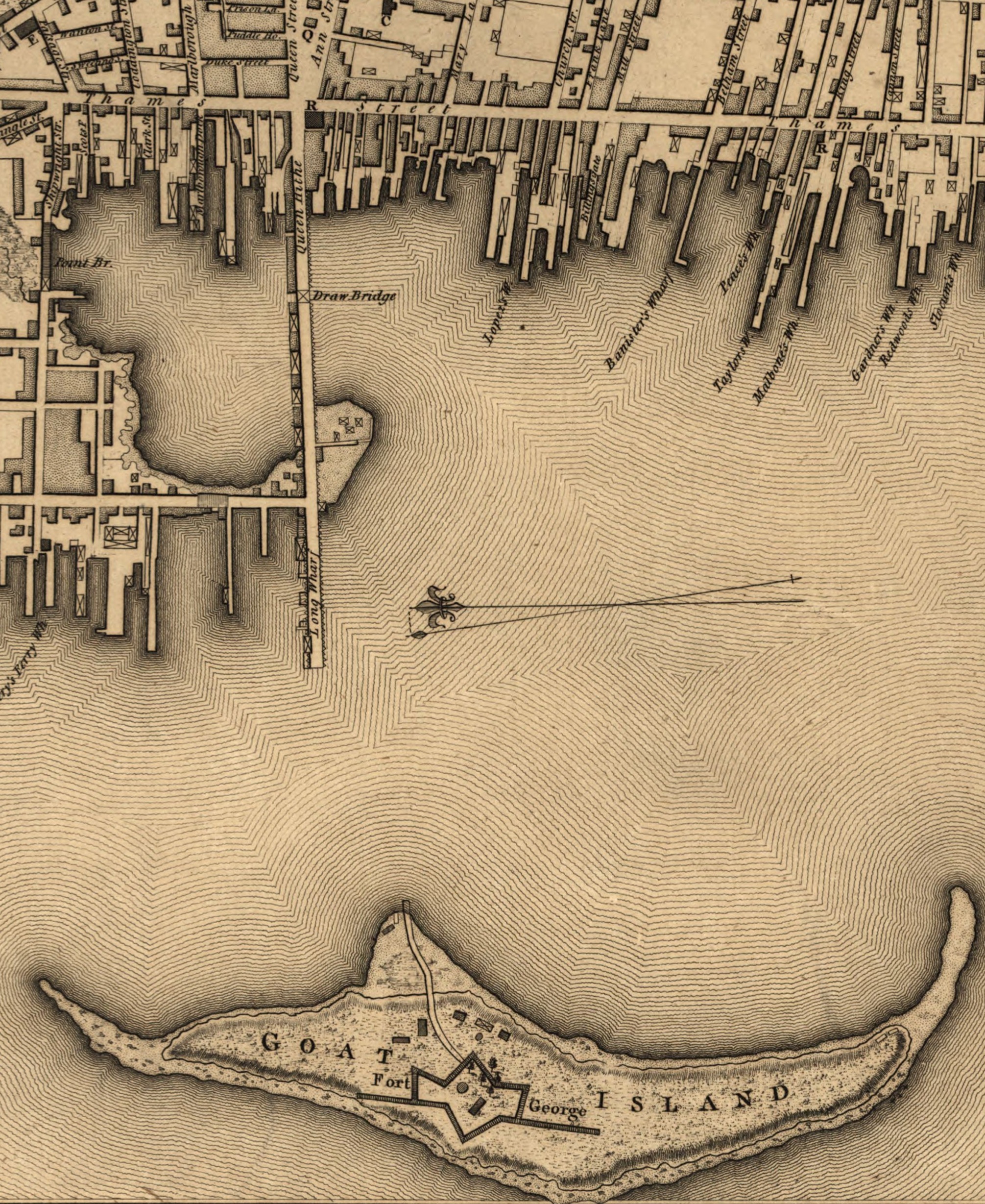
The 32-gun frigate Flora was sunk in between Long Wharf and Goat Island. Excerpt of a map created by British mapmaker Charles Blaskowitz, 1777 (Library of Congress)
As I set forth in my Rhode Island Campaign book, taken together, this loss of warships, carrying in total 210 cannon, was the most significant loss suffered by the British navy in the entire Revolutionary War. It exceeded the British naval losses even at Yorktown. This fact has not been adequately appreciated, since the ships were not lost as a result of combat. But a loss is a loss, regardless of its cause.[4]
Immediately after the British warships were sunk, salvagers sailed around the sunken ships looking to bring up cannon and any other valuable items. After the Rhode Island Campaign ended, and before the British departed Newport in October 1779, the British tried to raise some of the sunken ships. At low tide, the hulk of the Flora could be seen. But the British failed to raise the former frigate Flora.
In July 1780, nine months after the British departure from Newport, American salvagers succeeded where the British had failed, by recovering Flora. That spring an investment group headed by Nathanael Greene, his brother Jacob, and his cousin Griffin, had purchased the rights to the sunken ships at the bottom of Newport harbor.[5] Credit for raising Flora, however, went largely to Griffin Greene.
First, Griffin had to plug sixteen holes in the bottom of the ship that Captain Brisbane had ordered to be drilled in August 1778. Greene had a man, using a diving bell, swim down into the depths of the sunken ship and plug the holes.[6]
Next, laborers and horses went to work using a “powerful forcing pump” that Griffin had adapted from one described in a French encyclopedia. Powered by horses and set on a flat barge anchored near the vessel, the pump drained 144,000 gallons of water per hour, and after a mere six hours Flora had been raised.[7]
According to one source,
A powerful forcing pump, discharging twenty-five hundred hogsheads an hour, worked by horses in a flatboat alongside, enabled [Greene] so effectually to heave the water from their holds, that with the assistance of lighters, they rose to the surface, and once more floated on the ocean.[8]
Jacob Greene proudly informed Nathanael of the details by letter, adding that Newport Tories watching the proceedings from the shoreline “could hardly believe their own eyes.” Jacob bragged that Flora was a “large” and “fine” ship thought to have a value equal to any new ship built in America.[9] The Greene firm also raised at least one other sunken transport.[10]
Griffin reportedly consulted Denis Diderot’s famous French Encyclopédie. Griffin probably used the “Planches” volume, which had diagrams of machinery, including for hydraulics.[11] There does not appear to be a single diagram of a pump that Griffin relied upon. He may have combined two concepts found in the Encyclopédie. One may have been a “forcing pump” that used pistons to force water up pipes under pressure. This diagram was in the Hydraulics section of the Encyclopédie.

Cover page for Denis Diderot’s French Encyclopédie. The multivolume encyclopedia, a radical attempt to place all human knowledge in one place, was one of the most impressive creations of the Enlightenment in Europe (Diderot, Encyclopédie)
Second may have been a Horse Whim, which was found in sections on Mines and Agriculture in the Encyclopédie. The diagram for this machine depicts a machine where horses walk in circles to turn a vertical shaft, which used gears to drive pistons up and down.
As with most of Nathanael Greene’s investments, Flora soon became a financial albatross. Failing to find many other investors to share the cost, the Greene family firm spent an unexpectedly large sum fitting out the former British warship in East Greenwich Harbor as a privateer and for the carrying trade.[12] It did not set sail until about January 29, 1782, when it left Boston with 26 twelve-pound cannon and a crew of 130.[13] That was after the American-French victory at Yorktown, Virginia, but both sides were still sending out privateers to raid enemy ships. Two days later, the vessel lost its bowsprit and foremast in high winds. After another expensive refitting at Port-au-Prince, its crew took a valuable prize—and then quickly lost it to a British warship. With war’s end at the end of 1783, the demand for privateers evaporated, and the ship lost much of its value. The Greene firm sent Griffin and the ship to France with a hold full of cargo, but the proceeds were not enough to pay for the return voyage.[14] Finally, with the assistance of the Marquis de Lafayette, a friend of the Greene family, and after Griffin was in Europe for two years, he sold Flora to the French navy, but at a considerable loss.[15]
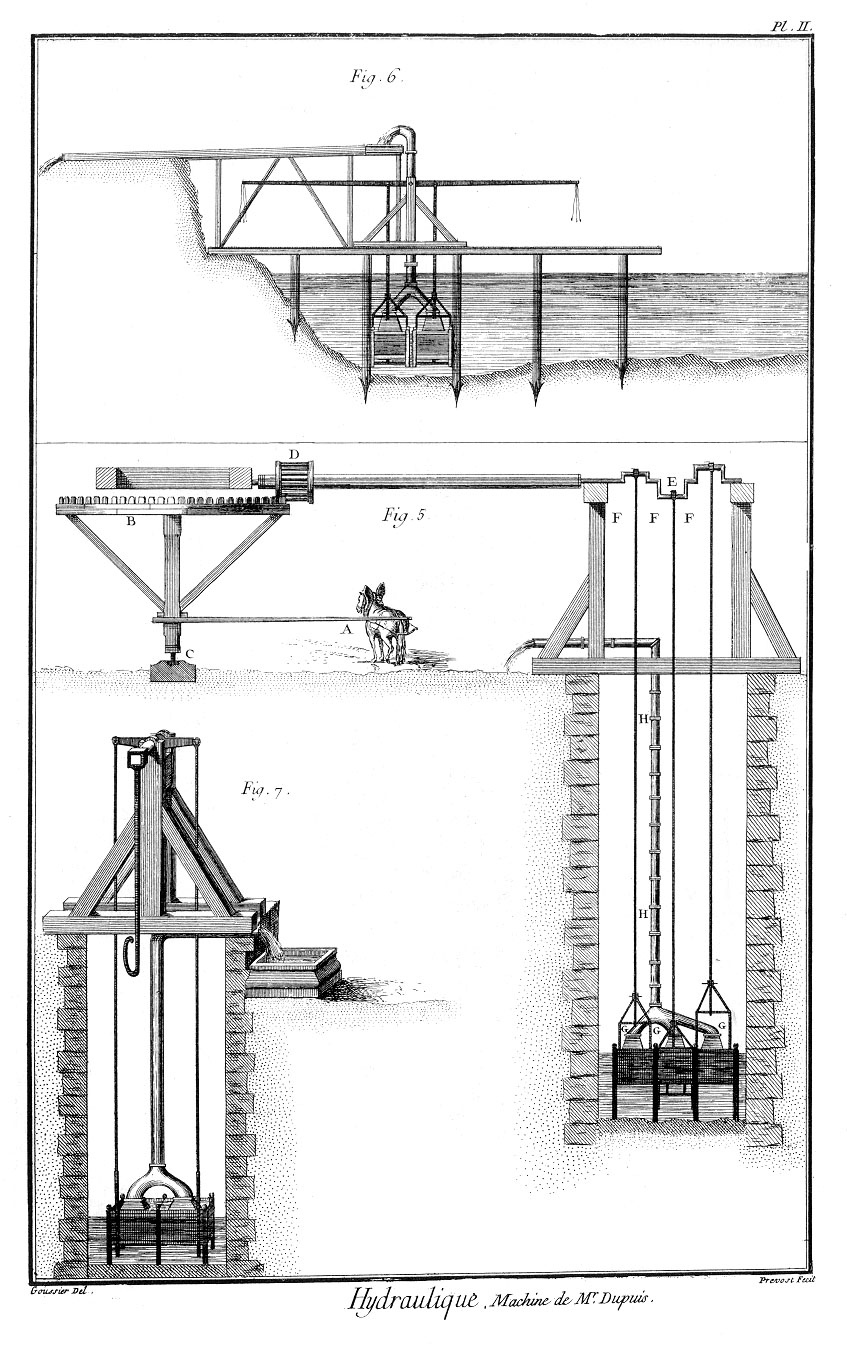
This diagram from the Encyclopédie may have been relied upon by Greene to build his water pump. Here is the text accompanying the diagrams, translated into English: Fig. 5. The same machine powered by a horse. A: the horse-powered mechanism. B: the wheel. C: the wheel’s pivot. D: the lantern receiving the wheel’s teeth. E: the crank. F, F, F: the rods with their frames. G, G, G: the hoods or chimneys where the water flows. H, H: the common pipe that receives the water as it exits the hoods or chimneys. 6. The machine applied to the draining of a marsh. This is how it must be set up for this purpose. 7. The machine placed in a well with a hand crank. With the same machine built on a large scale, and with all waste removed, it is possible to drain 11520 muids of water per day. Fig. 7 shows how to install it in a well. (Diderot, Encyclopédie)
Still, at least one American sailor and former British prisoner wrote of the “exultation and satisfaction” he had when in Port-au-Prince he “stepped upon the deck of the Flora.”[16] And in the end, the French navy had at least acquired one of her longtime foe’s prized frigates.[17]
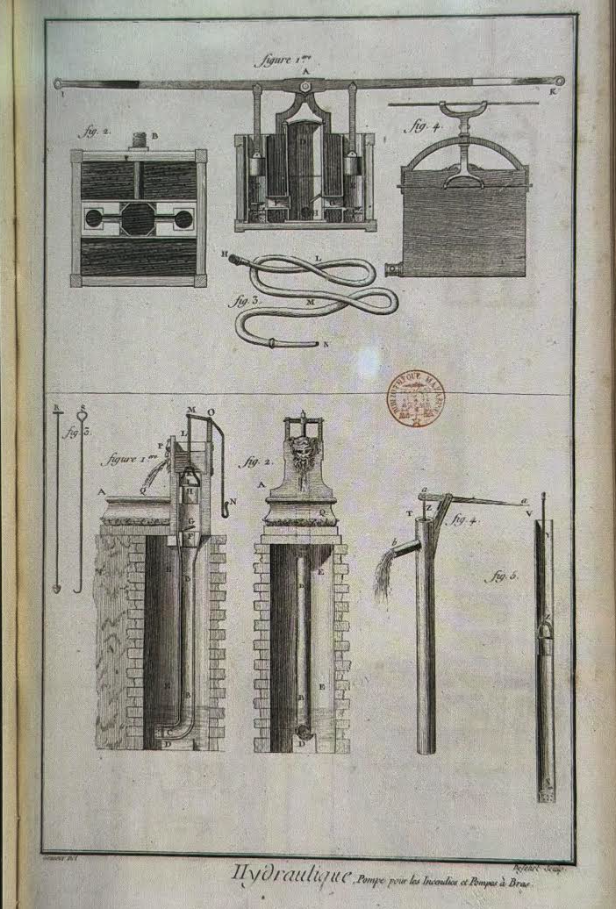
This page from the Encyclopédie shows a hydraulic system (Diderot, Encyclopédie)
After the war ended, Griffin Greene joined other Rhode Islanders, including former general James Varnum and former navy commander Abraham Whipple, in settling the first town in what would become the state of Ohio, at Marietta, on the Ohio River. Greene continued to use his active mind figuring how machinery could be used. At Marietta, he assisted on a model of a floating mill, based on one he had seen in Holland. The Dutch floating mill likely relied on tides, while his would rely on the Ohio River’s current. Greene also spent, according to a mini-biography of him:
more than a year in planning a self-moving machine, for perpetual motion, thinking it might be applied to the propulsion of boats on the Ohio river. When built, it moved with the accuracy and steadiness of a nice to a stand-still, in spite of the efforts of its inventor, being bound by the laws of gravitation, which it had not power to resist. It was reluctantly abandoned, and the curious wheels and levers with which it was made, were in being a few years since, lying in the garret of the old Mansion house in Marietta, amidst the dust and rubbish of by-gone days.[[18]
Next, Griffin turned his attention to applying steam to moving boats on nearby rivers. According to the mini-biography of Greene, Greene:
invented an engine so perfect in its model as to attract the confidence of Mr. Elijah Backus, a man of discernment, and owner of the island opposite to Farmers’ Castle, and since known as Blennerhasset’s. He became jointly concerned in the project, and about the year 1796, they visited Philadelphia and employed an ingenious mechanic to build a steam engine. In this enterprise they expended about a thousand dollars. The man proved to be unskillful or unfaithful, and the work was dropped without being finally put to the test.[19]
Greene, in his elderly years, was appointed to several federal posts at Marietta. He died in 1804 at the age of 55 after a long illness.[20]
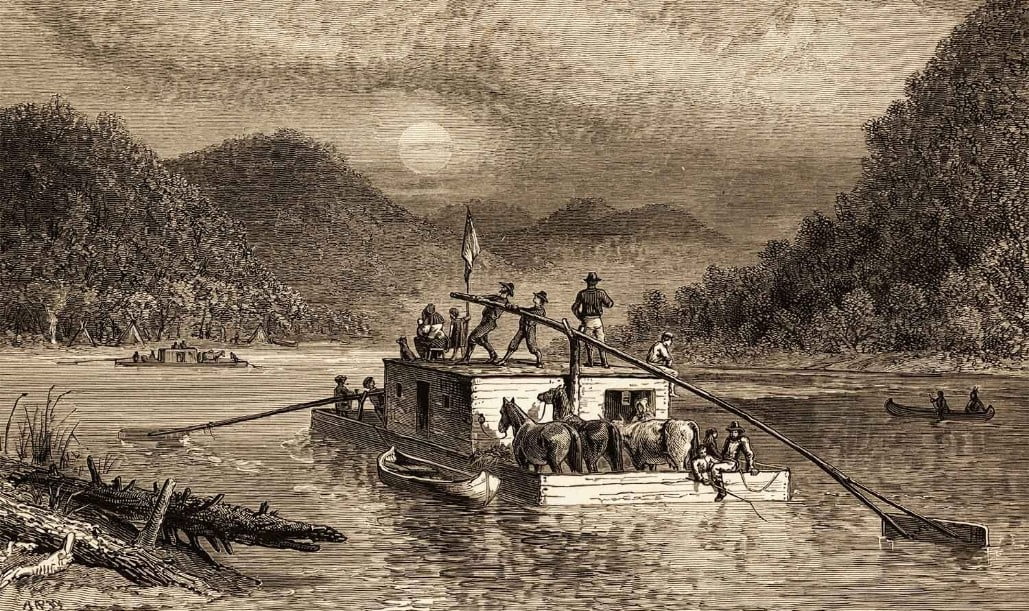
Drawing of a type of flatboat used on the Ohio River
Notes
[1] S. P. Hildreth, Biographical and Historical Memoirs of the Early Pioneer Settlers of Ohio (Cincinnati, OH: H. W. Derby & Co., 1852), 279. [2] Francis B. Heitman, ed., Historical Register of Officers of the Continental Army during the War of the Revolution, April 1775, to December, 1783 (Washington, D.C.: Rare Book Shop Publishing Co., 1914), 260. [3] Christian McBurney, The Rhode Island Campaign: The First French and American Operation of the Revolutionary War (Yardley, PA: Westholme, 2011), 61-62, 69, 84-95 and 110. [4] Ibid., 94-95. [5] See Griffin Greene to Nathanael Greene, March 27, 1780, in Richard K. Showman, Dennis Conrad, and Roger Parks, eds., The Papers of Nathanael Greene Papers, vols. 1-13 (Chapel Hill, NC: University of North Carolina Press, 1976-2005), vol. 5, 481 and n.3; Jacob Greene to Nathanael Greene, April 25, 1780, in ibid., 534 and n.7; William Blodget to Nathanael Greene, May (after 20), 1780, in ibid., 570 and n.3. [6] Hildreth, Biographical and Historical Memoirs, 287. [7] Jacob Greene to Nathanael Greene, July 13, 1780, in Showman, et al., eds., Greene Papers, vol. 6, 92 and n.1; see also Willam Heath Recollections, June 30, 1780, in William Heath, Heath’s Memoirs of the American War (Boston: 1798) reprinted by Books for Libraries Press (1970), 224. [8] Hildreth, Biographical and Historical Memoirs, 287. [9] Jacob Greene to Nathanael Greene, July 13, 1780, in Showman et al., eds., Greene Papers, vol. 6, 92 and n.1. [10] Jacob Greene to Nathanael Greene, October 1, 1780, in Showman et al., eds., Greene Papers, vol. 6, 325. [11] See Denis Diderot, L’Encyclopédie, Volume 26, Planches. For online access, go to [12] Jacob Greene to Nathanael Greene, Oct. 15, 1780, in Showman et al., eds., Greene Papers, vol. 6, 325; Griffin Greene to Nathanael Greene, Sept. 20, 1781, in ibid., vol. 9, 379; Jacob Greene to Nathanael Greene, May 4, 1783, in ibid., vol. 12, 641-642. [13] Charles Petit to Nathanael Greene, Feb. 14, 1782, in ibid., vol. 10, 367. [14] Jacob Greene to Nathanael Greene, May 4, 1783, in ibid., vol. 12, 641-43. [15] G. Greene to N. Greene, Dec. 14, 1784, in ibid., 13:438-39; Marquis de Lafayette to Nathanael Greene, Feb. 9, 1785, in ibid., 452. [16] Ebenezer Fox Recollections, in Rankin (ed.), Narratives of the American Rev., 149-51. [17] Originally constructed as the French naval frigate Vestale, the HMS Unicorn had captured it in 1761 during the Seven Years’ War and it was brought into the Royal Navy with the name Flora. See John B. Hattendorf, Newport, the French Navy, and American Independence (Newport, RI: Redwood Press, 2004), 33, n.24. After its purchase from the Greene brothers, the French navy renamed the frigate La Flore. In 1792 the French navy resold it to a French aristocrat who used it as a privateer. The vessel was retaken in 1798 by the HMS Phaeton and then sold out of naval service. The Musée National de la Marine in Paris has a model of La Flore as La Reconnaissance. Id.; D. K. Abbass, Rhode Island in the Revolution, Big Happenings in the Smallest Colony (USDI National Park Service, Battlefield Protection Program, 2nd ed., 2006), vol. 2, 268. [18] Hildreth, Biographical and Historical Memoirs, 288-89. [19] Ibid., 290. Blennerhassets is no doubt a reference to what is now Blennerhasset State Historical Park in West Virginia. The park’s website contains the following”The history of Blennerhassett Island has made it the Ohio River’s most famous island. In 1789, the island was settled by Harman and Margaret Blennerhassett, wealthy Irish aristocrats fleeing political persecution and personal scandal. Over the years, the couple’s mansion gained a reputation for being the West’s most beautiful home. Then, in 1805, they allowed their estate to become headquarters for Aaron Burr’s military expedition to the Southwest, an episode that raised the island to national renown and awarded it a permanent footnote in American history. The Burr conspiracy, which is suspected to have involved a treasonous plot to create a new country independent of the United States, has become the subject of many stories, poems, artwork and Broadway shows. The Blennerhassetts fled the island when Burr’s scheme collapsed but the mansion and history remain.
See Blennerhasset Island Historical State Park, Overview & History,” at https://wvstateparks.com/parks/blennerhassett-island-historical-state-park/park-historr/
[20] See Hildreth, Biographical and Historical Memoirs, 290.
I thank my son-in-law, Anubav Gupta, for finding the French encyclopedia references, using AI.
The Author

You Might Also Like