


I came across the copies of documents set forth below by accident. They tell a short, but tragic, tale of an enslaved teenager/young man named Fantee.
I was aware of Roby (or Rhoby) Whiting (or Whitting). Roby, from Warren, was the widow of Captain Nathaniel Whiting. The two were married on September 12, 1771. During the American Revolution, Roby was a known Loyalist—someone who wanted King George III to continue to rule the thirteen American colonies, including Rhode Island.
On May 25, 1778, a raiding party of British and German troops from British-occupied Newport raided Warren and Bristol. The main goal of the raid was to destroy boats at the nearby Kickemuit River that could be used to transport an American Army from Tiverton to the northern part of Aquidneck Island. The raiders largely succeeded, and they also invaded the compact towns of Warren and Bristol, torching a number of public buildings and houses owned by known Patriots, as well as accidentally burning down two churches, as well as taking some seventy prisoners, about fifty of whom were civilians.[1] During the raid of Warren, some soldiers entered Roby Whiting’s home and stole some cash from her, even though she was an avowed Loyalist (more on this incident below).
Now we jump to 1782, the tail end of the American Revolutionary War. This is after the British surrender at Yorktown, Virginia, which everyone expected (correctly) would lead to the end of the war. But technically, the parties were still at war.
The story becomes about a enslaved man named Fantee. His African first name indicates that he may have been born on the coast of West Africa, where the powerful Fantee tribe ruled large swaths of land.[2] Perhaps Fantee was a “privilege slave,” that is, an African captive, often a boy, assigned to an officer of a slave ship and sometimes brought back to Rhode Island. In 1782, he was about sixteen years old.
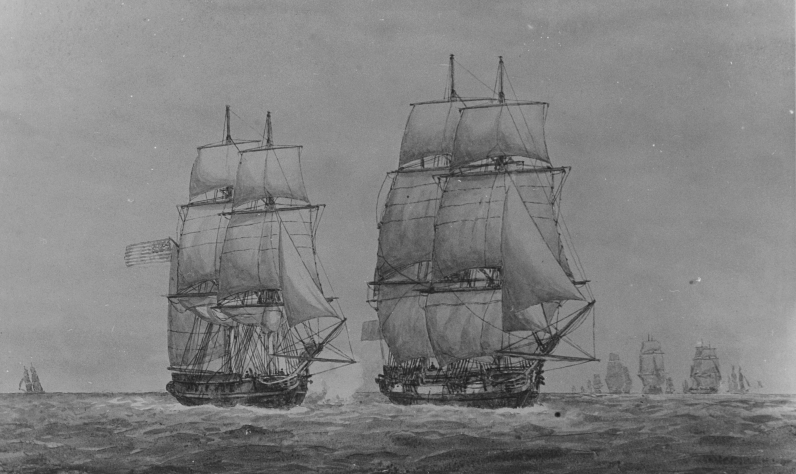
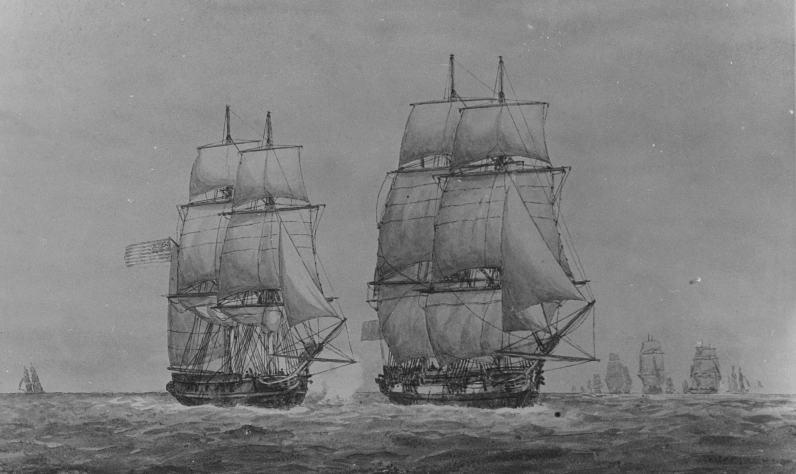
An American privateer captures a British merchant ship in the Caribbean (Naval Heritage and History Command)
I searched an African slave trade database and came up with a single voyage from North America that was commanded by a Nathaniel Whitting. His co-commander (and possible superior) was Thomas Rogers. It is likely that Rogers hailed from Newport and Whitting from Warren. The vessel was registered in Newport and departed Newport on June 14, 1773, purchased about one hundred African captives on the West Coast of Africa, and arrived with them at the British-controlled island of Barbados on May 4, 1774.[3] It could well be that Fantee was a privilege slave on this voyage who was brought back to Warren by Nathaniel Whiting. He would have been about eight years old. The name of Fantee refers to a powerful tribe that then operated in what is now Ghana, whose leaders were experienced slave traders.[3.5]
In a list of property held by residents of Warren in 1778, “Nathan Whiting” is reported to have held one enslaved person. That person was likely Fantee.[4]
While searching for information on a totally different topic, I came across the following copies of documents in a Rhode Island Historical Society publication from 1900. The documents were found in a file in the Society’s library. They are set forth below in chronological order.[5]
Here is the first document (original material is in italics; some corrections to spelling, punctuation, and grammar have been made):
AGREMENT:
Warren May 22nd, 1782.
This Day an agreement is made between Mrs. Roby Whiting of Warren, and Edward Jones of Providence, for the hire of a Certain Negro Boy Named Fantee, for the space of Twelve Months, for which the said Edward Jones promises to pay to the said Mrs. Whiting, or order, the sum of Fifty-four Spanish Milled Dollars.
In Presence of Benjamin Allen
Edward Jones
Benjamin Allen
Roby Whitting
Roby thus is poised to receive a nice amount of rent for renting the services of Fantee to Edwad Jones of Providence. That is, if Fantee cooperates. Fantee is sent to Providence. Let us see how he fares.
EDWARD JONES TO MRS. ROBY WHITING.
PROVIDENCE 7TH JANUARY, 178[3]
Madame:
This Day I received yours by Fantee, who I have not seen for 16 Days. He left my house in perfect good humour, and promised to be at home in the evening. During his Absence he employed his time in stealing, for which he has been had up [i.e., caught], but the people [he stole from] being Quakers, they released him. Your Friend, Mrs. Manning, can inform you of his behavior. He has run me into debt about 16 Dollars that I have already heard of [and] has taken from the house by way of stealth, about [erased] more, that we have already missed since the 2nd of last May. He has absented himself from my service without leave [a total of] 37 Days. I suppose in this case you will do, as you would choose others to do by you. Agreeable to your desire, I have given him all his things [clothes and other belongings] and ordered him directly home, though I am much blamed for not putting him in prison. I should be glad you would either bring or send the writing of mine as soon as possible that affairs may be immediately settled. You mention the Ill-usage you received when at my house, pray do you think it was not merited? Or don’t you think that your hiring me a servant possessed of every vice under heaven, [instead of] an honest lad, was not an imposition of the grossest kind?
Yours, etc.
Edward Jones
Unfortunately, Fantee has not cooperated in regards to his enslaved status. He failed to be at Edward Jones’s house for 37 days, making him unavailable to engage in work for Jones. And he had been caught stealing money. Presumably, Fantee was tired of being enslaved and left Jones’s house, but found it necessary to engage in some illegal acts to survive.
Jones’s response indicates that Roby had visited Jones’s house in Providence and that Jones had expressed anger towards her because he was not getting the bargain for which he had negotiated.
The next letter below is from Dr. James Manning, then the President of Rhode Island College (now Brown University) in Providence. At this time, he was enslaving a man named Lewis Manning, then about 29 years old, whom he would manumit in 1784.[6] Roby and Dr. Manning likely became acquainted when Dr. Manning was founder and head of the school when it started out at Warren. The college moved to Providence in 1770. The “Mrs. Manning” referred to in Jones’s letter above is James Manning’s wife, Margaret Stites Manning.
PRESIDENT MANNING TO MRS. ROBY WHITING.
Providence, February 1st, 1783
Madame,
I received your Letter Night before last. Your Boy had been at your House the Day before, for a Paire of Shoes and Stockings he left there before, but he was not within [the house]. On receiving your Letter I went myself about Town [in Providence] and made Enquiry for him, but could not hear of him after Eleven O’clock that Day. Today I am informed by Lasell and Mr. [Edward] Jones that the former [Lasell] took him [Fantee] up yesterday on the Road to Boston, where he had made himself known by stealing a Crown and cheating a Landlord, etc. Last Night he was lodged in the Jail of this Town [Providence], by the above Gentlemen, where You can find him by applying. I wrote you before a long Letter by him, in which I gave an Account of his stealing from a Number of People and amongst the rest a new Barcelona Handkerchief from my Lewis, &c &c, but it seems the Rogue had address enough to destroy it [that is, destroy the evidence of theft]. I am
Yours &c
James Manning
To Mrs. Roby Whiting, Warren.
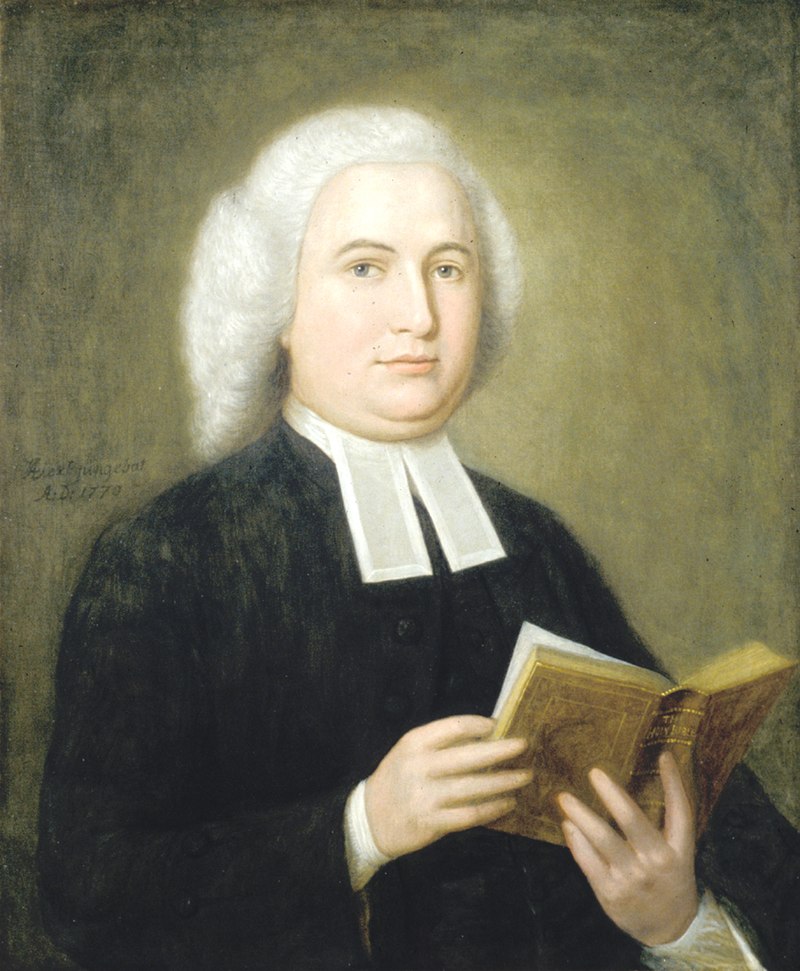
James Manning (1738-1791) painted in 1770 by Scots artist Cosmo Alexander (Brown University Portrait Collection)
Manning indicates that Fantee stole a handkerchief from Lewis Manning, the man he had enslaved. Fantee tried to escape to Boston and likely wanted to start a new life there, but was caught not too far from Providence and thrown in a jail in Providence. To get out of jail, Roby would have to pick him up. Next is a list of the costs that Fantee incurred, provided by Dr. Manning as an attachment to the above letter. Before Fantee could be released, Roby would have to pay these debts.
MEMORANDUM.
Memorandum of Cash Paid at Providence for Fantee:
To Cash Paid to Redeem Fantee’s Clothes. .068
To Cash Paid to Mr. Sheldon [probably the jailer] for 4 days in Jail. .080
To Cash Paid Mr. Lasell for his Trouble. .060
To Cash Paid For Cheating the Tavernkeeper. .034
To Cash at Farrey’s [the Ferry?] @ 3d/. .013
To Cash Paid For drink of Cherry Rum. .010
£1.63 [one pound, six shillings and three pence]
As will soon become clear immediately below, Roby is fed up with Fantee and has made an awful plan for him:
RECEIPT.
Warren, February 6th, 1783
Then Received of Roby Whitting a Negro Man Slave in good Order which I am to Carry at her Risk in the Good Sloop Patty to the West Indias [i.e., the Caribbean] there to Dispose of him for her on the best Terms I Can and there to Ship the Net proceeds to her on board the Said Sloop or Some Other Bottom in West India goods if a good Opportunity presents and if not to purchase Bills or make the Returns in Cash so that I do the Best in my Power for the Benefit of Said Roby Whitting—She paying for the passage of Said Negro and Commissions as Customary. Witness my hand at Warren the day and Year aforesaid.
Isaac Gorham
Accordingly, a Warren ship captain, Isaac Gorham, agreed to take Fantee on board his sloop that is sailing to the Caribbean, probably on a commercial voyage. Gorham could also have been a “letter of marque,” meaning a commercial ship that was also licensed to act as a privateer and seize enemy (that is, British) shipping. In any event, once at a safe port, Gorham was to sell Fantee, probably to a plantation owner on a French-controlled island, such as Martinique or Guadeloupe. Gorham would reduce the sales proceeds by a fee for his taking Fantee on board his vessel as a passenger and other costs of maintaining him. Gorham may also have sought to claim a commission on the sale as part of the deal.
Before the sloop sailed, Roby considered whether to purchase insurance, in case the sloop is lost at sea or is captured by a British warship.
JAMES BOURN TO MRS. WHITING
Newport, February 15: 1783
I have according to your request Enquired Concerning of Insurance on your Negro. I don’t find anybody here [in Newport] that cares to underwrite upon him till Yesterday. Captain Caleb Gardner told me he would insure him the first passage only Clear of the Enemy for thirty percent. So that you can think on it and if you would choose to have it Done Let me know. I would get it Done. Nothing more at present but to acquain[t] you we are all well [and] hoping you and Mr. Sanders’s family and your Brother’s family well Likewise. [I] Remain yours to command,
James Bourn
To Mrs. Roby Whiting
James Bourn, a family friend of Roby’s from Newport, has done Roby the favor of finding someone willing to pay for insurance. Captain Caleb Gardner, an established Newport merchant, slave ship captain, and slave trader, has agreed to provide insurance, but only in the event the sloop Patty is seized by the British on its outgoing voyage to the Caribbean. (So not if the ship is lost as sea in a storm).) Gardner’s charge is steep: 30 percent of the net sale proceeds of Fantee after he is sold in the Caribbean. It is not known if Roby agreed to purchase the insurance.
By selling Fantee out of state, Roby was breaking a recent 1779 law. In May 1779, a North Carolina man agreed to purchase from a South Kingstown farmer an enslaved woman and three of her young children. The North Carolina man aimed to carry them to North Carolina and probably sell them there at a profit. But some Westerly men who found out about the scheme hid Abigail and her children before they were carried out of Rhode Island. The Rhode Island General Assembly then quickly enacted a law banning the sale of enslaved people to out of state buyers. The legislation also would have permitted Fantee to complain to a justice of the peace of the attempt to sell him out of state, and if proved Fantee was to receive his freedom. The law did have one way out for Roby. If an enslaved person had “become notoriously unfaithful and villainous,” the Rhode Island slaveholder could sell the enslaved person out of state. Fantee may have satisfied that standard. But to benefit from that provision, Roby would have had to have obtained a judgment in the Bristol County Court that Fantee met this standard. Roby did not take this step; accordingly, she was in violation of the 1779 law.[7] Isaac Gorham of Warren was also a participant in the lawbreaking arrangement.
The following document explains Fantee’s awful fate:
DEPOSITION of ISAAC GORHAM.
The Deposition of Isaac Gorham of Warren in the County of Bristol etc., Mariner, on Oath saith that I the deponent on the 13th day of February AD 1783 Sailed from the port of Warren, Master of the Sloop Patty, bound to the West Indias [the Caribbean] and having on board a Negro Man about Eighteen or Twenty Years Old, a Healthy and Active Lad, the Property of Rhoby Whitting of Said Warren Widdow. And that on the Seventh day of March in the Same year being about four Leagues to windward of Monte Christo was taken by a British Sloop of Warr Called Le Gatroon Commanded by Benjamin Hulk Esquire, and that Said Negro was taken on board the Ship whereby he was lost to his Said Mistress and further saith not.
Isaac Gorham
CERTIFICATE:
Bristol ss
In the State of Rhode Island and Providence Plantations at Warren in the County of Bristol in Said State on the 20th day of July AD 1786 the Fore named Isaac Gorham in his own proper person came and being duly Cautioned and Carefully Examined made a Solemn Oath to the Truth of the foregoing Deposition to be used before the Commissioners Appointed by Act of Parliament of Great Brittain in the tryal of the Claim of Rhoby Whitting of Said Warren, Widdow, for the Compensation of her loss, etc.
Before me:
William T. Miller, Justice Quorum
Accordingly, the sloop Patty was indeed captured by a British warship, just before it was about to reach a safe port in the Caribbean. The sloop was captured off Monte Christo, which is a small, uninhabited island situated between the Caribbean islands of Saint Vincent and Grenda.
Fantee, described by Captain Gorham as a “healthy and active lad,” was captured too. It is most likely the case that Fantee was sold at auction to a sugar plantation owner on a British-controlled island, probably at Jamaica, Barbados, or Grenada. Enslaved people on sugar plantations in the British Caribbean experienced horrible working conditions and had an incredibly high death rate.[8] Perhaps Fantee instead accepted an offer to join the crew of a British warship, a fate that also had a relatively high death rate, but at least a sailor eventually could find means to attempt to escape. Fantee’s fate is unknown.
The Deposition indicates, surprisingly, that its purpose was for Roby Whiting to recover for her losses inflicted by the British in respect of her “property” by applying to the British government for a recovery. Justice William Miller was willing to cooperate, even though Roby had been a Loyalist.
More than one hundred Rhode Island Loyalists submitted claims to a Royal Commission established to consider and act upon claims for losses suffered by Loyalists during the American Revolution. In most cases, they had fled Rhode Island and were residing in England, Canada or another British colony. And in most cases, the losses were attributable to Patriots seizing the property of Loyalists. Roby had, however, a different type of claim. She had remained in Warren and was claiming losses caused by the British military.
A book that summarizes Loyalist claims for reimbursement of losses provides as follows for Roby Whiting:
Whitting, Rhoby of Warren. Memorial. Warren 1786. A native of Warren, in May 1778 she was robbed of her cash in the house by the [British] Army. The rebels offered her negro servant boy money to go with them as a soldier but she sent him on a sea voyage when he was taken by a British ship. Action: Rejected (13/24/504).[9]
Thus, Roby failed to recover on her two claims for compensation. In her claim, she stated that Fantee had been approached by Patriot Army recruiters and offered money to enlist in the Patriot Army. But Fantee was still enslaved at the time. Thus, he would not have been allowed to serve unless he had enlisted in a short time frame, from February 15 to June 10, 1778. At that time, an enslaved man could obtain his freedom by enlisting in the First Rhode Island Regiment of Continentals. But Fantee did not do that (likely to his regret, as matters turned out). Since this offer of freedom was unavailable after June 10, 1778, Roby’s claim is dubious. In addition, as the above correspondence strongly suggests, Fantee was placed on a Warren ship that would take him to the Caribbean where he was to be sold, presumably because of his bad conduct. It was certainly one of the harshest punishments imaginable—to be sold to a sugar plantation in the Caribbean.
Notes:
[1] Virginia Baker, The History of Warren, Rhode Island, in the War of the Revolution, 1776-1783 (Warren: Privately Printed, 1901), 14-24. [2] See Christian McBurney, Dark Voyage: An American Privateer’s War Against Britain’s African Slave Trade (Yardley, PA: Westholme Publishing, 2022), __. [3] Trans-Atlantic Slave Trade Database, Legacy Version, at legacy.slavevoyages.org (Voyage #36468). [3.5] See McBurney, Dark Voyage, 136. [4] “Valuation List” of Warren, R.I., 1778, in Virginia Baker, The History of Warren, Rhode Island, in the War of the Revolution, 1776-1783 (Warren: Privately Printed, 1901), 48. [5] “Papers Relating to Fante,” Publications of the Rhode Island Historical Society, New Series, vol. 8, (Providence: the Society, 1900), 190-94. [6] See Jane Lancaseter, “Were There Slaves Living on College Hill for Twenty Years?,” April 24, 2021, The Online Review of Rhode Island History, https://smallstatebighistory.com/were-there-slaves-living-on-college-hill-for-twenty-years/. [7] See Christian McBurney, An Enslaved Mother Rescues Her Family from being Transported to the South—and Spurs a Law Change,” Jan. 22, 2022, The Online Review of Rhode Island History, https://smallstatebighistory.com/an-enslaved-mother-rescues-her-family-from-being-transported-to-the-south-and-spurs-a-law-change/. [8] See McBurney, Dark Voyage, 6-8. [9] Peter Wilson Coldham, American Migrations, 1765-1799, The Lives, Times, and Families of Colonial Americans Who Remained Loyal to the British Crown Before, During and After the Revolutionary War, as Related in Their Own Words and Through Their Correspondence (Washington, D.C.: National Genealogical Society, 1980), 148. St. Michael’s Episcopal Church of Bristol was also unsuccessful in recovering for the loss of its being burned down during the May 1778 raid. Ibid., 136.The Author

You Might Also Like