

In the Barneyville Historic District of Swansea, Massachusetts, near Old Providence Road and the Palmer River, there is a granite monument erected in 1912 with a bronze plaque that reads as follows:
NEAR THIS SPOT STOOD THE JOHN MYLES GARRISON HOUSE THE PLACE OF MEETING OF THE TROOPS OF MASSACHUSETTS BAY AND PLYMOUTH COLONIES . . . WHO MARCHED TO THE RELIEF OF SWANSEA AT THE OPENING OF KING PHILIP’S WAR A.D. 1675.
Listed below that inscription are the names of several of those slain in the conflict, including a man named William Cahoon. The backgrounds of John Myles and William Cahoon will be explained in the following paragraphs.
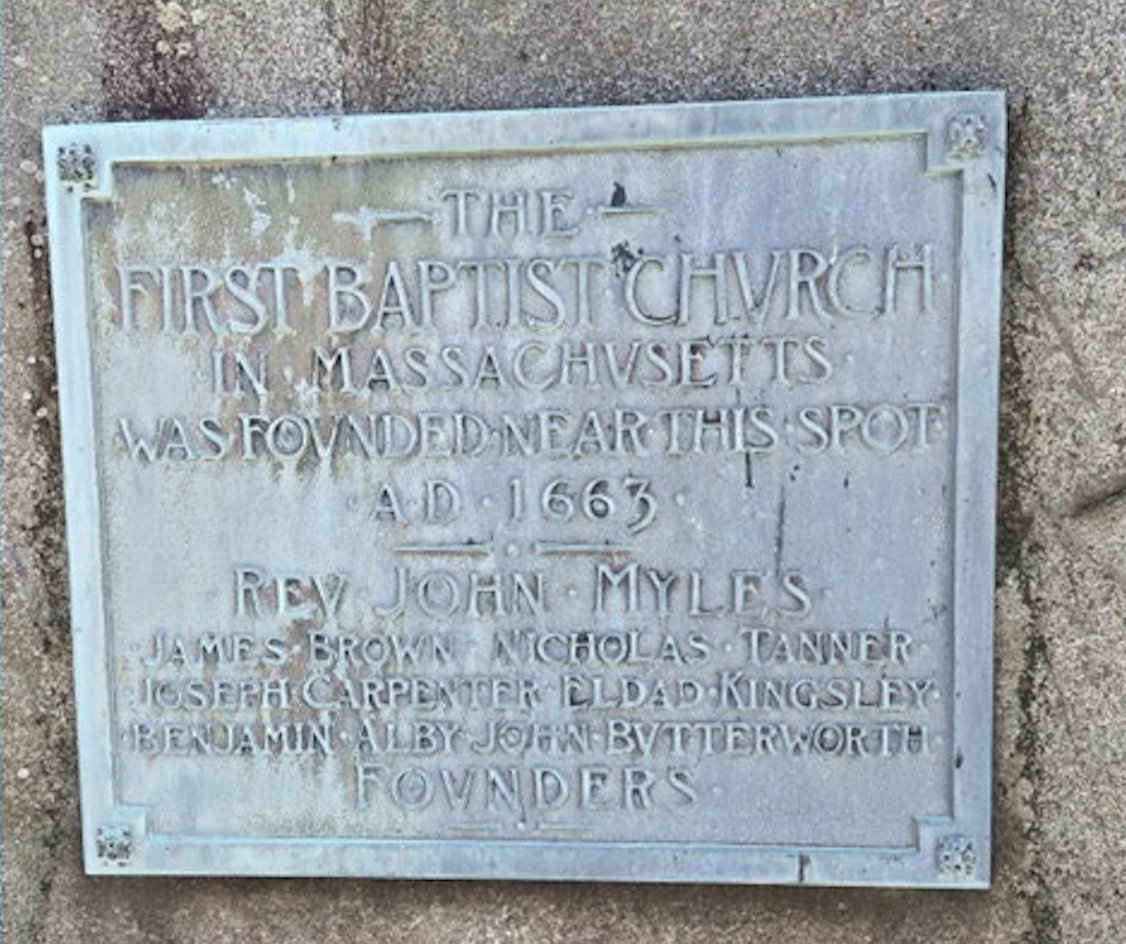
A winding mile and a half away from the Barneyville historic marker is an earlier granite monument erected by the Rhode Island Historical Society at Nockum Hill in 1906. The bronze plaque on the Nockum Hill monument reads: “THE FIRST BAPTIST CHURCH IN MASSACHUSETTS WAS FOUNDED NEAR THIS SPOT A.D. 1663.” There is no mention of the conflict on this monument. However, it has long been believed that the church, founded at this location by the Reverend John Myles, was destroyed, along with much of the surrounding settlement, during King Philip’s War (or Metacom’s War), which lasted from 1675 to 1676.
Nockum Hill is now part of Barrington, Rhode Island. However, at the time of King Philip’s War, it was still part of the Plymouth Colony town of Swansea and later became part of Massachusetts in 1691 when the two colonies merged. It was finally incorporated into Barrington in 1770 after the colonial borders were settled.
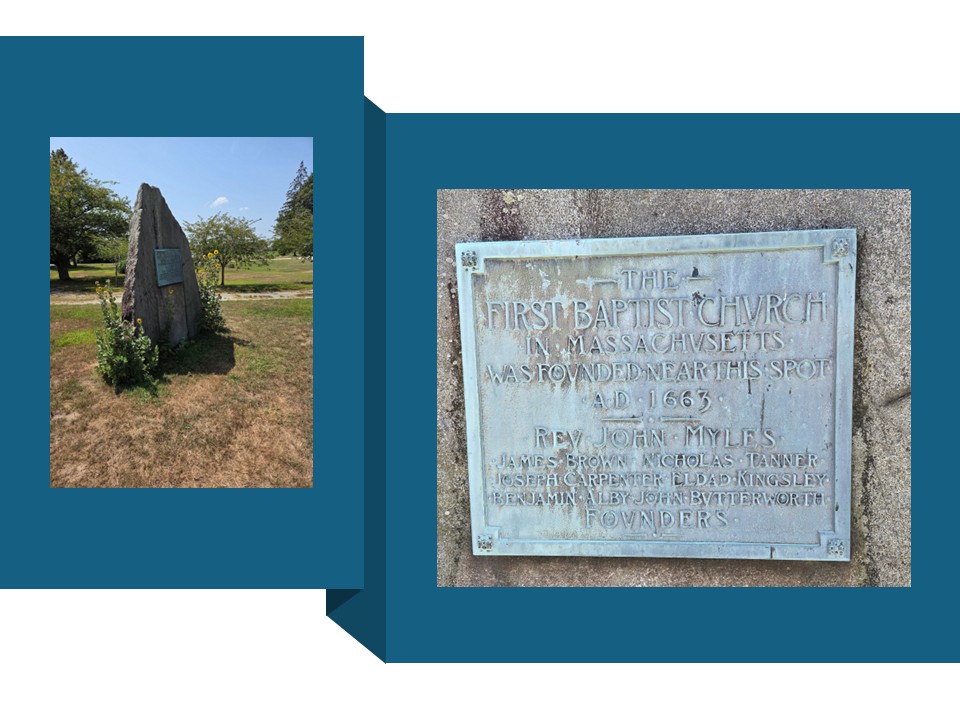
Monument at Nockum Hill commemorating the location of John Myles’s church (Steven Venuti)
The actual date the physical church at Nockum Hill was constructed was not 1663, as written on the monument, but nearer to 1667, following John Myles’s expulsion from the Plymouth Colony Town of Rehoboth. Myles and other members of his congregation were fined and ordered to “remove theire meeting unto some other place, where they may not prejudice any other church.”
The stories of how two men named on these plaques, William Cahoon (1633-1675) and the Reverend John Myles (1621-1683), became directly involved in King Philip’s War could not be more different. But both have direct ties to Oliver Cromwell and the English Civil War.
Throughout his reign, King Charles I quarreled with Parliament over war, taxes, and religion. This quarrel led to Charles taking the unprecedented step in 1642 of entering Parliament in an unsuccessful attempt to arrest five members of Parliament (called MPs) in the opposition. This so angered Parliament that civil war erupted between the supporters of King Charles (called the Royalists) and the Parliamentary Forces (called the Roundheads), ultimately led by Oliver Cromwell and his “New Model Army.”
Charles gained the support of the Scottish Royalist forces after he promises to officially recognize their Presbyterian religion. But following a failed invasion attempt into England by the Scots, Charles was taken prisoner in 1648. And by 1649, Charles I had been tried, convicted of Treason, and beheaded. Meanwhile, the Scottish Royalists continued to battle Cromwell’s New Model Army. In 1650, Cromwell successfully defeated the main Scottish army at the Battle of Dunbar, killing 4,000 Scottish soldiers and taking another 10,000 prisoners.
In December of that same year, 150 of Cromwell’s Scottish prisoners-of-war arrived in Boston aboard the ship Unity as indentured servants to John Becx and John Foote, proprietors of various ironworks operations in Massachusetts. Most of these indentured prisoners were sold by the proprietors at a profit. But many were kept to serve out their indentures at the Saugus Ironworks or the Braintree bog iron furnace. Among the Scottish Royalist prisoners sentenced to serve out his indenture at the Braintree furnace was William Cahoon, the 17-year-old Grandson of the 13th Laird of Dunbarton. Cahoon’s indenture lasted approximately eight years.
While the fate of William Cahoon and that of his fellow Scottish soldiers clearly took a turn for the worse at the hands of Oliver Cromwell, Cromwell’s rise in power had a very opposite effect on the Reverend John Myles and his fledgling ministry in Wales.
Following the beheading of King Charles I in 1649, the English government fell briefly under the direct control of a group of MPs known as the “Rump Parliament.” However, the MPs’ failure to introduce the political, legal, and social reforms Cromwell and his New Model Army had fought to achieve soon led to their ouster and to the appointment, in 1653, of Oliver Cromwell as Lord Protector of England, Wales, Ireland, and Scotland. Although Cromwell’s tactics, both militarily and politically, were often quite severe, his government did introduce a measure of religious toleration toward protestant denominations (other than the Anglican Church favored by the monarchy). Baptists, in particular, benefited from this change.
Toleration of the Baptists was likely rooted in their direct involvement in Cromwell’s government or due to their service as members of his New Model Army. Many Baptists are believed to have served either as officers or army chaplains. Myles himself, an Oxford-educated minister, served in the government as a member of Cromwell’s council of “Tryers,” responsible for the vetting of others seeking official recognition as ministers.
Beginning in 1649, John Myles established what is believed to be the first Baptist Church in Wales in the small Swansea village of Ilston. So successful was Myles’s first gathering that, within just a few years, his congregation had spread to villages throughout Swansea and beyond. Few outside of Ilston had the luxury of assembling in a church building. So, it was common for his followers to meet in congregants’ homes. Myles documented these events in a logbook, known as the “Ilston Book.” There is a granite monument commemorating the book near Myles’s original church in Swansea, Wales. The original book is housed at the John Hay Library at Brown University.
The freedom that allowed Myles and his Baptist congregation to flourish under Cromwell’s rule was short-lived. Following Cromwell’s death in 1658 and the brief political vacuum it created, in 1660 the monarchy was restored with the return of Charles II, the eldest surviving child of Charles I, to the throne. This was bad news for Myles. Within short order, and in sharp contrast to Cromwell’s acceptance of the Baptists, Charles II established the “Act of Uniformity” mandating use of the Book of Common Prayer and requiring that all clergy be ordained by an Anglican Bishop. And just to be certain the message was clear to Cromwell’s supporters, the King ordered Cromwell’s corpse to be exhumed and taken to London, where it was hanged, beheaded, and the head mounted on a spike at Westminster.
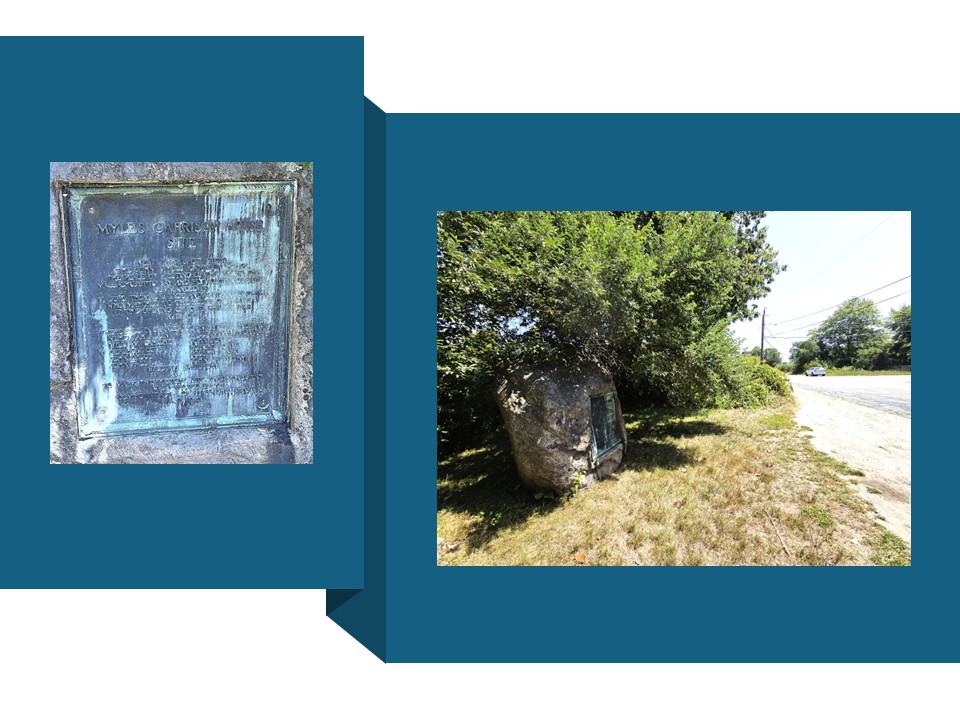
Monument at Myles Garrison, Swansea, Massachusetts, listing William Cahoon among those killed in the King Philip’s War. The monument stands near the entrance to the Doug Rayner Wildlife Preserve on Nockum Hill. The monument was installed in 1906 by the Rhode Island Historical Society (Stephen Venuti)
John Myles got the message. By 1663, Myles and some fellow Baptists, having fled persecution in Wales, established a new church in the Plymouth Colony Town of Rehoboth. Following the same playbook used in Wales of using private homes as his church, Myles’s first meetings in Rehoboth were held in the home of John Butterworth. Though Myles and his followers successfully escaped certain persecution back home in Wales, they quickly learned that not everyone in Plymouth Colony was accepting of their differing views of Christianity. This reality became clear when, in 1667, the Plymouth Colony court ruled that “for theire breach of order in setting up of a publick meeting without the knowledge and approbation of the Court,” John Myles and another member of his congregation, James Browne, were fined five pounds each. The Court also ruled that “theire continuance att Rehoboth, being very prejudicial to the peace of that church and that towne, may not be allowed . . . yet they shall remove theire meeting unto some other place, where they may not prejudice any other church . . . .”
In what turned out to be a silver lining for Myles and his Baptist congregation, James Browne was married to Thomas Willett’s sister. Back in 1653, the same year that Cromwell was named Lord Protector of England, Thomas Willett, along with the Plymouth Colony Governor Thomas Prence and a few other proprietors, had purchased the land south of Rehoboth known as Sowams from the Massasoit Ousamequin and his son Wamsutta.
Willett, in the hopes of establishing a new town with increased shore access for his shipping interests, and Myles, in need of a legally sanctioned meetinghouse location, both petitioned the Plymouth Colony Court. Later in 1667, just months after Myles was ordered to leave Rehoboth, Willett and Myles were granted joint authority to establish a new town, just south of Rehoboth in the Sowams territory. The Court also granted that the town would be called Swansea, in honor of Myles’s home in Wales.
Unlike Myles’s village home back in Wales, the new town of Swansea was a frontier settlement that proved to be a further and unwelcome encroachment into the territory of the Pokanoket/Wampanoag territory. The seat of power for Metacom (called King Philip) of the Pokanoket was at Mount Hope, now part of Bristol, Rhode Island. The Court, it would seem, was fully cognizant of the danger inherent in this encroachment when it “granted liberty unto Captaine Willett to purchase what lands he can . . . so as hee doe not much straiten the Indians.”
For the next eight years, Swansea evolved into a village centered at Nockum Hill with its meetinghouse believed to be located along modern-day George Street. The Town fathers were very particular about who was allowed to live and own property in the Town. Although Myles and his followers were Baptists, Willett was a Congregationalist. This led to a compromise which stipulated that “no erroneous” persons or men “of evil behavior” were allowed to settle in the Town.
It is unknown whether William Cahoon maintained his Scottish Presbyterian roots. But he was among those men deemed suitably free of “erroneous” or “evil behavior” to be admitted to the Town. Having completed his indentured servitude at the Braintree furnace following his capture by Oliver Cromwell at Dunbar, Scotland, William Cahoon settled for a time on Block Island and began to raise a family. He became a skilled brickmaker and at some point made his way to Nockum Hill. According to the minutes of the Swansea Town Meeting records, dated December 24, 1673, it was voted that “in Consideration of a Lot and other Accommodations Granted and Given by and from the Town . . . William Cahoon Shall Supply all the Inhabitants of the Town with Bricks at a Price not Exceeding Twenty Shillings . . . .”
William Cahoon’s tenure as the local brick merchant, along with Myles’s church and the surrounding village, proved to be very short-lived. On June 23, 1675, a Wampanoag man was shot and killed in an encounter at the Swansea home of John Salisbury. In response, the next day was “appointed and attended as a day of solemn Humiliation throughout the Colony.” However, as recorded in his 1676 written account, A Brief History of the War with the Indians of New England, Increase Mather wrote, “as soon as ever the people of Swanzy were come from the place where they had been praying together, the Indians discharged a volly of shot whereby they killed one man & wounded others. Two men were sent to call a Surgeon . . . but the Indians killed them by the way . . . .” One of the two men killed that day on the way to “call a Surgeon” was William Cahoon, whose body was later found and buried near Lake Street in Rehoboth. About nine or ten white settlers were killed on June 24. The war had begun.
Evidence uncovered by the Connecticut-based Public Archaeological Survey Team Inc. (“PAST”), in partnership with the Barrington Preservation Society and the Town of Barrington, and in accordance with the United State Department of the Interior, National Parks Service, Battlefield Protection Program (ABPP), FY 2021 Grant # P21AP10840, and detailed in the July 10, 2025 Technical Report, “A Place Called Nockum Hill and the Inception of King Philip’s War,” leaves little doubt that the events of June 24, 1675 described by Increase Mather occurred as the people of Swansea were gathered at John Myles’s Meeting house at Nockum Hill in what is now Barrington, Rhode Island. Mather, to repeat, stated that the first shootings had occurred “as soon as . . . the people of Swansea” had exited the meeting house.
Recent archeological surveys of the property yielded dozens of musket balls and other munitions, including steel balls that were larger than typical musket balls and were fired from weapons called swivel guns or murder guns. The author is committee chair of the Barrington Preservation Society’s Nockum Hill Cultural Resource Management Committee.
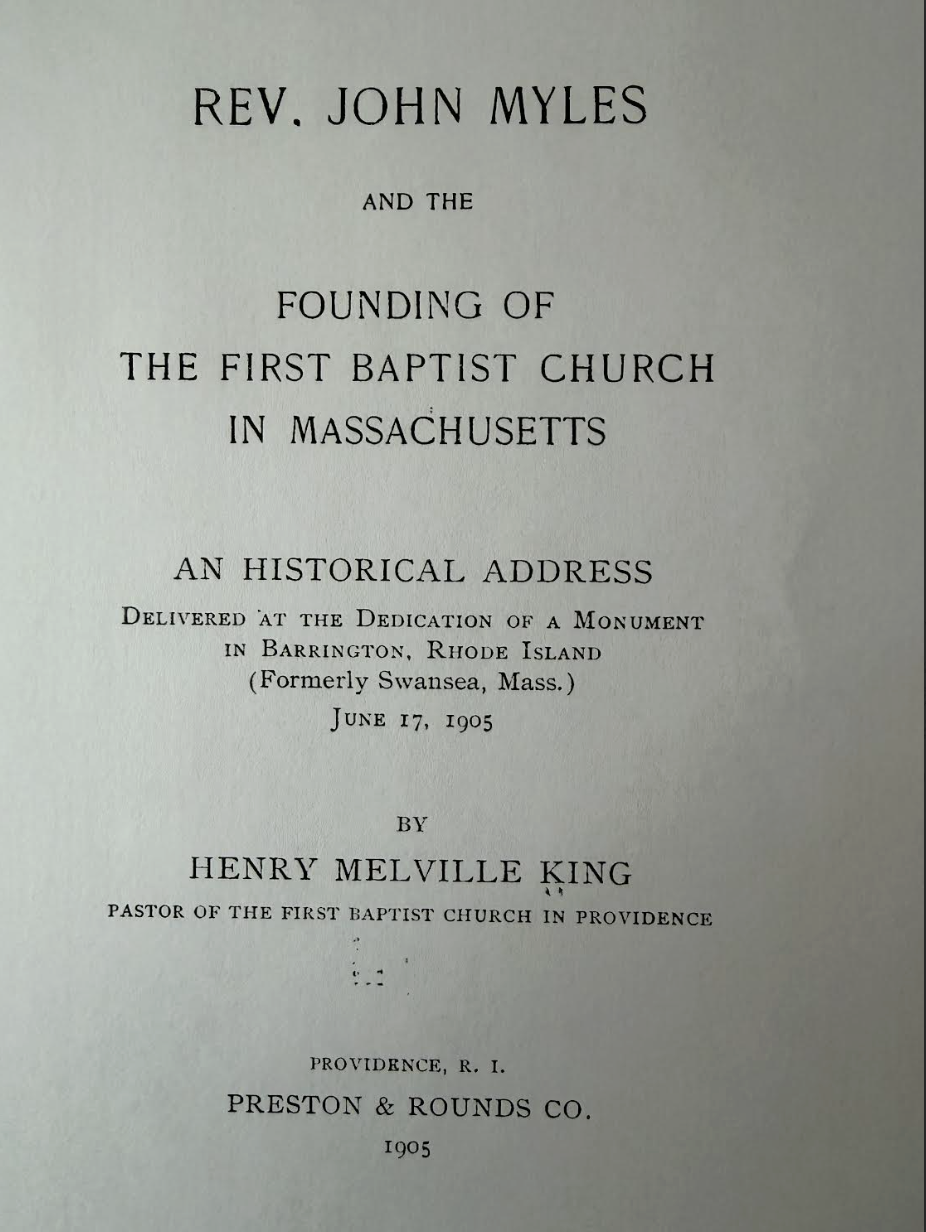
Bibliography:
Thomas Williams Bicknell, A History of Barrington, Rhode Island (HardPress Publishing,1898).
________. Sowams: with Ancient Records of Sowams and Parts Adjacent (Associated Publishers of American Records, 1908).
John Raymond, In a Place Called Swansea (Gateway Press, Inc., 1987).
Increase Mather, A Brief History of the Warr with the Indians in New-England (Printed and Sold by John Foster over against the Sign of the Dove, 1676).
Nathanel B. Shurtleff and David Pulsifer, eds., Records of the Colony of New Plymouth in New England, Acts of the Commissioners of the United Colonies of New England, 1653-1678-9, Vol. 5 (Massachusetts, 1855).
________. Records of the Colony of New Plymouth in New England, Court Orders, 1662-1677, Vol. 4 (Massachusetts, 1855).
________. Records of the Colony of New Plymouth in New England, Court Orders, 1668-1678, Vol. 5 (Massachusetts, 1856).
Aran, Johnson, About The Battle of Dunbar (Scottish Prisoners of War Society, 2019).
Ross K. Harper, David Leslie, and Mary Guillette Harper, Report: Metal Detecting Survey and Ground Penetrating Radar Survey, Plat 37, Lot 3A, George Street, Barrington, Rhode Island (Storrs, CT: Public Archaeology Survey Team, Inc., 2020).
Charter of Massachusetts, 1691. Massachusetts State Archives.
British History Online, Calendar of State Papers Colonial, America and West Indies: Volume 1, 1574-1660. Originally published by Her Majesty’s Stationery Office, London, 1860.
“Baptists During the English Civil War & Commonwealth, 1642 to 1660.” John Moore Museum, at www.johnmooremuseum.org/baptists-during-the-english-civil-war-commonwealth-1642-to-1660/
Ariel Fisher, “History of the First Baptist Church of Swansea, Massachusetts,” The Baptist Memorial and Monthly Record (1845).
The Rev. Dr. Charles K. Hartman, Pastor, “Biography, John Myles: Church Planter,” First Baptist Church in Swansea, Newsletter (Oct. 2004).
Charlotte Carrington-Farmer, “Identity – Occupation and Nation – Scotland and Jersey” (undated, unpublished draft used with author’s permission). (Charlotte Carrington-Farmer is a History Professor at Roger Williams University).
Ross K. Harper et.al., Technical Report “A Place Called Nockum and the Inception of King Philip’s War, Barrington, Rhode Island (January 2025; Revised July 10, 2025).
For more articles on the Nockum Hill site, including the Technical Report, go to https://barringtonpreservation.org/nockum-hill/
The Author

You Might Also Like