


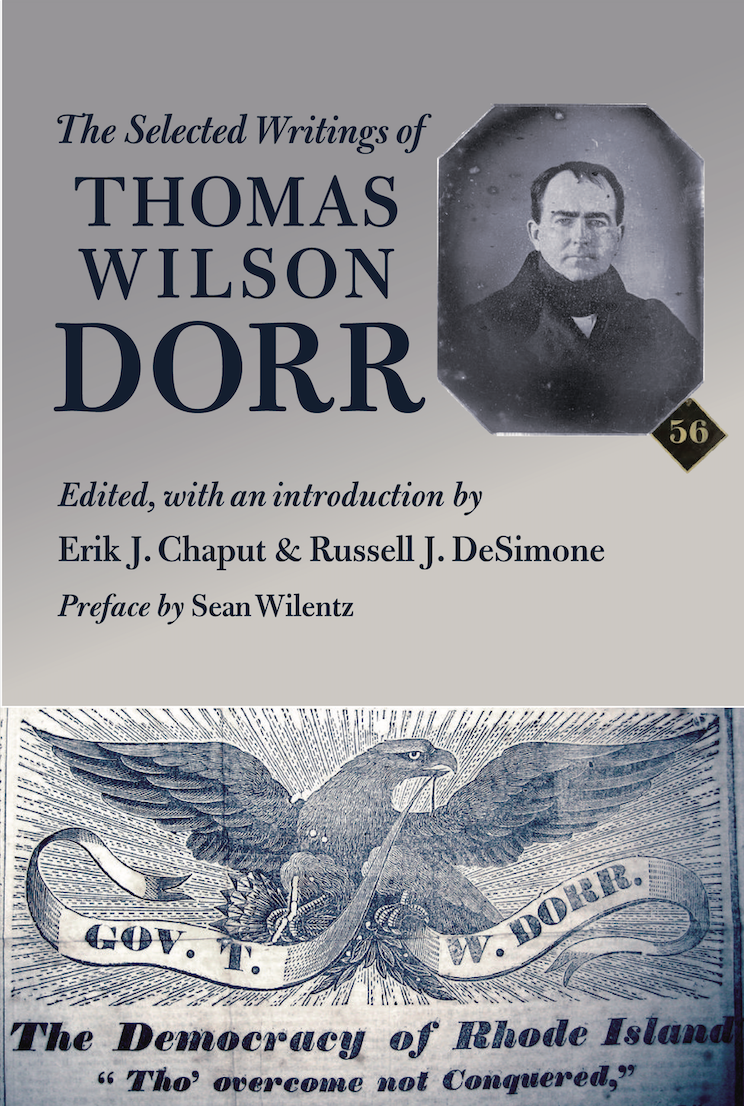
If you have not heard of Thomas Dorr and appreciate Rhode Island history, you should buy this book. Even if you know all about him, you should purchase the book because of Dorr’s selected writings in it and the excellent background material provided by the book’s editors.
I have Thomas Dorr as the fifth greatest Rhode Islander of all time. Perhaps he should be third—or even second, behind just Roger Williams. He had more impact on Rhode Island, arguably, than any Rhode Islander apart from the founder of Rhode Island.
Thomas Dorr, most of all, was a fighter for a broad and open democracy. That remains a relevant topic today. The editors, Erik J. Chaput and Russell J. DeSimone, have spent much of their lives curating works on Dorr, including for a massive website project, The Dorr Letters Project hosted by Providence College at https://library.providence.edu/dorr.
The editors, impressively, persuaded Sean Wilentz, perhaps the country’s leading historian of the age of Jacksonian democracy in America (covering the period from about 1800 to 1850), to write a preface to Selected Writings of Thomas Wilson Dorr. Wilentz begins with an efficient short history of Dorr’s life in a paragraph, which I reproduce here:
“In the 1840s, Thomas Wilson Dorr was one the most famous men in the United States, or, in some circles, one of the most notorious. A son of privilege from Rhode Island, he had gravitated, as a young state officeholder, to various reform movements, including abolitionism, but found most urgency in fighting for political democracy in his reactionary home state. Even as political rights for propertyless white men had swept through the rest of the growing nation during the decades after the American Revolution, Rhode Island’s all-powerful landed and mercantile elite clung to a colonial charter that dated back to 1663 and that effectively disenfranchised a majority of the male citizenry, including the state’s rapidly growing manufacturing working class. Rejecting his connections with the Whig Party, Dorr became a champion of a radical democratic movement that declared the standing order illegitimate, formed its own government under a new People’s Constitution with powerful public support, and elected Dorr as governor. The reactionaries resisted. Dorr, invoking his right to revolution inscribed in the Declaration of Independence, resorted to military force, which failed miserably, even comically. The conflict wound up sweeping away the ancient charter and brought a genuine albeit carefully calibrated measure of democracy to Rhode Island. Dorr remained a hero to Democrats, including to former president Andrew Jackson, who in private, cheered on the rebels. But following a savage repression, the man and the movement faded into ignominy and then obscurity.”
Chaput and DeSimone expand on Dorr’s fascinating life with a thirteen-page introduction (really a mini-biography) of Dorr. Then, before each chapter that represents a stage in Dorr’s career, the authors provide a one page introduction to the letters set forth in the chapter. By reading just the book’s introduction and the introductions to the seven chapters, readers will gain a good understanding of Dorr’s life.
The core of the book is in the writings of Dorr himself. He writes in a surprisingly modern way, without the puffery sometimes appearing in other letters of the day. His care about democracy and voting is palpable.
Here are the seven chapters:
Early Reform Efforts, 1831-1839
Constitutional Crisis, 1840-42
Rhode Island Rebellion
Governor in Exile, 1842-1843
State Prisoner #56, 1844-1845 [this explains the number 56 on the book’s cover]
Democratic Stalwart, 1845-1854
The book’s appendices contain Dorr’s Harvard graduation oration of 1823, the People’s Constitution of November 18, 1841, and a “Memoranda at Request of Thomas W. Dorr being Dangerously Ill” (August 16, 1847). Next is a short, but most welcome, Glossary of Key Individuals in the Life of T.W. Dorr. I was happy to see in the glossary Elisha R. Potter, Jr., since I grew up in his Kingston house.
In the middle of the book is a section of well-chosen photographs and prints. Most are from the collection of Russell J. DeSimone, the leading collector of Dorr Rebellion ephemera. The reader gets all of this in just 275 pages.
The book is yet another publication from the Rhode Island Publication Society. It is a gorgeous and high quality production, from the book’s cover to the interior pages. Yet the price to readers is just $29.95. The nonprofit Rhode Island Publications Society is obviously more interested in getting readers to buy their Rhode Island history books than to make a profit from them.
You can order a copy of The Selected Writings of Thomas Wilson Dorr by clicking on the link on the upper right side of this webpage. You can also just respond to this email and I will put you in touch with the publisher.
The Author

You Might Also Like