


Newspaper obituaries for African American residents who died in Newport, Rhode Island, in the decades after the American Revolution are sparse in number. When they were in the Newport Mercury, it was often at the behest of a former enslaver. Such was the case for these six residents: Dutchess Quamino, baker, and wife of John Quamino, in 1804; Cato Stevens in 1807; Arthur Tikey Flagg, ropemaker (cordwainer) in 1810; Pomp Brinley in 1813; Cudjo Vernon in 1823; and Sarah (Searing) Lyndon in 1826. Although the enslavers often praised the deceased for a well-lived life, the words provide little in the way of understanding the family of those previously enslaved.
Therefore, when I came across a document compiled by Gladys Bolhouse and Fannie Cushman, of the records of Job E. Townsend (1758-1829), I was hopeful that I would find some clues to the lives not recorded elsewhere. Townsend, of the illustrious Newport furniture and cabinet making family, made coffins for Newport deceased from at least 1803 to 1828. Indeed, listed are the names of 400 residents. In reviewing Townsend’s chronological lists, I looked for the names of African Americans who Townsend indicated were black, colored, or negro.[1] Other individuals of African heritage were evident by their first names, which were Rhode Island place names, from Greek or Roman heritage, or from African languages.
Once I had these lists, I compared them with notes from Newport Town Council Meetings for 1803 to 1823, which indicate payments by the town for coffins and funerals of the poor.[2] Finally, I looked for information in the recently developed digital Newport Historical Society database that might be helpful in connecting the sources.
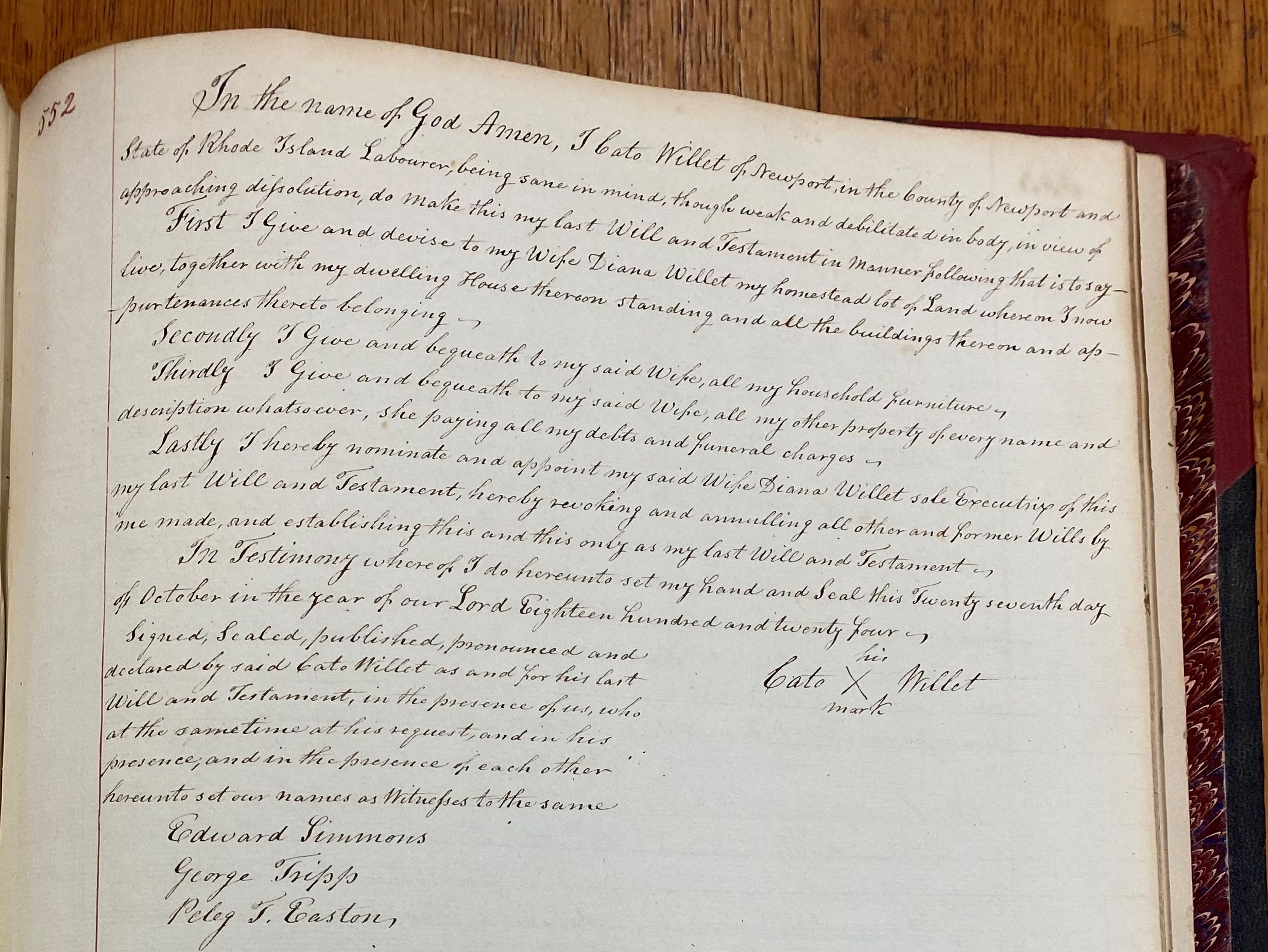
Will of Cato Willet, Probate Records, vol. 6, Newport City Hall Records (the author).
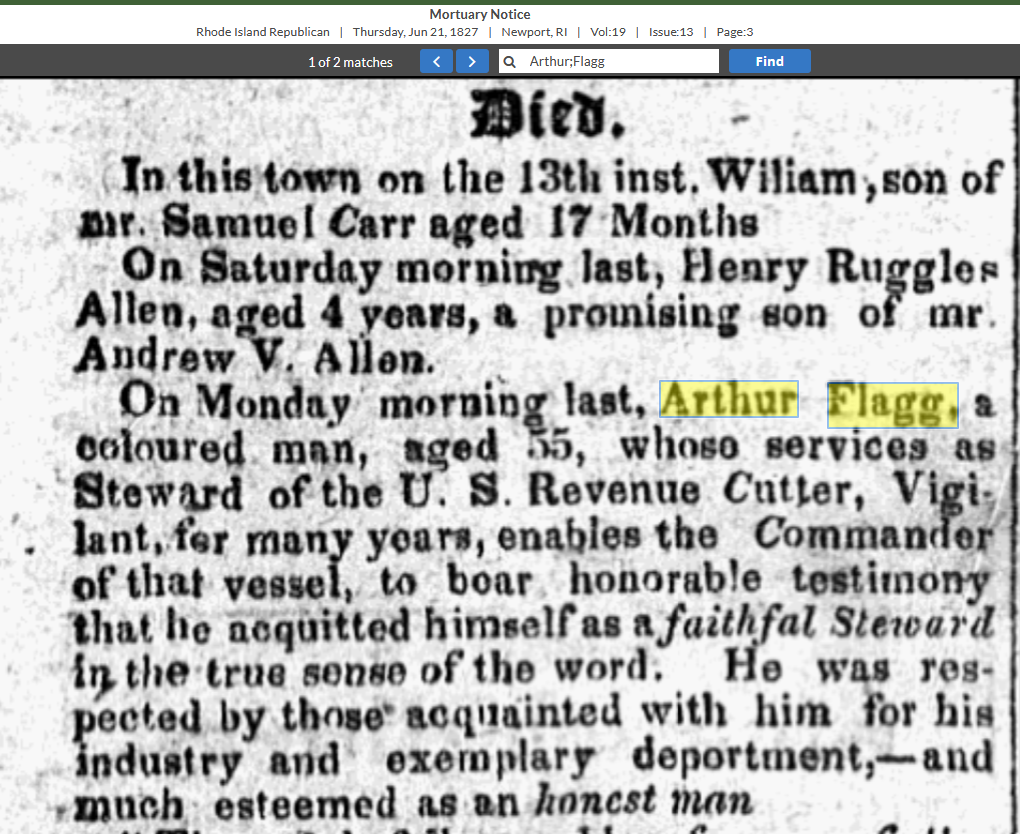
Obituary of Arthur Flagg, Jr. from the Rhode Island Republican, June 21, 1827
Third generation furniture maker, Job E. Townsend, had a side business of making coffins for Newport’s deceased, representing seventeen percent of his income. Typically, he worked with readily available wood, such as cedar, cherry, poplar, chestnut, maple, or walnut. Those coffins were at most one-third the cost of a mahogany coffin, which cost twenty dollars. His account books provide the dates Townsend worked on coffins, the individuals for whom he made the coffin, and who paid for that service.[3]
In the accounts, it is possible I may have missed someone who was of African descent. For example, Alexander Jack, who buried a child in 1815 in a Townsend coffin, is considered by some to be of African heritage but his family passed for white in the federal censuses. Amey James, buried in 1815, may be the same woman originally from South Kingstown, the wife of David James, whose residency status was examined on September 26, 1812, by the Newport Town Council; at the time she was not warned out (i.e., asked to leave the town and return to her hometown. Miney Lawton, buried in 1804, Sylvester Browning in 1814, and Julia Lillibridge in 1822 could also be of African heritage, as the town paid for their funerals.
The following dates indicate when Townsend was contacted to make a coffin, the name of the deceased person, and how he was paid. If the coffin payment did not come from the estate of the deceased or a family member (which accounted for seventeen coffins in those years), then the town of Newport paid for the coffins; the least costly were made of pine, usually $3.00 apiece. Townsend was paid out of the Poor Fund for 29 coffins. That accounts for 46 burials of African Americans. There were other coffin makers in town, whose accounts may hold the names of additional African Americans.[4]
Job E. Townsend Coffin Records 1803-1828
1803 Violet Stevens, third wife of Zingo Stevens, paid by her husband[5]
1805 Pompy Lady (could this be the wife of Pompey Levy) Lucy Johnson
1806 Dinah Sisson (widow of Neptune Sisson ca1729-1794)
1807 Richard Vickery, paid by Arthur Flagg (ca 1733-1810)[6]
Mrs. James Niles (Slyve Burke), paid by her husband, a black man[7]
Daughter of Humphrey Weeden (ca. 1769-1852)
1808 Child of Frank Chaloner (1777-1864 on his gravestone).
Mother of Frank Chaloner (Hannah).
Violet Hammond, by her estate.
Mrs. Jacob Gardner (negro) paid by Newport Gardner[8]
A grandchild, paid by Newport Gardner.
A child, paid for by Arthur Flagg
Cuff Potter
1809 Cuffe Rodman, paid by his estate[9]
A child, Quash Mowat (ca.1734-1823) paid by son-in-law Henry Clarke[10]
1810 Arthur Flagg, paid by his estate
1811 Violet Amy (relative of Prince Amy also spelled Almy)
Widow of Richard Vickery
Sarah Rodman, widow of Cuff Rodman, paid by the estate[11]
1813 Heddy Diddeo
Dinah Green
Mrs. Bird (possibly Sylvia Bird, widow of Newport Carr, who died in 1790)
Widow of Newport Phillips
1814 Mrs. Prince Thurston (may be another name for Primus Thurston)[12]
1815 Child of Arthur Flagg, paid by Philip Collins
Newport Thurston (“negro”)
1816 Thomas Chapman (“black”)
Prince Bailey, paid by his daughter[13]
Edward Browning, paid by Arthur Flagg
Child of Anthony Flagg[14]
1817 Zingo Stevens, paid by his estate
Sharp (Sherpo) Brown
Newport Phillips
Mrs. Quash Mowatt, (Quint was her first name)[15]
1818 Child of Anthony Flagg
1819 Child of Anthony Flagg
Scipio Tanner[16]
1820 Child of Anthony Flagg
Phillis Bowers, paid half by the town and half by the Baptist church[17]
1821 Peggy Tanner, widow of Scipio
1823 Israel Thomas, Ezra Thomas, Dinah, and Toney Thurston (colored)
1824 Cato Willet, his coffin paid for by his estate
1827 Arthur Flagg (“negro man”), paid for by his estate[18]
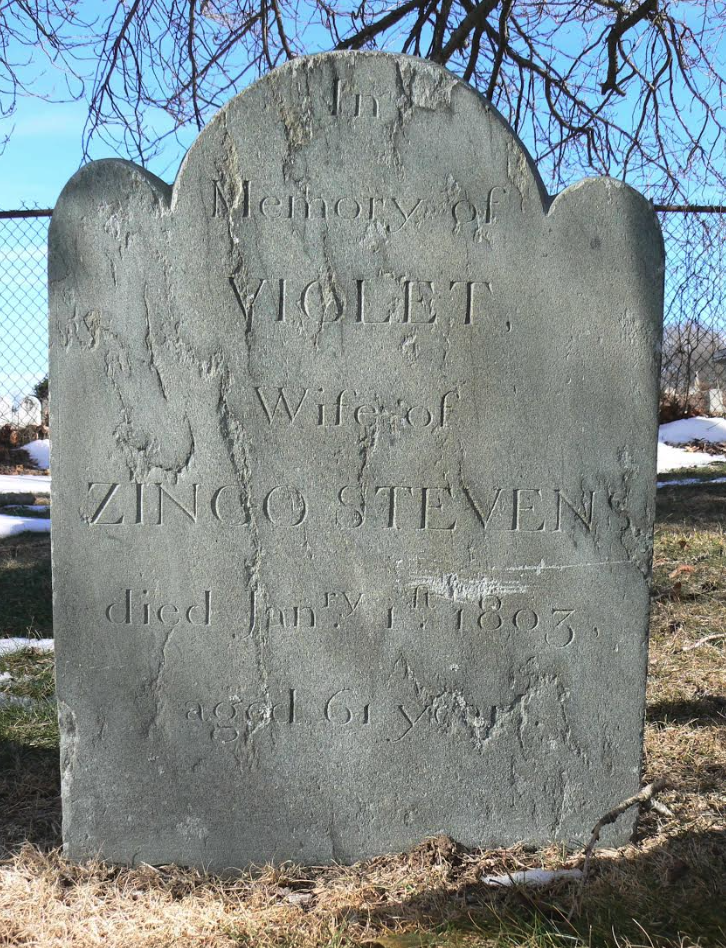
“In Memory of Violet Wife of Zingo Stevens died Janry 1st 1803 aged 61 years” (Rhode Island Historical Cemetery Commission)
Newport Town Council Meeting Records 1803-1825
A search of town records provides corroborative information for whom Townsend made the coffins and who paid him. The town sometimes paid $4.75 for a coffin for a poor person. For the 32 African Americans in the records, the Town Council also paid for the burials. Between 1815 and his own death in 1824, Cato Willet served as undertaker for the African American community for at least twelve funerals of residents. He received “$2.50 out of the Poor Fund” for each burial, including the horse, hearse, digging the grave, and funeral procession.[19] The town paid Mintus Weeden for the responsibility of six funerals of African Americans beginning in 1817.[20] Other town residents who received payments for burying the dead included John Tillinghast and Daniel Vernon.
1805 Pompey’s Lady[21]
Lucy Johnson
1808 Cuff Potter
1811 Wife of Richard Vickery
Violet Amy or Almy
1813 Heddy Diddeo
1814 Prince (or Primus?) Thurston
1815 Newport Thurston
Phillis Brown, Cato Willet paid by the town for hearse-hire and burial
Quaco Mumford, Cato Willet paid by the town for burial
1816 Thomas Chapman
Prince Lillibridge, Cato Willet paid by the town for burial
Cudjo Gibbs, Cato Willet paid by the town for the burial[22]
1817 Zingo Stevens, Mintus Weeden paid by the estate and the town
Sharpe Brown, Cato Willet paid by the town,
Newport Phillips
1818 John Thomas, Cato Willet paid by the town
Lucy Peterson, Cato Willet paid by the town
Quint Mowatt, Mintus Weeden paid by the town
1819 Scipio Tanner, Mintus Weeden paid by the town
1821 Peggy Tanner, wife of Scipio Tanner
1822 Sally Chaloner, Cato Willet paid by the town for the funeral
Jube Lillibridge
John Pearce, Cato Willet paid by the town for the funeral
Richard Thomas, Cato Willet paid by the town
Prince Champlin, Cato Willet paid by Christopher Grant Champlin[23]
1823 Israel Thomas, Ezra Thomas (colored), Toney Thurston, and Dinah
Thomas Thurston, Cato Willet paid by the town
1824 James Sampson, his wife, and one child, Mintus Weeden paid by the town[24]
In conclusion, the exploration of these sources provides one more way to make connections to African American lives in early nineteenth century Newport. Without existing gravestones, Town Council Records and Accounts of Coffins can open new avenues for research.
Notes:
[1] Mrs. Oliver M. “Fannie” Cushman, Transcriber for the Daughters of the American Revolution, Newport Custom House Records of Seamen 1798-1799; Records of Coffins Made by Job Townsend 1803-1828; Deaths of 1823-1844 in Almanac No. 1 (1959), Newport Historical Society. Accessed at https://www.familysearch.org/library/books/records/item/357223-births-and-deaths-from-newport-and-portsmouth-births-of-seamen-1798-1799-job-townsend-coffins-1803-1828-benjamin-pearce-coffin-record-1835-1841-and-deaths-copied-from-almanac-no-1-1803-1844. [2] Newport Town Council Meetings, 1807-1814 #2005, 1815-1821 #2012, and 1822-1825 Mss #2035, Newport Historical Society. [3] Martha H. Willougby, “The Accounts of Job Townsend.” Accessed at https://chipstone.org/article.php/318/American-Furniture-1999/The-Accounts-of-Job-Townsend,-Jr. [4] John Tillinghast built fifteen coffins from 1814 to 1819, according to the Town Council Meeting Records, for poor white residents. See Furniture Maker Samuel Vinson’s Ledger, 1797-1813, #514, vault A, Newport Historical Society. Thank you to Edward Andrews, Newport Gardner’s Anthem: A Story of Slavery, Struggle, and Survival in Early America (Cornell University Press, 2025), 122-123, 155-156, for the information on Vinson-made coffins for three children of Newport Gardner who were buried between 1784 and 1798. [5] To pay Townsend, Zingo Stevens secured a loan of £1.7 from the African Humane Society of which he was a member. Stevens was a dues-paying member of the African Union Society. See Heather Bollinger, “Zingo Stevens,” Newport Historical Society, https://collections.newporthistory.org/People/stories. The Stevens Shop carved a simple stone indicating the death of Violet at 61 years of age. [6] Arthur Flagg was a respected cordwainer in Newport. Other gravestones for members of his family included one for a daughter Nancy in 1801 and one for his wife in 1802. Kaela Bleho, “Arthur Tikey,” Newport Historical Society, https://collections.newporthistory.org/People/stories. [7] The couple married at Second Baptist Church in 1800 by Reverend Gardner Thurston. See “James Niles,” Newport Historical Society, https://collections.newporthistory.org/People. [8] Jacob Gardner, born in 1785, was a son of Newport Gardner (Occramer Marycoo ca. 1733-1826). After the death of his enslaver, Caleb Gardner (1739-1806), a young man, Jack Gardner, was manumitted. See Newport Town Council, Book # 2005 (September 1807), p. 503. “Constant Tabor and Audley Clake, as executors of the last will and testament, presented a Black Boy, Jack Gardner, about age sixteen to eighteen, that he may be set free, approved by Elizabeth Gardner and William Gardner [teenage children by second wife Sarah Fowler who lived from 1761 to 1795]. The Council examines the young man and sets him free as he is healthy and able to earn a living.” The wife of Audley Clarke, Mary Gardner (1770-1832), was the daughter of Caleb Gardner by his first wife Sarah Robinson (1746-1777). See Sotheby’s advertisement online, “The Important Lieutenant Colonel Caleb Gardner Chippendale Block-and-Shell-Carved Block-Front Chest of Drawers, attributed to John Townsend (1733-1809), Newport, Rhode Island, circa 1788.” Constant Tabor (1743-1826) was a legislator and a clerk of inferior court. See also “Jacob Gardner,” Newport Historical Society, https://collections.newporthistory.org/People. Jacob married Rachel Rodman in First Congregational Church, Newport, in 1806. He joined the African American organizations to help others in the community. See Edward Andrews, “Newport Gardner,” Newport Historical Society, https://collections.newporthistory.org/People/stories. [9] Cuffe Rodman (ca. 1769-1809) was an active member of the African Union Society for over two decades of his life. See “Cuffe Rodman,” Newport Historical Society, https://collections.newporthistory.org/People. [10] Quash Mowat’s daughter, Charlotte Mowat (1787-1826?) married Henry Clarke (ca. 1786-1830) in the First Congregational Church in 1806. This is likely the same young man whom Audley Clarke (1770-1844), a merchant and financier of slave ships, manumitted in September 1807. “Negro Harry, about age twenty-two, who is healthy and able to work for a living.” The Council set him free. See Newport Town Council Book #2005, p. 559.The Clarke couple traveled on the Vine to Liberia with Newport Gardner in 1826 along with their five children and her sister Harriet Mowat (also spelled Moett, Mowett). They died in Africa. Accessed list at https://ccharity.com/contents/roll-emigrants-have-been-sent-colony-liberia-western-africa/emigrants-to-liberia-ship-lists/brigvine1826/. [11] Sarah was the daughter of Zingo Stevens, who inherited substantial property in Newport. Heather Bollinger, “Sarah Rodman” and “Zingo Stevens,” Newport Historical Society, https://collections.newporthistory.org/People/stories. [12] Primus Thurston was a distiller and along with his wife Violet, owned lots, # 125 and #127, in Easton’s Point in Newport from 1800. Her husband declared bankruptcy in 1814 according to the Rhode Island Republican. See also LE 12: 644, LE 13: 8 and the Acct. Bk Proprietors Easton’s Point, 350, Newport Historical Society. [13] The gravestone in God’s Little Acre was for Catherine, daughter of Prince Bailey and his wife Dianna. She died at the age of sixteen. [14] Who was Anthony Flagg? In the review of the genealogy of the white Ebenezer Flagg family, none of his siblings, sons, or grandsons were Anthony Flagg. There was an Abraham Flagg, a son of Arthur Flagg Sr. [15] Trinity Church Records show Quash and Quint Mowet married there in 1787. [16] Zoe Hume, “Scipio Tanner,” Newport Historical Society, https://collections.newporthistory.org/People/stories. [17] Quam Bowers, her husband, was a lifelong dues paying member of each of the African American organizations from 1780s until his death in 1810. Phillis attended the Newport African Benevolent Society School from October 1808 to March 1809. See “Phillis Bowers,” Newport Historical Society, https://collections.newporthistory.org/People/. [18] Arthur Flagg, Jr. (1764-1827) died at sea. [19] Cato Willet wrote a will leaving a house and a lot of land to his wife, Diana. Newport Probate 6: 552, Newport City Hall, Newport, Rhode Island. Willet may have served the community even earlier, as the African Humane Society voted to stop organizing funeral processions in 1803. See Meeting Minutes, November 10, 1803, African Humane Society Papers, p. 99 (referenced in Andrews, Newport Gardner’s Anthem, 90). [20] Nelson Tomakloe, “Sarah Charles, Josias Budgel, her Husband and Their Children,” Rhode Island Roots 39 (Dec. 2013): 186-189. Mintus Weeden (1766-Mar. 1851) died in Newport at the age of eighty-five. At thirteen years of age, Peleg Carr placed Mintus with Joseph S. Taylor, Assistant Commissary head for the North Kingston militia during the Revolutionary War. Weeden became a free black, who married Ruth Charles, and in Jamestown was head of household in the 1790 census. From 1800 he was in Newport with his eight children as head of household. [21] Levy was a member of the African Union Society for decades and was head of household in the Federal Census of 1790. See “Pompey Levy,” Newport Historical Society, https://collections.newporthistory.org/People/. [22] There were two Cudjo Gibbs, likely father and son. The elder married Ann Wickham in 1788. He may have been the sponsor of baptisms at Trinity Church in 1812; another was a sponsor of baptisms at the same Anglican church in 1822 and died in 1832. See “Cudjo Gibbs,” Newport Historical Society, https://collections.newporthistory.org/People/. [23] “Prince Champlin,” Newport Historical Society, https://collections.newporthistory.org/People/. Cato Willet signed with an “X,” indicating he received payment from Champlin for the burial. Object B43A_F26_nn4, Newport Historical Society. [24] James Sampson underwent a residency examination before the Newport Town Council, September 26, 1812; they did not warn him out of town. He attended the African Benevolent Society evening school and became a dues-paying member of that organization which helped educate other people of color. “James Sampson,” Newport Historical Society, https://collections.newporthistory.org/People/.The Author

You Might Also Like