


This article reviews the last names of Narragansett Indian families from 1777 to 1936, almost 160 years, using four separate lists.
From the Revolutionary War Period, 1775-1783:
In March and April of 1777, Rhode Island towns took a census of their men, to determine who was available to be drafted. The preferred age was from sixteen to fifty, but men up to the age of sixty could be drafted too. Of course, only able bodied men were required to serve.
Most of the Narragansetts resided in Charlestown, where their lands were located. One in three persons in Charlestown at the time was an Indian. In the Charlestown section of the Rhode Island 1777 Military Census in the Rhode Island State Archives are the following last names of Indian men :
Aaron; Anthony; Brown [refugee from Jamestown]; Cuff; Charles; Cheats; Commuck; Coopin; Coyes; Daniel; Dick [refugee from Jamestown]; Garrett; George; Harry; Hazard; Hoxsie; Jeffrey; Johnson [refugee from Newport]; Joes; Lewis; Matthews; Niles; Oney; Packey; Peckham; Perry; Sachem; Secatur; Stattock; Toohigh; Treddles; Tyken; Wappy; Wilson; Skesuck
In the South Kingstown section of the same Rhode Island 1777 Military Census are the last names of two Indian men, both likely Narragansetts:
Arnold; Robinson
It should be noted that the names were recorded by White men, who often used phonetic spelling.
Not all of the men listed in the 1777 military census enlisted in patriot army units from 1775 to 1783, but many did. For example, these men were some of the Narragansetts who served in the First Rhode Island Regiment of Continentals and the Second Rhode Island Regiment of Continentals at some point in the period from 1777 to 1783:
Benedict Aaron; John Charles; Ephraim Charles; James Daley; William Coopin; Toby Coyes; James Daniel; John George; John Harry; Henry Hazard; Pharaoh Hazard; John Lewis; Henry Matthews; Samuel Niles; James Niles; James Niles, Jr.; Gideon Nocake; Joshua Nocake; and John Perry.
Unfortunately, many of them died of disease while in service.
Many of the Anglicized names are common in what is now Washington County (also South County). The names were often taken from familiar White families in the area. The Indian families may have worked on the farms of some of the White families in the last part of the seventeenth century or early eighteenth century. However, a good number of the last names have the sound of Indian names. These include Cheats, Commuck, Sachem, Secatur, Stattock, Toohigh, Wappy, and Skesuck.
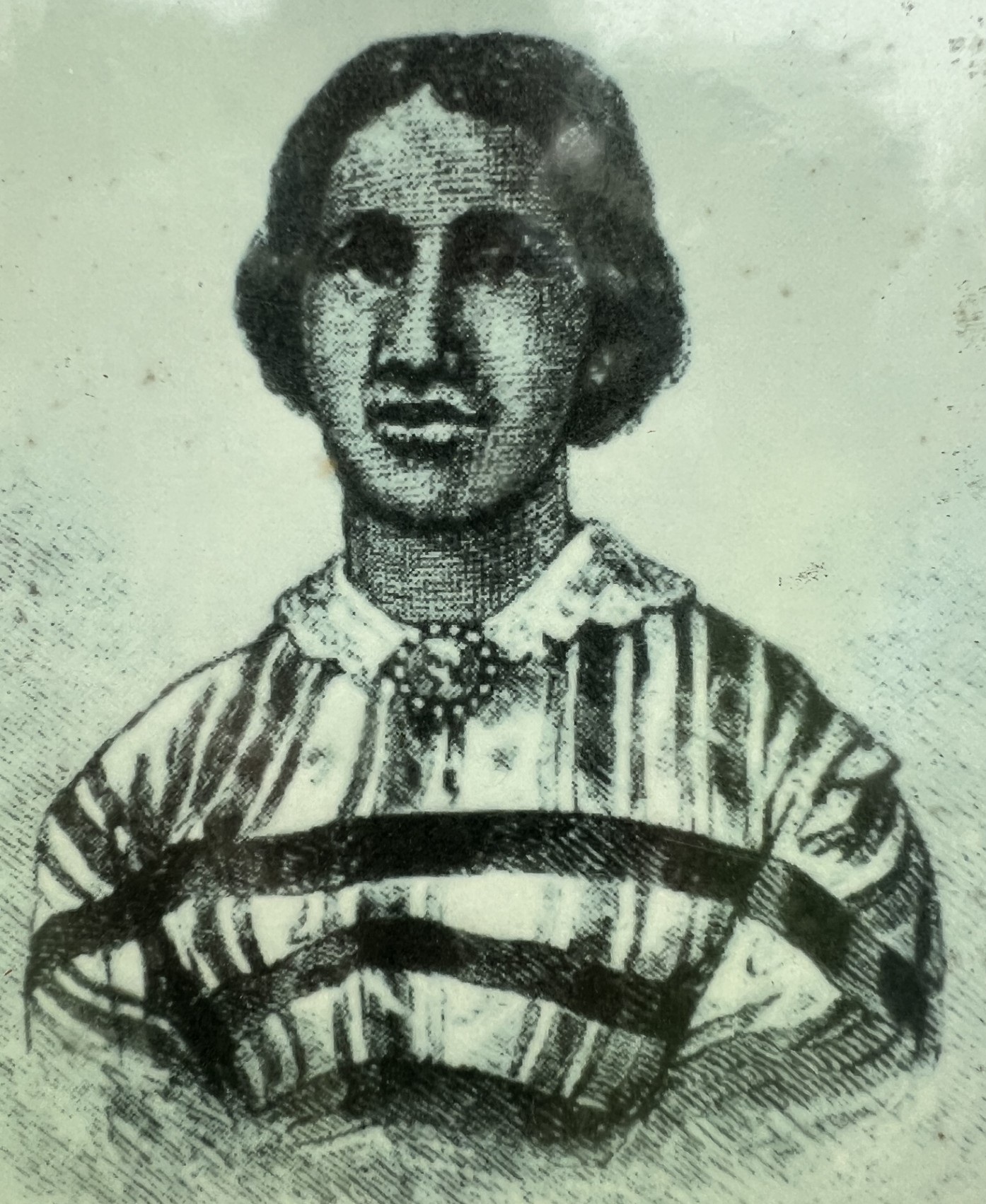
Esther Kenyon, who became known as Queen Esther. After her elder brother King Tom passed away, she was crowned at Coronation Rock in about 1770 (A Popular History of the United States, vol. 3, 1879).
From a 1785 Petition Filed with the General Assembly:
The most complete list of early Narragansett names I am aware of (granted, I have not spent a huge amount of time researching) is from a petition filed with the Rhode Island General Assembly in February 1785. There were two sides in the dispute. One supported the Tribal Council, which had replaced the sachem as the ruling power of the Tribe. The other side supported the beneficiaries of the former sachem. In the mid1700s, the Tribe suffered when King Tom, a long-time sachem of the Tribe, sold off lands to pay his extravagant debts. King Tom may have sold or transferred lands to some of his supporters. The former beneficiaries of King Tom suddenly had some of their lands taken away by the current Tribal Council. For example, “Land that was given by the King and his Council unto Gideon Nocake they have taken it way and given it unto James Wappy when the said Nocake was a soldier in the Continental service and likewise the land that was given by the King and his Council to Daniel Perry they have taken and given to Betty Cooping while said Perry was a soldier in the Continental Service.”[2]
Both parties sought to have the General Assembly intervene. I do not know what the resolution of the disputes were. In any case, both sides had parties sign the petition. The petition is signed by eight members of the Tribal Council. Then 129 Narragansetts sign in support of the petition. Then a smaller group, those who opposed the land transfers by the Tribal Council, signed—a total of forty more. In all, 177 Narragansetts signed the petition. Accordingly, it is a great resource for last names. (It should be noted that this list does not contain the names of any children.) Here are the names, with the number of times they appear in brackets if it is more than once.
Abraham [4]; Anthony [2]; Cate; Charles [3]; Commuck [10]; Cooping (or Coopin); Coyhis [2]; Cuff [6]; Daniel; Garrett; George; Jeffrey [3]; Hamer [3]; Harry [16]; Hazard [3]; Jackways [2]; James [3]; Lewis [5]; Michel [10]; Niles; Paul; Pall; Peckham [2]; Penny; Perry [5]; Phillip [4]; Potter [4]; Prince; Pucky [2]; Queen [2]; Robin [2]; Roger [8]; Sachem [3]; Sam [5]; Sealing; Seketor [14]; Sefit; Shadrock [2]; Shelley; Shoucks; Skesucks [12]; Simon; Simond [6]; Sock [3]; Sois?; Sudamen; Tiken [2]; Toyes; Trim; Wappy [3].
Some names have disappeared, I believe, such as Coyhis, Pucky, Sachem, Sam, Shoucks, Skesucks, Sock, Tiken and Wappy. The name Seketor is still used today. The most common names were Harry (16 people), Seketor (14), Skesucks (12), Commuck (10), and Michel (10). Again, a White man likely wrote the petition (several prominent White men from Charlestown and nearby towns also signed the petition, including Joseph Stanton, Jr.), but at least they would have had good knowledge of their neighbors.
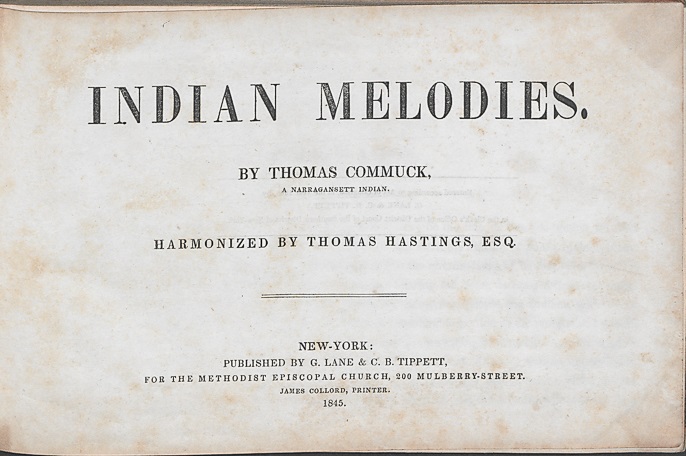
Thomas Commuck was the author of this songbook entitled Indian Melodies in 1845. Commuck, a Narragansett, had moved from Charlestown to Brothertown, Wisconsin.
From an 1881 Narragansett Tribal List:
From 1880 to 1884, the state of Rhode Island held hearings and took steps that ultimately resulted in the state de-tribalizing the Narragansetts and purchasing some of their reservation land. The Narragansetts persevered over the decades and were able to reverse those results. In 1978, the state of Rhode Island transferred back to the Narragansetts about 1,800 acres in Charlestown. And the Narragansetts received federal tribal recognition in 1983 (still the only tribe in Rhode Island to be federally recognized). At least in 1881, a detailed list of the identities of Narragansetts was taken in order to distribute the proceeds of the land sales. In the list below, I set forth the last names only. In brackets, I provide the total number of Narragansetts who had that last name.[1]
Ammons [10]; Brown [19]; Bent [4]; Brant [1]; Babcock [8]; Cone [11]; Champlin [26]; Carpenter [1]; Congdon [8]; Crieghton [1]; Clark [1]; Conway [4]; Crandall [5]; Cooper [3]; Fairweather (Fayerweather) [6]; Gardner [7]; Green [7]; Hazard [14]; Helm (Helme) [7]; Henry [4]; Hopkins [11]; Holmes [1]; Harris [1]; Hilton [2]; Jackson [2]; Jones [1]; Johnson [11]; Michel [12]; Malbone [1]; Moody [8]; Noka [15]; Noyes [3]; Nichols [9]; Olney [1]; Primos [2]; Perry [8]; Peters [3]; Robinson [2]; Rogers [2]; Rice [5]; Stanton [6]; Sekater [11]; Sullivan [1]; Sampson [1]; Sias [4]; Thomas [12]; Taylor [2]; Wilcox [6]; Watson [4]; Wilson [1]; Weeden [3]; White [1].
By this time, many Narragansetts had intermarried with Black people, many of whom obtained their freedom or were born free after Rhode Island enacted its gradual abolition law in 1784. The enslaved Blacks were assigned the last names of their South County enslavers. Still, a few Indian last names survived, including Ammons, Noka, Sekater, and Sias.
In the Tribal List, a total of 296 names appear (my math might be a bit off). The Narragansetts named provided their residences as follows:
Charlestown: 104 Narragansetts
Providence: 47 Narragansetts
Westerly: 40 etc.
South Kingstown: 38 (includes 13 in Wakefield, 3 in Kingston, and 1 in Kenyon Mills (Usquepaugh))
Hopkinton: 13 (including 4 in Hope Valley and 1 in Ashaway)
Carolina: 10 (Carolina straddles both Charlestown and Richmond)
Richmond: 9
Newport: 6
Narragansett Pier: 5 (at the time, Narragansett was part of South Kingstown)
East Greenwich: 4 (2 were just “Greenwich”; they probably meant East Greenwich, not West Greenwich)
North Kingstown: 3
Bristol: 1
Norwich, CT: 4
Stonington, CT: 2
Montville?, CT: 1
Clinton Corner, CT: 1
Connecticut: 1 (no town provided)
Boston, MA: 1
Worcester, MA: 1
Unlisted: 5
Total Number of Narragansetts Listed: 296
From a 1936 Tribal List:
This list of Narragansett last names appeared in the Narragansett Dawn, a magazine published by members of the Narragansett Tribe in 1935 and 1936 and edited by Narragansett historian Princess Redwing.[3] The article states that the names represent 439 Narragansetts. Here are the names in the order written:
Anderson; Ammons; Babcock; Brown; Bennett; Brothers; Barrie; Dove; Davis; Dodge; Burrill: Champlin; Cook; Fairweather; Fry; Freeman; Ford; Farrow; Gardner; Glasko; Hill; Carter; Helme; Hazard; Jackson; Johnson; Hopkins; Lansing; Micheal; Lincoln; Mars; Hamilton; Harry; Noyes; Noka; Nichols; Neves; Steele; Scott; Smith; Stanton; Sekator; Stockett; Ross; Reckling; Rhodes; Peckham; Perry; Potter; Wilcox; Williams; Weeden; Simons; Watson; Webster; Mitchell; Grant; Revelto; Thomas; Twist; Daley; Peters; Lucas; Lane; Guy; Lewis; Adams; Robinson; Wilson; Taylor; Monroe; Reels.
The author of the article is not identified but was probably Princess Redwing. The article states that the 1881 list missed many Narragansetts who had moved out-of-state, including those who received a strong education and moved for jobs to cities, or those in Brothertown, Wisconsin, where some Narragansetts moved to after the Revolutionary War. The article further states that of those individuals on the 1881 list, 82 were still living in 1936.
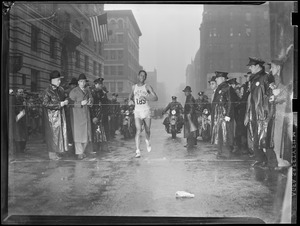
Tarzan Brown is the most famous of modern-day Narragansetts. Here he is on his way to winning the 1939 Boston Marathon, his second Boston Marathon win in four years (Leslie Jones Collection, Boston Public Library)
Current Times:
I went to the South Kingstown public schools in the 1970s and attended school with, and played on basketball teams with, many families that now identify as Narragansetts. They include the following names that are set forth above: Hazard (many!), Robinson, Fayerweather, Perry, Reels, Sampson, and Sekater. These names are now associated in South County more with people of color than White people.
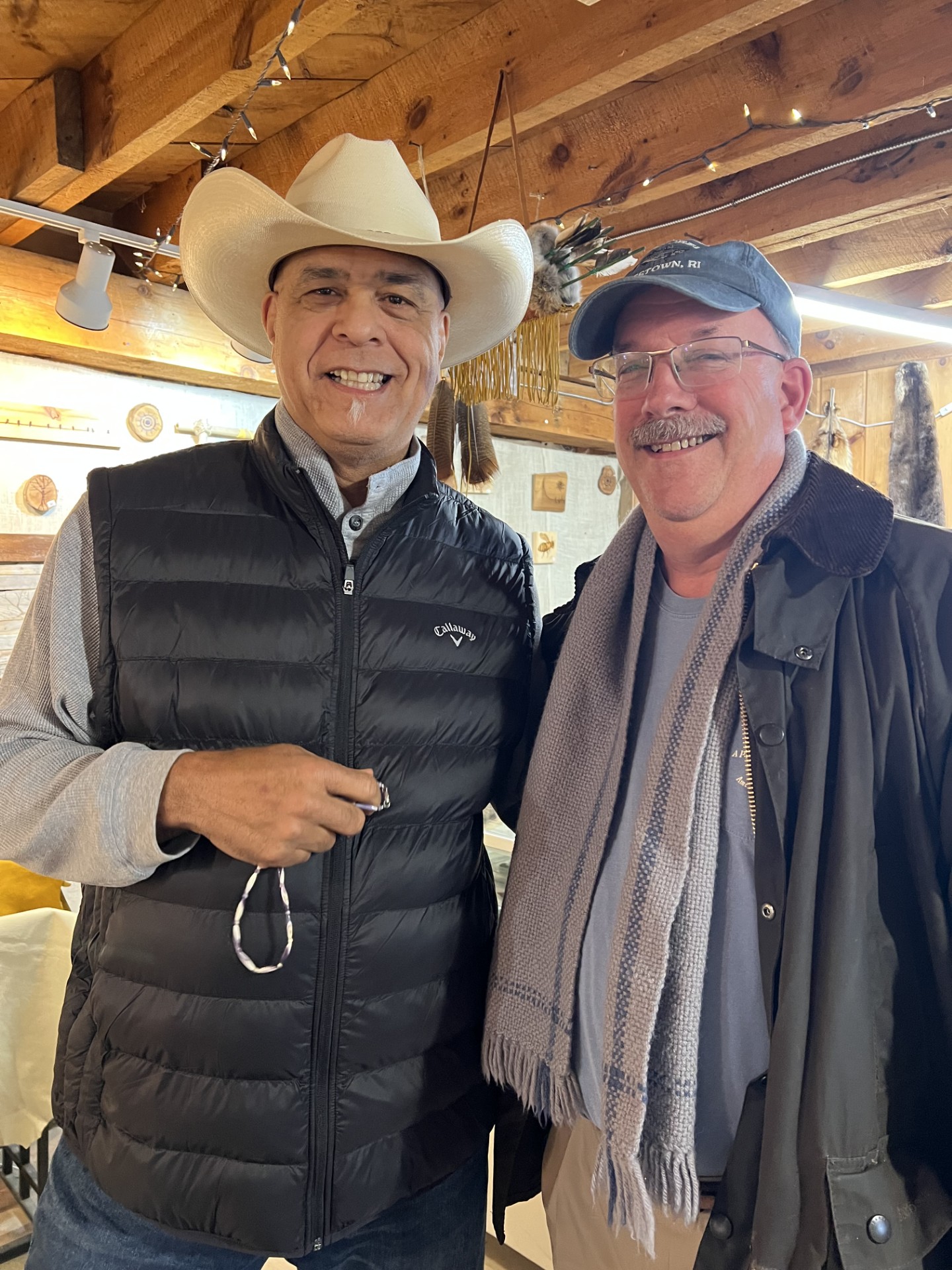
The author, Christian McBurney, with Allen Hazard on the left, in Allen’s Purple Shell shop at 4820 Post Road at the Umbrella Factory in Charlestown. Allen, a member of the Narragansett Tribal Nation, is renowned for making traditional wampum jewelry, much of it from the purple part of quahog shells found at nearby beaches. In the 1970s, Allen and Christian played on the same South Kingstown middle school and high school basketball teams (Allen had a much better career!).
From current lists of a handful of Narragansett tribal leaders and employees on the Narragansett Tribe’s website,[4] I note the following last names that are listed in this article above:
Brown; Fry; Hazard; Noka; Perry; Sampson; Secatau (based on a version of Seketer or Secatur); Stanton; and Thomas.
Notes:
[1] I found the Narragansett Tribal List for 1881 at these two locations on the web: [2] Petition submitted to the General Assembly by a group of Narragansetts, Feb. 1785 Session, in Rhode Island State Records, Mss 231, SG 3, Series 1, Box 3, Folder 15, Rhode Island Historical Society. [3] See “Narragansett Tribal Lists of 1880 and 1936,” The Narragansett Dawn, vol. 1, no. 12 (April 1936), 282=84. The Rhode Island Historical Society has made a copy of this magazine available online at https://encompass.rihs.org/wp-content/uploads/2024/03/0112_Apr_1936.pdf. [4] See http://www.narragansettindiannation.org. For names, see tabs for Tribal Government and Contact Us. See also the History tab for a short history of the Tribe.
The Author

You Might Also Like