


[From the editor: According to its website, “The Carnegie Hero Fund awards the Carnegie Medal to individuals in the United States and Canada who risk death or serious physical injury to an extraordinary degree saving or attempting to save the lives of others.” Originally funded by steel magnate and philanthropist Andrew Carnegie in 1904, the award is unique in that it makes awards to civilians and not military personnel. In this series of article, I will copy the explanations from the Carnegie Hero Fund’s website for individuals who received the award who hailed from Rhode Island. This article has award winners whose last names begin with the letters from A to D.
This award is also unique in that the award goes to ordinary people—but these are special people who were willing in an instant to risk their lives to save others. The award recipients are of all ages. The youngest one in this article is twelve years old. The most recent awards were handed out to Connor N. Devine (2017 heroic deed) and John Conley of Barrington (a 2010 heroic deed). If either Connor or John is still in the state, please give him a shout out! The earliest heroic deed below was 1924.
Sadly, many of the attempted rescues in the decades before the 1970s deal with people drowning. Happily, more people today know how to swim, so the need for such rescues appears to have lessened. It is important that children be taught how to swim!
I thank the Carnegie Hero Fund Commission for granting permission for the publication of this series of articles. You can read more about the award by clicking on the link to the website next to this article on the right side. Note that you can nominate individuals as well. About 20 percent of the Medals are awarded posthumously.]

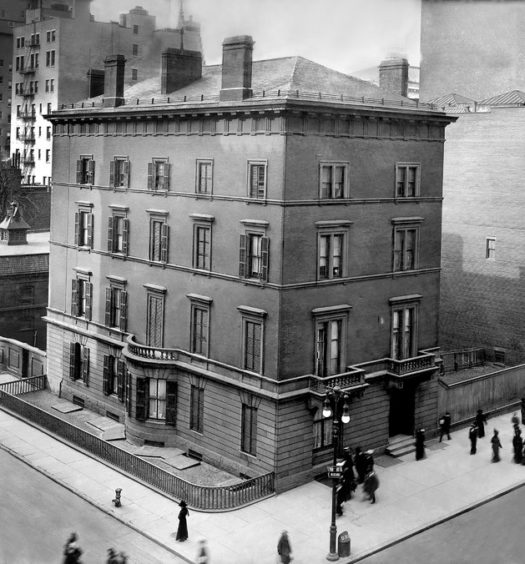
Photo of Andrew Carnegie at his desk circa 1910. He was born in Scotland and made it big in America as an industrialist (Carnegie Hero’s Fund Commission Website)
Rhode Island Winners (A-D)
Robert F. Barton
Providence, RI
Robert F. Barton, 12, schoolboy, saved M. Germaine Titus, 14, and Beatrice F. LaFleur, 13, from drowning, Providence, Rhode Island, January 11, 1931. While Robert, two older boys, Germaine, and Beatrice were skating in a line abreast on Roger Williams Park Lake, they broke through the ice, which was one inch thick, and went into water five to seven feet deep. The hole in the ice was more than 25 feet long and was five to six feet wide. It was dark, and the water was very cold. Robert, who was the nearest to the bank, touched bottom and then broke the ice for eight or nine feet to the bank. The girls went under the surface briefly in deep water and then grasped one of the older boys, who could not swim. Robert waded from the bank and then swam three feet to Germaine. He grasped her, swam three feet to wadable water, and took her to the bank. He then worked himself close to Beatrice by holding to the ice and swam a few feet to her. Towing her, he swam five feet to wadable water. The other boys pulled themselves to wadable water by holding to the ice.
Alan W. Butler
Cranston 5, RI
Alan W. Butler, 37, structural fire fighter, saved Borden A. Tuell, 64, master mariner, from burning and an explosion, Newport, Rhode Island, August 7, 1958. In a heavy fog in Narragansett Bay a tank ship piloted by Tuell collided with a tanker carrying gasoline, causing an explosion which set both ships afire as they went aground some distance apart. Tuell and five other men made their way to the bow where, after starting a pump which quenched the flames on that part of the deck and dropping the anchor, the five men entered the water and made their way 75 feet to shore. Tuell, too badly burned to follow, remained on the ship. Butler, with others on shore, shot a line to Tuell, who fastened it about himself and the railing so that the men holding the other end could lower him into the water. As they attempted to do so, Tuell’s attire became entangled about the railing, suspending him against the side of the ship. Butler volunteered to remove Tuell from the danger of spreading flames or an explosion of gasoline fumes. After disrobing to underwear and socks, he waded and swam to the anchor chain at the opposite side of the bow from Tuell. With difficulty he climbed vertically 25 feet on the chain, which was uncomfortably warm, and reached the opening of the hawsepipe from which it hung. Butler, who was of slight build, then entered the 18 inch pipe and climbed 10 feet farther along the chain, emerging onto the deck. Flames rose 20 feet above the stern area of the ship as Butler ran across the bow deck to Tuell and freed him. Butler remained on deck as the firemen fed the line from shore and lowered Tuell into a boat. Returning to the hawsepipe, Butler descended the anchor chain and swam back to shore. Tuell suffered severe burns, and Butler sustained cuts and bruises. They recovered. Only seven of the 38 men aboard the tank ship escaped death or injury.
Raymond S. Cairo
Riverside, RI
Raymond S. Cairo helped to save Lumena J. Rodrigues from drowning, Riverside, Rhode Island, June 18, 1987. Lumena, 8, a non-swimmer, and two other children were carried into the deep water of a cove of the Atlantic Ocean by a strong tidal current. They called for help. Cairo, 20, appliance mover, who lived nearby, was alerted and ran to the scene. Fully clothed, he waded and swam to the children, who were about 100 feet from the bank. Grasping Lumena, Cairo took her toward the bank, en route handing her to another man who had swum out for the children. Cairo was then swept away by the current, to a narrow point of the cove where it was spanned by a bridge. He was able to maintain a hold against an abutment of the bridge until others helped to remove him from the cove. Lumena, taken to the bank by the other man, required hospital treatment, and she recovered.
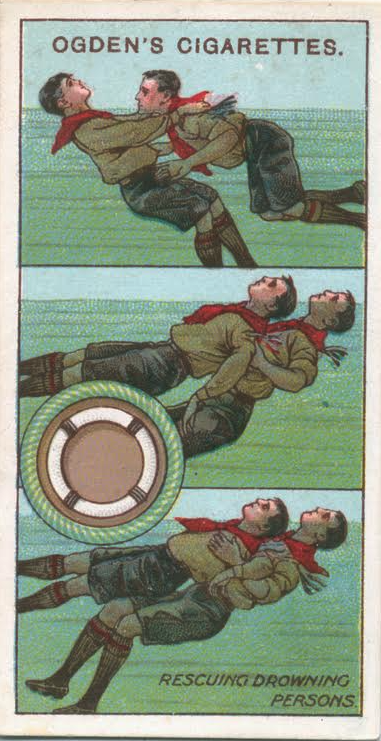
Boy Scout practicing rescuing a pretend drowning victim, circa 1910 (New York Public Library Digital Collections)
Joseph F. Cannon
Providence, RI
Joseph F. Cannon, 24, meter reader, saved Dana H. Kerrick, 9, and Francis J. Raponi, 6, from drowning, Providence, Rhode Island, February 7, 1948. Dana and Francis broke through ice on the Orange Street slip of the Providence River into water 12 feet deep 40 feet from a wharf. Cannon ran 250 feet to the end of the wharf, descended a piling, and swam to the two boys, breaking ice with his hands. Taking hold of them with one hand and grasping the edge of the ice, he began to work his way back in the path he had made. Ice broke off repeatedly, and they were submerged briefly five times before reaching the end of a rope thrown by men who pulled them to the wharf. Two men who had climbed part way down the piling liftin ed Dana and Francis from the water onto the wharf. Cannon had to be assisted from the water. He and the boys were chilled and fatigued but recovered.
William S. Caswell
Narragansett, RI
William S. Caswell saved four children, aged two to six, from burning, in Peace Dale, Rhode Island, November 29, 1967. At a railroad crossing a station wagon containing a woman and her five children was struck by a freight train. Knocked from the crossing, the automobile overturned onto its side; and flames broke out at the rear. Caswell, 32, railroad engineer, jumped from the train, which stopped with the engine about 30 feet beyond the crossing, and ran to the station wagon. Flames burned on a tire directly under the fuel tank of the overturned vehicle and also around the opening of the door at the rear. Caswell reached through the doorway and removed a five-year-old girl. He carried her away from the automobile and beat out the flames on her clothing. Returning to the station wagon, he saw the mother standing near it, holding the youngest child. The flames around the door opening were spreading to the interior roof as Caswell stepped inside in a crouching position. He handed a three-year old girl and then a two-year-old boy outside to the mother. Still crouching, Caswell moved eight feet into the station wagon to get a six-year-old boy. As the flames continued to spread on the interior roof, Caswell backed out with the boy. A short time later flames engulfed the vehicle. Only the five-year-old girl had sustained burns. She recovered.
Michael Cherwinski
Woonsocket, RI
Michael Cherwinski, 24, truck driver, died attempting to save Normand A. and Anna M. Varieur and Alfred W. Picard, 9, 6. and 6, respectively, from drowning, Woonsocket, Rhode Island, February 6, 1938. The children broke through weak ice into water 10 feet deep 30 feet from the bank of Social Pond and held to the edge of the ice. Cherwinski, who could not swim, ran toward the children. When he was 10 feet from them, the ice broke under him. He threshed and tried to hold to the edge of the ice, which broke under his weight; and then he sank and was drowned. The children also sank and were drowned.
William L. Ciffo
Woonsocket, RI
William L. Ciffo, 47, police detective sergeant, helped to save Arthur Boutiette and attempted to save Ronald E. L’Heureux from drowning, Manville, Rhode Island, February 24, 1963. When he was aided from the water Ciffo’s arm and legs were stiff, and he had difficulty in breathing. He was hospitalized for a respiratory infection and recovered.
Ronald E. L’Heureux, 16, schoolboy, died helping to save Arthur Boutiette from drowning, Manville, Rhode Island, February 24, 1963. Arthur, 14, schoolboy, and Ronald, 16, schoolboy, were in a small boat in the Blackstone River when the craft swamped at midstream. Arthur, a poor swimmer, struggled to stay afloat in icy water 20 feet deep and called for help. Ronald swam five feet to him and took hold of his jacket. Arthur flailed wildly as Ronald towed him eight feet to the boat, which then was in an inverted position 70 feet from an ice apron extending 30 feet from the bank. Ronald thrust Arthur onto the flat bottom of the boat and with effort pushed it across the current to the ice apron, which he tried in vain to break. Ronald then became inert and slumped across the corner of the craft with his face in the water. Arthur worked his chest and arms onto the ice and kept his feet on the boat. He called for help. A man was attracted and worked his way 15 feet across the ice atop two logs. Police Detective William M. Ciffo and the chief inspector then arrived, followed soon afterward by other police and firemen. Ciffo removed his coat and shoes. With a rope tied about his waist and held by men on the bank, he crawled on the ice toward Arthur. A fireman moved five feet onto the ice and threw one end of a rope to the first man. Nine feet from Arthur, Ciffo broke through the ice. A life preserver was thrown to him and he carried it with him as he broke the ice ahead of him to open water 15 feet deep three feet from Arthur. Ciffo swam to Arthur and took hold of him, urging him to be calm. Arthur clung to the preserver as Ciffo supported him and reached toward Ronald, who still was inert. The boat then tilted. Ronald slid into the water and sank. Ciffo drew slack in the rope attached to him and fastened it around Arthur’s waist. The first man hurled the end of his rope to Ciffo, who also tied it about Arthur. Others drew on the ropes, pulling Ciffo and Arthur nine feet through the path the former had broken in the ice. When effort was exerted to draw Ciffo and Arthur onto the ice, the fireman and the first man broke through. Both ropes then were released and went slack. As both sank to their eyes, Arthur grasped Ciffo tightly with his arms and legs. The fireman and the first man returned to the bank. The men regained holds on one rope and again attempted without success to draw Ciffo and Arthur onto the ice. Ciffo was too tired and numb to aid himself or Arthur out of the water. Normand F. St. George arrived and saw the situation. Without removing any of his attire, he jumped onto the ice, breaking through. Flailing his arms, he broke the ice ahead of him as, treading water, he made his way 20 feet to Ciffo and Arthur. He then held to the rope with one hand and with the other helped Ciffo to support Arthur. The men drew all three through the path in the ice. By the time he was five feet from the bank, Ciffo was too numb to support Arthur any longer and was aided from the water. St. George, still holding Arthur, was drawn by the rope to the bank. The fire department rescue squad, using boats, soon recovered Ronald’s body. Arthur recovered.
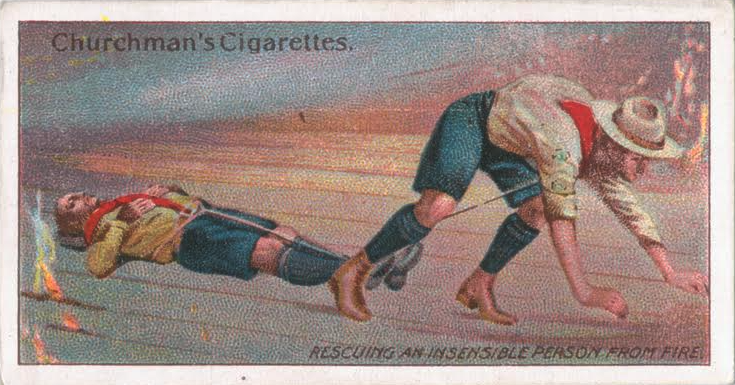
Boy scout practicing rescuing a pretend drowning victim, circa 1910 (New York Public Library Digital Collections)
Earl Wyatt Clark, Jr.
Alton, RI
Earl Wyatt Clark, Jr., saved Alan N. Brunelle from drowning, Ashaway, Rhode Island, March 9, 1979. When his kayak capsized in the flood-swollen Pawcatuck River, Brunelle, 21, a non-swimmer, was thrown into deep water where, unconscious, he floated face down in the swift current. Clark, 27, laborer, entered the cold water fully clothed and, after some difficulty, reached Brunelle. Although feeling effects of the cold, Clark then towed Brunelle, who revived, to safety.
Joseph B. Coleman
Providence, RI
Joseph B. Coleman, 37, parish priest, saved Catherine L., 7, and Janet Waters, 11, from being shot, Providence, Rhode Island, March 27, 1966. A man armed with an automatic pistol broke into a second- story apartment, held Catherine, Janet, and their mother hostage, and talked of committing suicide if it became necessary to kill them. The mother managed to escape and notify police, but the man fired at them when they started up the inside stairway. He then broke a window and fired at least 15 times at other policemen who had surrounded the house. When Coleman arrived the police were urging the man to release the girls, but he refused to do so. Coleman approached the dwelling and was recognized as a priest by the gunman. Talking with the man, who shouted irrationally, Coleman proceeded to the first-floor porch and climbed up onto a tier of concrete blocks with his head below the window where the gunman stood. He pleaded in vain for the man to lower the girls to him. Someone shouted a remark which angered the man. He fired at least two shots toward policemen in the area, the bullets passing over Coleman’s head. Coleman jumped down from the blocks and ran to the other end of the porch. A policeman fired four tear gas grenades, two of which fell to the ground near the porch. The other two entered the room where the gunman and the girls were located. All thrust their heads outside. Janet called to Coleman for help. He returned to the blocks beneath the window and again urged the man to lower the girls. The gunman said he would surrender the children to Coleman only if he entered the house to get them. Almost blinded by the tear gas, Coleman entered the building alone and ascended the stairs to the apartment door. The gunman moved a furniture barricade and opened the door. When Coleman asked for the pistol, the man handed it to him. It still contained ammunition. Coleman carried Janet down the stairs as the man followed, carrying Catherine. The gunman was taken into custody by the police and later was sentenced to prison.
John Conley
Barrington, RI
John Conley helped to save a woman from drowning, New Bedford, Massachusetts, August 7, 2010. An 86-year-old woman was the driver of an automobile that in an accident left the parking lot of a marina, entered New Bedford Harbor, and began to sink in water about 10 feet deep at a point about 50 feet from the bank. Witnessing the accident, Conley, 54, chiropractor, ran to his boat, which was docked at the marina, donned a diving mask and fins, and then jumped into the water and swam about 60 feet to the car. Using a tool, he broke out the car’s back window and with another man who responded cleared pieces of glass from the window, both men incurring cuts to their arms and hands. Water entering the car caused it to sink quickly. Moving to the driver’s side of the vehicle, Conley twice submerged in attempts to pull the woman through the partially open window of the driver’s door, but he was unsuccessful each time and surfaced for air. On a third attempt, Conley pulled the woman out of the car. They surfaced. Conley and the other man swam her to the dock and with the aid of others hoisted her from the water. The woman was hospitalized for treatment of an underlying health condition, and she recovered. Conley also required hospital treatment, for cuts, and he too recovered.
Connor N. Devine
Warwick, RI
Connor N. Devine rescued Alyssa T. Garcia from assault, Warwick, Rhode Island, March 5, 2017. Garcia, 18, was at work inside a drug store when a 41-year-old man, armed with a butcher knife, approached her and stabbed her multiple times. She screamed and fell to the floor, while the assailant continued to stab her. Connor N. Devine, 19, shift supervisor, was behind the front, checkout counter when he heard Garcia’s screams and hurried to investigate. Seeing Garcia under attack by the man, Devine shouted at the assailant to stop, and threw a crate at the assailant’s head, but the assailant continued his assault on Garcia. Devine then retrieved a utility cart from nearby and forcefully rammed the cart into the assailant multiple times, knocking him away from Garcia. The knife slipped from the assailant’s hand and landed on the floor a few feet away. As Devine and others made efforts to attend a badly injured Garcia, a store customer pinned the assailant to the floor. Police arrived shortly and arrested the assailant. Garcia, who suffered multiple stab wounds, was hospitalized.
Leonard H. Donigan
Providence, RI
Leonard H. Donigan died assisting in an attempt to save Frank Allen Tefft from drowning, Providence, Rhode Island, February 10, 1924. (See case of FRANK ALLEN TEFFT.) Donigan, 18, clerk, accompanied Hansen to the hole into which Frank, 14, schoolboy, had fallen and held to Hansen’s skates. When the ice broke under them, Donigan immediately sank and was drowned.
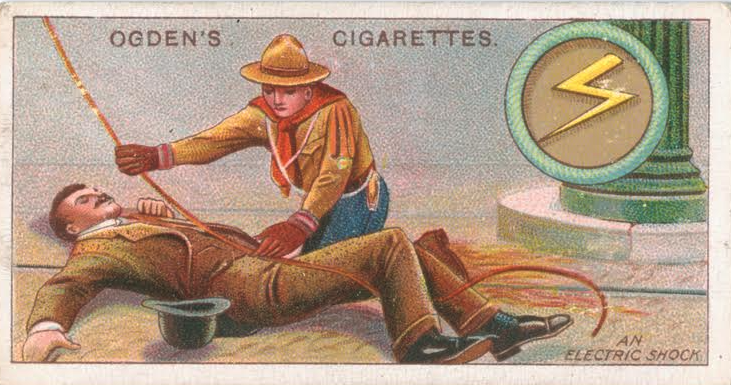
Boy Scout rescuing a pretend drowning victim, circa 1910 (New York Public Library Digital Collections)
Richard C. Dorner
Newport, RI
Richard C. Dorner, 33, store manager, saved Marie V. Lee, 64, from burning in Newport, Rhode Island, April 21, 1957. In late afternoon while Mrs. Lee, an invalid, was asleep in a second floor bedroom of a frame dwelling, fire broke out at the bed. Mrs. Lee’s daughter found her mother’s room completely filled with dense smoke. While she telephoned a fire alarm, her husband and then a neighbor and his wife each attempted to enter the bedroom but were driven back by the smoke and intense heat. Dorner was attracted and, learning that another person was trapped upstairs, entered the dwelling, with which he was not familiar. He ascended a stairway to the second floor hall, where dense smoke extended downward to a foot above the floor. Peering through less dense smoke near the floor, Dorner noted the open door of Mrs. Lee’s bedroom at the end of the hall. He crawled through the hall and into the room, coughing from the smoke. His eyes by then were watering profusely, and he closed them tightly as he crawled about the room with his head near the floor. Locating the bed, he probed its surface and touched Mrs. Lee, who was unconscious. Dorner opened his eyes and saw flames burning near him on the bed and on two walls of the room. He pulled Mrs. Lee from the bed, dragged her to the hall and thence to the stairway, where he got to his feet and carried her from the dwelling. Firemen arrived and extinguished the flames, which had badly charred the bedroom and destroyed its furnishings. Mrs. Lee was removed to a hospital, revived, and treated for smoke inhalation. Dorner, who had inhaled some smoke, suffered temporary throat irritation. Both recovered.
You Might Also Like