

The Providence City Archives houses more than 24,000 cubic feet of archival material throughout the city, and only 75 percent of it has been accounted for thus far, so the possibility of finding something unique in our collection of the accumulated textual history of Providence’s 390-year-old past is likely. Case in point with our latest discovery: Henry Bowen’s Day Book.
I discovered the book tucked away inside our vault room on the bottom shelf of an old steel bookcase. Someone, long ago, placed surplus copies of dusty twentieth-century city tax books on top of it—as if it was just as unsubstantial, in a contemporary sense, as the ledgers that cloaked it from the peering eyes of Providence City Hall’s future archivists. That all changed one day when I began making an inventory of the items shelved there and recalled seeing an antiquated brown vellum book cover that seemed out of the ordinary.
It turned out to be a ledger book belonging to Henry Bowen, dating back to the American Revolution. The book’s entries range from February 1775 to August 1802. The ledger records what items were sold, to whom, and at what cost in old Royal currency (pounds, shillings, and pence). It provides a view of what common people, families, or businesses from Providence County and the surrounding area were buying. This gives us a glimpse of the supply and demand for goods in upper-Rhode Island during the American Revolution and the Early National Period.
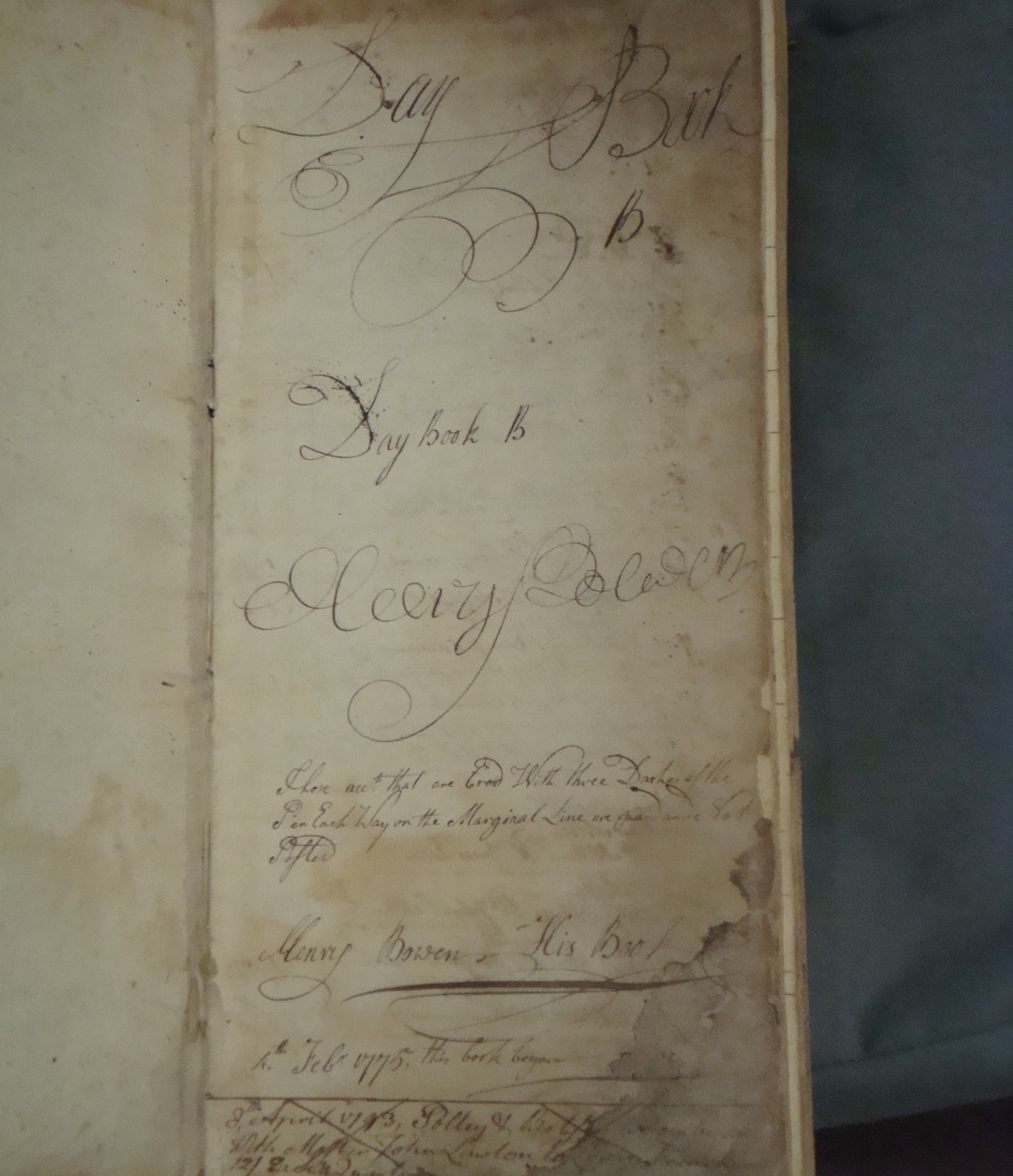
Cover for Henry Bowen’s Day Book (Providence City Hall Archives)
The daybook is mentioned in an unexpected source: Thomas Bicknell’s A History of Barrington, Rhode Island, where Edward Field, a well-known Rhode Island historian and former clerk of Providence’s municipal court, took possession of the ledger in the 1880s.[1] Some of Henry Bowen’s entries are transcribed and explained in detail across twelve pages in Bicknell’s history.
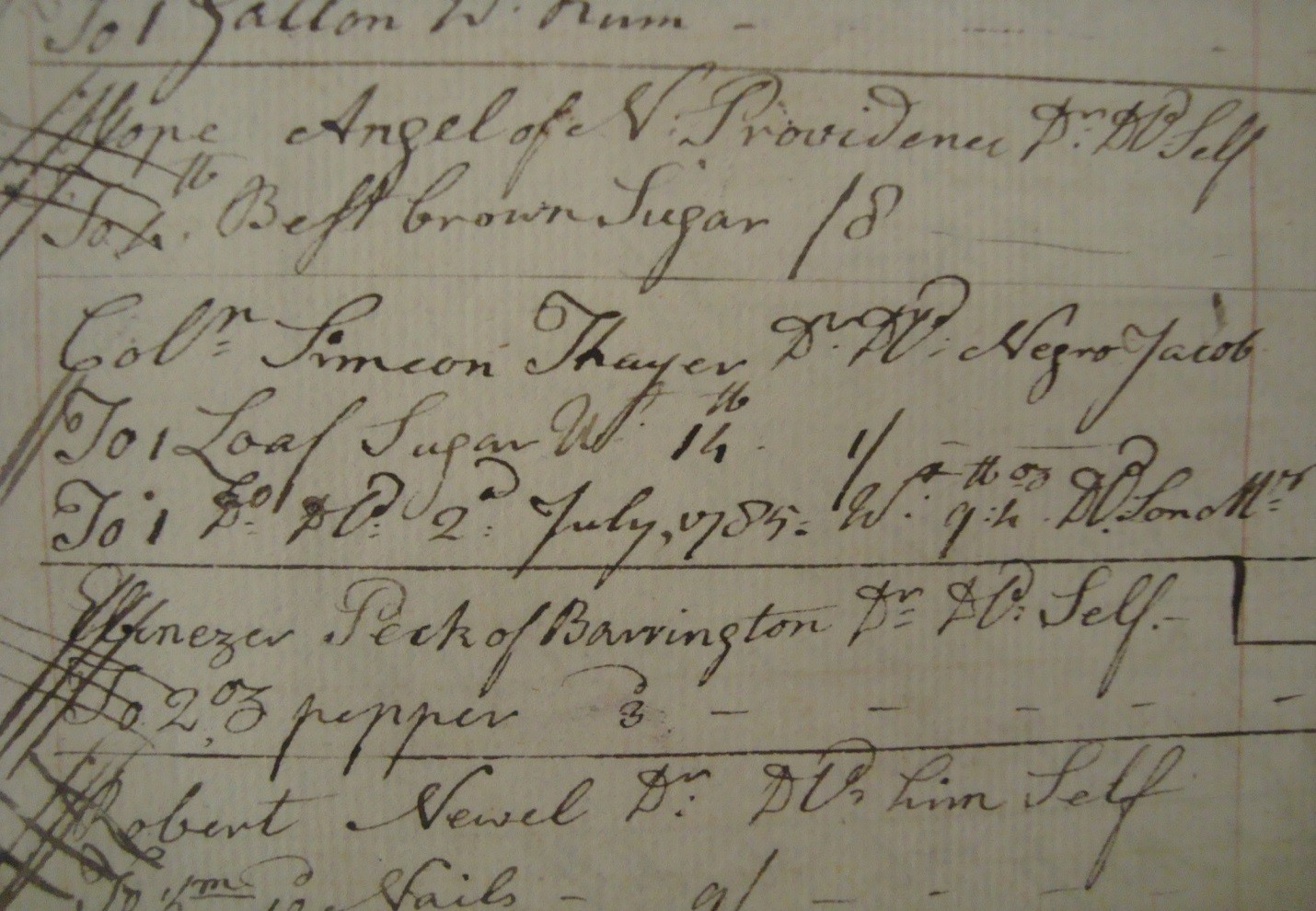
Some of the items Mr. Bowen sold include common everyday commodities like flour, brown sugar, tea, coffee, and rum, as well as less common items such as “small wine glasses,” “a silk handkerchief,” and “one beaver [felt] hat” for one pound and six shillings. Bowen also sold items to Providence’s most prominent early families, such as the Angells, Browns, Chafees, Thayers, Thurbers, and Vialls.
Bowen sold a loaf of granulated sugar to the renowned French and Indian War and Revolutionary War hero Simeon Thayer of Providence, whose military account, the Journal of the Invasion of Canada in 1775: Including the Journal of Captain Simeon Thayer, is still in print today. After retiring from his military career, Thayer bought property on “Stamper’s Hill” in Providence (near the area where North Main Street splits between the current Providence Center and Whole Foods Market, overlooking the Moshassuck River) and opened a tavern called the Montgomery Hotel in 1784. The sugar and money were likely exchanged by one of his African American tavern servants, “Negro Jacob,” and brought back to the tavern for food and drink. The hotel operated for several years until Thayer purchased a farm in Cumberland. He died on October 13, 1800, at the age of sixty-three, after falling from a horse. His remains are buried at the North Burial Ground.
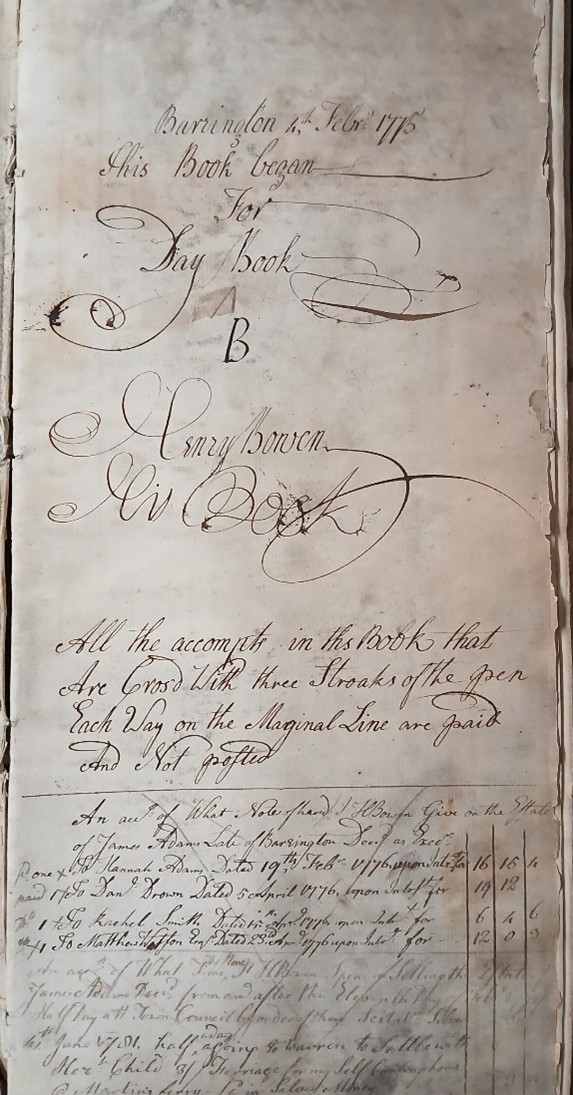
Page one and binding of Henry Bowen’s Day Book (Providence City Hall Archives)
Henry Bowen, son of Penuel Bowen and Frances (Davis) Bowen, was born in Woodstock, Connecticut, on July 26, 1738. He later settled in Barrington Village, Rhode Island, where he received a license on July 23, 1770, authorizing him to open a tavern and sell goods from a general store on the side. The tavern, once located on Joshua Bicknell’s farmland, was built next to Barrington Village’s County Road, a prime piece of real estate for a tavern located between Providence in the north and Newport to the south. Regrettably, a fire destroyed the tavern in 1873.
A record of Bowen’s marriage is kept in the City Archives’ vital records collection, showing that Bowen married Mary Adams (born in Warren, July 12, 1742) in Providence on November 1, 1764. They had six children, four of whom died in infancy. Mary died in Barrington on October 30, 1778, the cause of death remaining unknown. Henry’s first surviving child, Hannah Bowen, was born in Woodstock on May 3, 1766, and died in Providence at twenty-one years old on December 27, 1787. Their second surviving child, also named Henry Bowen, was born in Barrington on September 18, 1774, and “died very suddenly” in Rehoboth, Massachusetts, on May 31, 1788. He was buried in Barrington alongside his mother. On May 2, 1779, Henry Bowen (senior) married his second wife, Elizabeth Harding (born in Swansea, Massachusetts, November 9, 1751), in Barrington. They had three children together: Mary Bowen (born on March 19, 1780), Elizabeth Bowen (born on October 6, 1781), and Henry Bowen (born on August 4, 1791).[2]
For nearly fifteen years, Bowen operated his tavern and store in Barrington, meeting many important local leaders, including patriots of the American Revolution, while recruiting for the war effort. Samuel Allen became a delegate to the Continental Congress in 1790. His son, Captain Viall Allen, started his military career as an ensign in the Barrington militia, witnessed the Siege of Boston in June 1775, took part in the Battle of Rhode Island on August 29, 1778, and received a captaincy in the Rhode Island State Militia in February 1780. They often visited the tavern. No doubt both men had long discussions about the British occupation of Newport and the war effort. Maybe one of these talks turned into a heated argument, as Samuel Allen is recorded in Bowen’s ledger to have broken one armchair, a window, and a split-pane door, for which he owed five shillings and seven pence.
In late 1783, Bowen leased the tavern to John W. Bicknell and Enoch Remington, auctioned off many of his belongings, and moved to Providence, where he began a more ambitious career as a merchant. The atlas, Owners of Lots in Providence, R.I., 1798, compiled by Henry R. Chace, shows that Bowen owned two pieces of land. One appears to be a house on High Street (now part of West Street). The other was a warehouse and storefront where he ran his business. It was located between Wickenden Lane, Front Street, Hill Street, and Shore Street on Providence’s East Side, near John Brown’s Wharf, facing Salt Water Harbor (now India Point). This was prime real estate for a trader, explaining his business dealings in Barrington and Bristol, where ships could easily transport his goods to local ports in upper-Narragansett Bay.[3] Beyond his entrepreneurship, his resume included town collector, assessor of taxes, a tithing man, and a constable.
Henry Bowen died in Providence on August 22, 1807, in his sixty-ninth year, and is buried in Swan Point Cemetery. His estate was bequeathed to his children on the twenty-second of the following month and year, according to his will, which is also housed in the City Archives municipal probate collection.[4]
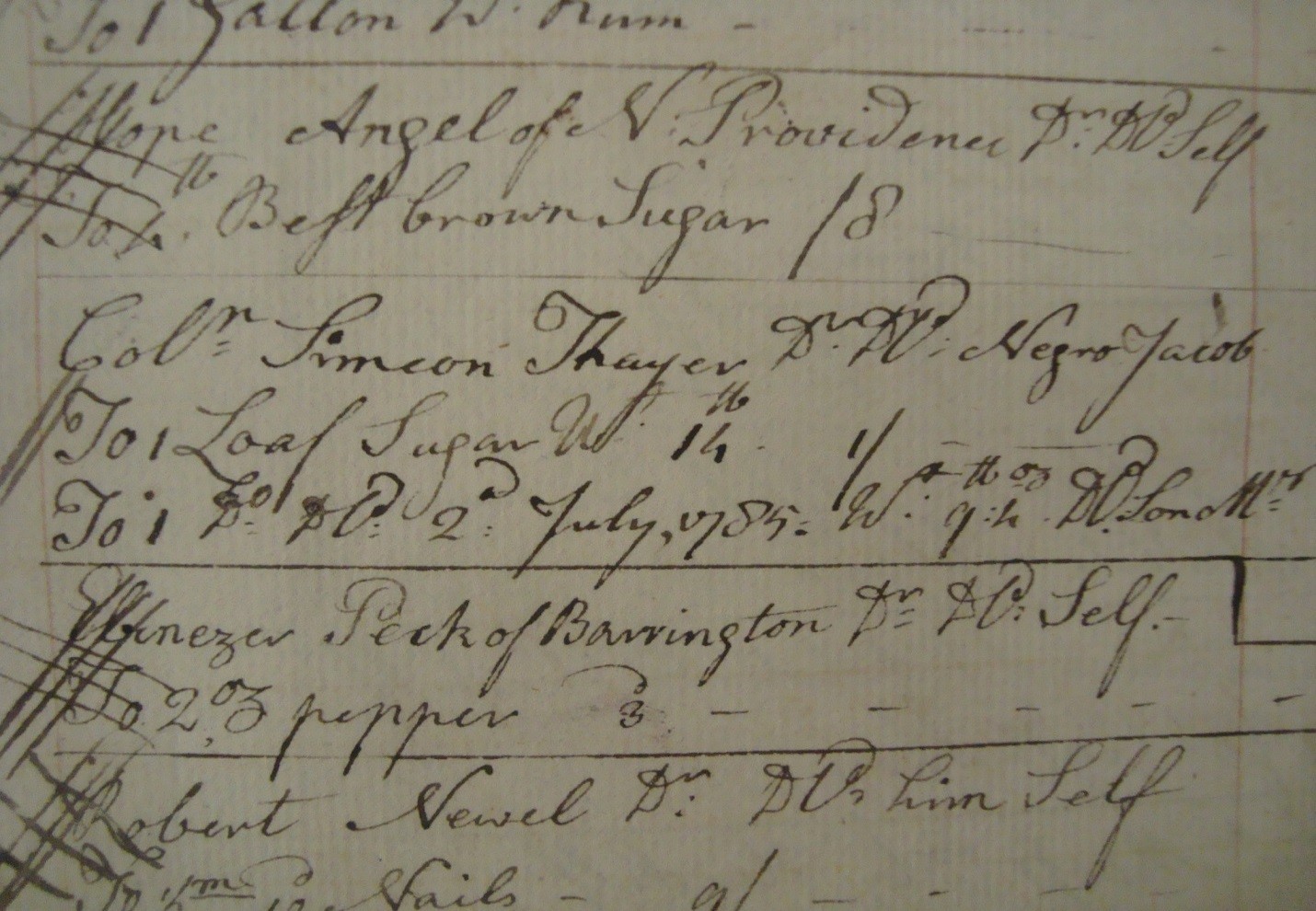
Henry Bowen sold a loaf of granulated sugar to the renowned French and Indian War and Revolutionary War hero Simeon Thayer of Providence, whose military account, the Journal of the Invasion of Canada in 1775: Including the Journal of Captain Simeon Thayer, is still in print today. After retiring from the Second Rhode Island Regiment of Continentals in 1781, Thayer bought property on “Stamper’s Hill” in Providence (near the area where North Main Street splits between the current Providence Center and Whole Foods Market, overlooking the Moshassuck River) and opened a tavern called the Montgomery Hotel in 1784. The sugar and money were likely exchanged by an African American servant, “Negro Jacob,” and brought back to the tavern for food and drink. It appears Jacob was not enslaved; in the 1790 census, Simeon Thayer is recorded as having one person of color residing at his Providence house, and that person was free. Heads of Families, Rhode Island 1790 Census, p. 34. The hotel operated for several years until Thayer purchased a farm in Cumberland. He died on October 13, 1800, at the age of sixty-three, after falling from a horse. His remains are buried at Providence’s North Burial Ground.
By a fortunate accident, his book survived the ravages of time. In the hands of the archives staff, it became a rediscovered time capsule, offering not only a connection to his past but also to the people and places he interacted with. The record he left is simply a reflection of his daily business transactions with his customers in Providence County during the late eighteenth century. In his time, it served as a tool for managing his business. Rediscovered, it now functions as a valuable resource for researchers—a primary source document that helps us better understand the socio-economic history of colonial Rhode Island.
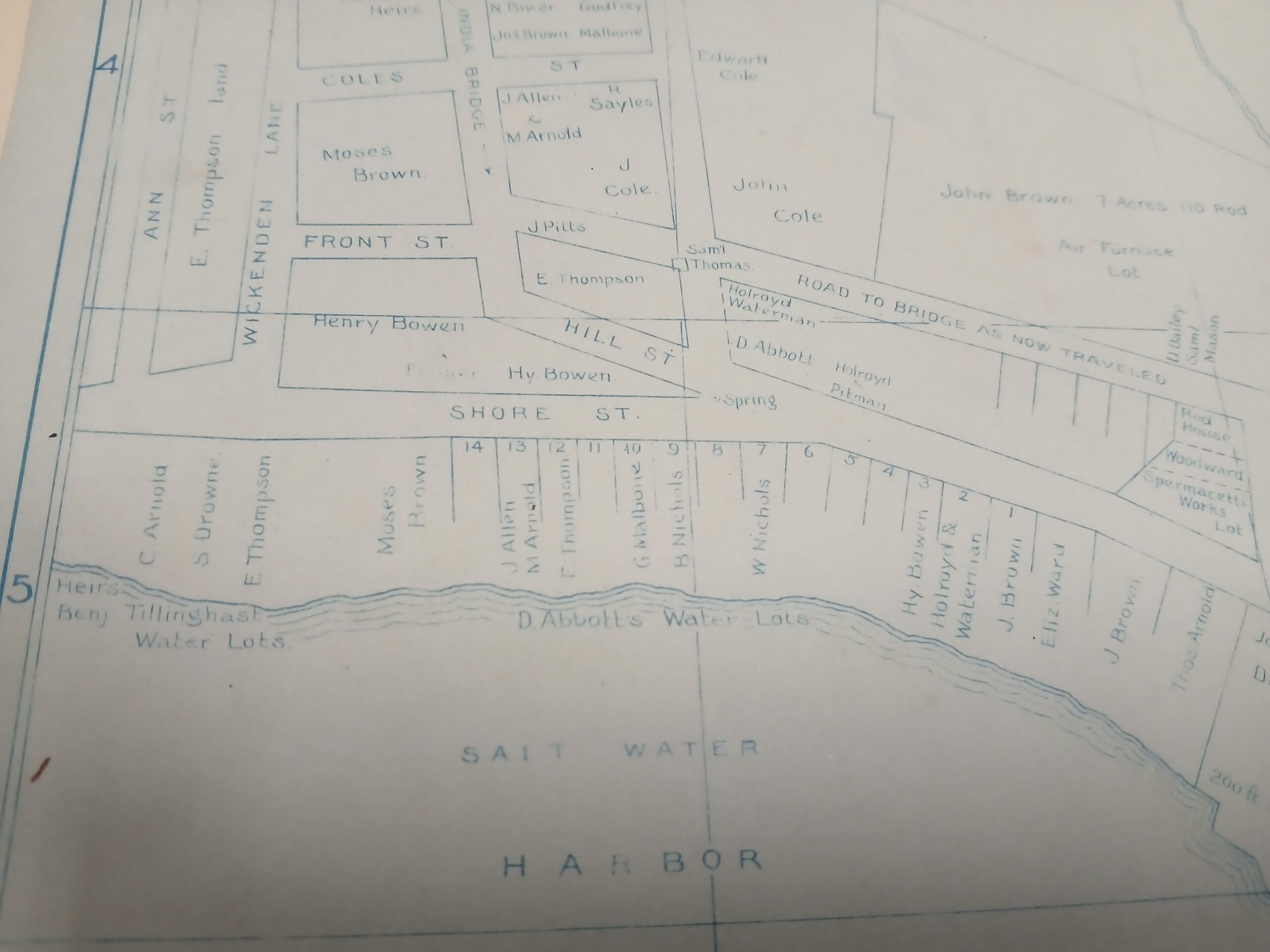
Providence map shows the location of Henry Bowen’s store in 1798 at the corner of Wickenden and Shore Streets. Property owned by Moses Brown is next door. Excerpt of Map of Providence, Henry R. Chace, Owners and occupants of the lots, houses and shops in the town of Providence, Rhode Island, in 1798 (Salem, MA: Higginson, 1998), Plate II, A5.
Special thanks to Rhode Island College Intern Patrick Waldron for assisting in the research for this article.
Notes:
[1] Thomas William Bicknell, A History of Barrington, Rhode Island (Providence: Snow & Farnham, 1898), 311. [2] Record of Birth, Marriage, and Deaths, Book 2:98, Providence City Archives, Providence. [3] Bicknell, History of Barrington, 318; Henry R. Chace, Owners of Lots in Providence, R.I., 1798, Plate II, A5 & Plate XIII, D6, Providence City Archives. [4] Administration of Henry Bowen, 1807, A3869, Providence Probate Records, Providence City Archives.The Author

You Might Also Like