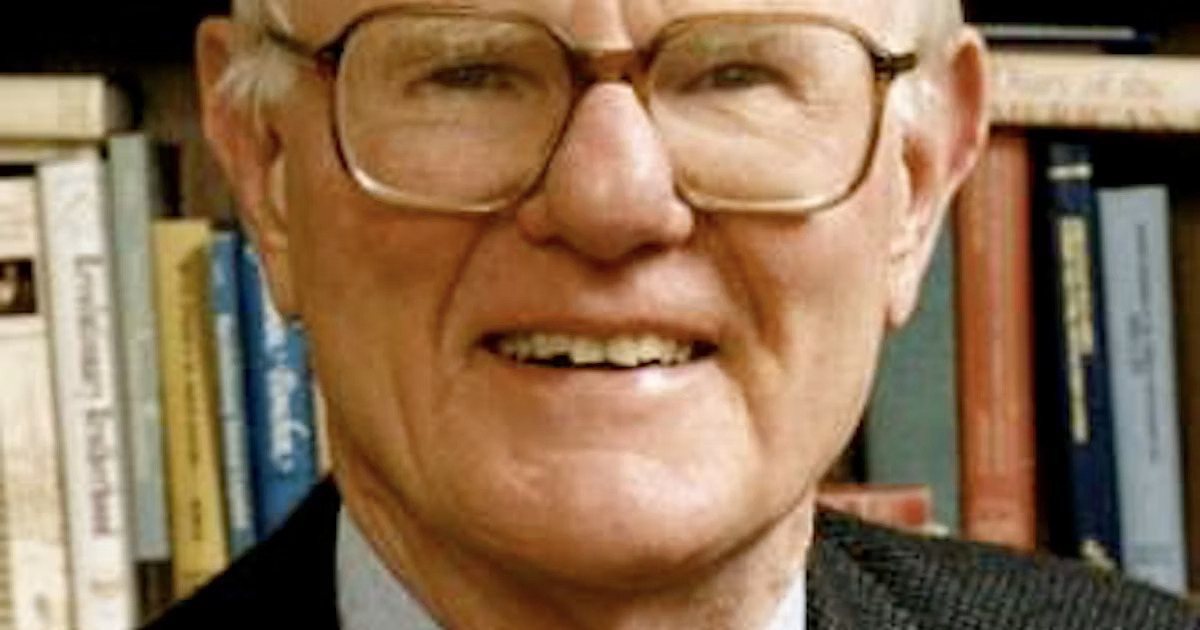


On Sunday, June 7, at the Shaw’s supermarket parking lot on Taunton Avenue in East Providence, Professor Gordon Wood was struck by an automobile and seriously injured. He died at the hospital later that evening. This is a great loss not only to his family and friends, but also to those who appreciate early American history, particularly in light of the upcoming 250th anniversary of America’s adoption of the Declaration of Independence. He was 92 years old and still active on the speaking circuit.
I did not know Gordon Wood well and cannot say that I was his friend. But we crossed paths several times over the years; he knew me because of my American Revolution and Rhode Island history writing; and I, of course, knew him. I will begin this appreciation of Professor Wood by recounting some of my interactions with him. Then I will end with a more traditional summary of his extraordinary life.
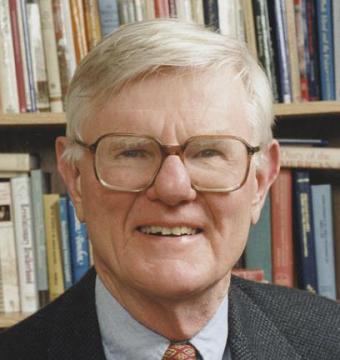
Gordon Stewart Wood in his office at the History Department building at Brown University (Brown University)
My Interactions with Professor Wood
I arrived at Brown University as an undergraduate rube in September 1977. As an American history lover, I anticipated majoring in History and looked forward to attending Professor Gordon Wood’s classes. His fame had preceded him. Fortunately, I somehow found out that he would be going on a lengthy sabbatical to the United Kingdom in a year-and-a-half. Accordingly, if I wanted to take his three semester-long courses—American Colonial History, The American Revolution, and History of the Early Republic—I needed to begin right away. It was unusual for a freshman to take such high level courses, without taking at least the American History Survey courses first. I met with Professor Wood in his office at the History Department’s wooden clapboard building at 79 Brown Street and described my predicament. I did sneak in that I had a deep interest in American history and had even authored a book when I was sixteen years-old on the history of my hometown, Kingston, Rhode Island. Professor Wood, happily, encouraged me to take all three courses immediately.
I registered for his American Colonial History class. In the Spring semester I took his American Revolution class. And in the Fall semester of my sophomore year I took his Early Republic class. I am glad I did. He was an excellent lecturer and put a lot of passion and effort into them. His classes were some of the highlights of my education at Brown.
It was not the practice in those days to tape lectures. I took the following approach. I wrote down as many words from Professor Wood’s lectures as I could. Then I would rush back to my dorm room and patiently try to decipher my scribbling and print out his lectures in as neat handwriting as I could. Yes, this was a very nerdy thing to do (I think the word “nerd” was invented about then). But I am glad I did this for all three of his classes—I still have his lecture notes and referred to them in creating a recent lecture, Causes of the American Revolution.
Wood began lecturing to undergraduates at Brown in 1969 and he continued teaching the same three classes I took at Brown until he retired in 2008. That is 39 years! In my classes with him, class size was about sixty students. Thus, he likely taught more than 2,000 students!
The next time I met Professor Wood in person was in Washington, D.C., where I was then living with my family. Wood came to give a lecture on Benjamin Franklin in about 2005. In the Q&A, I mentioned that I had taken all three of his classes at Brown, but that I remembered one lecture in particular. It was the day after the Boston Red Sox had been defeated in the famous 1978 playoff game against their hated rivals the New York Yankees on an unlikely home run by light-hitting shortstop Bucky Dent. The Yankees had won again, and the “curse of the Bambino” continued to haunt Red Sox fans like me. I had walked into Professor Wood’s class the next morning in a dark, downcast mood. I recalled that Professor Wood began his lecture mentioning the heartbreak of the game. Did he remember, I asked? At the conclusion of my question, Professor Wood’s eyes lit up and he excitedly blurted out, “Yes, I said it was like a Greek tragedy.” Wonderful!
A few days after the lecture and introducing myself to Wood, I sent him an email. I mentioned that it would be a great legacy if he could have all of his lectures videotaped and made available by, say, The Teaching Company, which was just coming out with video and audio tapes of lectures. Professor Wood wrote back quickly and said that he had looked into it but had declined to do it. That was a real loss. However, with the Internet, there are numerous lectures of his available to the general public.
At the end of the day, Wood was able to combine sharing his deep learning of American history, while at the same time earning decent money. History writing is not a way to become wealthy by any means, but he did publish a host of well-received books. And he was able to command healthy speaking fees, even in the last years of his life. Good for him.
Professor Wood’s approach to early American history was to look at the big picture, searching for significant social and political developments and changes. He also focused on the great thinkers among the Founders—John Adams, Thomas Jefferson, James Madison, and Benjamin Franklin—but avoided hagiographic biographies. He found it difficult when many younger professional historians took a different path—focusing on the experiences of Black people, Native Americans, and women. Brown University itself hired such historians to replace Professor Wood (and talented ones), rather than historians who followed Wood’s approach to history. (I am not sure what Professor Wood thought of me; I straddled both worlds). Still, Professor Wood had plenty more to say and contribute. He wrote in Empire of Liberty, in 2009, that slavery was a cancer “eating away at the message of liberty and equality.”
I next met Professor Wood about three years ago at a lecture in Rhode Island, where I often lecture. This lecture was at Rhode Island’s premier retirement home, LaurelMeade in Providence on Blackstone Boulevard. I was surprised, but pleased, to see him among my lunch guests prior to my talk on my recent book, Dark Voyage: An African Privateer’s War Against Britain’s African Slave Trade. He paid attention during it and did not fall asleep, so I took that as a good sign; and he even gave me a nod afterwards, which pleased me.
The next time I saw him was again at a talk at LaurelMeade, on my just published book on rumrunners in Rhode Island during Prohibition. This time we sat next to each other at lunch and had a nice conversation. Knowing he was a Red Sox baseball fan, I asked if he ever saw Ted Williams play at Fenway Park. He eyes widened at the thought and said yes he did, many times. He had grown up in a working class family. He was able to get into games as a child when the Red Sox were not that good. He would be with his friends in the far left field or right field stands, where there were few fans, and chase after long foul balls.
I was hoping to give at least one more lecture at LaurelMeade at which he would attend. It was to be on The Causes of the American Revolution. Many of the concepts I employ in the talk I learned in his classes. But first, I had to give the lecture on June 18 at the Rhode Island Historical Society. Sadly for all of us, he did not live that long.
Professor’s Wood’s Remarkable Career
OK, now let’s turn to a more traditional remembrance.
Gordon Stewart Wood was born in 1933 in Concord, Massachusetts, and grew up in Worcester and Waltham. After graduating from Tufts University, he served in the U.S. Air Force in Japan, where he earned a master’s degree in history from Harvard University. Then he obtained his Ph.D. in history from Harvard in 1964, under the great historian of the American Revolution, Bernard Bailyn. Bailyn’s Ideological Origins of the American Revolution was and remains a seminal work in American intellectual history. Wood would take Bailyn’s work and go even further.
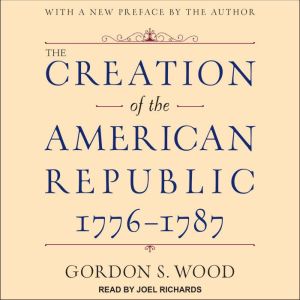
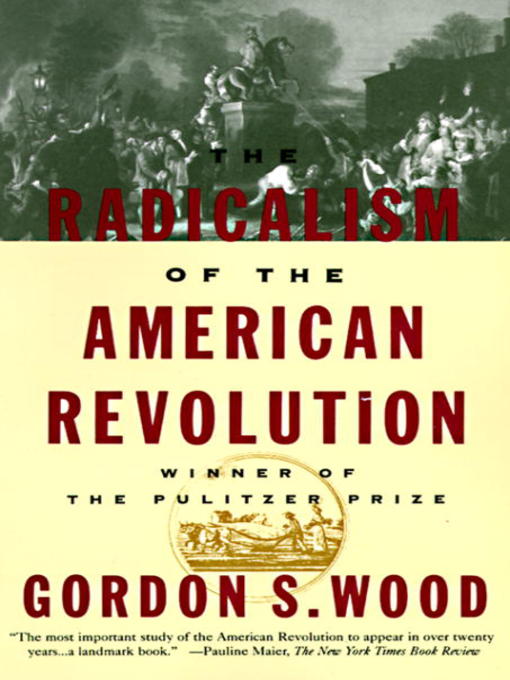
Wood joined the faculty at Brown University in 1969, the same year he had published his seminal book, The Creation of the American Republic, 1776-1787 (1969), which won the prestigious Bancroft Prize in 1970 (The U.S. Supreme Court has cited Professor Wood’s writings 24 times, mostly to this book.). His The Radicalism of the American Revolution (1992), won the Pulitzer Prize for History in 1993. His Empire of Liberty: A History of the Early Republic, 1789-1815 (2009), won several prominent prizes, and was nominated for the Pulitzer Prize. He authored seven more books on early American history, penned numerous articles, and co-authored or edited many other works.
In 2011, he was awarded a National Humanities Medal by President Obama. In the same year, he received the Arthur M. Schlesinger Jr, Award from the Society of American Historians. In 2012 he received an award from the John Carter Brown Library of Brown University and the John. F. Kennedy Medal from the Massachusetts Historical Society. In 2015 he received the Centennial Medal from the Harvard Graduate School. In 2000, he was elected to the Rhode Island Heritage Hall of Fame.
Wood became briefly famous by his being mentioned in the 1997 film Good Will Hunting by movie star Matt Damon’s character. Damon’s pugnacious but brilliant character taunts a Harvard student, “You’re gonna be regurgitating Gordon Wood, talking about, you know, the pre-revolutionary utopia and the capital forming effects of military mobilization.” It is a remarkable scene that readers can find on the web; I provide a link at the end of this article.) Wood later said of the scene, “That’s my two seconds of fame! More kids know about that than any of the books I have written.” He later also pointed out that he did not endorse any of the concepts stated by Damon’s character.
Wood was one of the leaders in signing on to a letter from historians that opposed certain unfounded conclusions made in the 1619 Project that were originally published by The New York Times Magazine. Many other eminent U.S. historians co-signed the letter, including Sean Wilentz and James McPherson. The main objectionable contention made in the 1619 Project article was the dubious claim that the preservation of slavery motivated many Patriots to support independence against Britain. This conclusion was reached despite, as was later revealed, the 1619 Project retaining a historian who had advised that that conclusion was not accurate and that, in fact, the rhetoric of the American Revolution gave rise to an abolition of slavery movement in the North (a topic that I write and speak about). The New York Times mentioned the incident in its obituary of Professor Wood, but failed to add that when the 1619 Project’s authors came out with their book, this conclusion was eliminated (several other obituaries took the same approach).
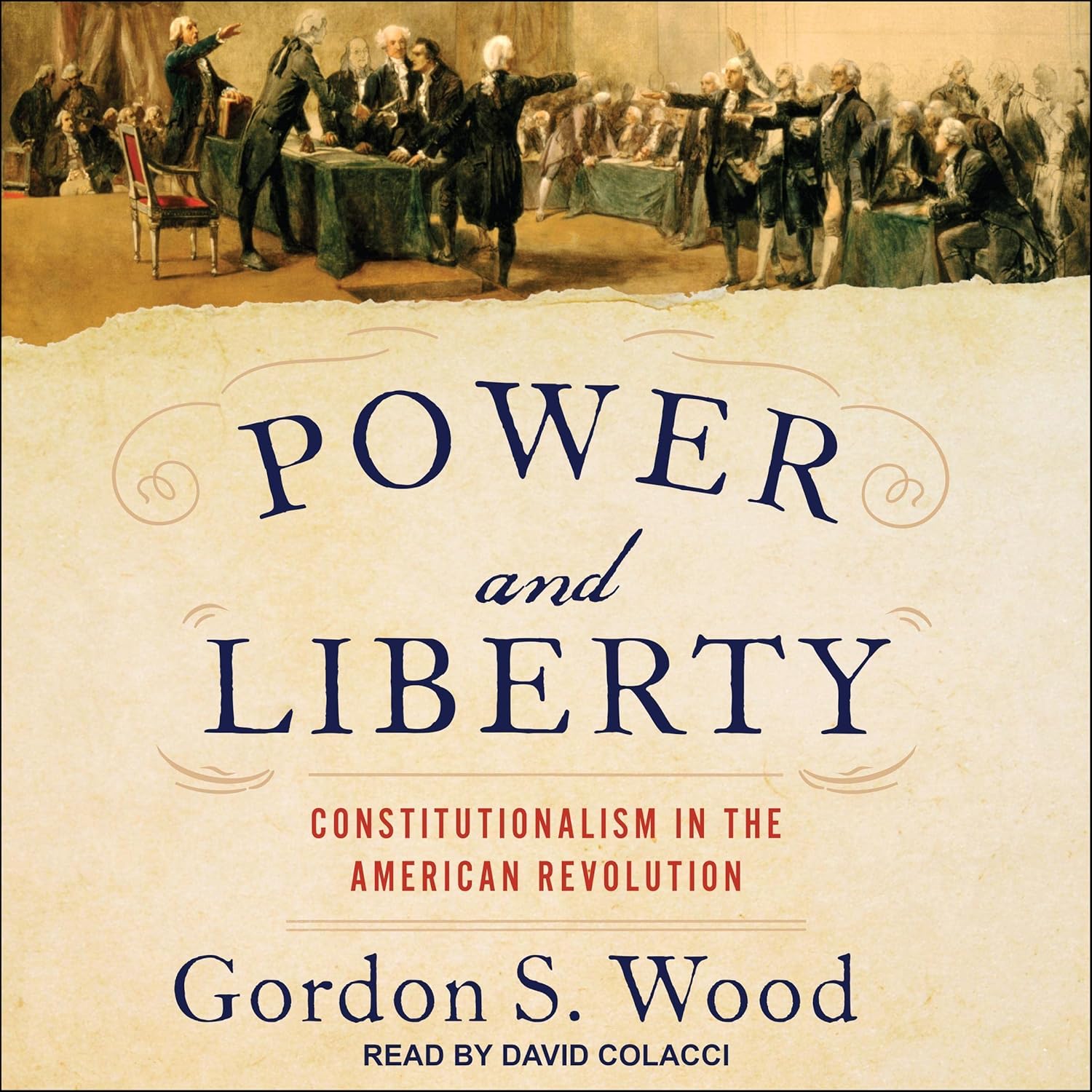
I have been asked by some who have never read a book by Professor Wood: what book of his would I recommend? I recommend two to start with, both of which are short. The first is The Radicalism of the American Revolution. It is a very accessible book to read and his shortest. The second is his most recent, Power and Liberty: Constitutionalism in the American Revolution. As one reviewer noted, “This book distills the core insights of a long career into a single small volume that grabs the readers’ interest from the first page and never lets go.” Wood has a great opening chapter on the imperial crisis with Great Britain that led to the Revolution, and separate chapters on a variety of topics, including on the crisis in the 1780s that led to the U.S. Constitution, the making of the U.S. Constitution, slavery and the Constitution, and the Emergence of the Judiciary (i.e., John Marshall). There is a nugget on every page. For example, Wood writes that with the possible exception of Georgia, no colony ever paid any stamp tax!
Some of Professor Wood’s Key Teachings
When I took Professor Wood’s American Revolution course, he emphasized that the Revolution initially was not forward-thinking, wanting to create a new government and society. Instead, he emphasized, it was backward looking. Patriots revolted not against the English constitution but on behalf of it, in what they often characterized as a conservative attempt to retain their traditional rights as Englishman. They were, in a sense, being more English than the English.
But once the momentum of the Revolution got rolling, change was in the air. Americans did, after all, want to create a new government and a new society. The American Revolution, Wood argued, was “the most radical and far-reaching event in American history.” Wood continued, “one class did not overthrow another; the poor did not supplant the rich. But social relationships—the way people were connected to one another—were changed, and decisively so.” The Revolution from 1776 to 1800 “destroyed aristocracy,” inaugurated “an entirely new kind of popular politics,” and “made the interests and prosperity of ordinary people—their pursuit of happiness—the goal of society and government.” Among other accomplishments, he wrote in The Radicalism of the American Revolution, this transformation “made possible the antislavery and women’s rights movements of the nineteenth century and in fact all our current egalitarian thinking.”
One of Wood’s main themes was the law of unintended consequences. He emphasized that topic even in my classes in 1978. The well-educated and well-read elites of the Revolution, such as Adams and Jefferson, expected that their types would rule a new republican United States and that ordinary people would naturally defer to them, but it did not turn out that way. The Revolution that swept past 1800 morphed into something none of the Founders expected or could contain. The new order of politics embedded in the U.S. Constitution was devised by elites, Wood observed in the Creation of the American Republic, but it led to “the destruction of the very social order they had sought to maintain.” In an interview, Wood said that he was not aware of any significant developments that occurred as leaders planned.
Wood also emphasized what a different world it was in colonial American times and that people thought in a totally different way than we do today. After reading numerous colonial pamphlets, Wood once recalled, it had “opened up an intellectual world that I had scarcely known existed.”
Unfortunately, Wood appeared only a few times in the recent Ken Burns documentary, The American Revolution. But when he did appear, he made his words count. He said in one memorable scene:
“All men are created equal.” That is the most famous and important phrase in our history. If we don’t celebrate it, we have no reason to be a people. And Lincoln knew that. And that’s why he says, “All honor to Jefferson.”
As we approach our nation’s 250th anniversary, Wood did a great service explaining why the Declaration of Independence and the American Revolution are so important today. He summarized this view in a recent interview:
The Revolution is the most important event in our history. It not only legally created the United States but it infused into our culture our noblest ideals and highest aspirations, our beliefs in liberty, equality, and the happiness of ordinary people. Since there is no American ethnicity, these ideals and values are the only thing holding us together as a nation.
Wood expanded on this crucial line of thinking. There has been a movement among a few who fear recent immigration trends that those who have ancestors that go back several generations have a stronger stake in the U.S. than more recent immigrants. “This is a position that I reject as passionately as I can,” Wood wrote last year. He continued:
The United States is not a nation like other nations, and it never has been. There is at present no American ethnicity to back up the state called the United States, and there was no such distinctive ethnicity even in 1776 when the United States was created….
Because of extensive immigration, America already had a diverse society [in 1776]. In addition to seven hundred thousand people of African descent and tens of thousands of native Indians, nearly all the peoples of Western Europe were present in the country. In the census of 1790 only sixty percent of the white population of well over three million remained English in ancestry….
. . . .
In Jefferson’s Declaration [of Independence], Lincoln found a solution to the great problem of American identity: how the great variety of individuals in America with all their diverse ethnicities, races, and religions could be brought together into a single nation. As Lincoln grasped better than anyone ever has, the Revolution and its Declaration of Independence offered us a set of beliefs that through the generations has supplied a bond that holds together the most diverse nation that history has ever known.
Since now the whole world is in the United States, nothing but the ideals coming out of the Revolution and their subsequent rich and contentious history can turn such an assortment of different individuals into the “one people” that the Declaration says we are. To be an American is not to be someone, but to believe in something. That is why . . . the 250th anniversary of the Declaration next year is so important.
Professor Wood was a centrist historian. He once wrote, “I don’t think our history should be seen as a moral tale, either good or bad.” Instead, he observed, “I think historians should try to understand where we came from as honestly as we can, without trying to say this was a great celebration or that this was a disaster. I don’t think either of those extremes is true of our history.”
A Brown University announcement of Wood’s death recalled the following:
When he was awarded the National Humanities Medal, Wood said he hoped it would draw attention to the field of history, which he called the “ultimate humanistic discipline.” “We don’t teach history because we want to have history teachers or history professors,” he said at the time. “We’re teaching history because it enriches lives.”
Professor Akhil Reed Amar, a friend of Wood’s and also a preeminent scholar of U.S. history, described Wood in a 2026 book as “America’s greatest living historian.” Now he is among the greatest U.S. historians who ever lived.
Four close family members survive Professor Wood: Louise, his wife of seventy (yes, 70!) years, and their three children (two of whom became history professors).
Sources:
“Pulitzer Prize-Winning Author and Historian Gordon Wood Hit and Killed by Motorist,” June 8, 2026, GoLocal/Prov News Team, https://www.golocalprov.com/news/pulitzer-prize-winning-author-and-historian-gordon-wood-hit-and-killed-by-motorist
“Gordon S. Wood,” Wikipedia, https://en.wikipedia.org/wiki/Gordon_S._Wood.
“Gordon S. Wood,” Biography, Brown University, Department of History, https://history.brown.edu/people/gordon-s-wood.
“Passages: Pulitzer Prize-winning historian and Brown professor emeritus of history Gordon S. Wood,” June 8, 2026, Brown University, https://www.brown.edu/news/2026-06-08/gordon-wood-passages.
Hillel Italie, AP national writer, “Gordon S. Wood, Influential scholar of the American Revolution, dies at 92,” June 8, 2026, ABC news, https://abcnews.com/US/wireStory/gordon-wood-influential-scholar-american-revolution-dies-92-133687814.
David Hackett Fischer, “Gordon S. Wood, Historian of the American Revolution,” New York Times, July 22, 2011.
Ilya Somin, “Gordon Wood on America as a ‘Credal Nation” Open to all Races and Ethnicities,” Nov. 22, 2025, Reason, https://reason.com/volokh/2025/11/22/gordon-wood-on-america-as-a-creedal-nation-open-to-all-races-and-ethnicities/.
“Gordon S. Wood: How the American Revolution ‘infused into our culture our noblest ideas and highest aspirations,” March 31, 2016, Library of America, https://www.loa.org/news-and-views/639-gordon-s-wood-how-the-american-revolution-infused-into-our-culture-our-noblest-ideals-and-highest-aspirations/.
David Stout, “Gordon S. Wood, Pioneering Historian of Early America, Dies at 92,” New York Times, June 8, 2026.
Jason Willick, “How a great historian influenced the Supreme Court,” Washington Post, June 14, 2026.
To listen to Matt Damon’s famous scene in Good Will Hunting, click here:
https://www.americanrhetoric.com/MovieSpeeches/specialengagements/moviespeechgoodwillhunting.html
The Author

You Might Also Like