

Filmmaker Ken Burns has never been shy about tackling big topics, especially the conflicts that have defined us as a nation. In 1990, Burns’s epic documentary on the Civil War captured the hearts and minds of over 40 million Americans as they tuned in over the course of five nights to learn about the conflict that claimed the lives of over 700,000 Americans. In recent years, Burns has chronicled World War II and the Vietnam War, presenting the conflicts in a way that helps a new generation of Americans process the unspeakable cruelty of war, the interaction between battlefield commanders and public officials, the heroism of soldiers on the ground and, most importantly, the wars’ long-term consequences that shaped American society. [1]
In his most recent endeavor on the American Revolution, which premiered in November on PBS, Burns’s trademark style is on full display as he dives headlong into the 18th century – no easy task for a filmmaker. The “Ken Burns effect” with voiceovers, background music, still images, including, paintings, maps and engravings, is used to chronicle the seven bloody years of warfare from 1775 to 1781. Only Ken Burns could make Amos Doolittle’s famous engravings detailing the battles at Lexington and Concord come alive on screen in a way that the viewer can feel the action of battle as if they were photographs. (The documentary was also made by Sarah Botstein and David Schmidt).
Throughout the production Burns embraces historical complexity and avoids presenting a romanticized picture of the past that serves to distort rather than enhance our understanding, something that marred his 1990 film on the Civil War.[2] Viewers are treated to engaging and poignant narration penned by writer Geoffry Ward, a long-time collaborator with Burns, and delivered on screen by Peter Coyote. Informed and balanced views from our nation’s leading historians, including, among others: Christopher Leslie Brown, Rick Atkinson, Vincent Brown, Collin Calloway, Kathleen DuVal, Jane Kamensky, Gordon S. Wood, Joseph Ellis, Alan Taylor, Maya Jasanoff, and the late Bernard Bailyn, add greatly to the film and will make it of interest to the layperson and the scholar.
The American Revolution premiers at a contested moment. Intense debates over who should control the teaching and memorialization of the American past are raging in conjunction with a full throttle assault on civic institutions. As historian Edward Ayers has recently noted in a powerful essay, educators each and every day “explain matters of moral and political complexity to children struggling to comprehend who they are and where they fit in the American story.” It is in the classroom that students “come to understand ideals, memories, and historical truths larger than themselves.” [3] Burns’s film will enable Rhode Island educators to help their students navigate the complexity of our founding, to understand the heroism of a small “band of brothers,” as George Washington referred to them as they rose up against a global empire under a shared ideological identity based on the Enlightenment principles of human equality. At the same time, the film will help students understand how expression of those ideals did not always play out on the ground.[4]
Episode 1, “In Order to Be Free (May 1754-May 1775)” opens with a powerful quote from writer Thomas Paine, who emigrated from England to the colonies in 1774.[5] Paine secured a teaching job in Philadelphia and then worked as a journalist for the Pennsylvania Magazine. Burns does not use either of the two works teachers and students would be most familiar with, Common Sense (1776) and the American Crisis essay series (1776-1783) to open. Burns turns instead to the second part of Paine’s Rights of Man, which was written to promote the ideals of the French Revolution and to counter British conservative attacks against ideology dealing with the people’s sovereignty. “From a small spark, kindled in America, a flame has arisen not to be extinguished,” wrote Paine. “Without consuming, it winds its progress from nation to nation and conquers by a silent operation.”[6]
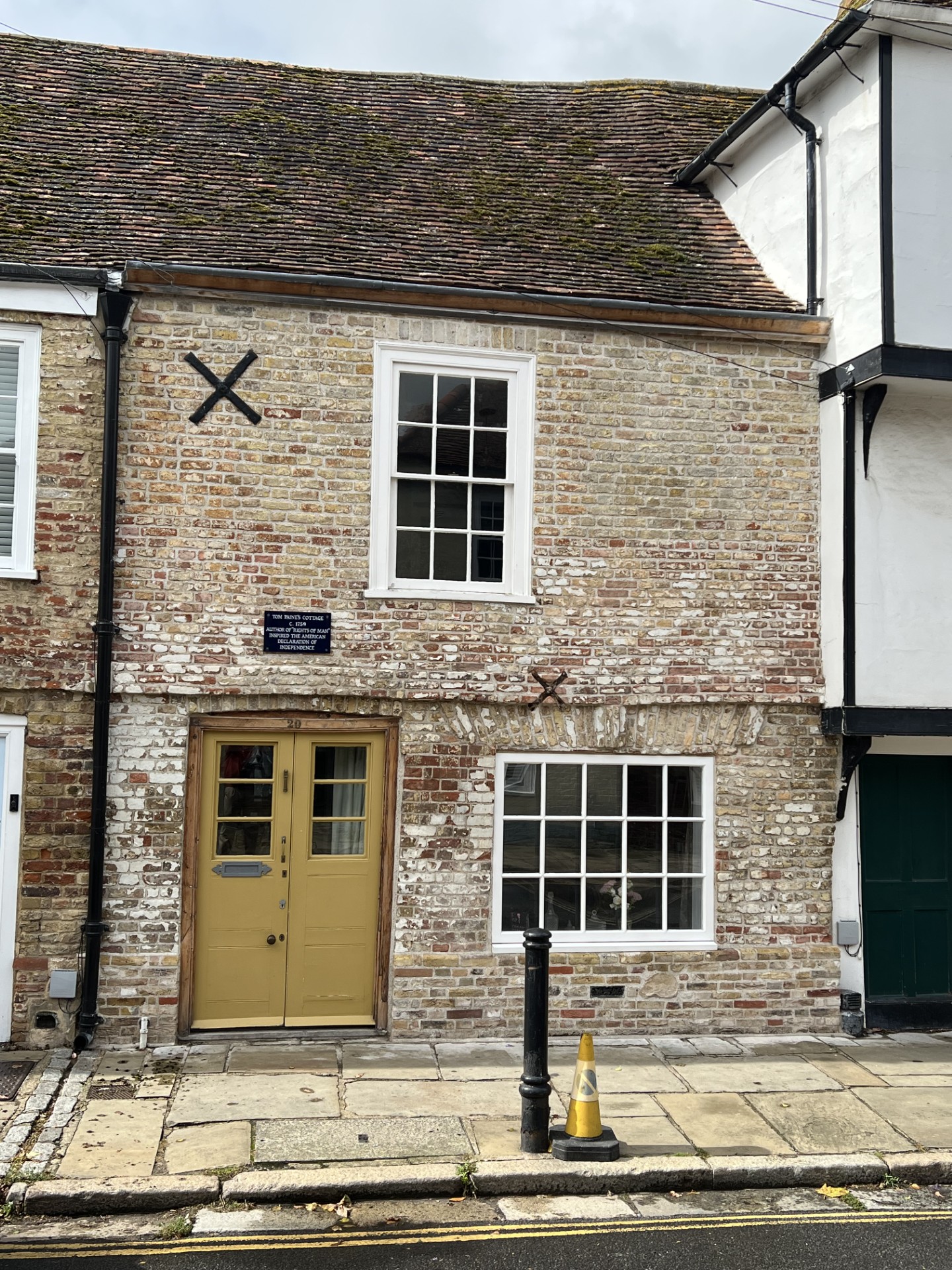
A house Thomas Paine once lived in at Sandwich, England (Christian McBurney)
Burns paints a wide canvas for his story. The American Revolution was “not just a clash between Englishmen over Indian land, taxes, and representation, but a bloody struggle that would engage more than two dozen nations, European as well as Native American, that also somehow came to be about the noblest aspirations of humankind.” The Revolution sparked conflict “in hundreds of places, from the forests of Quebec to the backcountry of Georgia and the Carolinas; from the rough seas off England, France and in the Caribbean, to the towns and orchards of Indian Country.” These points alone will help teachers break out of a traditional textbook mode of presenting the story of how the United States came into being in an age of Enlightenment. Another point that is expressed early on and that it will prove useful to teachers who want to broaden the canvas so to speak is the often-forgotten fact that in the mid-18th century Great Britain had 26 colonies in the Atlantic World and not just the 13 on the eastern seaboard of North America. A lot was at stake as the American patriots threatened the bonds of the empire, especially with the profitability of the British sugar producing islands in the West Indies, which included Jamaica, Barbados, and Antigua. However, whereas the presence of British troops in American cities was seen as a provocation by the Crown, especially by Bostonians on Griffin’s Wharf in 1773 or a small band of Rhode Islanders on Namquid Point the year before, the British army was a welcome sight to slaveholders in the Caribbean who lived in constant fear that slaves would rise up against them as they had numerous times before.
The American Revolution, as Burns makes clear in the opening episode, is not simply a story of the actions of elite colonials, but also of women, common laborers, free and enslaved African Americans, and Native Americans. The years 1775-1781 produced a radical transformation in the lives of indigenous peoples, as the Patriots’ desire for land encroached on tribal sovereignty. “Long before 13 British colonies made themselves into the United States, the Six Nations of the Iroquois Confederacy — Seneca, Cayuga, Onondaga, Tuscarora, Oneida, and Mohawk — had created a union of their own that they called the Haudenosaunee — a democracy that had flourished for centuries,” maintains the narrator in drawing on the work of Kathleen DuVal.[7] (There was no attempt to explain how the Iroquois democracy was similar or different from modern Western democracies.) The film links this union of Native American tribes with Ben Franklin’s abortive attempt in 1754 to form a colonial Union. Later in the episode the controversial claim about the desire of western land as a prime motivating factor for American patriots is presented by historian Collin Colloway, an expert on Native American history, but the film quickly turns to Boston and other New England port cites as a new wave of policies to raise revenue for the depleted British treasury threatened the livelihoods of colonial merchants and forced them to mount a response both on paper and in the streets that would eventually pull in a wider swath of the population.
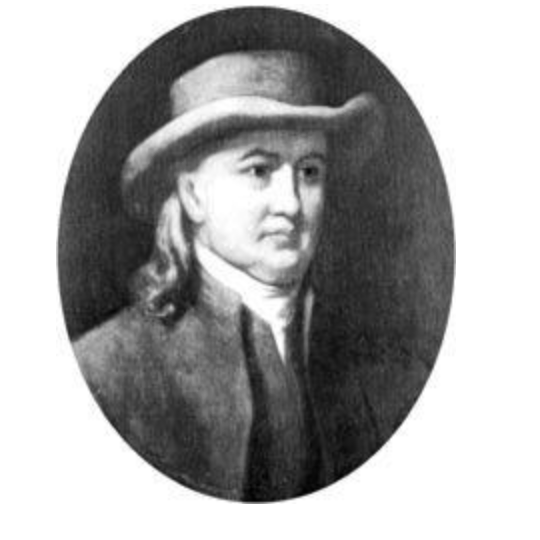
Stephen Hopkings, 1707-1785 (New York Public Library Digital Collections)
Before 1763 each colony in British North America was basically free to frame its own laws, subject only to review by the Privy Council in London. Though the traditional textbook narrative has the era of “salutary neglect” coming to an end in 1763 with the Peace of Paris that brought a formal end to the Seven Years’ War, Boston merchants had been feeling the pain of tightening restrictions several years before. British economic reforms challenged the colonists’ understanding of their standing within the British empire. As historian John W. Tyler notes in his important work, Smugglers and Patriots (1984), without the “revival of orthodox mercantilism in the early 1760s,” northeast merchants might “never have realized how many of their true interests lay outside the empire.”[8] Boston merchants often complained that they were being picked on by the Crown, while their Rhode Island brethren got away with smuggling (a fair critique). A renewed discussion of the duty on foreign molasses and a move to have British naval commanders act as custom officials unnerved Boston merchants to no end. The loss of foreign molasses was synonymous in the minds of the merchant class with the loss of the entire West Indies as a market for their key exports of lumber and fish.[9]
In January 1764, Rhode Island Governor Stephen Hopkins, a prominent spokesman for the cause of northern merchants, penned a lengthy essay explaining the nature of the carrying trade and the slave trade.[10] Hopkins, a native of Scituate who moved to Providence in the early 1740s, was the Rhode Island representative at the Albany Congress in 1754 where he supported Benjamin Franklin’s plan for colonial union. A long-time governor for most of the period between 1755 and 1768, alternating the office at times with his rival, Samuel Ward of Newport, Hopkins’s 1764 essay was a response to the British government’s attempt to enforce and extend the Molasses Act (passed in 1733) and restrict colonial merchants’ ability to trade widely in the Caribbean. The essay was printed in pamphlet form in London, but appeared in dozens of colonial newspapers, including the February 6 and 13, 1764 editions of the Newport Mercury.
In what became known as the Sugar Act, the British government, in the minds of the merchant class, was attempting to change the long-standing relationship between colonists and the mother country. Parliament did not share this view. In the minds of British officials, the Sugar Act was simply designed to lessen the incentive for colonials in the North, particularly New England, to smuggle in cheaper foreign molasses. In reality, Britain lowered the price of foreign molasses, in conjunction with a stepped-up enforcement apparatus, in the hopes that smuggling would decrease and merchants would, therefore, elect to pay the reduced levy. Things did not play out that way, however.
In one of the most important pamphlets of the Revolution published, James Otis, Jr., a prominent Boston attorney, declared that the colonists were “entitled to the natural, essential, inherent and inseparable rights of our fellow subjects in Great Britain.” Otis, a major figure in Boston politics, is sadly not brought up in the film but his sister Mercy Otis Warren receives considerable treatment. At the height of his career, Otis dominated the Boston town meeting and the House of Representatives. Otis gained fame in 1761 with his argument on behalf of Boston merchants in what became known as the Writs of Assistance case. Under new British policy, Crown agents no longer needed to obtain individual legal warrants each time they sought to search a vessel or warehouse but instead could freely without probable cause or express permission. Otis was enlisted to challenge the writs in court. He lost the case, but his arguments set the stage for the ideological position of the Patriots in years to come.
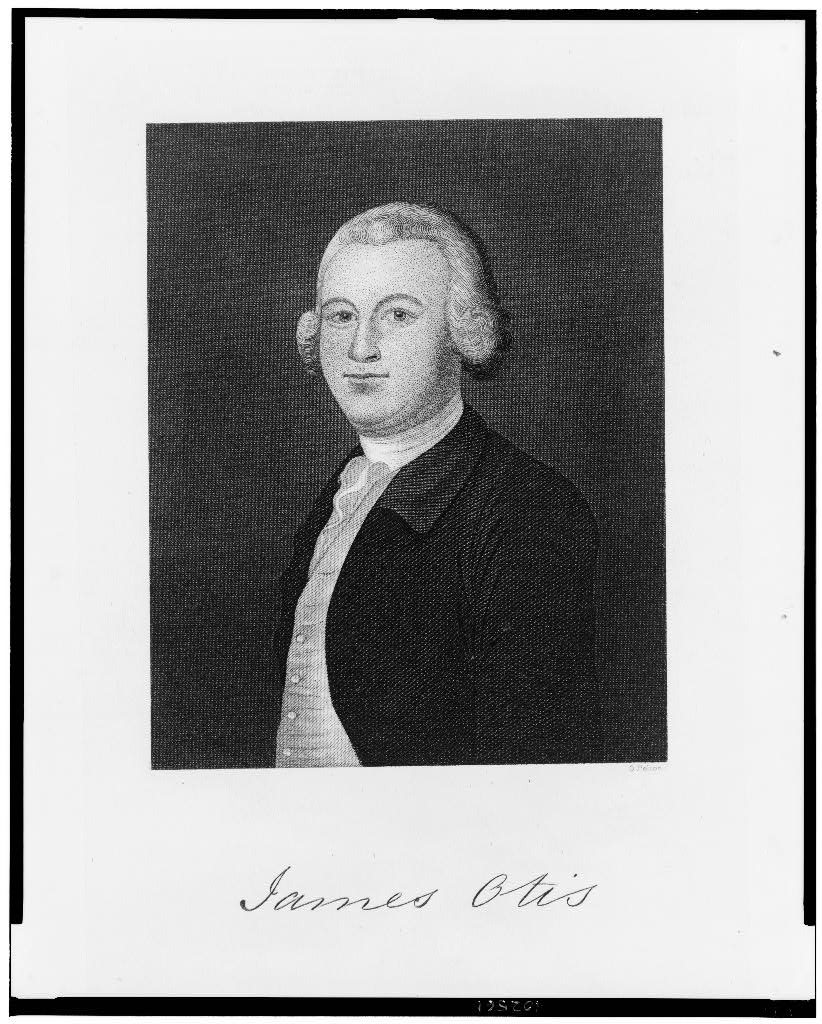
James Otis (1725-1783) by Oliver Pelton (Library of Congress)
In his 1764 pamphlet — a true must-read for students — Otis began with a bold assertion that all government originates from the unchangeable will of God, that is in every society there must be a supreme sovereign.[11] That sovereign, in Otis’ analysis, was the people, “the power of a simple democracy.” Otis, like other writers, compared British taxation policy to “slavery,” employing a host of metaphors to make his case that Britain was eliminating the rights of freemen. Stephen Hopkins, a slaveowner who was expelled from the Society of Friends in 1773 for refusing to manumit all his slaves, used the slavery metaphor in his widely reprinted tract, The Rights of the Colonies Examined (late 1764; reprint early 1765): “Those who are governed at the will of another, or of others, and whose property may be taken from them by taxes or otherwise without their own consent and against their will, are in the miserable condition of slaves.”[12] Otis, unlike Hopkins, also made the claim that the colonists were “by the law of nature free born, as indeed all men are, white or black.” Does this “follow that tis right to enslave a man because he is black?” Otis answered “no.” A spark, however dim in these early stages, was emerging that would link an ideology of the sovereign rights of the people with antislavery principles. As historian Christopher Brown maintains in the film, “part of what happens in the years before the American War is that liberties are kind of broken out of a national context. These are not English liberties. These are transcendent liberties. These are liberties that all individuals have by the nature of being human.”[13]
Otis and Hopkins both challenged the authority of Parliament over the colonies, but that position was not yet widely accepted. Indeed, even after shots were fired at Lexington and Concord, it took over a year for a formal declaration of independence to be issued. The loyalist mentality, brilliantly captured in the film, found expression early on in a pamphlet published by Martin Howard of Newport.[14] Howard fled the colonies after the riots that broke out in the wake of the passage of the Stamp Act. As noted in the film, in addition to Boston, Newport experienced violent protests against the Stamp Act in late August 1765.[15]
The Stamp Act, enacted in March 1765, placed stamp duties upon a series of colonial legal documents, papers, almanacs, and newspapers. As the editors of the Newport Mercury proclaimed, the Stamp Act was set to “deprive” the colonists of their “invaluable charter rights and privileges” and “drain” them of their “cash” eventually leading them to “abject slavery.”[16] In one of many violent protests that broke out, a mob attacked Howard’s Newport home destroying his property and stealing his possessions. Rhode Island printer William Goddard, who was closely aligned with Stephen Hopkins, defended the violence that was connected to the Stamp Act protests, throwing blame back on British policy makers in his one-off publication (printed in New Jersey), the Constitutional Courant. Goddard had made a name for himself in the printing world by operating the Providence Gazette from October 1762 to May 1765. In the Constitutional Courant, Goddard used the celebrated Benjamin Franklin illustration of the segmented serpent from the French and Indian War, with each part representing a colony, under the exhortation, “JOIN OR DIE.” Goddard helped to make it a symbol of wide-spread colonial opposition to the authority of the British Crown. The “guilt of all these violences is most justly chargeable upon the authors and abettors of the Stamp Act,” for it was they “that endeavored to destroy the foundations of the English constitution.”[17] As Stacy Schiff notes in the film, “Part of our Revolution I think we have largely sanitized. I think we’ve forgotten much of the street warfare, of the anarchy, of the provocations that took place.” The Providence branch of the Sons of Liberty sent out proposals for the creation of a correspondence union to New York, Newport, and New Hampshire towns. Newport’s Sons of Liberty, a committee of thirty, was set up to make sure no stamps were landed from the HMS Cygnet and to prevent customs officers or merchants from using the stamps.[18]

A print by Daniel Chodowiekci showing citizens in Boston burning British proclamations about the Stamp Act of 1765 (Library of Congress)
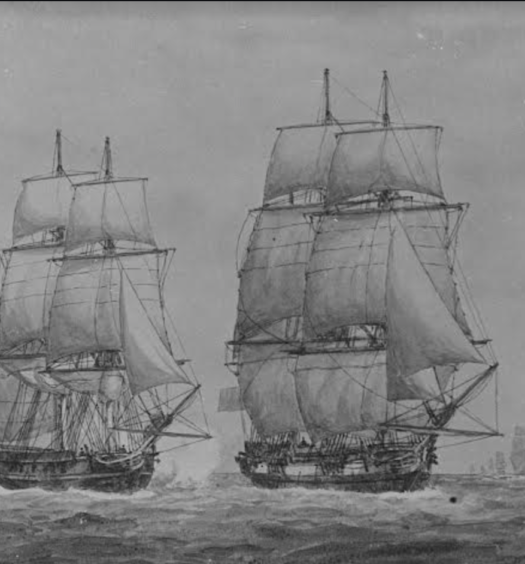
After coverage of the Stamp Act protests, the film follows a traditional narrative of events, with the arrival of troops in Boston in 1768, the 1770 violence near the Massachusetts state house that left 5 colonists dead, to the burning of the British schooner HMS Gaspee in 1772, and then to the dramatic events of the Boston Tea Party in mid-December 1773. The earlier, brazen act of burning the HMS Liberty in 1769 near Goat Island in Newport is not mentioned. The vessel originally belonged to the prominent Boston merchant John Hancock but had been confiscated by the Crown and brought into service in the Royal Navy.[19] Hancock would later serve as president of the Second Continental Congress. The burning of the HMS Gaspee, a critical moment in the run up to the Revolution, is often left out of narratives so Rhode Island teachers should take the opportunity to explore with students how Burns places the important event in conjunction with other key moments.[20] Several months after the burning of the HMS Gaspee, committees of correspondence were formed. According to Mercy Otis Warren, who published a history of the American Revolution in 1805, “no single step contributed so much to cement the union of the colonies, and the final acquisition of independence, as the establishment of committees of correspondence. This supported a chain of communication from New Hampshire to Georgia that produced unanimity and energy throughout the continent.”[21]
The year 1774 and the convening of the First Continental Congress in Philadelphia looms large towards the end of the first episode. Stephen Hopkins and Samuel Ward represented Rhode Island at the gathering at Carpenter’s Hall on Chestnut Street. At the meeting, approval was given for extra-legal organizations throughout the colonies. The Association, which grew out of the First Continental Congress and is discussed aptly by historian Joseph J. Ellis, called for the appointment of local committees in every community to enforce boycotts. Not discussed in the film, but of major importance, was the adoption by the delegates of the positions put forth in a revolutionary declaration from the town of Suffolk, Massachusetts. The resolves, authored by Doctor Joseph Warren, set a clear guide for resistance.[22] As historian T.H. Breen notes in his important book, American Insurgents, American Patriots (2010), thousands of Patriots who had never held public office prior to this period, “flooded into positions of leadership” within their communities to work towards the goals of the Continental Congress.[23]
A sharply divided American polity took to the newspapers in the winter of 1774-1775 as the Association’s rules were enforced and many colonies began preparing for the possibility of moving from a war of words to armed hostilities. As Ellis writes in his engaging book, The Cause (2021), “every hour of every day in multiple towns, hamlets, and farming communities, all doubters, temporizers and recalcitrant patriots were forced to face the same kind of intimidation” that British soldiers faced during their retreat to Boston on April 19, 1775.[24]
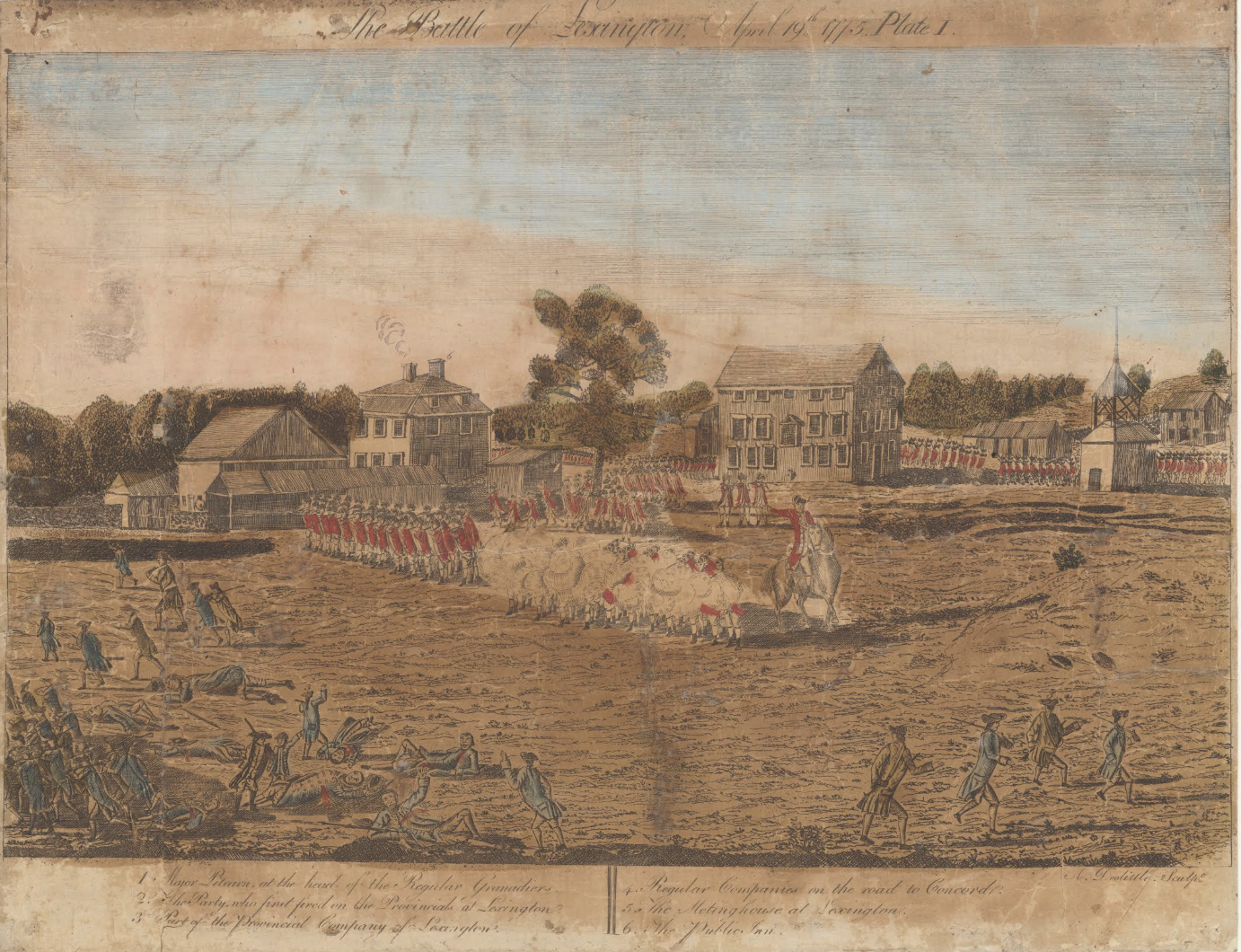
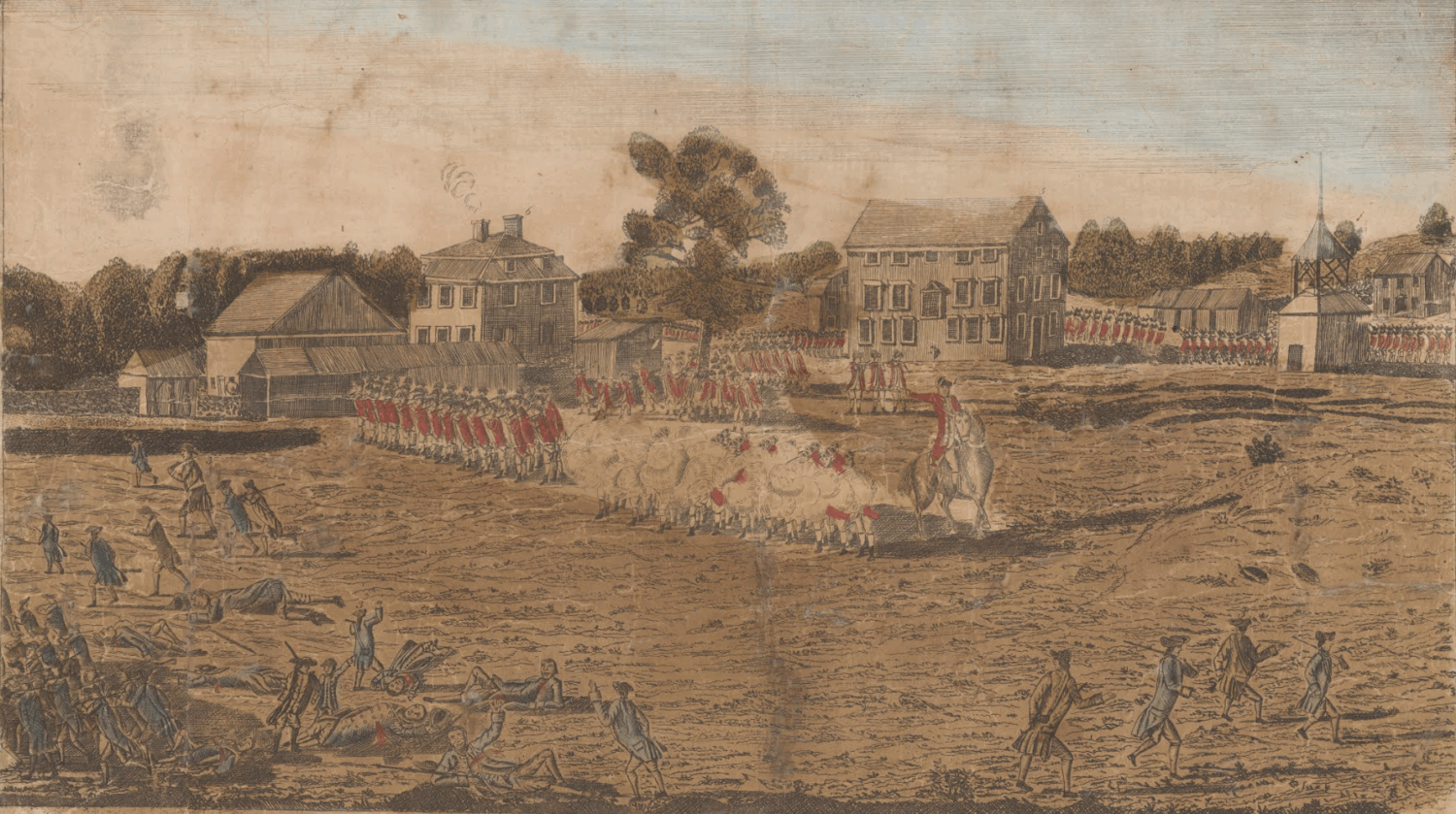
In December of 1775, Connecticut silversmith and engraver Amos Doolittle issued a series of four engraved views of the Battle of Lexington and Concord. This one shows British soldiers firing on Lexington Green (New York Public Library Digital Collections)
Upon hearing of the Lexington alarm on April 19, Captain Joseph Knight of Scituate, Rhode Island, called his men together and mustered the following morning to march to Boston.[25] The siege of the city that had served as a crucible of the contentious politics for 15 years was about to begin. Rhode Islander Brigadier General Nathanael Greene marched to Boston following the fighting at Lexington and Concord to join the newly formed Army of Observation. “The whole country was assembled in Arms with Surprising Expedition, and Several Thousand are now Assembled about this Town threatening an Attack and getting up Artillery. And we are busy in making preparations to oppose them,” wrote Massachusetts Governor Thomas Gage to the Earl of Dartmouth, the British Secretary of State.[26] The siege of Boston was about to begin.
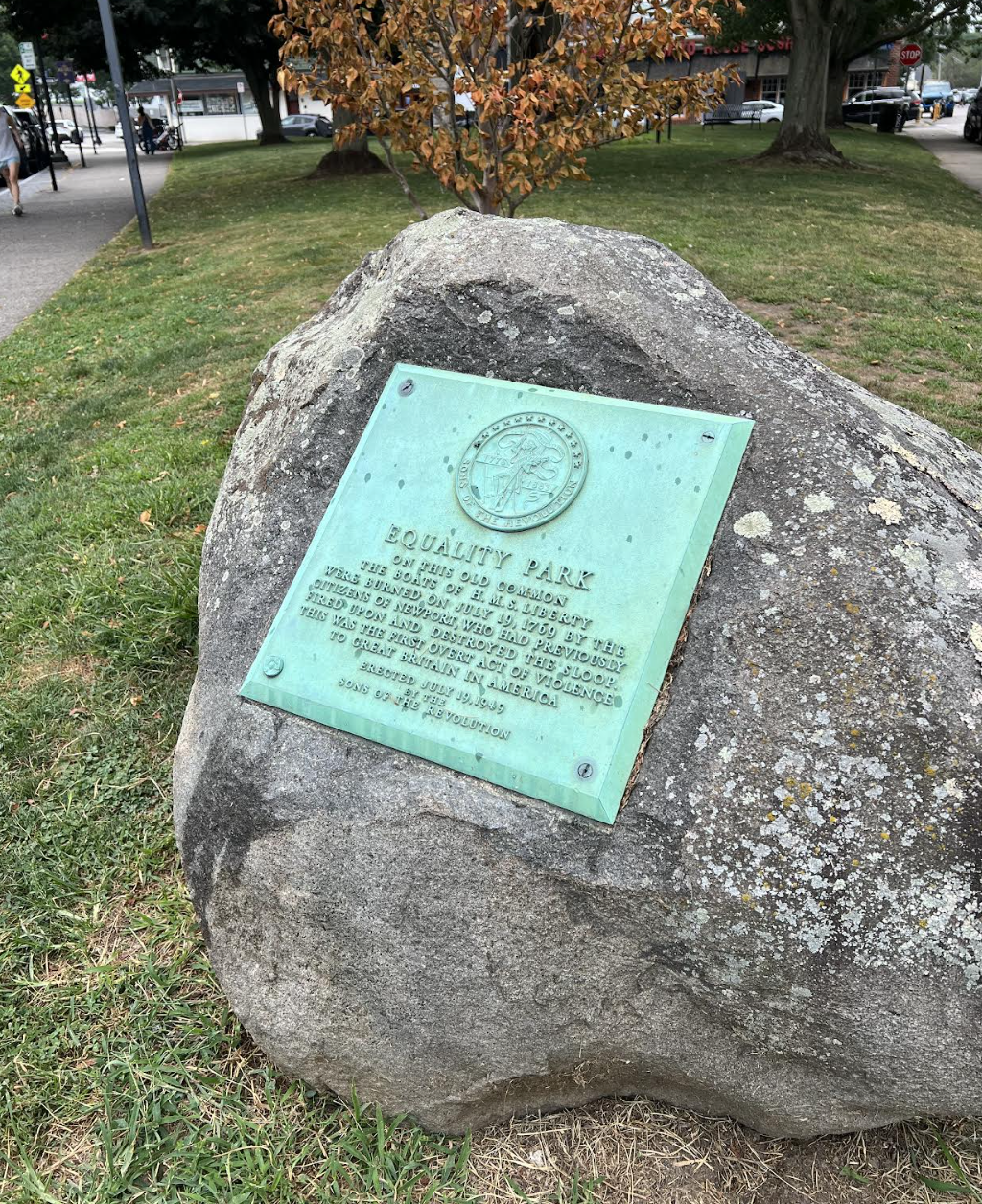
This rock and marker are located at Equality Park in Newport. The marker reads: “On this old Common the boats of H.M.S. Liberty were burned on July 19, 1769 by the citizens of Newport, who had previously fired upon and destroyed the sloop. This was the first overt act of violence to Great Britain in America.” (Christian McBurney)
Notes:
[1] For a complete list of Burns’s films spanning the course of four decades see https://kenburns.com/the-films/. [2] See Robert Brent Toplin, Ken Burns’s The Civil War: Historians Respond (Oxford University Press, 1997). See also Keri L. Merritt, “Why We Need a New Civil War Documentary,” Smithsonian Magazine (April 2019): https://www.smithsonianmag.com/history/why-we-need-new-civil-war-documentary-180971996/. [3] Edward Ayers, “Trump’s Reckless Assault on Remembrance,” The New Republic (August 2025) https://newrepublic.com/article/198387/trump-reckless-assault-remembrance. [4] At their disposal in the classroom teachers have the extensive backfiles of Rhode Island History, the Journal of the American Revolution, and the Online Review of Rhode Island History. A useful reading list of titles connected to the American Revolution can be found here: https://www.battlefields.org/learn/articles/start-reading-about-revolutionary-war [5] Viewers should consider reading the pamphlets in Gordon S. Wood, ed., The American Revolution: Writings from the Pamphlet Debate, Volume 1, 1764–1772 (Library of America, 2015) as they watch Episode 1. [6] The full text of Thomas Paine’s Rights of Man – part II can be accessed on Project Gutenberg: https://www.gutenberg.org/files/3742/3742-h/3742-h.htm#link2H_4_0008 [7] The author of several important works on the Revolutionary era, readers should see Kathryn Duval’s important work, Independence Lost: Lives on the Edge of the American Revolution (Random House, 2015). See also this piece DuVal published in the Connecticut Post right before the premier of Burns’s film: https://www.ctpost.com/news/article/before-the-american-revolution-native-nations-21192363.php [8] John W. Tyler, Smugglers and Patriots: Boston Merchants and the Advent of the American Revolution (University of Northeastern Press, 1984), 23. [9] Ibid., 70. [10] Hopkins’s essay originally appeared in the Providence Gazette in January 1764 and Newport Mercury in February 1764. It was also published in pamphlet form, which can be accessed on Archive.org: https://archive.org/details/bim_eighteenth-century_an-essay-on-the-trade-of_hopkins-stephen_1764. [11] Otis’s pamphlet can be accessed on the Teaching American History website: https://teachingamericanhistory.org/document/rights-of-the-british-colonies-asserted-and-proved. [12] Hopkins’s pamphlet can be accessed on the Teaching American History website: https://teachingamericanhistory.org/document/the-rights-of-the-colonies-examined/. Ironically, the Brown brothers forwarded a copy of the pamphlet to the governor’s brother, Esek, who was then on the coast of Africa captaining the slave ship Sally. [13] The hypocrisy of white colonials’ use of slavery to describe their condition was not lost on the British writer Samuel Johnson who asked, “how is it that we hear the loudest yelps for liberty among the drivers of negroes?” Johnson’s 1775 pamphlet, Taxation No Tyranny, can be accessed on the Liberty Fund: https://oll.libertyfund.org/titles/johnson-taxation-no-tyranny-an-answer-to-the-resolutions-and-address-of-the-american-congress. [14] For an informative discussion of the Hopkins vs. Howard battle, see historian Abby Chandler’s essay in the Rhode Island Current: https://rhodeislandcurrent.com/2024/01/08/a-tale-of-two-rhode-island-colonists/. Historian Maya Jasanoff, the author of the groundbreaking work, Liberty’s Exiles: American Loyalists in the Revolutionary World (New York: Alfred A. Knopf, 2011), should be required reading for those interested in the Loyalist story. The Loyalist Newport Gazette, which was published during the British occupation of Newport from December 1776 to October 1779, can be accessed online through the Chronicling America database: https://www.loc.gov/item/sn83021183/ [15] Teachers should make use of this interactive timeline produced by the Newport Historical Society: https://newporthistory.org/resource-center/digital-resources/stamp-act-crisis-timeline/. See also Sheila Skemp, “Newport’s Stamp Act Rioters: Another Look,” Rhode Island History (May 1989): https://storage.googleapis.com/stateless-www-rihs-org/2020/02/1989_May.pdf and Allen T. Mansfield “‘Circumstances not Principles’: Elite Control of the Newport Stamp Act Riots,” Newport History: Journal of the Newport Historical Society (1996): https://digitalcommons.salve.edu/newporthistory/vol67/iss232/2 [16] Newport Mercury, October 28, 1765. [17] The issue with the snake on the masthead can be viewed here: https://philadelphia-museums.washingtonpapers.org/node/6824 [19] See historian Pauline Maier’s classic work, From Resistance to Revolution: Colonial Radicals and the Development of American Opposition to Britain, 1765–1776 (New York: Alfred A. Knopf, 1972), 79-81. [20] William D. Metz, “Rhode Island’s Road to Rebellion Against Great Britain, 1764-1775,” April 21, 2021, The Online Review of Rhode Island History, https://smallstatebighistory.com/rhode-islands-road-to-rebellion-against-great-britain-1764-1775/.- See Russell J. DeSimone and Christian McBurney, “The Gaspee Affair: A Rhode Island Perspective on Its 250th Anniversary,” Small State Big History (June 2022): https://smallstatebighistory.com/the-gaspee-affair-a-rhode-island-perspective-on-its-250th-anniversary/ The Gaspee.org digital depository remains indispensable for teachers looking to bring the story to their students.
- Mercy Otis Warren. History of the Rise, Progress, and Termination of the American Revolution (Boston, 1805). Accessed online at: https://oll.libertyfund.org/titles/cohen-history-of-the-rise-progress-and-termination-of-the-american-revolution-vol-1
- The Suffolk Resolves can be viewed on the Massachusetts Historical Society website: https://www.masshist.org/database/696
- T.H. Breen, American Insurgents, American Patriots: The Revolution of the People (Hill and Wang, 2010), 12.
- Joseph J. Ellis, The Cause: The American Revolution and its Discontents, 1773-1783 (Liveright, 2021) 50.
- Robert Grandchamp, “Rhode Island Militia Battles the Dreaded British Captain James Wallace on Prudence Island,” Small State Big History (November 2017): https://smallstatebighistory.com/rhode-island-militia-battles-dreaded-british-captain-james-wallace-prudence-island/
- Thomas Gage to the Earl of Dartmouth, April 1775 in John Rhodehamel, ed., The American Revolution: Writings from the War of Independence (The Library of America, 2001), 20.
The Author

You Might Also Like