

“Long did I endeavor with unfeigned and unwearied Zeal, to preserve from breaking, that fine and noble China Vase the British Empire: for I knew that being once broken, the separate Parts could not retain even their Share of the Strength or Value that existed in the Whole” (Benjamin Franklin to Lord Howe, July 20, 1776)
Writing from Philadelphia in June 1776, just days before a formal declaration of independence was ratified by the Second Continental Congress, John Adams replied to a note from Benjamin Kent, an ordained minister and the attorney general of Suffolk County, Massachusetts. Though an obvious state of war had existed since April 1775, there were many colonists who were still in denial about the ramifications of the fighting. Many still harbored hopes for reconciliation. John Adams was not among them. Nor was his wife Abigail, who, while staying at her family’s house in Weymouth, wrote to her husband in Philadelphia the day before the battle of Bunker Hill, about the important need to get more “powder” to attack the British in Boston.[1] John Adams had recently nominated George Washington to take charge of the newly created Continental Army with the goal to do just that.[2]
“That We are divorced, as well as from Bed and Board, is to me, very clear,” wrote John Adams to Kent. The only “Question,” in Adams’s mind, dealt with “the proper Time for making an explicit Declaration in Words.” Reflecting on varying sentiments in Congress, Adams reminded Kent that “you can’t make thirteen Clocks, Strike precisely alike, at the Same Second.”[3] Nor could you make, as George Washington and Nathanael Greene found out in the New York Campaign in 1776, always compel scores of militia units to fight effectively as an army.

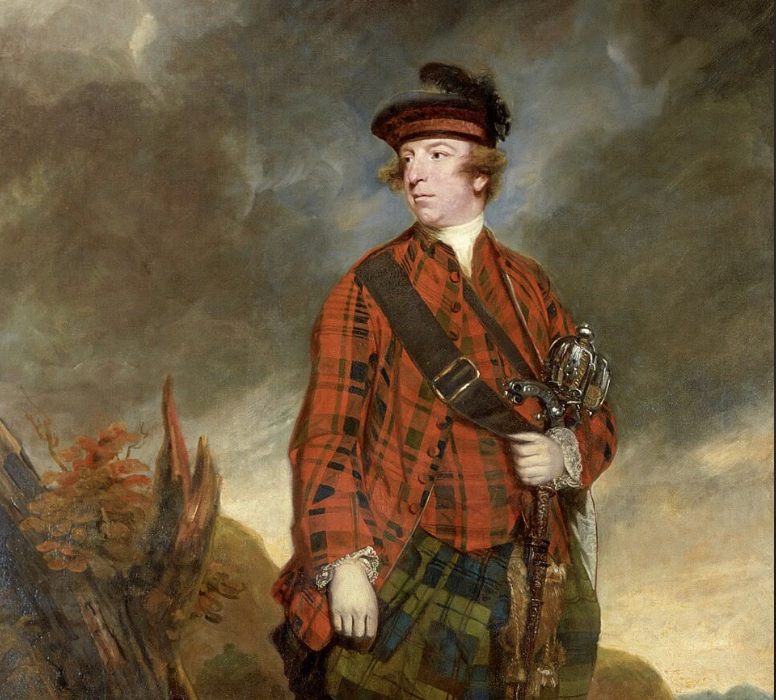
John Murray, 4th Earl of Dunmore, by Sir Joshua Reynolds (ca. 1765) (Wikipedia)
Burns uses the writer Rick Atkinson to chronicle the intense fighting that took place on the road from Lexington and Concord back to Boston in the spring of 1775. Atkinson, a military historian, has written a multi-volume history of the Revolution and is able to convey on screen a high level of detail about military campaigns.[4] Loyalists expected the colonial militias to march into Boston to continue the battle. Instead, the city was surrounded. It would remain so for nine months. Occupied by the British Army, Boston became a city under siege. With the aid of Atkinson and writer Nathaniel Philbrick, Burns next chronicles the intense fighting at the battle of Bunker Hill (really Breed’s Hill) on June 17, 1775, conveying the savagery and bloodletting that was to characterize so much of the overall fighting that took place between 1775 and 1781.[5]
In Boston, British soldiers gutted the Old South Meeting House, burning the pews and pulpit. Over 12,000 residents fled the city, including Ben Franklin’s sister Jane who traveled south to Rhode Island for safety, staying with the Greene family (the family of former governor William Greene).[6] The majority who remained in Boston were loyal to the Crown and the few that were not, suffered greatly. As Atkinson notes, loyalists from the countryside “slipped into Boston for Crown protection, then complained bitterly to [Governor] Thomas Gage that allowing all rebel sympathizers to leave would invite bombardment of the town; hostages must be kept to discourage attack.”[7] Gage declared martial law, but he did offer to free those who turned in their arms, save for Samuel Adams and John Hancock. The siege of Boston lasted until March 17, 1776, when the Royal Navy carried 11,000 British soldiers and hundreds of loyalists left the city to Halifax in Canda. Washington marched into Boston the next day, but he did not stay long because he knew the British would eventually move south to New York City, another crucial port city in the American economic world.
The film spends considerable time on the often glossed over invasion of Canada by Continental forces starting in 1775. The “ultimate goal,” of this tragic, ill-fated mission, “was to eliminate the province as a military threat and perhaps adopt it as the 14th American Colony.” Teachers should use the film to help chronicle the military maneuvers by General Richard Montomery and Colonel Benedict Arnold. Arnold’s invasion began as a diversion for Montgomery’s thrust down the Richelieu River from the Isle aux Noix. Accompanying Arnold was Rhode Islander Lieutenant Colonel Christopher Greene who would later lead the famed First Rhode Island Regiment of Continentals (known as the “Black Regiment”). Jeremiah Greenman, who kept a journal throughout the war, enlisted as a private in a company commanded by Captain Samuel Ward of Westerly, the son of one of Rhode Island’s delegates to the Continental Congress. In the summer of 1775, Greenman served in Rhode Island’s Army of Observation on the outskirts of Boston under the command of Nathanael Greene. He would return after a year, without shoes, and only after a prisoner exchange.[8]
The goal of the ill-fated Canadian expedition was to open the St. Lawrence River to Quebec, the fall of which it was argued would destroy British influence in Canada. The assault on Quebec City in December 1775, however, ended with Arnold wounded, General Montgomery shot dead, and over 400 Continental soldiers captured. Among the Rhode Island prisoners who spent more than a year in captivity in Canada were Christopher Greene and Samuel Ward.
Gordon S. Wood, one of the leading historians of his generation, makes a brief, but important appearance in Episode 2, “An Asylum for Mankind, May 1775-July 1776.” Wood, a long-time Rhode Island resident, taught for decades at Brown University and is the author of one of the most important books on the Revolution published in the last 50 years, The Radicalism of the American Revolution (1992).[9] As Wood notes, up until the 18th century, “people assumed that everything will always remain the same. But the idea that you could take charge and change your culture, that’s the fundamental basis of the Enlightenment, that man can be changed.” The central tenets of the European Enlightenment that made its way across the Atlantic, dealt with the sanctity of individual human dignity and a skepticism towards traditional modes of authorities. According to Wood, “everything that we believe in comes out of the Revolution. Our ideas of liberty, equality, it’s the defining event of our history.” The crucial line in the Declaration of Independence, that “All men are created equal,’” that is, according to Wood, “the most famous and important phrase in our history. If we don’t celebrate it, we have no reason to be a people.” Wood has argued that because of the diversity of people who settled in the United States—English, Irish, Scotch-Irish, Jews, Catholics, and Africans—as well as Native peoples, those five words are the country’s creed that holds the country together.
The lead up to the American Revolution saw a recognition to some extent of the contradictions of the coexistence of chattel slavery and ideas of liberty and freedom—a central element of the Revolution was the expansion of antislavery ideology. As historian Christian McBurney has argued, the years before the Revolution “saw an emerging recognition, particularly in the North, that the African slave trade was wrong and should be banned on moral grounds or at least restricted.”[10] Indeed, starting in 1769, Connecticut, Maryland, New Jersey, Pennsylvania, and Rhode Island imposed bans or severely restricted slave imports. These were perhaps the first antislavery enactments in the Western World. Americans first considered the matter of slavery, the slave trade and racial equality in the political and ideological milieu created by the Revolution. Indeed, there were two “revolutions” happening simultaneously: one against imperial authority and one against the institution of human bondage.
In 1773, Benjamin Rush, a prominent Philadelphia physician and ardent patriot, wrote a pamphlet denouncing slavery and the slave trade.[11] In 1774, Rush was among the founders of the Pennsylvania Society for Promoting the Abolition of Slavery, the first such society in the Western World.[12] In April 1775, Quaker Anthony Benezet called the first meeting of the Society for the Relief of Free Negroes Unlawfully Held in Bondage. Benezet, a French immigrant in Philadelphia, had sparked anti-slavery sentiments in America long before shots were fired at Lexington and Concord through his writings, especially a powerful 1766 pamphlet.[13] Writer Thomas Paine, whose powerful tracts are discussed in episodes 2 and 3, was among the ten white Philadelphians who attended Benezet’s meeting.[14] However, this remarkable development is barely hinted at in the documentary.
After coverage of the savagery at Bunker Hill, the film turns south to Virginia to detail John Murray, the Fourth Earl of Dunmore and the royal governor of the colony, and his infamous “emancipation” proclamation. On November 7, 1775, Dunmore declared martial law and issued this proclamation: “I do hereby further declare all invented servants, Negroes or others (appertaining to rebels) free, that are able and willing to bear arms, they join His Majesty’s troops as soon as may be.” It led to the largest revolt against slavery in American history.
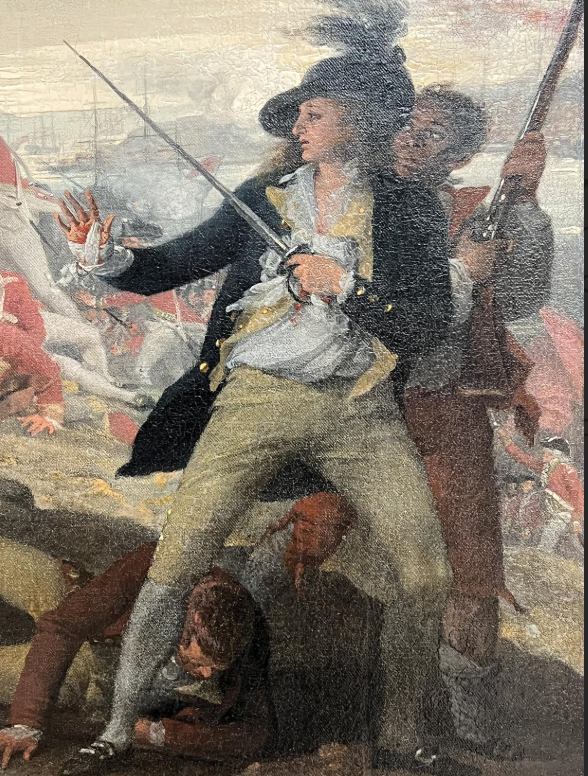
A scene from The Battle of Bunker Hill, June 17, 1775, by John Trumbull (ca. 1786). In the scene, a Black soldier carrying a musket fights along side Lieutenant Thomas Grosvenor (photograph by Christian McBurney, taken at the Yale University Art Gallery)
Stationed in Boston, Washington urged the council of war in October 1775 to end the recruitment of Black soldiers. The council agreed. However, Washington did not remove free Blacks already enlisted. Even John Adams, an opponent of slavery, agreed with the decision. In a 1776 letter to Jonathan Sergeant of New Jersey, Adams noted that any patriot plan to arm slaves and free them for enlisting could lead to southerners, particularly South Carolinians, to “run out of their Wits” if they ever even got “Hint of such a measure.”[15]
It is important to point out that there was to be no freedom for Dunmore’s 57 slaves in Williamsburg, Virginia, nor the slaves of loyalists. This was a pure military measure designed to meet the immediate need of stopping a rebellion. It was not meant to upset the status of slavery in the largest British colony. “If the Virginians are wise, that arch traitor to the rights of humanity, Lord Dunmore, should be instantly crushed, if it takes the force of the whole colony to do it. Otherwise, like a snow Ball in rolling, his army will get size—some through Fear—some through promises—and some from Inclination joining his Standard—But that which renders the measure indispensably necessary, is, the Negroes; for if he gets formidable, numbers of them will be tempted to join who will be afraid to do it without,” wrote Washington to Lieutenant Colonel Joseph Lee.[16]
Dunmore added to the fear of white Virginians when he ordered the naval town of Norfolk shelled on New Year’s day 1776.[17] As historian Douglas Egerton makes clear, Dunmore’s proclamation did not emerge out of nowhere, for a “policy of black freedom in the name of military exigency” had been “coalescing” in the upper echelons of the British government for months.[18] On July 19, 1776, a British patrol reached Washington’s Mount Vernon. Seventeen slaves fled that day, among them was Harry Washington who is discussed in the film.[19]
The film makes the claim that Dunmore’s Proclamation “helped drive Southern slaveholders to the side of the revolutionaries.” For those who have engaged with the controversy over several points made in the lead essay New York Times Magazine 1619 Project, this will be familiar territory. A lot of ink was spilled on this debate in 2019-2020.[20] As historian Leslie Harris wrote in response to some of the misleading claims in the original version of the1619 Project dealing with the preservation of slavery as a primary cause of the Revolution, “Far from being fought to preserve slavery, the Revolutionary War became a primary disrupter of slavery in the North American Colonies.”[21] Some of the largest and most prominent southern slaveholders, including George Washington, Henry Laurens and Thomas Jeferson, were already in the arms of the patriots long before Dunmore’s emancipation proclamation was issued. Nevertheless, Dunmore’s order did play a significant role that deserves full treatment in the classroom.
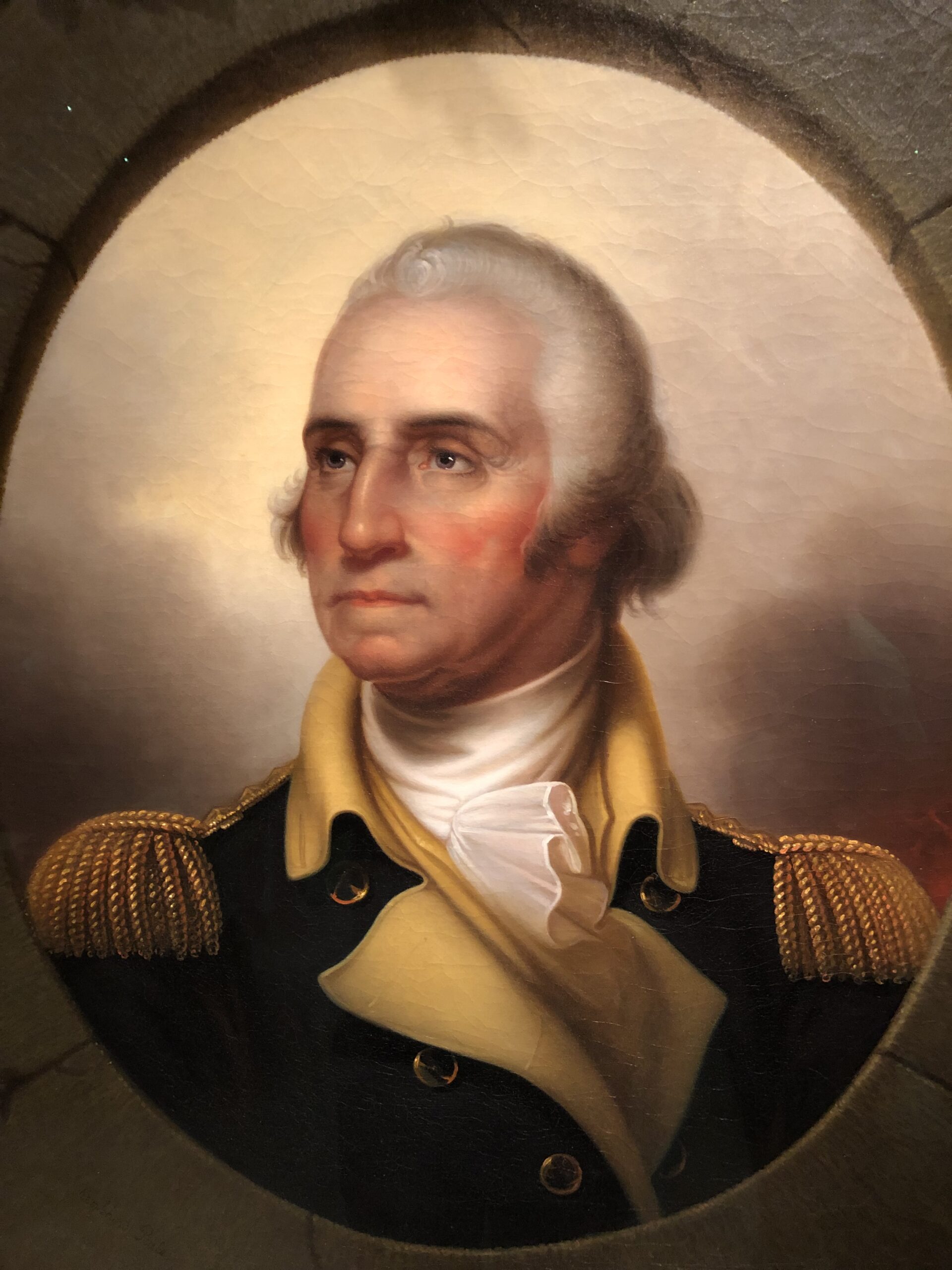
George Washington by Rembrandt Peale (ca. 1823) (photograph taken by Christian McBurney, at the National Museum of the United States Army
For example, in Virginia’s May 1775 resolutions sent to Congress, Dunmore’s proclamation featured prominently: “The King’s representative in this colony hath only withheld all the powers of Government from operation for our safety, but having retired on board an armed ship, is carrying on a piratical and savage war against us, tempting our slaves by every article to resort to him, and training and employing them against their masters.”[22] Jefferson picked up the same theme in his draft of the Declaration of Independence, echoing the language almost word for word. As historian Edward Larson has noted, the patriots “did not necessarily view themselves as fighting a war to preserve slavery—likely few if any of them did—but recruiting enslaved Blacks to subdue their white masters struck many as an unconscionable example of imperial effrontery.”[23]
With Dunmore’s proclamation top of mind, Washington in short order changed his views about enlisting free Black soldiers. Washington wrote to John Hancock, president of the Continental Congress, on December 31, 1775, to reverse an order he had given two months prior that prevented Black enlistment. It has been “represented to me that the free negroes who have Served in this Army, are very much dissatisfied at being discarded—as it is to be apprehended, that they may Seek employ in the ministerial Army—I have presumed to depart from the Resolution respecting them, & have given License for their being enlisted.”[24]
Episode 2 concludes with the drafting and ratification of the 1776 Declaration of Independence.[25] Historian Annette Gordon-Reed, an expert on Jefferson, helps the viewer understand how Jefferson understood slavery and freedom in the context of his revolutionary document.[26] Teachers will benefit from spending time with the deleted passages from the Declaration that is mentioned in the film. In forceful language, Jefferson’s condemned the slave trade and even slavery itself as a violation of natural law. These sections were not approved by Congress. Reflecting back years later, John Adams noted that he was “delighted with [the draft’s high tone and the flights of oratory with which it abounded, especially that concerning Negro slavery, which, though I knew his Southern brethren would never suffer to pass in Congress, I certainly never would oppose . . . . Congress cut off about a quarter of it, as I expected they would; but they obliterated some of the best of it, and left all that was exceptionable, if anything in it was. I have long wondered that the original draft had not been published. I suppose the reason is the vehement philippic against Negro slavery.”[27]
John Lind, a prominent British attorney, answered Jefferson’s Declaration in a stinging pamphlet raising the question of hypocrisy that would forever be connected to the document:
It is their boast that they have taken up arms in support of their own self-evident truths—“that all men are created equal”—“that all men are endowed with the unalienable rights of life, liberty, and the pursuit of happiness.” Is it for them to complain of the offer of freedom held out to these wretched beings? Of the offer of reinstating them in that equality, which, in this very paper, is declared to be the gift of God to all; in those unalienable rights, with which, in this very paper, God is declared to have endowed all mankind.[28]
However, the prominent British abolitionist Granville Sharp rightly saw through Lind’s hypocrisy and placed blame for slavery and the slave trade in the British Empire as a whole.[29] At the time, Britain was the leading country in the world in the Atlantic slave trade.
Several days after a final version was ratified by Congress, Washington ordered the Declaration to be read to the Continental Army. The public reading led men to tie ropes to a statue of King George III in New York City and pull it to the ground. The remains of the statue were later melted to make bullets.
The impact of the Declaration was widespread, and despite the removal of language attacking slavery, antislavery advocates immediately seized the document’s potential. In Rutland, Vermont, the Black pastor Lemuel Haynes delivered a fiery sermon using the words that were printed in the final version to ask poignant questions about how far the patriots were willing to take their revolution:
We live in a day wherein Liberty & freedom is the subject of many millions’ concern; and the important struggle hath already caused great effusion of blood; men seem to manifest the most sanguine resolution not to let their natural rights go without their lives go with them; a resolution, one would think every one that has the least love to his country, or future posterity, would fully confide in, yet while we are so zealous to maintain, and foster our own invaded rights, it cannot be thought impertinent for us candidly to reflect on our own conduct, and I doubt not but that we shall find that subsisting in the midst of us, that may well be styled Oppression, nay, much greater oppression, than that which Englishmen seem so much to spurn at. I mean an oppression which they, themselves, impose upon others.[30]
In Boston, Prince Hall, a free Black abolitionist, sent a petition capturing the sentiments of a “great number of blacks detained in a state of slavery in the bowels of a free and Christian country humbly shows that your petitioners apprehend that they have in common with all other men a natural and unalienable right to that freedom which the Great Parent of the Universe has bestowed equally on all mankind.”[31]
Teachers could extend a lesson on the Declaration by examining Jefferson’s 1786 comments about the Revolution made to the French politician Nicolas Démeunier, who had queried Jefferson for an article he was working on relating to the United States for the French Encyclopedia. As Annette Gordon-Read has recently noted, “No prominent member of the Founding Fathers engaged more directly, and some would argue more disastrously, with the subject of race than Thomas Jefferson.”[32] In 1786, a few years after the end of the Revolutionary War, Jefferson had this to say: “Who can endure toil, famine, stripes, imprisonment or death itself in vindication of his own liberty, and the next moment be deaf to all those motives whose power supported him thro’ his trial, and inflict on his fellow men a bondage, one hour of which is fraught with more misery than ages of that which he rose in rebellion to oppose.”[33] Yet of the more than six hundred people Jefferson enslaved during his lifetime, he freed only ten and, after 1790, never lent his considerable talents to any meaningful emancipation plan for Virginia or the nation.[34]
Episode 3, “The Times that Try Men’s Souls” (July 1776-January 1777), focuses heavily on the British capture of New York City with an armada of ships carrying over 20,000 troops, first landing on Staten Island. Detailed coverage is given to the Battle of Long Island (Brooklyn Heights), Washington’s daring escape in August 1776, the battle of Manhattan in September 1776, and then the fighting around White Plains in late October 1776.[35] Teachers should take time to discuss the implications of the failed peace conference in September on Staten Island.[36] Teachers would also do well to expose students to the role of Nathanael Greene of Coventry in this critical moment of the Revolution, for it was Greene’s wise counsel that eventually persuaded Washington to abandon plans to defend New York City. Though he lacked prior military experience, Greene, the “fighting Quaker,” rose quickly through the ranks of the Continental army, becoming a major general by the end of the siege of Boston, something that would have been impossible in the British Army. “The present Case is of such Magnitude and big with such Consequences to all America, that a reconsideration of the earlier decision is imperative,” wrote Greene.[37] Yet Greene was not infallible; Washington also took his advice to defend Fort Washington, the patriots’ last bastion on Manhattan Island, which turned out to be a disaster for the Americans after a British army stormed it, with the loss of more than 3,000 captives.
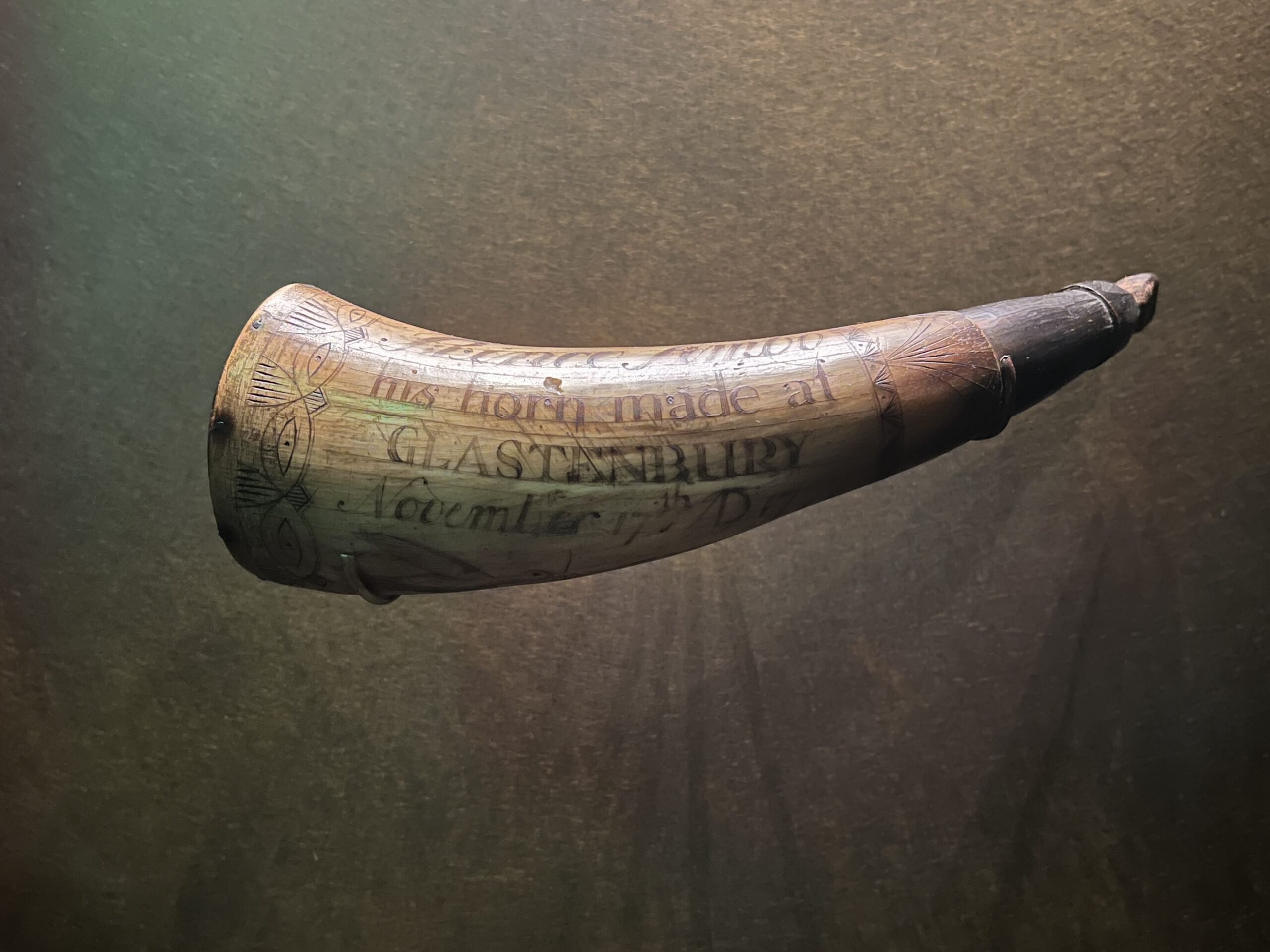
Prince Sambo’s powder horn. Prince Sambo, from Glastonbury, Connecticut, served in a Connecticut regiment during the Revolutionary War (photograph taken by Christian McBurney, at the Smithsonian National Museum of African American History)
The exploits of Rhode Islander Daniel Hitchcock’s 11th Continentals, who were in the center of the American defensive line during the Battle of Brooklyn Heights on August 27, could also prove useful in the classroom.[38] Ultimately, Washington fled across the Hackensack River to New Jersey, then over the Delaware River, to Pennsylvania, leaving British General William Howe in total possession of New York City. The British, as the film mentioned, also seized in December 1776 Newport, Rhode Island, as well as the rest fo Aquidneck Island and the rest of Jamestown, along with outposts in New Jersey.
The military exploits and heroics of Colonel Benedict Arnold take center stage early in Episode 3. Though wounded in the siege of Quebec. Canada, Arnold successfully kept the British from invading the colonies through the Lake Champlain region (Battle at Valcour Island), after creating a small navy from scratch.
Also, of importance in this episode and prime for classroom discussion, is the effort to draft state constitutions. As historian Alan Taylor, the author of numerous books on early America, including, American Revolutions: A Continental History, 1750-1804 (2016), notes in the film, “When we think about our American Revolution, we, of course, think about independence from Britain, and that’s a big deal, but we also need to think about this is the formation of republican government, and it’s also the formation of our union of our states, and all three of those were enormous gambles.” Indeed, as military campaigns were being waged on the ground, an unprecedented era of constitution making was taking place with nearly all the American states embarking on the task of writing new governing documents.[39]
Episode 3 ends with Washington’s surprise attack against an encampment of Hessians at Trenton, New Jersey. Washington won the battle with a loss of only four men and gained roughly 900 prisoners. He follows this up with another victory just north in the town of Princeton. Daniel Hitchcock’s troops fought valiantly at the often forgotten Second Battle of Trenton on January 2, 1777, as well as at the more famous Battle of Princeton on January 3, 1777.[40] For Rhode Island teachers, however, a classroom focus should be the British capture of Newport a few weeks prior. This will be discussed in the next installment.
Notes:
[1] Abigail Adams to John Adams, June 16, 1775. Accessed online through the Adams Family Papers at https://www.masshist.org/digitaladams/archive/doc?id=L17750616aa. Though he was an ardent patriot during the Revolution, members of his family were loyalists, who eventually made their way to Halifax, Nova Scotia. In 1785, after the war, Kent joined them there. [2].Joseph J. Ellis, His Excellency: George Washington (New York: Alfred A. Knopf, 2004). 68-70. [3] John Adams to Benjamin Kent, June 22, 1776. Accessed online through the National Archives at Founders Online, the John Adams Papers, at https://founders.archives.gov/documents/Adams/06-04-02-0130 [4] Readers should use Rick Atkinson, The British Are Coming: The War for America, Lexington to Princeton, 1775-1777 (New York: Henry Holt and Company, 2019), as they watch episodes 2 and 3. [5] Nathaniel Philbrick, Bunker Hill: A City, a Siege, a Revolution (New York: Viking, 2013). [6] Jill Lepore, Book of Ages: The Life and Opinions of Jane Franklin (New York: Vintage Books, 2014), 170-171. [7] Atkinson, The British are Coming, 85. [8] See Robert Bray and Paul Bushnell, eds., The Diary of a Common Soldier in the American Revolution, 1775-1783 (DeKalb, IL: Northern Illinois University Press, 1978). [9] See Erik J. Chaput, “Revisiting the Radicalism of the American Revolution,” Providence Journal, June 1, 2025, also accessed at https://www.providencejournal.com/story/opinion/columns/2025/06/01/book-helps-us-see-the-big-picture-of-american-revolution-opinion/83348587007/?gnt-cfr=1&gca-cat=p&gca-uir=true&gca-epti=z11—-p000914c000914d00—-v116712o11—-b0085xxd118565&gca-ft=180&gca-ds=sophi. [10] McBurney, Dark Voyages: An American Privateer’s War on Britain’s African Slave Trade (Yardley, PA: Westholme Publishing, 2023), xii. See also McBurney’s brilliant trilogy of essays on the budding abolitionist movement and the slave trade in the Journal of the American Revolution from 2020 at https://allthingsliberty.com/author/christian-mcburney. [11] Rush’s 1773 pamphlet, “An Address to the Inhabitants of the British Settlements, On the Slavery of the Negroes in America,” can be accessed here: https://quod.lib.umich.edu/cgi/t/text/text-idx?cc=evans;idno=N10229.0001.001;node=N10229.0001.001:2;rgn=div1;view=text [12] See the original constitution for the organization here: https://digitalcollections.statelibrary.pa.gov/Documents/Detail/943155?item=943159 [13] See an excerpt: https://www.gilderlehrman.org/sites/default/files/inline-pdfs/AppenE.pdf. For more, see David L. Crosby, The Complete Antislavery Writings of Anthony Benezet, 1754-1783: An Annotated Critical Edition (Baton Rouge, LA: Louisiana State University Press, 2014). [14] On slavery and antislavery in the Atlantic World in the eighteenth century, teachers should consult the work of historian Christopher L. Brown, a prominent figure in Burns’s film: https://history.columbia.edu/person/brown-christopher/. Historian Sean Wilentz has written a series of essays on slavery and antislavery during the American Revolution that would work well in the classroom. See Sean Wilentz, “American Slavery and ‘the Relentless Unforeseen,’” The New York Review (November 2019); Wilentz, “The Radicalism of Northern Abolition,” The New England Quarterly (March 2023), 8–26; and Wilentz, “The Revolution Within the American Revolution,” The New York Review (October 2023). [15] John Adams to Jonathan Dickinson Sergeant, August 17, 1776. Accessed online through the National Archives in Founders Online in the John Adams Papers: https://founders.archives.gov/documents/Adams/06-04-02-0215. [16] George Washington to Joseph Lee, December 15, 1775. Accessed online through the National Archives in Founders Online in the George Washington Papers: https://founders.archives.gov/documents/Washington/03-02-02-0508. [17] See the second chapter in a new series by Michael Kranish titled “Revolutionary Revelations” (2025) in the Washington Post: https://www.washingtonpost.com/politics/interactive/2025/thomas-jefferson-battle-norfolk-burning/. [18] Douglas R. Egerton, Death or Liberty: African Americans and Revolutionary America (Oxford, England: Oxford University Press, 2009), 70. [19] This interactive map of Harry Washington’s life will work well in the classroom: https://storymaps.arcgis.com/stories/1bbc314b54da43d99dd890e3b3f4b0c5. [20] See this online exchange between New York Times editors and prominent historians: https://www.nytimes.com/2019/12/20/magazine/we-respond-to-the-historians-who-critiqued-the-1619-project.html. See also Erik J. Chaput, “Newspapers Pushes Faulty History,” Province Journal , January 22, 2020: https://www.providencejournal.com/story/opinion/2020/01/22/my-turn-eric-j-chaput-newspaper-pushes-faulty-us-history/1849849007/?gnt-cfr=1&gca-cat=p&gca-uir=true&gca-epti=z116207d00—-v116207b0069xxd116965&gca-ft=244&gca-ds=sophi. [21] Leslie M. Harris, “I Helped Fact-Check the 1619 Project. The Times Ignored Me,” Politico, March 6, 2020, accessed at: https://www.politico.com/news/magazine/2020/03/06/1619-project-new-york-times-mistake-122248. [22] Accessed online through the Encyclopedia Virginia accessed at: https://encyclopediavirginia.org/primary-documents/virginias-fifth-revolutionary-conventions-resolutions-for-independence-may-15-1776/#:~:text=Fleets%20and%20armies%20are%20raised,employing%20them%20against%20their%20masters. [23] Edward J. Larson, American Inheritance: Liberty & Slavery in the Birth of a Nation, 1765–1795 (New York: W. W. Norton & Company, 2023), 98. See my lengthy review essay reviewing the book in “Teaching the Story of “Universal Liberty” in Revolutionary Rhode Island: A Review of Edward J. Larson’s American Inheritance: Liberty and Slavery in the Birth of the Nation, 1765-1795,” May 13, 2023, Online Review of Rhode Island History, at https://smallstatebighistory.com/teaching-the-story-of-universal-liberty-in-revolutionary-rhode-island-a-review-of-edward-j-larsons-american-inheritance-liberty-and-slavery-in-the-birth-of-the-nation-17/. [24] George Washington to John Hancock, December 31, 1775. Accessed online through the National Archives in Founders Online in the George Washington Papers: https://founders.archives.gov/documents/Washington/03-02-02-0579. [25] Important works teachers should consult include Pauline Maier, American Scripture: Making the Declaration of Independence (New York: Knopf, 1997) and Danielle Allen, Our Declaration (New York: Liveright, 2015). [26] See Annette Gordon-Reed, The Hemingses of Monticello: An American Family (New York: W.W. Norton & Co., 2008) and Annette Gordon-Reed and Peter Onuf, Most Blessed of the Patriarchs: Thomas Jefferson and the Empire of the Imagination (New York: Liveright, 2016). [27] See John Adams to Timothy Pickering, August 6, 1822. Accessed online through the National Archives at Founders Online in the John Adams Papers: https://founders.archives.gov/documents/Adams/99-02-02-7674. For the text of the deleted passage see: https://blackpast.org/african-american-history/declaration-independence-and-debate-over-slavery/ [28] John Lind, “An Answer to the Declaration of the American Congress,” (1775), 107. Lind’s 100-page pamphlet can be accessed here: https://babel.hathitrust.org/cgi/pt?id=osu.32435018412635&seq=111&q1=boast. See also essay by David Oterson in “That Audacious Paper: Jonathan Lind and Thomas Hutchinson Answer the Declaration of Independence,” July 3, 2025, Journal of American Revolution: https://allthingsliberty.com/2025/07/that-audacious-paper-jonathan-lind-and-thomas-hutchinson-answer-the-declaration-of-independence/. [29] See Granville Sharp, “The Law of Liberty: Or, Royal Law, By Which All Mankind Will Certainly Be Judged!” (1776), 49. Accessed online here: https://quod.lib.umich.edu/cgi/t/text/text-idx?cc=ecco;idno=004891922.0001.000;node=004891922.0001.000:3;rgn=div1;view=text. [30] See https://teachingamericanhistory.org/document/liberty-further-extended-or-free-thoughts-on-the-illegality-of-slave-keeping-under-construction/ [31] See the text of the petition here: https://teachingamericanhistory.org/document/massachusetts-antislavery-petition/. Teachers can access a host of Revolutionary era antislavery petitions from free Blacks and enslaved Blacks in Massachusetts here: https://www.masshist.org/features/endofslavery/struggle#:~:text=In%20the%20early%201770s%2C%20groups,fourth%20example%20dated%20January%201777. [32] Annette Gordon-Reed, “Jefferson Divided,” December 18, 2025, The New York Review: https://www.nybooks.com/articles/2025/12/18/jefferson-divided-annette-gordon-reed/. [33] Thomas Jefferson to Nicolas Démeunie June 26, 1786. Accessed online through the National Archives at Founders Online in the Thomas Jefferson Papers: https://founders.archives.gov/documents/Jefferson/01-10-02-0001-0006. [34] Statistics taken from the education pages at Monticello.org: https://www.monticello.org/slavery/slavery-faqs/property/. [35] An excellent source to assign to students is Joseph J. Ellis, Revolutionary Summer: The Birth of American Independence (New York: Alfred A. Knopf, 2013), 68-172. [36] The report can be accessed through the National Archives at Founders Online in the Benjamin Franklin Papers: https://founders.archives.gov/documents/Franklin/01-22-02-0358. [37] Quoted in Ellis, Revolutionary Summer, 140. [38] See also Damien Cregeau, “Colonel Daniel Hitchcock in the American Revolutionary War Remembered,” May 6, 2023, Online Review of Rhode Island History, at https://smallstatebighistory.com/?s=hitchcock. [39] See Jack Rakove, Revolutionaries: A New History of the Invention of America (New York: Houghton, Mifflin, Harcourt, 2010), chapter 4. [40] On Colonel Hitchcock’s military role at Trenton see: https://www.battlefields.org/learn/maps/trenton-second-battle-jan-2-1777.The Author

You Might Also Like