

Old Home Days was a mid-nineteenth century New England tradition in which former sons and daughters of a town returned to the town of their birth for a reunion. The celebrations included orations, parades, and feasts. In some instances, the celebration lasted a week, in others only a day; in all cases it was intended to be a joyous event. The concept of Old Home Days carried over into the early twentieth century and in some towns it is still practiced. Over time the practice has spread beyond New England and is celebrated across America.
While Old Home Day celebrations are of no lasting importance, they do provide us with a window into life of an earlier time, when things were simpler and certainly less hurried. From my small collection of Rhode Island Old Home Day items including books, postcards, ribbons, and other ephemera it is possible to somewhat reconstruct the events that took place.
The first such celebration in Rhode Island occurred in Newport in August 1859. A month earlier the committee of arrangements had sent out invitations to absent Newporters. Sons and daughters from across Rhode Island, from Westerly to Woonsocket and all the towns in between, including Block Island and Prudence Island, descended upon Newport the week leading up to the eventful day. A total of nearly five hundred former Newporters living in-state attended. Almost three hundred more came from Massachusetts and one hundred and thirty-two came from New York. One even came from England and another from Cuba. In all between eleven and twelve hundred sons and daughters travelled to their former home in Newport. It was said that the numbers calling at the mayor’s office to sign the registration book was so great that the book had to be disassembled, and pages spread about so as to shorten the wait time to sign the book.
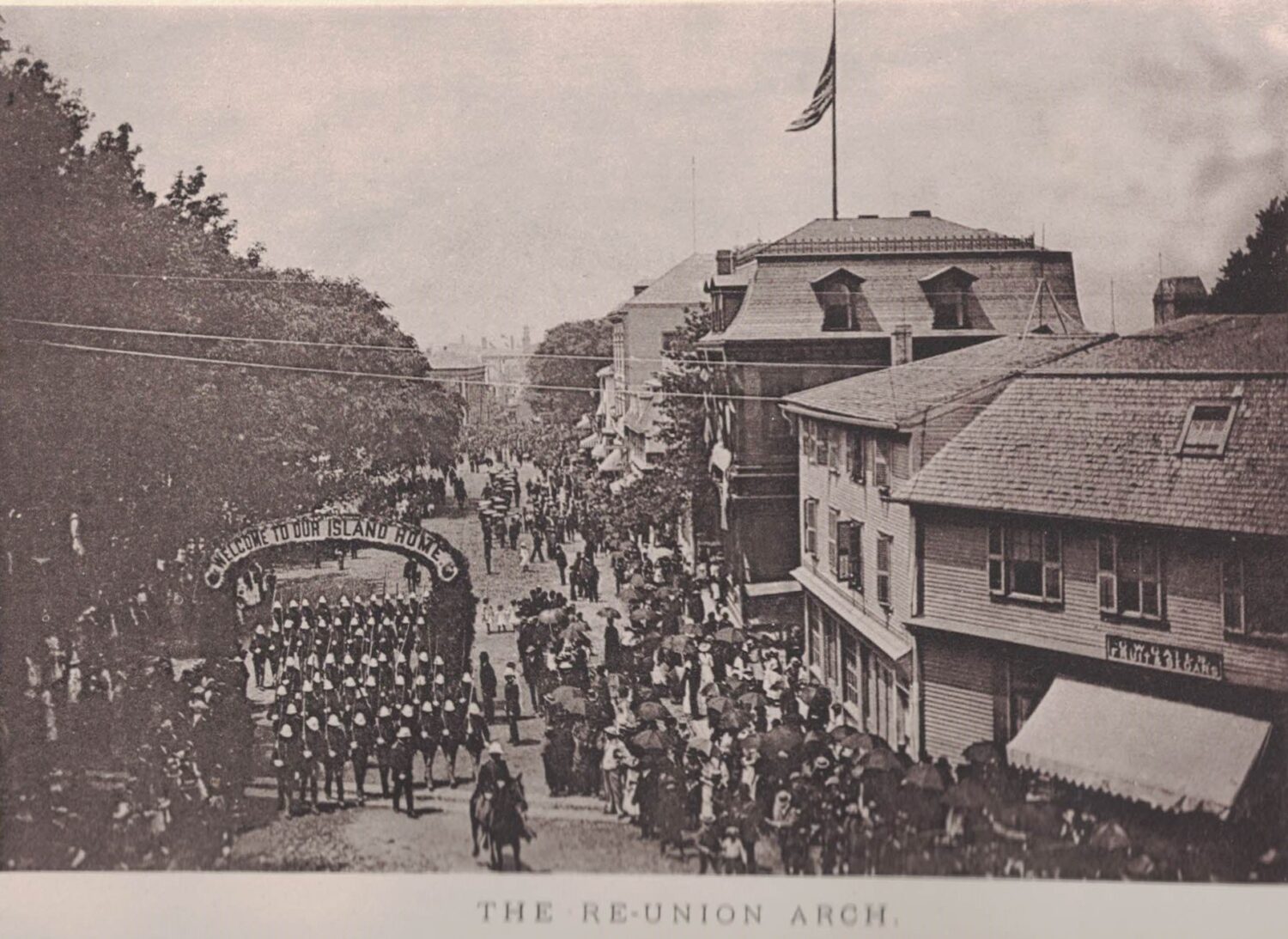
While the day of celebration was set for August 23rd, preparations were made well in advance. The town was decorated with flags and bunting of red, white, and blue that were placed on public buildings as well as private homes and businesses. A large twenty-foot arch spanned the Parade (Washington Square) with a sign reading “Welcome to our Island Home.” On the evening of August 22, the town was illuminated with numerous buildings lighted with lanterns; the Old Stone Mill at Touro Park was the major attraction with five hundred Chinese lanterns used in its illumination.
The morning of August 23rd was ushered in with the ringing of church bells and the firing of cannons. Just before noon a procession set off from the Parade (Washinton Square). The mile long procession consisted of city and state dignitaries, militia and fire companies, and four bands interspersed throughout the procession. They were then followed by Newport’s returning sons and daughters marching six abreast. Following the procession, the marchers gathered under tents near Ocean House on Bellevue Avenue where food was provided and speeches were given. The afternoon session was capped off with an address by the Rev. Walter Channing. The celebration continued into the evening, again under the tents, where delegates from various towns spoke to the audience. By all accounts the first reunion in Rhode Island was a success.
In 1880, 21 years after the Newport Old Week celebration, the town of Bristol held a week-long bicentennial celebration commemorating its 1680 founding. As part of this celebration the committee on arrangements invited 1,500 former Bristolians to attend. Each day of the celebration had an assigned theme. Friday, September 24th was designated Old Home Day.

1859 satin badges worn at the August 1859 Newport reunion of its sons and daughters (Author’s Collection)
A quarter century after the initial 1859 reunion, Newport held a second reunion of its sons and daughters on July 4, 1884. Like the first reunion the event called for illuminations, especially at the Old Stone Mill. Also included was a procession said to consist of four thousand marchers and a feast followed by numerous orations. The 1884 celebration differed from the earlier one in that fireworks were planned but the wet weather on July 3rd caused them to be aborted halfway through. The register showed returning sons and daughters coming from across America with one attendee coming from Kingston, Ontario, in Canada and another from Maui in the Hawaiian Islands. Unlike future home comings the Newport Committee of Arrangements for both 1859 and 1884 each decided to publish a book to commemorate their celebrations, which today is a valuable source of detailed information.

The 1884 Reunion Arch set up on the Parade in Newport (Author’s Collection)
Interestingly, several accounts attribute the creation of Old Home Week to the year 1897 when New Hampshire governor Frank West Rollins called on native sons and daughters to return home. It may be true that Governor Rollins initiated the term “Old Home Week,” but the idea of a reunion was practiced decades earlier in Rhode Island. It would be, however, another twenty years following the 1884 celebration in Newport that Rhode Island, spurred by the homecoming craze that gripped the country at the turn of the century, when another old home week celebration was held in Rhode Island. The first such recorded celebration in Rhode Island in the twentieth century occurred in the rural town of Foster in 1904.
Foster’s celebration was a one-day event and as such was called Old Home Day.[1] Other than the intended purpose of reuniting native sons and daughters, the celebration was intended to raise funds for the repair of the century-old Town Hall. The event took place at Foster Center on September 15, 1904, and more than 2,000 people attended—a phenomenal number when one considers Foster was (and still is) a rural town. The next day’s edition of the Providence Journal referred to Foster as “that little parallelogram on the western border of the state,” but did concede that Foster Center “was indeed a centre of activity, a metropolis of a day.”
To accommodate the one-day population surge the Providence and Danielson Railroad provided a special car leaving Exchange Place in Providence to carry a party of speakers and guests. The day’s most notable guest was Foster’s native son, Senator Nelson Aldrich. The festivities provided for rekindling of long-lost friendships on the front lawn of Town Hall. Planned events included a parade with a band, dinner provided at long tables in front of Town Hall, speeches by notables including an address by Senator Aldrich, and the reading of poems. The celebration concluded with everyone singing “Old Folks at Home.”
The celebration at Foster was a great success. Remarkably, it has been held ever since making it one of the longest running events in the state—the Bristol Fourth of July parade excepted.
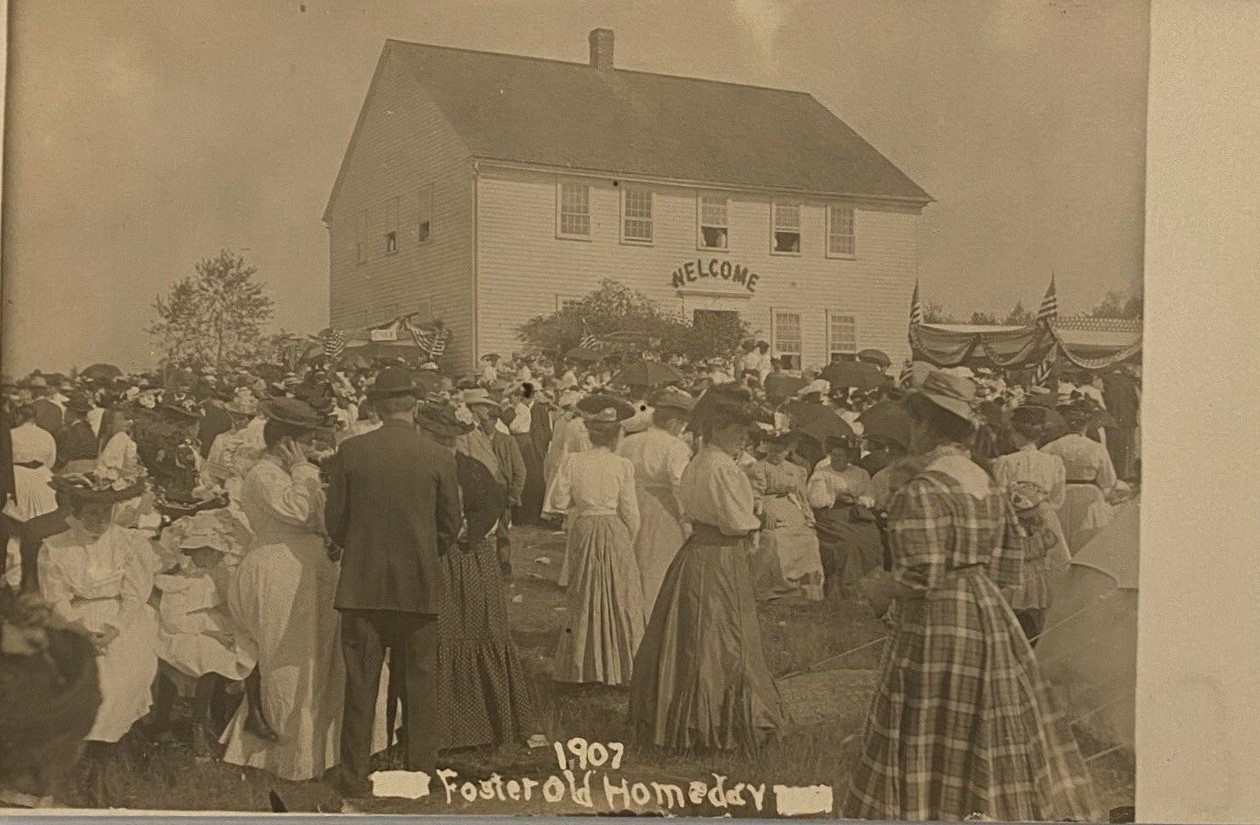
Postcard image of Foster’s 1907 Old Home Day (Author’s Collection)
The year 1905 saw two Old Home Weeks and one Old Home Day in Rhode Island. The first celebration occurred in late August at Pawtuxet village and ran from August 27 to September 2. The week-long celebration included the nearby localities of Edgewood in Cranston and Lakewood in Warwick. Pawtuxet’s Old Home Week had the distinction of being the only one in Rhode Island that encompassed two towns. Planned activities were many, including boat races (both sail and power boats), firemen musters with the usual contest pitting firemen from different companies in bucket races, life saving exhibitions put on by the U.S. Volunteer Life-Saving Corps, an evening parade of illuminated canoes on the Pawtuxet River, and many other events including the obligatory speeches by local dignitaries and politicians including Governor George H. Utter. The event proved such a success that a second Old Home week was scheduled for the following August.
Just a week after the Pawtuxet event the city of Newport held another Old Home Week celebration. It was a most eventful week with band concerts every day and fireworks every evening. Sporting events included swimming races, baseball games, and yacht racing—one featuring competition for the Astor Cup by the New York Yacht Club. Other unusual events included a fox hunt, cricket matches and a flower show. Of course, there were parades, orations, and a clambake.
Also in 1905, North Smithfield for the first time celebrated Old Home Day. The celebrations held on August 31 mostly occurred on the grounds of the Congregational Church and the Lapham Institute. Governor Utter again was a guest speaker. He arrived in a special car, accompanied by other elected officials including Lieutenant Governor Frederick H. Jackson and William Sprague IV, the former governor during the Civil War and U.S. Senator. Old Home Day would be celebrated in North Smithfield annually for many years to come.
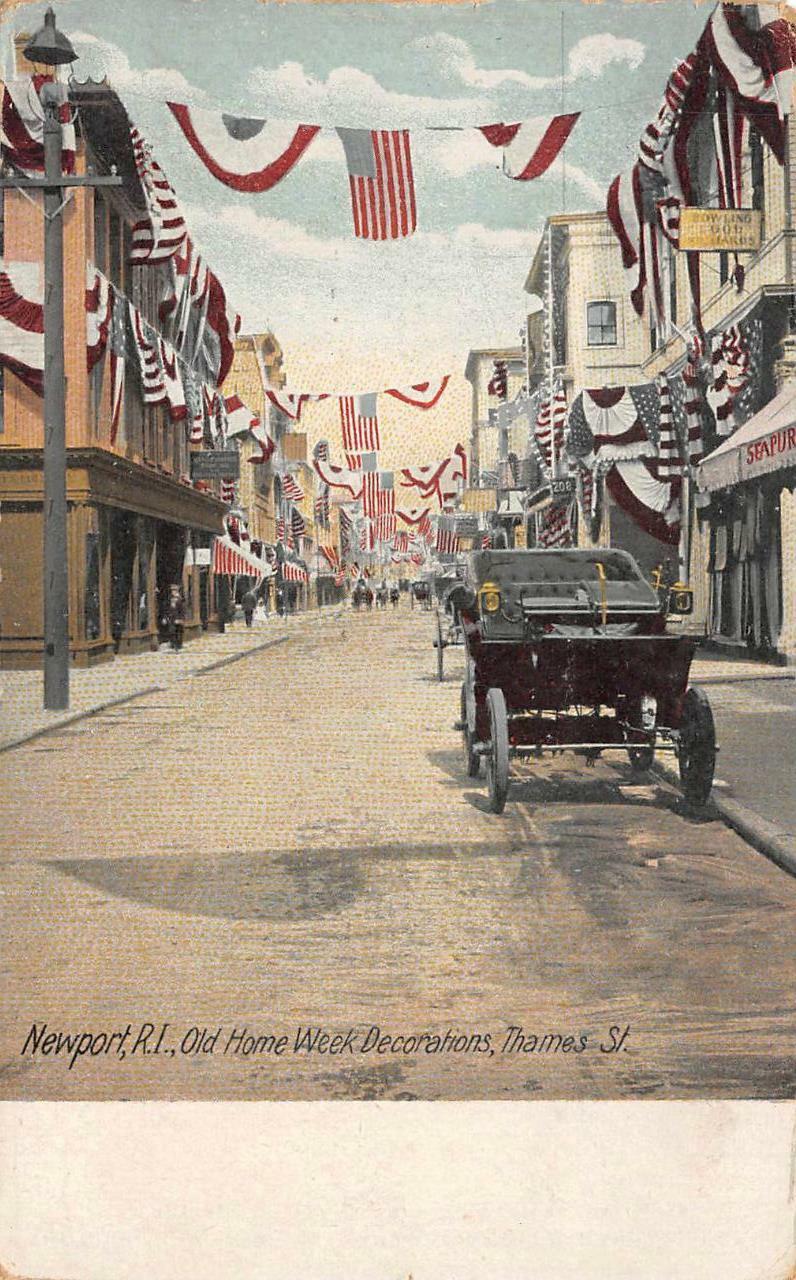
Thames Street in Newport decorated for Old Home Week in 1906 (Author’s Collection)
In 1906 three more Old Home Week celebrations took place. The first occurred in Newport from August 6 through the 11, the second celebration took place in Pawtuxet from August 27 to September 2, and the last event, lasting one day, occurred in Chepachet on September 19, 1906.
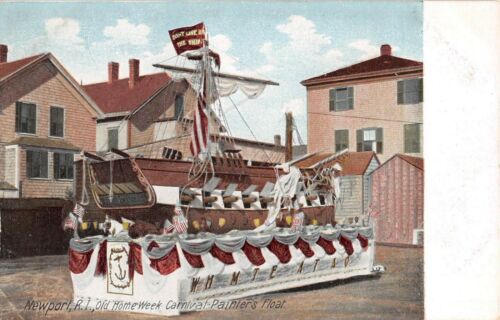
Painters’ Float used in the 1906 Newport’s Old Home Week parade (Author’s Collection)
The Chepachet celebration in 1906 was such a success it became an annual event that lasted until 1947. Surely the concept of the celebration must have evolved over time from being a reunion of the town’s sons and daughters to more of a town block party. Dr. Clifford W. Brown, Chepachet historian, has developed “Chepachet’s Old Home Days,” a wonderfully documented and illustrated on-line account of the events.[2]. Dr. Brown’s history for the Chepachet celebrations, spanning from 1906 to 1947, is by far the best documented accounting of Old Home Day celebrations for any town. Dr. Brown’s account also gives the reader some idea of the enormous amount of effort that went into planning and execution of these events.
By late July 1907, the concept of Old Home Week had taken hold and there were many observances in Rhode Island. That year Rhode Island’s capital city of Providence held a large Old Home Week celebration, running from July 28 to August 3. By all standards it was a massive event and was unparalleled by any other Old Home Week celebration before or since in Rhode Island. Sunday, July 28, was designated as Roger Williams Day and was marked with many church sermons centered on the spirit of the celebration and the state’s commitment to separation of church and state. Monday, the first secular day, was designated as Historical Day with many attendees visiting historic sites. The day’s most notable event was the dedication of a tablet to mark the site of the French Camp of General Rochambeau’s Army on its march to Yorktown. Tuesday was designated as Municipal Day with an open house at the State House, City Hall, and the Court House; several band concerts and a clambake were also planned. The next three days were referred to as Carnival Days with all sorts of planned entertainment for attendees including a parade of fire companies, an exhibition of life saving crews, and a parade of electrical floats. The last day, Saturday, was designated Merchants Day with a British Day parade and outing at Vanity Fair, golf and tennis tournaments at Wannamoisett Country Club, and a band concert at Roger Williams Park, to name but a few of the planned events. Throughout the week the city was festooned with patriotic bunting and flags and even businesses partook of the decorations.
While many Old Home Day events were not large celebrations compared to those of Providence or Newport, they still consisted of a parade, social events, and dinner. One addition to the event in some cases included sermons given from the pulpit of many different denominations. One example of this type of observance occurred in Old Warwick by the Six Principal Baptist when Roger Williams and his precepts on Soul Liberty was the general theme.
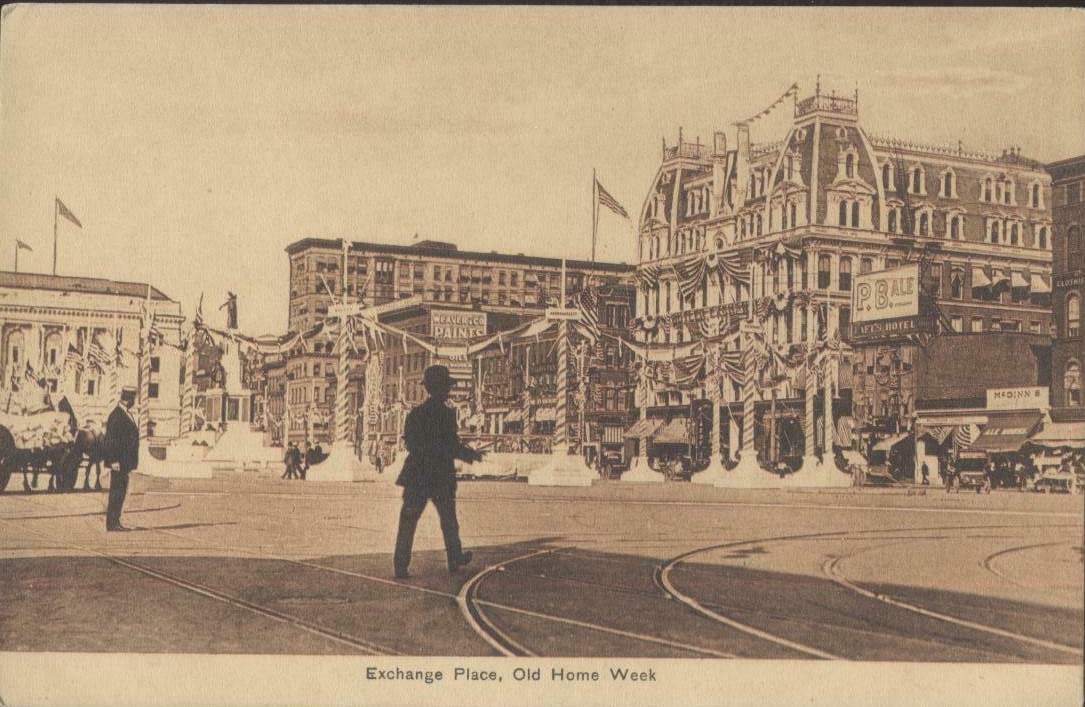
Exchange Place in Providence decorated for Old Home Week, 1907 (Author’s Coollection)
By 1907 the concept of Old Home Week proved so popular that one Pawtucket newspaper reported “The Old Home Week sentiments is catching on and employees of numerous establishments in this city and neighborhood have petitioned their employers for two- or three-days’ vacation so that they may take part in the exercises either as participants or as spectators.”[3]
The least extensive Old Home Day celebration that year may have occurred in Georgiaville. The Universalist Church there held an Old Home Day on September 1st for its members and past members. As one newspaper account noted, “Members of the old choir will be present as a special musical feature, and it is hoped that as many as possible of the old members and friends of the church will attend.” There was no parade, no visiting politicians, and not even a dinner was offered.
Although a majority of Old Home Day or Week celebrations occurred in the early part of the twentieth century, some towns held such celebrations well into the century. In July 1915 Burrillville celebrated Old Home Day in the village of Pascoag. In attendance were Governor R. Livingston Beeckman and Congressman Ambrose Kennedy, as well as other state and town officials—after all, no politician would ever pass on an opportunity to “press the flesh.”
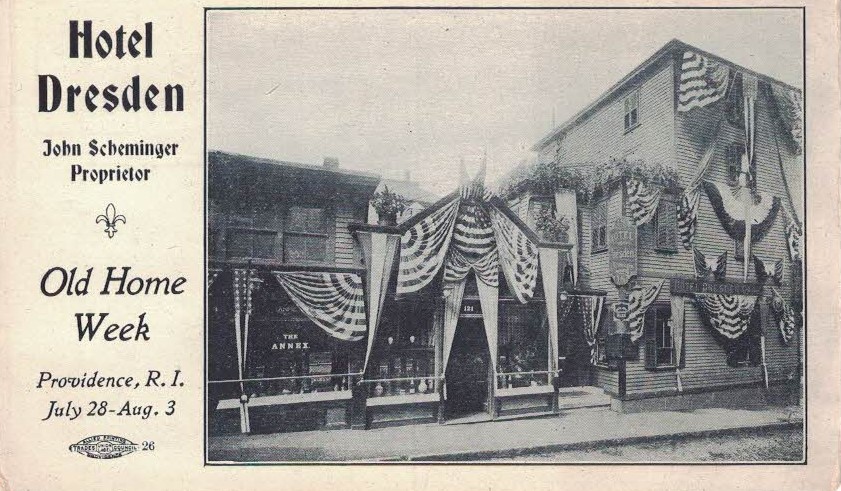
Providence’s Hotel Dresden decorated for Old Home Week in 1907 (Author’s Collection).
Also in 1915, the town of Cumberland celebrated Old Home Day at Grant Farm in Arnold Mills with a clambake and 450 people in attendance. The crowd was too large to accommodate all at one time so a second clambake serving was held. Music was provided by the Woonsocket Cornet Band.
In 1928 Exeter and Scituate each held an Old Home Day celebration—on the same day in August. The Scituate celebration took place on the lawn of the Congregational Church in North Scituate with Governor Norman Case attending, while the Exeter event took place on the grounds of that town’s Liberty Baptist Church. Both towns celebrated in the most Rhode Island of ways, with a clambake.
In September 1930, the town of Bristol held a week-long celebration commemorating the 250th anniversary of its settlement; one day of the celebration was designated Old Home Day.
The popularity of Old Home Week was manifested in Paramount Pictures’s 1925 silent film titled Old Home Week. However, with the coming hustle and bustle of modern times the idea of holding a celebration to call home a town’s sons and daughters began to fade into history. Now it is remembered as a quaint vestige of days past.

A 1925 silent movie poster for Old Home Week
Notes:
[1] The town of Foster may have been following the lead of its neighboring town of Killingly, CT that observed Old Home day in July of 1904. [2] See “Chepachet’s Old Home Days” at https://www.chepachetbaptist.org/oldhomedays.htm. [3] Pawtucket Evening Times, July 30, 1907.The Author

You Might Also Like